audience

Nicole Scherzinger reveals audience member fell ASLEEP during Disney gig as she jokes about fan taking a nap

NICOLE SCHERZINGER has revealed an audience member fell ASLEEP during one of her Disney gigs.

The ex-Pussycat Dolls star, 47, had a hilarious response to the seemingly knackered attendee, whose mid-show nap has gone viral after a clip was shared on social media.

Nicole Scherzinger showcased her showstopping vocals at the Walt Disney Concert Hall, but one fan stole the showCredit: Getty
The snoozing audience member has become a social media star after he turned the performance into a snooze festCredit: tiktok/@nicolescherzinger

Nicole made light of the seemingly heavy sleeper during her Walt Disney Concert Hall debut in Los Angeles on Thursday last week, where he was filmed wide mouthed as she performed.

The footage, which shows the audience member enjoying a snooze as Nicole’s belting vocals echoed around the venue, was widely shared on Tiktok.

She then jokingly re-posted the footage on her Instagram account, where she captioned it: “Lullaby album pending”.

Her post has already received over 18,000 likes on the platform.

‘I’M A PUSSYCAT’

Nicole Scherzinger breaks silence on ‘diva’ claims & opens up on wedding


SHOCKZ AND SCHERZ

Inside Nicole Scherzinger’s stunning Albert Hall show with rude jokes

British singer Natasha Bedingfield chimed in on the action in the comments section, as she wrote: “I would definitely play that every night”.

While other pals and followers also left equally hilarious responses.

One wrote: “The performance of his dreams”.

While another added: “Bless him. He looks so relaxed bet he woke up for Don’t Cha”.

It comes as the star took the Royal Albert Hall by storm with a one woman show last month.

The performance, on October 6, received a stellar review from The Sun Bizarre’s Jack Hardwick, though she reportedly faced ‘diva’ allegations backstage, according to MailOnline.

She kicked off the evening by making a rude joke about hooking up with her fiancé, former rugby ace Thom Evans.

Dressed in a stunning tight black dress covered in a silver spiderweb pattern, Nicole told the crowd: “I want you to know that this little girl, this little ­Hawaiian, Filipina, Spanish, Chinese, ­Polish and Irish — that’s right, two per cent Irish, that counts — has come a long, long way.”

Smirking, she added: “I also have English in me. His name is Thom. That’s him over there.”

Lusting after her fiance may have left Nicole slightly confused, though. He’s actually Scottish.

The singer met Thom as she worked on The X Factor: Celebrity back in 2019.

The couple then went public with their relationship in 2020, as they made their red carpet debut.

NO WEIGH

McDonald’s twice a day saw me reach 25st… I’ve lost 12st & now exes want me back


WASHOUT

I’m A Celeb in chaos as stars are EVACUATED from camp and filming delayed

Ever the performer, Nicole continued despite the wide mouthed attendee sitting in the front rowCredit: tiktok/@nicolescherzinger

Nicole and Thom have been together for four years, and plan to get married following the former rugby ace’s beach proposal in 2023.

The pair seem loved up as ever. and regularly post cute snaps and work out clips together.

She regularly posts work out footage with her hunky ex rugby ace fiance Thom Evans on her socialsCredit: Instagram

Source link

‘Everybody Loves Raymond’ is more than just a saying, 30 years on

On a sunny Saturday afternoon last month in Los Angeles, excited fans opted for a dark studio at CBS Television City where a reunion with the beloved Barone family of “Everybody Loves Raymond” would take place. Devotees of the Emmy-winning sitcom gathered for a live taping of a 90-minute 30th anniversary special, airing Monday on CBS.

“This is a bucket list-type thing,” said longtime fan Kim Brazier, who flew in from Gulfport, Miss. “I only watch ‘Everybody Loves Raymond.’ I have it on repeat. I watch it when I’m getting ready in the morning, and it’s kind of my lullaby when I go to bed.”

The popular sitcom, which ran for nine seasons from 1996 to 2005, was known for its hilarious depiction of family dynamics. Ray Romano starred as sportswriter Ray Barone, married to Debra (Patricia Heaton). The couple raised three young children while navigating marital squabbles, awkward parenting moments and constant meddling from Ray’s parents, Marie and Frank (Doris Roberts and Peter Boyle), who lived across the street with Ray’s jealous, downtrodden police officer brother Robert (Brad Garrett).

Inside the reunion, the atmosphere brimmed with nostalgia as Romano and the show’s creator, Phil Rosenthal, hosted the live taping from the living room they once brought into millions of households each week. The set was meticulously recreated for the occasion, including the Barone couch, which Romano now owns and had transported from his home for the occasion.

Cast members were brought out one by one throughout the afternoon, each remaining on stage as the panel grew, including Rosenthal’s wife, Monica Horan, who played Robert’s longtime love interest, Amy.

Two men walking toward the front of a stage where several directors chairs are lined up and audience sits before them.

Ray Romano and Phil Rosenthal walking to the stage for the 30th anniversary reunion, which was taped before a live studio audience, just like the series.

(Matthew Taplinger / CBS)

The group reminisced about working with one another and shared their favorite episodes, accompanied by clips on surrounding screens that included a reel of outtakes of funny lines improvised by Romano and Garrett cracking up their fellow castmates. As each segment played, Rosenthal and the cast watched, fully absorbed with smiles across their faces, while the audience sat rapt, revisiting these cherished moments.

A week and a half later, in a Zoom interview with Rosenthal and Romano, the latter reflected on returning to the set. “It was emotional and surreal. At first it felt so strange to be back, like we went back in time,” Romano says. “And then after we were joking and comfortable for a while, it felt like we never left.”

Just like the reunion, the original series was filmed in front of a live studio audience, a conscious choice to capture the energy in the room. “We had me, a comedian, and comedy writers, and we wanted to hear the laughs,” Romano says.

And the laughs were plentiful. Rosenthal told the crowd at the taping that the cast often had to pause after punchlines to let laughter die down. Occasionally, he said, the laughter went on so long it had to be edited out of episodes. The only time the audience wasn’t in stitches was when Romano literally needed them. He once sliced open his hand during a scene where he was cutting cheese; Romano went to the hospital to be sewn up and then returned to finish the episode.

From the stage, Romano recounted the show’s origin story, which dates back to his 1995 stand-up comedy debut on the “Late Show With David Letterman.” His five-minute routine focused on parenting his toddlers and losing his perspective on adult-oriented humor. He noted that the last joke he’d written dated back to when his twin sons were babies — a bit about jingling his car keys to make them laugh — which he physically demonstrated during the appearance. After the “Late Show” crowd laughed, he pushed the bit one step further. “I’m glad you laughed at that,” he said. “If you didn’t, I would’ve had to come down there and rub my nose in your bellies.”

A group of 10 people clapping and standing on the set of a television show.

The cast of “Everybody Loves Raymond” during the taping of the finale episode of the series, which aired in May 2005.

(Richard Cartright / CBS / AP)

Meanwhile, Rosenthal, then a writer on ABC’s sitcom “Coach,” was at home with Horan watching Romano’s set. It immediately resonated with the couple. “It made me laugh so hard,” he says. “We had just had a kid, and the material was eminently relatable.”

Two weeks later, when Letterman’s production company offered Romano a development deal, he met with Rosenthal, and the two began shaping the sitcom, blending their sensibilities. Rosenthal says the resulting show became a hybrid of his sitcom experience with Romano’s sensibility that everything must be rooted in truth. “It had to feel real and honest,” Rosenthal says. “And you don’t do anything just to get a laugh. We had a rule in the writers room: ‘Could this happen?’ Are we stretching credibility so far that we break the bond of relatability with the audience?”

They developed the show around their own lives, modeling the Barone children after Romano’s, and incorporating material from his Letterman routine. The character of Robert was based on Romano’s real-life brother, a New York City police officer whose bitter quip when Romano won an award — “Everybody loves Raymond” — became both the show’s title and a line of dialogue his fictional counterpart delivered in the pilot.

Rosenthal contributed his own family inspiration too, basing Ray’s TV mom largely on his mother, with aspects of Romano’s. At the anniversary special, he told the audience with a wink that his mother had always insisted the character was “an exaggeration.”

Phil Rosenthal, left, and Ray Romano on the recreated set of "Everybody Loves Raymond."

Phil Rosenthal, left, and Ray Romano on the recreated set of “Everybody Loves Raymond.” (Sonja Flemming / CBS)

Two men and a woman smiling and sitting at a small table with coffee cups in front of them.

Brad Garrett, left, played Ray’s brother and Patricia Heaton, played Debra, Ray’s wife in the series. (Sonja Flemming / CBS)

When it came time for casting, approximately 20 women auditioned to play Ray’s wife, but Heaton nailed it, with a bold choice setting her apart. She was the only actor who actually kissed Romano during the audition, while the rest just mimed it. It wasn’t until the reunion, however, that Heaton learned onstage that she was the only one who’d done so.

The reunion also revealed that Garrett’s casting as Robert was a surprise to Romano. His real brother is shorter than he is, while Garrett is 6 feet 8, prompting Romano to joke that two brothers had been cast at once.

Rosenthal noted that to avoid the appearance of nepotism, he never suggested his wife for the role of Amy. Rather, it was a writer on the show who had put her name forward.

The reunion also honored Boyle and Roberts, who died in 2006 and 2016, respectively. The taping coincided with what would have been Boyle’s 90th birthday, and his wife, Lorraine, was in the audience. Romano shared that Boyle was nothing like his grumpy character Frank. During the first rehearsal, Boyle gave the nervous Romano advice: “It’s just like water. Just let it flow.”

Roberts, meanwhile, was the show’s matriarch on- and off-screen, known for making pots of soup in her dressing room and looking out for the cast. Horan recalled Roberts as professional and protective, pointing out whenever anyone was unwittingly blocking Horan’s light in a shot.

A older couple stands facing a younger couple as a man sits at a kitchen table and looks up at them.

Frank and Marie, played by Peter Boyle and Doris Roberts, were remembered during the reunion special. The taping coincided with what would have been Boyle’s 90th birthday.

(Robert Voets / CBS)

Later in the afternoon came another poignant moment when Madylin Sweeten and younger brother Sullivan Sweeten, who played Ray and Debra’s children, Ally and Michael Barone, joined the panel. Madylin was 5 when the show began, while Sullivan was 16 months old. His twin brother, Sawyer, who also appeared on the show as Michael’s twin, Geoffrey, died by suicide in 2015, just before his 20th birthday.

Speaking about his late brother, Sullivan said that he tries to stay positive by reflecting on his best moments with Sawyer, sharing that most of them happened on the set of the show. Madylin said that she and Sullivan work with the National Suicide Prevention Hotline, noting that most who seek help do survive.

Now 34 and a mom herself, Madylin reflected on growing up on a hit series. At the time, she was too young to fully grasp its importance, revealing that she remembers being upset one year when she couldn’t participate in a school play because she had to be on set. As scenes of the Barone children played above the stage, she wiped away tears at the sight of Sawyer as a child.

It was easy to see what made the cast feel like a real family. Their chemistry filled the studio once again, and their connection endures.

“Imagine spending nine years with people and then staying in touch,” Rosenthal says. “Phil and I see each other all the time,” Romano adds, before Rosenthal chimes in: “Our families vacation together.” They shared that they’d had lunch with the show’s writers earlier that day.

The affection among the cast is matched only by the devotion of the fans who filled the studio. Throughout the taping, the audience erupted in laughter, cheers and applause, a testament to how deeply the show remains embedded in people’s lives. Even 20 years after its finale, everybody still loves Raymond.

“It was the ultimate honor,” Rosenthal says of the enthusiastic fans who showed up for the reunion. “We can die happy that we made something of lasting value.”

Asked why they’ve never considered a reboot, Romano is clear. “This was our legacy, this was our baby, and we wanted to treat it right,” he says. “We wanted to leave on a high note and go out on top, and that’s what we did.”

Source link

In ‘A Sexual History of the Internet’ Mindy Seu reveals the unexpected

The technologist and professor Mindy Seu was having drinks when her friend casually referred to the phone as a sex toy. Think about it, her friend, Melanie Hoff, explained: We send nudes or watch porn, it’s vibrating and touch-sensitive — it’s practically an appendage.

“What exactly is sex, and what exactly is technology?” Seu wondered. “Neither can be cleanly defined.”

Around the same time, in 2023, Seu had just published “Cyberfeminism Index,” a viral Google Sheet-turned-Brat-green-doorstopper from Inventory Press. Critics and digital subcultures embraced the niche volume like a manifesto — and a marker of Seu’s arrival as a public intellectual whose archiving was itself a form of activism. The cool design didn’t hurt. “If you’re a woman who owns a pair of Tabis or Miistas, you are going to have this tome,” joked comedian Brian Park on his culture podcast “Middlebrow.”

Still, the knot between sexuality and technology tugged at her. “Recently, my practice has evolved toward technology-driven performance and publication,” she said. “It’s not exactly traditional performance art, but I believe that spaces like lectures and readings can be made performative.” Though she wasn’t yet finished exploring this theme, she wasn’t sure how to approach it next — until an experiment by Julio Correa, a former Yale graduate student, sparked an idea. Correa had devised an Instagram Stories-based lecture format, and she immediately saw its potential. She reached out to ask if she could “manipulate” his idea into a performance piece, and would he like to collaborate?

  • Share via

Thus, “A Sexual History of the Internet” was born. The work is two things at once: a participatory lecture-performance conducted through the audience’s phones, and an accompanying, palm-sized, 700-plus-page “script” examining how our devices serve as bodily extensions.

The book isn’t exhaustive but instead a curated miscellany of non-sequiturs and the kind of dinner-party lore Seu delights in. Did you know that the anatomical structure of the clitoris wasn’t fully mapped until a decade after the invention of the World Wide Web? Or that the first JPEG — introduced in 1992 at USC — cribbed a Playboy centerfold nicknamed “Lenna,” which journalist and the author of the 2018 “Brotopia” Emily Chang called “tech’s original sin.”

The metaverse, web3 and AI — none of this is new, Seu said in her loft this past Saturday, hours before her West Coast debut at the Geffen Contemporary at MOCA. “But understanding the arc is helpful, especially how it’s tied to militaristic origins rooted in power, and how those same people were also confronted with sexuality.”

She’s just returned from a whirlwind tour — Antwerp, New York, Oslo, Madrid — with Tokyo next month. She splits her time between L.A. and Berlin, where her boyfriend lives, but for now, she’s staying put in what she calls her “bachelor pad on the set of a ‘90s erotic thriller,” inherited from a friend, the artist Isabelle Albuquerque.

The floor-to-ceiling windows high in a historic Brutalist artists’ complex overlook MacArthur Park and the downtown skyline. She’s offset the building’s cement with a childhood baby grand piano and her grandmother’s lacquer vanity with pearl inlay. That Seu marries the feminine and the spartan in her space feels intentional — a reflection of the dualities that animate her life and work.

"A Sexual History of the Internet" by Mindy Seu

“A Sexual History of the Internet” by Mindy Seu

(Photography by Tim Schutsky | Art direction by Laura Coombs)

Though she moved from New York three years ago, she resists calling herself an Angeleno — partly, she admits, because she never learned to drive despite growing up in Orange County. Her parents ran a flower shop after immigrating from South Korea. The household was conservative, Presbyterian and promoted abstinence. Like with many millennials, her sexual awakening unfolded online.

“I asked Jeeves how to have an orgasm,” she writes. “I sexted with classmates on AOL Instant Messenger. Any curiosities were saved until I could sneak onto my family’s shared ice blue iMac G3 in the living room.”

At 34, the very-online academic holds a master’s from Harvard’s Graduate School of Design and has taught at Rutgers and Yale before joining her alma mater, UCLA, as one of the youngest tenured professors (and perhaps the only one who has modeled for JW Anderson and Helmut Lang). Her first three years at UCLA have each had their crises — encampments, fires, ICE raids — yet her Gen Z students give her hope. “They’re so principled and motivated, even if it’s in a nihilistic way,” she said.

Online, fans declare their “brain crushes” on Seu, whose ultra-detailed spreadsheets have become unlikely catnip for TikTok. Vanity Fair dubbed her the rare cybernaut who “lands soft-focus photoshoots in niche lifestyle publications.” Her unusual power is the ability to move through different fields, Trojan-horsing her theories across academia, the art world, the lit scene, tech, fashion, et al. Seu’s notoriety continued to swell after appearing on the popular internet talk show “Subway Takes” with the standout zinger: “Gossip is socially useful, especially to women and the marginalized.”

“Mindy’s really good at bridging different audiences who might not read an academic text about the history of the internet but are interested in Mindy’s practice,” said Correa, Seu’s student-turned-collaborator. When the two workshopped their performance last year on their finsta (a.k.a. fake Instagram), they encountered one major hurdle: censorship. They had to get creative with their algospeak (like changing “sex” to “s*x”) to keep from getting banned.

Mindy Seu in her MacArthur Park loft.

Mindy Seu in her MacArthur Park loft.

(Carlin Stiehl / For The Times)

“A Sexual History of the Internet,” designed by Laura Coombs, carries that collaborative ethos into its financial structure. Seu’s first book went through traditional publishing, where authors often receive about 10% and contributors receive fixed fees. This time, she wanted a citation model that compensated the 46 thinkers who shaped her understanding of the subject.

She approached Yancey Strickler, director of Metalabel, “an indie record label for all forms of culture,” and co-founder of Kickstarter. Seu’s original proposal waived all profits to collaborators. “Everyone got paid but her,” Strickler said. If she wanted the model to be replicated, he told her, it needed a capitalist backbone.

They landed on Citational Splits, where everyone who was cited joined a 30% profits pool, in perpetuity, across future printings (27 opted in). The remaining 60% goes to Seu and five core collaborators. Strickler likened it to music royalties or company shares: “Your presence increases the project’s value, and some of that value should flow back to you.”

Neither can name a publishing precedent. “It shows a profound, practical morality that underlies her work,” he said.

At MOCA, about 300 Angelenos braved an atmospheric river to sit in the darkened former police car warehouse bathed in red light. No projector, no spotlight. A pair of Tabis winks at her all-black-clad friend; a couple holds hands as Seu moves through the room. (“I intentionally wear very noisy shoes,” she said earlier.)

With the calm cadence of a flight attendant, Sue instructs everyone to put their phones on Do Not Disturb, sound and brightness to max and open Instagram to find @asexualhistoryoftheinternet.

The audience reads in unison when their designated color appears. What follows is a chorus of anecdotes, artworks and historical fragments tracing the pervasive — and sometimes perverted — roots of our everyday technologies. Hearing men and women say “click and clitoris” together is its own spectacle.

“From personal websites to online communities, cryptocurrencies to AI, the internet has been built on the backs of unattributed sex workers,” one slide notes. Sex work has long been an early adopter of emerging technology — from VHS to the internet — and the present is no exception. Two years ago, OnlyFans creators made more money than the total NBA salary combined; today, the company now generates more revenue per employee than Apple or Nvidia.

Seu ends with the widely known dominatrix Mistress Harley’s concept of data domination, a subset of BDSM in which her “subs” (a.k.a. submissives) grant her remote access to their machines. Seu tells the crowd that she has essentially done the same, “viewing the voyeurs” and taking photos of us throughout the performance, which are already posted to Instagram.

We walk out into the dark rain, wondering what exactly we witnessed — and realizing, perhaps, we’ve been witnessing it all along.


Source link

Cosm turns ‘Willy Wonka’ into a multisensory experience

We are at the dawn of the era of “experimental cinema.”

At least that is the pitch by entrepreneurs such as Jeb Terry of Cosm and James Dolan of Sphere, whose domed venues have embraced the idea of reviving older films to augment them with new technologies. Terry used the phrase Tuesday in his introduction to a resuscitation of 1971’s “Willy Wonka and the Chocolate Factory,” which debuts this week at Inglewood’s Cosm with modern, CGI animation, aiming to emphasize the whimsy and childlike wonder of the Gene Wilder picture.

“Wonka” is the sophomore attempt by Cosm to redefine the moviegoing experience — “The Matrix” got the Cosm treatment last summer and “Harry Potter and the Sorcerer’s Stone” will follow next year. Seeing a film in what the venue calls “shared reality” can be all-encompassing and yet intimate as well as communal and, if everything works out, somewhat thoughtful. The 87-foot diameter spherical screen wraps above, below and behind us, but an emphasis on couch seating invites a cooperative environment. And guests are encouraged, for instance, to pull out their phones and capture and share the moment.

Cosm's spherical screen can give the illusion of dimension.

The spherical screen can give the illusion of dimension.

(Cosm)

It’s good fun, if you don’t take it too seriously, as experiential, in the case of “Wonka,” means a film dedicated to the power of imagination sometimes leaves a little less to it. Spirited and bright, Cosm’s approach to “Wonka,” a collaboration with experiential firm Secret Cinema and visual effects house MakeMake, is to ensure audiences are never not surrounded by eye candy. The result is alternately charming and clashing — why, I wondered, isn’t the animation done in a 1970s style to better complement the film?

In turn, has the film’s new magic replaced its subtle mystery? Or is that the wrong question to ask at screenings meant to feel like a social event, complete with chocolate tarts filled with peanut butter mousse and bright red vodka drinks with gold glitter salt rims?

A cramped scene from Willy Wonka

“Willy Wonka” is the second Hollywood film, following “The Matrix,” to run at Cosm.

(Cosm)

For this is experiential at its most maximal. Opening credits that unfold in the film with streams of chunky chocolate are now accompanied with smoothed-out images that look partly inspired by “Super Mario Bros.,” as tubes and pipes aim to place the audience inside a milky-chocolate-pouring factory. It’s cute, and you’ll find yourself diverting your attention from the framed screen of the film to take in the toy-like animated mechanisms. My only qualm here was the edges of the filmed footage have been sharpened away by gleamingly untroubled animation.

Elsewhere, news reports in the film are elongated to show us an entire, cartoon-like studio, scenes of galloping children on the sidewalk rush by as added assembly lines churn out chocolate below them and the movie’s first major song and dance moment, “The Candy Man,” is now surrounded by carnival-inspired visuals with swirling Candy Buttons, slot-machine-like flowers and gentle prods to, if not sing along, at least mouth the lyrics.

“Wonka,” a moderate success when it was released, grew in stature over time as Sammy Davis Jr. turned “The Candy Man” into a hit and second-run screenings on television made it vital at-home viewing for generations to come. It is, at times, delightfully demented, a family film with a weird streak — perhaps at times even a slightly sinister one. And yet I went to Cosm’s “Wonky” premiere not as a film critic but as someone curious about burgeoning movements in the immersive industry, interested more in how Cosm could use its tech to enhance, revitalize or find ways to illuminate a second-run film.

A screen within a screen -- a movie surrounded by animations.

At Cosm, when Charlie discovers his golden ticket, digital fireworks erupt.

(Cosm)

Illuminate is a key word, as when young Peter Ostrum as Charlie unwraps a candy bar with the much-sought-after golden ticket, the animated images around the framed screen erupted in fireworks. I remember watching that scene as a kid and feeling a bit tense, fearing, perhaps, the ticket would be snatched from him by the crowd that consumes him. Yet Cosm aims to turn “Wonka” into pure joy. Such a moment was a reminder at how much sway over the emotional tonality of the film such supplemental material can possess.

In that sense, the immersive ambitions of Cosm differ from experiments of the past — interactive dalliances in the ’90s that recently lived again on Netflix (see “Black Mirror: Bandersnatch”), or more recent 4DX theaters with movement-enabled seats (see the light, water and wind effects of “Twisters”). Perhaps that’s why what I thought worked best leaned more abstract, when, say, cartoonish cityscapes gave way to black-and-white pencil-like effects, or when the animations played up the wackiness of Wonka’s factory rather than try to flesh it out.

A whimsical scene featuring the Oompa Loompas.

A whimsical scene featuring the Oompa Loompas.

(Cosm)

I was distracted, for instance, when Wilder’s Wonka made his grand limping entrance, as the sheepish building behind him was now dwarfed by sparkly, shiny warehouses. Yet I was transfixed when Wilder’s character near the end was framed amid blindingly fast streaks of light, or when the helper Oompa Loompa characters were depicted out of frame as colorful orbs that looked like strands of DNA.

‘Willy Wonka and the Chocolate Factory’ at Cosm

I do feel it’s important to note that I’m more than two decades removed from having seen the original “Wonka.” Fresher in my mind are more recent cinematic explorations of the material and characters. While I chose to revisit “The Matrix” before taking that film in at Cosm, I opted for a different approach with “Wonka,” and I believe one’s likelihood to embrace what Cosm is attempting will increase exponentially by one’s attachment to the source material. Having forgotten wide swaths of the film, I found myself conflicted — watch the original film, or focus on Cosm’s accouterments — whereas with “The Matrix,” the material was recent on the mind and I was therefore more comfortable to wander and take in the dome’s impressive screen.

And it is impressive, indeed. When Charlie starts floating in Wonka’s factory, Cosm lifts the frame of the film, surrounding it with bubbles. Soon, depending on your seat, you may find yourself looking straight up. Cosm’s visuals are so crisp that at times they can simulate movement and dimension, and we get dizzyingly lost when the characters are trapped in a seemingly doorless room.

Elsewhere, Cosm takes on a buoyancy when Denise Nickerson’s Violet transforms into a bouncy blueberry. Another clever moment: When Charlie’s wall of moving hands is stretched beyond the screen and starts waving to the audience.

It’s in these instances when the film comes alive, and Cosm’s take on experiential cinema no longer feels like a novelty and becomes an experience.

Gene Wilder's Willy Wonka and Julie Dawn Cole's Veruca Salt in "Willy Wonka and the Chocolate Factory," as presented by Cosm.

Gene Wilder’s Willy Wonka and Julie Dawn Cole’s Veruca Salt in “Willy Wonka and the Chocolate Factory,” as presented by Cosm.

(Cosm)

Source link

Netflix is revamping its gaming strategy to win more users. Is it working?

Inside an office in Hollywood, not far from the Walk of Fame and the Sunset Bronson Studios, Netflix executive Alain Tascan revealed new content coming soon to the platform — but it’s not a TV show or a movie. It’s a new game where U.S. viewers compete to win thousands of dollars.

The game show, called “Best Guess Live,” will run on weekdays at 5 p.m. PT, where hosts Howie Mandel and Hunter March will unveil a set of five clues. Mobile game players tune in to make their best guesses. The earlier they can guess correctly with fewer clues, the higher the chances they can win more of the prize money. The show, filmed in Van Nuys, is Netflix’s attempt at appointment gaming for its audience of more than 700 million viewers.

“Can you imagine where you not only can go and play a game, but you could win a life-changing amount of money each and every day, and it takes no time, it’s easy, and you just have your phone?” said Mandel, widely known for his hosting turns on NBC’s “Deal or No Deal” and “America’s Got Talent.”

The goal is to make playing games on Netflix “as simple as streaming a movie on a Friday, using the same innovative mindset that led Netflix to transform itself from a company shipping DVDs to streaming movies, shows and now games,” Tascan said.

Netflix has been investing in its games vertical for the last four years, with mixed results. Last month, the streamer’s co-CEO Greg Peters gave the company’s gaming efforts a B- grade. Under Tascan’s leadership, the division has focused on some key areas, including narratives based on Netflix programs, games for children, social party games and mainstream titles like “Grand Theft Auto.”

The changes appear to be working. The number of downloads for Netflix games has increased 17% to 74.8 million from January to October of this year compared to the same period in 2024, according to data from app analytics firm Appfigures. The company is also releasing fewer games, adding 16 titles this year compared to 35 last year, Appfigures said.

Netflix declined to comment on the Appfigures data.

The company has also removed games in part due to low customer engagement. Netflix has released 142 games, with 78 of them still active as of October, according to Appfigures.

Its two most popular mobile games were released on Netflix in the last two years, including “Grand Theft Auto: San Andreas,” which came on the platform in December 2023 and achieved 44 million downloads. The streamer released an original, the multiplayer party royale title “Squid Game: Unleashed,” last year with 21 million downloads. The game had tie-ins to the popular series’ second season where players could earn cash or wild tokens in the game if they watched a certain number of episodes.

Some analysts say there is still room for improvement.

People wearing lanyards sit around a screen.

Journalists participate in a games demo at a Netflix office on Wednesday.

(Netflix)

“It still seems pretty experimental,” said Ross Benes, senior analyst at research firm Emarketer. “I don’t get the impression that they are on gamers’ list of their go-to sources of entertainment.”

On Thursday, Netflix said its first slate of five games for the TV, including Tetris Time Warp, Boggle Party, Pictionary: Game Night and LEGO Party! are now available. Prior to the new slate, subscribers could only play Netflix games on their mobile devices.

When consumers load up the TV games, they will see a QR code they can scan on their devices and use them as controllers in the game. For example in Netflix’s version of Pictionary, users draw on their phones.

“A big switch in the strategy is really to make sure that we are eliminating any friction that somebody can encounter when they want to play,” Tascan said in an interview. “We believe that on TV, in particular, where people enjoy their different shows, is the best place to offer something very easily approachable.”

The TV games are the latest iteration in Netflix’s effort that began four years ago. The company had beefed up its staff after acquiring four gaming businesses — Glendale-based Night School, Boss Fight Entertainment out of Allen, Texas, Finland-based Next Games and Spry Fox based in Seattle.

Netflix shut down Boss Fight Entertainment last month.

The gaming division efforts were first led by Mike Verdu, a former Facebook and Electronic Arts executive. He later transitioned to a role focusing on transforming game development and player experiences with generative AI in November 2024 and left Netflix earlier this year. Tascan, a former executive at Epic Games, was named Netflix’s president of games in July 2024.

Games has been an attractive area of investment for some companies, as younger audiences spend a lot of time playing titles like Roblox, Fortnite and Call of Duty. Tascan estimates there are 3 billion gamers in the world and with Netflix having an audience of more than 700 million people, “the Venn diagram is pretty large.”

The streamer on Thursday also announced new mobile games for kids, including digital coloring book “Barbie Color Creations” and a hairstyling game, “Toca Boca Hair Salon 4.”

It can be challenging for companies to get into the space. For example, in 2023, Google shut down its gaming service Stadia after it failed to gain traction with users.

Tascan said Netflix is not competing against traditional gaming consoles but is looking to innovate and find new ways to reach its customers.

Tascan said he is encouraged by the reactions he has seen.

“It’s a step in the right direction,” he said. “But at the end, how many people are going to have the same reaction? We are a company driven by data, and our main data is, how many people are going to engage?”

Tascan said he thinks it will be a few short years before Netflix becomes the Netflix of games. He hopes the division can improve from Peters’ grade of a B- to a higher level.

“What I hope is, by the end of the year, we’ll upgrade to an A, hopefully A+,” Tascan said.

Times editorial library director Cary Schneider contributed to this report.

Source link

Katie Price stuns live show audience as she claims she kissed footie hunk Jack Grealish

GLAMOUR model Katie Price has claimed she once kissed footie hunk Jack Grealish.

She also said the Premier League star — who is 17 years her junior — is one of the most famous celebrities she has smooched.

Katie Price and Kerry Katona chatting about their new tour.
Katie Price claimed she kissed Jack Grealish on a live show of her tour with singer Kerry KatonaCredit: Dan Charity
Aston Villa's Jack Grealish looks on during a Premier League match.
Mum-of-five Katie, 47, did not specify when she kissed the Prem starCredit: AFP

Mum-of-five Katie, 47, did not specify when they kissed after making the claim on a live show of her tour with singer Kerry Katona, 45.

An audience member told The Sun: “Katie and Kerry had Instagram messages from fans to be asked at the show.

“One asked who is the most famous person they have kissed.

“Katie said to Kerry, ‘Do you know who I have? Grealish’.

health check

Katie Price shares snap of son Harvey in hospital after fat jabs weight loss


body boost

Katie Price shows off TINY waist & tattoos & ‘doesn’t know’ weight loss reason

“She went bright red and hid her face with a pillow.

“The audience was shocked.”

Katie was speaking in front of around 300 people at the gig in Northwich, Cheshire, on Friday.

Jack, 30 — on loan at Everton from Man City — is in a long-term relationship with Sasha Attwood, 29.

His representative was asked to comment.

Source link

Oscars power rankings: Top 10 best picture contenders November 2025

Guillermo del Toro’s “Frankenstein” didn’t exactly wow audiences and critics when it premiered at the Venice Film Festival, and when it landed at the Telluride Film Festival a day later for a pair of late-night screenings, the response was even more muted. Leaving Colorado, the airport gate was full of hushed conversations between people registering their disappointment with the movie.

“Frankenstein,” the talk went, had three strikes against it — a plodding story, computer-generated imagery that looked appalling and was employed to often ridiculous effect and, outside of Jacob Elordi’s affecting turn as the monster, acting that seemed wildly excessive (Oscar Isaac) or hopelessly lost (Mia Goth). In short: a mess.

But then “Frankenstein” traveled to the Toronto, a city Del Toro regards as his “second home,” and finished as runner-up to “Hamnet” for the festival’s People’s Choice Award. Now playing in a theatrical limited release ahead of its Nov. 7 Netflix premiere, the movie has found favor with the filmmaker’s devoted fan base, selling out theaters, including dates at Netflix’s renovated Egyptian Theatre in Hollywood, where admission lines wrapped around the block. And some prominent critics, including my colleague Amy Nicholson, have written some thoughtful reviews of the movie, praising Del Toro’s lifelong passion project. Amy calls it the “best movie of his career.”

So in this update to my post-festival Oscar power rankings for best picture, you’ll find “Frankenstein,” a movie that’s hard to place on this list but harder still to ignore. Previous rankings are parenthetically noted.

Falling out of the rankings since September: “A House of Dynamite,” “Jay Kelly”

10. ‘Avatar: Fire and Ash’ (Unranked)

A scene from 2022's "Avatar: The Way of Water."

A scene from 2022’s “Avatar: The Way of Water.”

(20th Century Studios)

The last “Avatar” movie grossed $2.3 billion and, yes, earned an Oscar nomination for best picture. Yet I’m hard-pressed to find anyone who’s truly excited about devoting half a day to see the next installment, which clocks in at 3 hours and 12 minutes. Just because the first two movies were nominated doesn’t mean this one will be. But underestimating James Cameron’s ability to connect with audiences — and awards voters — seems dumb. So here we are, No. 10, sight (still) unseen.

9. ‘Bugonia’ (10)

Emma Stone in "Bugonia."

Emma Stone in “Bugonia.”

(Atsushi Nishijima / Focus Features)

Better than “Kinds of Kindness” but not nearly the triumph of “Poor Things,” this is mid Yorgos Lanthimos — off-putting, punishing and misanthropic but also featuring another showcase for Emma Stone’s bold, creative energy. There are a number of movies that could displace it as a nominee. Park Chan-wook’s “No Other Choice” offers a more humane — and funnier — look at ugly things people can do when desperate. But I’ll stick with “Bugonia” for now. After all, how many movies inspire people to shave their heads for a ticket?

8. “Frankenstein” (Unranked)

Oscar Isaac in "Frankenstein."

Oscar Isaac in “Frankenstein.”

(Ken Woroner / Netflix)

Netflix has four movies arriving during the awards season window — the meditative stunner “Train Dreams,” Katherine Bigelow’s riveting, ticking-clock thriller “A House of Dynamite,” the George Clooney meta-charmer “Jay Kelly” and “Frankenstein.” (That’s how I’d rank them in terms of quality.) One of these movies will be nominated. Maybe two. At this moment, nobody, including the awards team at Netflix, knows which one(s) it will be.

7. ‘It Was Just an Accident’ (7)

Mohamad Ali Elyasmehr, left, Madj Panahi and Hadis Pakbaten in "It Was Just an Accident."

Mohamad Ali Elyasmehr, left, Madj Panahi and Hadis Pakbaten in “It Was Just an Accident.”

(Neon)

Jafar Panahi’s Palme d’Or-winning thriller possesses a withering critique of the cruelty and corruption of an authoritarian regime, combined with a blistering sense of humor. Panahi (“The Circle,” “Taxi”) has been imprisoned by the Iranian government many times for criticizing the government, and his courage has been celebrated for its spirit of artistic resistance. He has been a ubiquitous presence on the festival and awards circuit this year, eager to share both the movie and his story. As the Oscars have thoroughly embraced international movies the last several years, “It Was Just an Accident” feels like it’s on solid ground.

6. ‘Wicked: For Good’ (6)

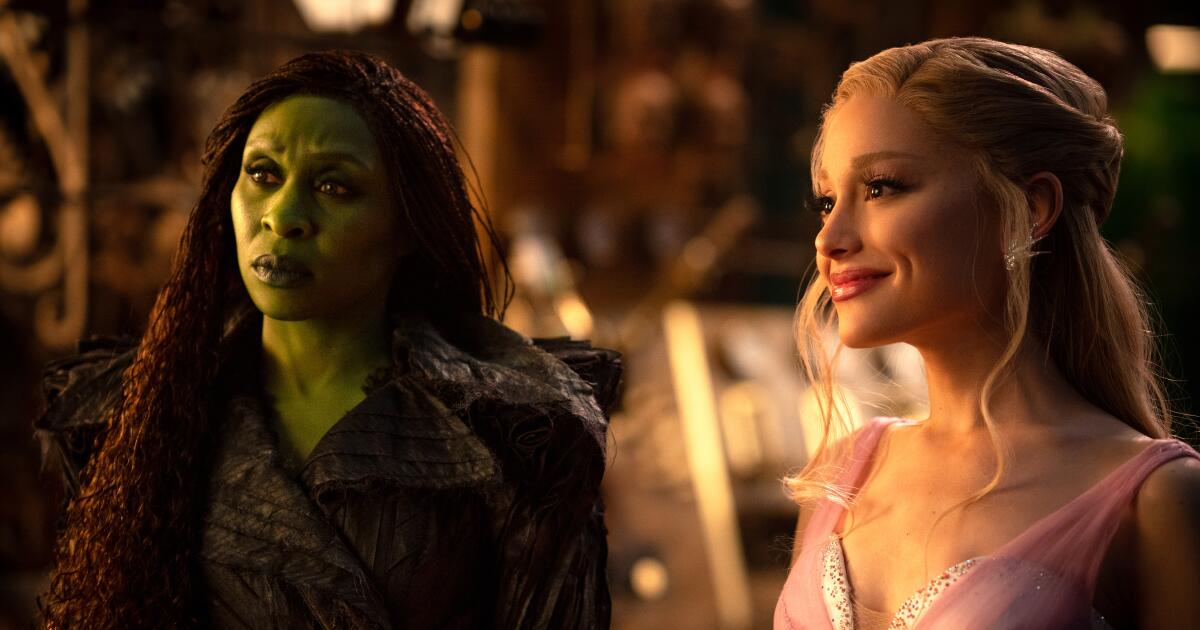
Ariana Grande, left, and Cynthia Erivo in "Wicked: For Good."

Ariana Grande, left, and Cynthia Erivo in “Wicked: For Good.”

(Giles Keyte / Universal Pictures)

An academy member recently expressed some reservations about this movie to me — not about the sequel itself, but about the prospect of seeing stars Cynthia Erivo and Ariana Grande embark on another tear-soaked promotional tour. Whatevs. The first “Wicked” movie earned 10 Oscar nominations, winning for production design and costumes. With the added casting category, the sequel might just surpass that number.

5. ‘Marty Supreme’ (8)

Timothée Chalamet in "Marty Supreme."

Timothée Chalamet in “Marty Supreme.”

(A24)

Josh Safdie’s wildly entertaining, over-caffeinated portrait of a single-minded ping-pong player premiered on its home turf at the New York Film Festival and people left the Lincoln Center’s Alice Tully Hall caught up in the rapture of the movie’s delirium. It might be the movie that wins Timothée Chalamet his Oscar, though he’ll have to go through Leonardo DiCaprio to collect the trophy.

4. ‘Sentimental Value’ (3)

Stellan Skarsgård, left, and Renate Reinsve in "Sentimental Value."

Stellan Skarsgård, left, and Renate Reinsve in “Sentimental Value.”

(Kasper Tuxen / Neon)

Neon won best picture last year with Sean Baker’s “Anora,” and it’s not unreasonable to think it could run it back with “Sentimental Value,” Joachim Trier’s piercing drama about a family reckoning with the past and wondering if reconciliation is possible — or even desired. The three actors cast in familial roles — Stellan Skarsgård, playing a legendary director angling for a comeback, and Renate Reinsve and Inga Ibsdotter Lilleaas as his daughters — are excellent, and Elle Fanning has a choice role as an A-list actor who becomes entangled in the family drama. And like “Anora,” this movie ends on a perfect, transcendent note. That counts for a lot.

3. ‘Sinners’ (4)

Michael B. Jordan in "Sinners."

Michael B. Jordan in “Sinners.”

(Eli Ade / Warner Bros. Pictures)

“Sinners” made a lot of noise when it was released in April and, months later, belongs in any conversation about the year’s best movie. The job now is to remind voters of its worth at events like the American Cinematheque’s upcoming “Sinners” screening with filmmaker Ryan Coogler and Michael B. Jordan. With the level of its craft, it could score a dozen or more nominations, with only “One Battle After Another” as a threat to best that count.

2. ‘Hamnet’ (2)

Paul Mescal in "Hamnet."

Paul Mescal in “Hamnet.”

(Focus Features)

Since its tear-inducing Telluride premiere, Chloé Zhao’s tender portrait of love and loss and the cathartic power of art has been hitting regional film festivals, racking up audience awards and proving that people love a good cry. Stock up on tissues now for the film’s theatrical release later this month.

1. ‘One Battle After Another’ (1)

Leonardo DiCaprio in "One Battle After Another."

Leonardo DiCaprio in “One Battle After Another.”

(Warner Bros. Pictures)

The Gotham Awards did away with its budget cap a couple of years ago, allowing indie-spirited studio movies like “One Battle After Another” to clean up and, one supposes, the show’s sales team to move more tables at its ceremony. It was no secret that Paul Thomas Anderson’s angry, urgent epic would score well with film critics groups. (Panels of critics vote for the Gothams.) It’s just a question of how many dinners Anderson will have to eventually attend for a movie that has easily become the most widely seen film of his career.


Source link