attacked

Five vessels attacked amid reports of Iranian drone boats, sea mines | US-Israel war on Iran News

Iranian explosive-laden boats appear to have attacked two fuel tankers in Iraqi waters, setting them ablaze and killing one crew member, after projectiles struck three vessels in Gulf waters, according to reports.

The ships targeted in late-night ⁠attacks on Wednesday in the Gulf near Iraq were the Marshall Islands-flagged Safesea Vishnu and the Zefyros, which had loaded fuel cargoes in Iraq, two Iraqi port officials told the Reuters news agency.

Recommended Stories

list of 4 itemsend of list

“We recovered the body of a foreign crew member from the water,” one port security official said, as Iraqi rescue teams continued searching for other missing seafarers. It was not immediately clear which ship that person was linked to.

One Iraqi port security source said Zefyros is flagged ‌in Malta and provided Reuters with a list of crew names.

Al Jazeera’s correspondent in Baghdad, Iraq, Mahmoud Abdelwahed, said the tankers were loaded with crude oil from the Umm Qasr port in southern Iraq in the Basra province, and were attacked soon after their voyage got under way.

“Iraqi officials say this is a flagrant violation of Iraq’s sovereignty given the fact this act, they say, of sabotage has happened in Iraq’s territorial waters,” Abdelwahed said.

Reuters said that reports of the use of explosive-laden unmanned surface vessels, which Ukraine has used with great effect in its war with Russia, come as Iran has blocked oil shipments from transiting the key Strait of Hormuz, through which one-fifth of ⁠the world’s oil transits but has been blocked amid the United States-Israeli war on Iran.

Reuters, citing two unnamed sources, also reported on Wednesday that Iran ‌has deployed about a dozen mines in the strait, while US President Donald Trump said US forces had struck 28 Iranian mine-laying vessels, amid warnings by Trump of severe repercussions should Iran lay mines in the key waterway for global shipping.

Strait of Hormuz sealed

Iran’s Islamic Revolutionary Guard Corps (IRGC) have warned that any ship passing through the Strait of Hormuz will be targeted.

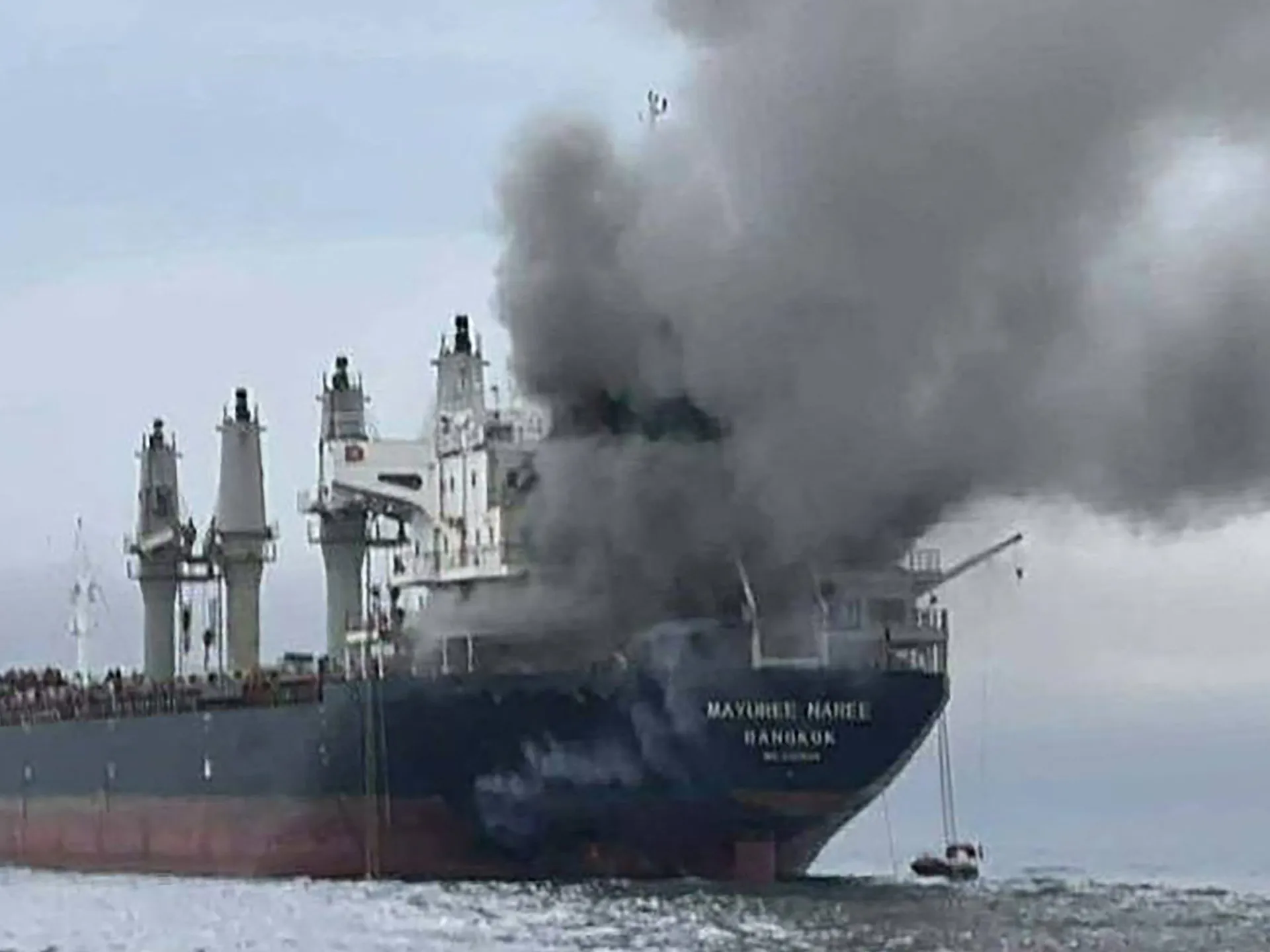
The Thai-flagged Mayuree Naree dry bulk vessel was struck by “two projectiles of unknown origin” while sailing through the strait earlier on Wednesday, causing a fire and damaging the engine room, the ship’s Thai-listed operator Precious Shipping said in a statement.

“Three crew members are ⁠reported missing and believed to be trapped in the engine room,” Precious Shipping said.

“The company is working with the relevant authorities to rescue these three ⁠missing crew members,” it said, adding that the remaining 20 crew members had been safely evacuated and were ashore in Oman.

Images shared by Thai news outlet Khaosod English showed what were reported to be crew members of the ship after their rescue by Oman’s navy.

The IRGC said in a statement carried by the semi-official Tasnim news agency that the ship was “fired upon by Iranian fighters”, suggesting the first direct engagement by the IRGC, who have previously fired missiles or drones.

The Japan-flagged container ship ONE Majesty also sustained minor damage on Wednesday from an unknown projectile 25 nautical miles (about 46 kilometres) northwest ⁠of Ras al-Khaimah in the United Arab Emirates, two maritime security firms said. Its Japanese owner Mitsui OSK Lines and a spokesperson for Ocean Network Express, its charterer, said the vessel was struck while at anchor in the Gulf, and an inspection of the hull revealed minor damage above the waterline.

All crew are safe, they said, adding that the vessel remains fully operational and seaworthy. The owner said the cause of the incident remained unclear and was under investigation.

A third vessel, a bulk ‌carrier, was also hit by an unknown projectile approximately 50 nautical miles (about 93km) northwest of Dubai, maritime security firms said.

The projectile had damaged the hull of the Marshall Islands-flagged Star Gwyneth, maritime risk management company Vanguard said, adding that the vessel’s crew were safe. Owner Star Bulk Carriers said the ship was hit in the hold area while it was anchored. There were no crew injuries and no listing.

The US Navy has refused near-daily requests from the shipping industry ⁠for military escorts through the Strait of Hormuz since the start of the war on Iran, saying the risk of attacks is too high for now, sources familiar with the matter told Reuters.

Source link

Russia says Ukraine attacked, sank gas tanker in Mediterranean

Russian President Vladimir Putin said that the sinking of a Russian gas tanker in the Mediterranean Sea was the result of a terrorist attack by Ukraine. The tanker sank between Libya and Malta after explosions and fire were observed by Libyan port officials. File Photo by Sergei Ilnitsky/EPA

March 4 (UPI) — A Russian liquefied natural gas tanker sank in the Mediterranean Sea on Wednesday after catching fire from what Russian officials said was an attack by Ukrainian drones.

Libyan port officials said there were explosions on the ship and it ultimately erupted in flames between Libya and Malta. The tanker was carrying about 62,000 metric ton of liquefied natural gas.

Thirty crew members were rescued and no deaths have been reported, TASS Russian News Agency reports.

Ukraine‘s security service has not commented on the incident.

The Russian Transport Ministry said in a statement that the tanker was attacked by unmanned Ukrainian boats.

The tanker was about 130 nautical miles north of the Sirte, Libya, port when it sank. It departed from the port of Murmansk, Russia.

“We qualify what happened as an act of international terrorism and maritime piracy, a gross violation of the fundamental norms of international maritime law,” the Russian Transport Ministry said in a statement.

“Such criminal actions, carried out with the connivance of the authorities of European Union member states, must not remain without assessment by the international community.”

Russian President Vladimir Putin echoed the statement of the transport ministry, calling it a “terrorist attack.”

The ministry adds that the tanker was operating in “full compliance with all international regulations.”

Source link

Which oil and gas facilities in the Gulf have been attacked? | Infographic News

Global energy markets remain in a state of high alert after several Gulf states suspended oil and gas production following escalating tensions in the region.

Since Saturday’s attacks by the United States and Israel, Tehran has targeted various sites in Israel and across several Gulf countries.

Recommended Stories

list of 4 itemsend of list

Initially, these Iranian attacks focused primarily on US military assets, but Gulf states have reported that Iran has since broadened its scope to target civilian infrastructure, including hotels, airports and energy facilities. Iranian officials have publicly denied targeting Gulf energy facilities, however.

The Middle East remains the world’s dominant source of hydrocarbon reserves and a major driver of crude oil and natural gas output.

How much oil and gas does the Middle East have?

Nearly half of the world’s oil reserves and exports come from the Middle East, which contains five of the seven largest oil reserves in the world.

Once refined, crude oil is used to make various products, including petrol, diesel, jet fuel and a wide range of household items such as cleaning products, plastics and even lotions.

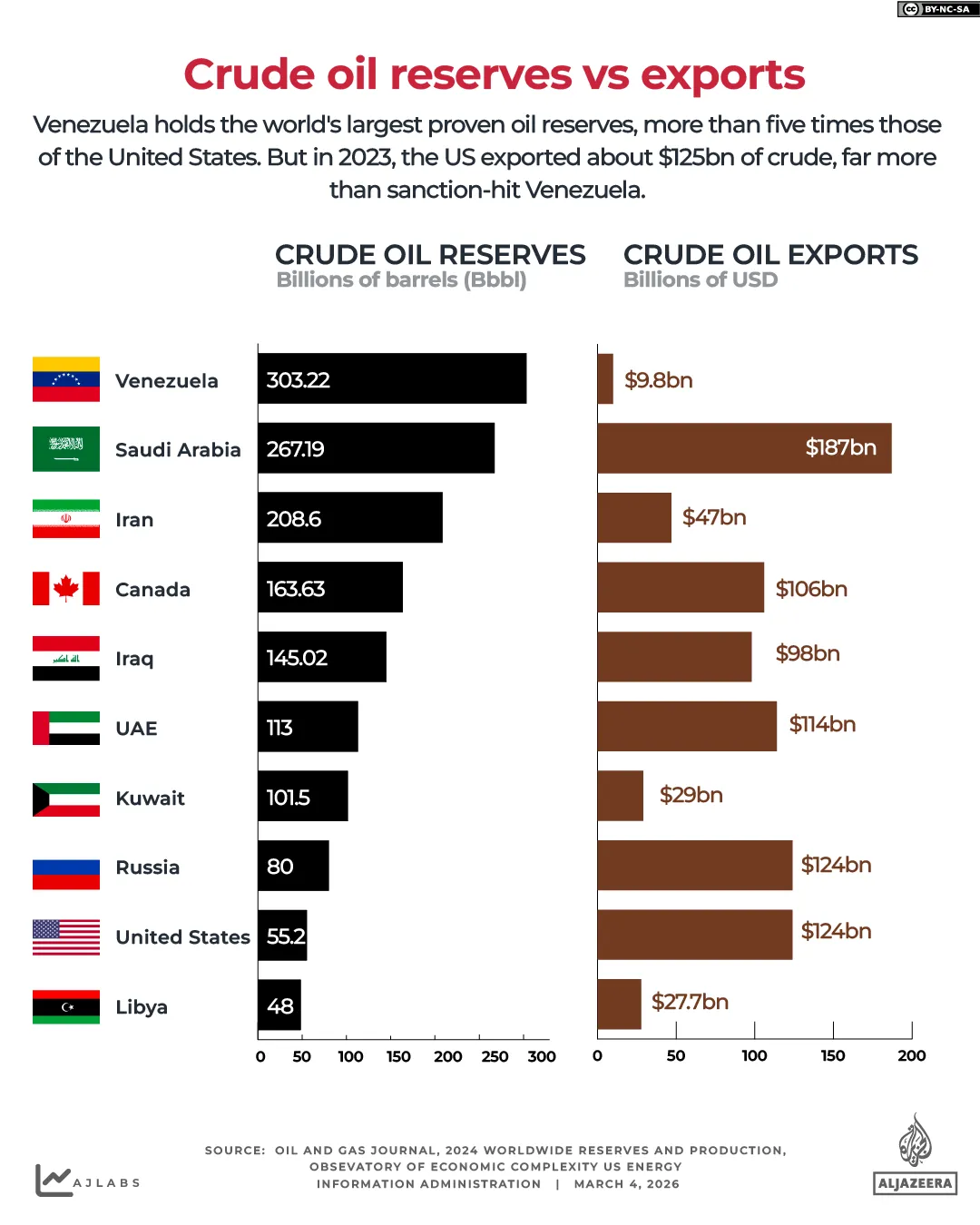
After Venezuela, which has 303 billion barrels, Saudi Arabia holds the world’s second-largest proven crude oil reserves, estimated at 267 billion barrels.

The Middle East’s largest oil reserves:

  • Saudi Arabia: 267 billion barrels
  • Iran: 209 billion barrels
  • Iraq: 145 billion barrels
  • UAE: 113 billion barrels
  • Kuwait: 102 billion barrels

Saudi Arabia is also the world’s top oil exporter with an estimated $187bn of crude in 2024, according to data from the Observatory of Economic Complexity (OEC).

The Middle East’s top oil exporters:

  • Saudi Arabia: $187bn
  • UAE: $114bn
  • Iraq: $98bn
  • Iran: $47bn – largely sold at a discount due to US sanctions
  • Kuwait: 29bn

Other Middle Eastern countries with sizeable oil exports include: Oman ($28.9bn), Kuwait ($28.8bn) and Qatar ($21bn).

INTERACTIVE_IRAN_GCC_OIL AND GAS SUPPLY-CRUDE_OIL_MARCH4_2026
(Al Jazeera)

In addition to crude oil, the Middle East is a global powerhouse for natural gas, accounting for nearly 18 percent of global production and approximately 40 percent of the world’s proven reserves.

Natural gas is primarily used for electricity generation, industrial heating, and in chemicals and fertilisers.

The heart of Middle Eastern gas is a single, massive underwater reservoir called the South Pars/North Dome field. It is the largest gasfield in the world, and it is shared directly between Qatar and Iran.

Gas is transported either through pipelines or by tankers. When using pipelines, the gas is pressurised and moved through steel networks. When pipelines are not feasible, such as across oceans, Liquefied Natural Gas (LNG) is used.

To create LNG, the gas is cooled to approximately -162C (-260F), shrinking its volume and allowing it to be safely loaded onto specialised tanker ships for global transport.

To transport oil and gas, tankers from various Gulf states must navigate the narrow waterway known as the Strait of Hormuz. Approximately one-fifth of global oil and gas passes through this strait, primarily heading to major markets in Asia, including China, Japan, South Korea and India, as well as to Europe.

INTERACTIVE - Strait of Hormuz - FEB24, 2026-1772104775
(Al Jazeera)

Which energy facilities have been attacked?

Here are the facilities which have recorded damage as of Wednesday:

Saudi Arabia – Ras Tanura oil refinery

On Monday, one of the world’s largest oil refining complexes, the Ras Tanura oil refinery owned by Saudi Aramco, was forced to halt operations after debris from intercepted Iranian drones caused a small fire.

This handout satellite image courtesy of Vantor taken and released on March 2, 2026, shows damage at the Saudi Aramco's Ras Tanura refinery.
This handout satellite image, courtesy of Vantor, released on March 2, 2026, shows damage at Saudi Aramco’s Ras Tanura refinery [AFP]

Saudi Aramco is one of the world’s largest companies, with a market capitalisation exceeding $1.7 trillion and revenue of $480bn. Headquartered in Dhahran, in eastern Saudi Arabia, Aramco controls 12 percent of global oil production, with a capacity of more than 12 million barrels per day (bpd).

On Wednesday, Saudi defence officials reported a second drone attempt on the facility but this was successfully intercepted with no damage or disruption to operations reported.

Qatar – Ras Laffan Industrial City LNG facilities

On Monday, Qatar’s Ministry of Defence reported that Iranian drones had targeted an energy facility in Ras Laffan belonging to QatarEnergy, the world’s largest LNG producer.

While no casualties were reported, QatarEnergy suspended the production of LNG and other products at the impacted sites.

RAS LAFFAN INDUSTRIAL CITY, QATAR - MARCH 3: A picture of Qatar Energy's operating facilities on March 3, 2026 in Ras Laffan Industrial City, Qatar. Qatar Energy announced a complete halt to liquefied natural gas (LNG) production at its Ras Laffan and Mesaieed facilities on March 2, 2026, after Iranian attacks targeted energy facilities. (Photo by Getty Images)
QatarEnergy’s operating facilities on March 3, 2026, in Ras Laffan Industrial City, Qatar [Getty Images]

QatarEnergy’s 81 million metric tonnes of LNG exports are mostly bound for Asian markets, including China, Japan, India, South Korea, Pakistan and other countries in the region. The halt in production hiked global gas prices to a three-year high this week.

Qatar – Mesaieed Industrial City

Qatar’s Defence Ministry said the country was attacked by a second drone launched from Iran on Monday, targeting a water tank belonging to a power plant in Mesaieed, without reporting any casualties.

On Tuesday, QatarEnergy also stopped production of some downstream products like urea, polymers, methanol, aluminium and others.

UAE – Fujairah and Mussafah oil terminals

On Monday, a fire broke out at Mussafah Fuel Terminal in southwest Abu Dhabi after it was struck by a drone.

On Tuesday, falling debris from a drone interception caused a fire at the Fujairah Oil Terminal along the eastern coast of the United Arab Emirates. No injuries were reported.

Large fire and plume of smoke is visible after, according to the authorities, debris of an Iranian intercepted drone hit the Fujairah oil facility, in Fujairah, United Arab Emirates, Tuesday, March 3, 2026. (AP Photo/Altaf Qadri)
A large fire and plume of smoke are visible after debris from an intercepted Iranian drone hit the Fujairah oil facility, in Fujairah, United Arab Emirates, on Tuesday, March 3, 2026, according to authorities [Altaf Qadri/AP Photos]

Oman – ports of Duqm and Salalah

On Tuesday, multiple Iranian drones struck fuel tanks and a tanker at the port of Duqm, with at least one direct hit on a fuel storage tank, causing an explosion.

On the same day, a drone strike was recorded at the Port of Salalah, which handles fuel and industrial minerals.

Athe Nova – oil tanker

On Monday, the Athe Nova, a Honduran-flagged tanker positioned off the coast of Khor Fakkan, UAE, was struck by Iranian drones as it was transiting the Strait of Hormuz, setting it ablaze. Despite the fire, the vessel managed to exit the chokepoint into the Gulf of Oman, and no casualties were reported.

Iran’s Islamic Revolutionary Guard Corps (IRGC) claimed responsibility for the strike, identifying the Athe Nova as an “ally of the United States”.

On the same day as the attack, Iran declared the Strait of Hormuz closed, warning that any ship attempting to pass would be “set ablaze”.

Since then, several other tankers have been hit.

INTERACTIVE_IRAN_GCC_OIL AND GAS SUPPLY-ATHE_NOVA_MARCH4_2026
(Al Jazeera)

Other regional energy disruptions

Although not directly targeted, the following energy sites suspended operations in response to Iranian retaliatory attacks:

Israeli offshore gasfields – Major gas production fields such as Leviathan and Tamar were shut down as a precaution following regional drone and missile launches linked to Iran.

Oil fields in semiautonomous Iraqi Kurdistan – Producers including DNO, Gulf Keystone and Dana Gas halted output as a safety measure amid the escalation.

Rumaila oilfield – Operations at Iraq’s largest oilfield – operated by BP – in southern Iraq were halted on Tuesday as a security precaution due to its proximity to the escalation zone.

Source link

Netanyahu says US and Israel attacked Iran to remove ‘existential threat’ | Benjamin Netanyahu

NewsFeed

Israel’s Prime Minister Benjamin Netanyahu says the joint US‑Israel strikes on Iran aim to remove an ‘existential threat.’ He hailed the joint action as empowering the Iranian people to shape their own future and praised US President Donald Trump for his leadership.

Source link

Mosques attacked, children racially abused as hard right rises in UK | Racism News

Names marked with an asterisk have been changed to protect identities.

London, United Kingdom – “People here are tired, scared and feel forgotten,” says Nabila*, a Muslim mother of two in Basildon, a town in the English county of Essex.

Recommended Stories

list of 4 itemsend of list

Sitting in her living room with a mug of tea, a Qur’an visible on the bookshelf and Japanese prints hanging to its right, she recalls a string of incidents in recent months: Glass thrown from a residential building at Muslim children, a racist attack on the local mosque where red crosses were daubed across its walls alongside the words “Christ is King” and “This is England”, and reports of drivers accelerating as Muslim women cross the road with their children.

Nabila
Nabila has been documenting incidents of racism in Essex, her home county [Courtesy of Nabila]

According to the 2021 census, Basildon is 93 percent white, and Muslims make up less than 2 percent of the population. Campaigners have warned that in areas where ethnic minority communities are smaller and more geographically isolated, they face heightened risks, as visibility increases vulnerability.

A single mother working full time, Nabila has been documenting incidents of racism, supporting victims and organising meetings with local authorities.

She said she no longer feels safe in the place she calls home.

After being racially abused while walking through her favourite park, she stopped going there altogether. Women, she said, are increasingly changing their daily routines, constantly watching over their shoulders. Racism now permeates every aspect of their lives, she added.

At a women’s listening circle organised by Nabila in collaboration with the local authority at the Wat Tyler Centre, another Muslim woman, Zarka*, spoke about her experiences as a young mother in Basildon who wears the hijab.

After being told to “take that rag off your head” during the school run by a passer-by, she stopped taking her children to school for two weeks. Beyond verbal abuse, she described the cumulative effect of everyday hostility, from cars failing to stop at zebra crossings and hostile looks from passersby.

‘I can’t do this any more, Mum.’

Hundreds of miles north, similar experiences are unfolding in Scottish classrooms.

Etka Marwaha’s daughter Anisa was seven when she first experienced racist taunting at her primary school in Glasgow.

Marwaha said Anisa became quiet and withdrawn. She was isolated on the playground and subjected to racial slurs. Months later, she broke down in tears in front of her mother, explaining the abuse she had suffered.

On multiple occasions, Marwaha contacted the school, urging them to take action, even offering her own support on understanding racism. But, she said, they failed in their duty of care, and the extent of the problem was kept hidden.

It went on for two years before Etka felt compelled to take her daughter out of the school.

“The plan was never to move her into a different school,” she told Al Jazeera. “But she was refusing to go to school; she would come home very, very upset. She was isolated.

“She was in tears, saying, “I can’t do this any more, Mum.’ So she made the decision, at that young age, that ‘I want to get out of here.’”

The girl’s new school is not in the catchment area, nor is there a direct bus to it, causing further inconvenience. But it has a zero-tolerance approach to racism, and Anisa is happier.

At her new school, Anisa can speak about her experiences of racism and how it made her feel.

The ordeal brought back painful memories for Marwaha’s own experiences at school.

“The racist bullying, for me, started at secondary school. You’d think times have changed, that people have been educated, but I think things have changed for the worse when a seven-year-old can openly make a racist comment and that’s accepted by society, and parents don’t address it.”

Sam*, a doctor in northwest Scotland with dual heritage children, said he has been surprised by the level of racism in local schools.

“There has been a clear normalising of racist jokes and name-calling. Every one of our kids has been affected,” he said. “Perhaps the biggest surprise is how few other students stand up against racism. When I was growing up, if someone was racist, they would be the person being socially excluded. Now, silence. It has forced us to look at moving out of the UK.”

‘Racism is out of control’

In the latest incident of alleged and potentially dangerous racism, a man walked into Manchester Central Mosque on Tuesday, reportedly with an axe and weapons. The man was arrested. There had been 2,000 worshippers in the mosque at the time, for the evening tarawih prayers during Ramadan.

Official figures underline the scale of the problem.

In October 2025, the UK Home Office revealed that the number of hate crimes recorded by police in England and Wales had risen for the first time in three years, including increases in racially and religiously motivated offences.

Religious hate crimes against Muslims rose by 19 percent, with a spike following the Southport murders and subsequent riots in mid-2025, the Home Office said.

The rise comes as hard-right politicians and activists, such as Reform leader Nigel Farage and the Islamophobic activist Tommy Robinson, rail against immigration. According to recent YouGov polling, if a general election were held tomorrow, Reform would lead with 24 percent.

Shabna Begum, head of Runnymede Trust, a race equality think tank, said, “Mainstream political and media actors have played in normalising and enabling racist narratives that have scapegoated migrants, people seeking asylum, Muslims and people of colour generally.”

In a report released last year, How Racism Affects Health, Runnymede highlighted the hypervigilance that people of colour have to operate with in order to guard their safety, and which causes long-term physiological damage, affecting life expectancy and mental health outcomes.

“For those that live in more disparate communities where they show up as minorities in a more visible way, that sense of threat is acute,” said Begum.

School suspensions for racist incidents have more than doubled in recent years, according to UK Department for Education data.

“Children as young as four are being sent home for racist behaviour,” Begum said. “This shows a society where racism is out of control, and that our school systems are failing to deal with the problem.

“They are making calculated decisions about where they will go, what travel routes they will take; withdrawing from regular social and community activities because they can no longer trust that those spaces will be safe for them.”

Source link

Reports say Ukraine attacked a Russian missile factory

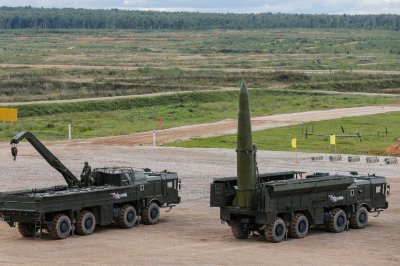
Ukraine Defense Forces on Friday night used attack drones to strike a Russian missile factory in the Udmurt Republic that builds the hypersonic Iskander-M, pictured, and the Oreshnik missile systems. Photo by Sergei Ilnitsky/EPA

Feb. 21 (UPI) — Ukrainian Defense Forces late Friday night struck a Russian missile production facility that manufactures some of Russia’s fastest and deadliest missile systems.

Ukrainian forces used attack drones to strike the Votkinsk Machine Building Plant in Russia’s Udmurt Republic, which produces the advanced missile systems, Ukrainska Pravda reported.

The factory builds the hypersonic Iskander and Oreshnik missile systems.

Ukraine‘s general staff confirmed the strike in a statement released on Saturday.

“On the night of February 21, units of the Missile Forces and Artillery of the Armed Forces of Ukraine carried out a strike with FP-5 Flamingo cruise missiles. A defense industry enterprise — the Votkinsk Plant in the city of Votkinsk — was hit,” the statement said.

“A fire was recorded on the premises of the facility,” it added. “The results are being clarified.”

The Udmart Republic is located about 770 miles east of Moscow and about 1,300 miles northeast of Kyiv.

The Iskander missile is a mobile system that is carried and launched from atop a large military transport and is capable of carrying conventional or nuclear warheads with a range of up to 310 miles for some variants. The missile travels at hypersonic speeds of up to Mach 7.

The Oreshnik missile is a medium-range ballistic missile that can carry either conventional or nuclear warheads at distances of up to 1,000 miles and possibly more than 3,000 miles, while traveling at up to Mach 11, or 8,000 mph.

Ukrainian Defense Forces also targeted the Neftegorsk Gas Processing Plant in the Samara Region of Russia and fuel and lubricants storage facilities in Russian-occupied parts of the Donetsk region.

The extent of damage from those strikes is under assessment.

Source link