“Covert action should not be confused with missionary work,” former United States Secretary of State Henry Kissinger declared after the sudden abandonment of Iraqi Kurds to their fate against the Iraqi government in 1975.
Half a century later, this doctrine of geopolitical expediency echoes across the Middle East. As the US and Israel encourage Kurdish militias to serve as a ground force against Iran’s central government, knowing their aspiration for “regime change” needs a ground force, history offers a severe warning.
Recommended Stories
list of 3 itemsend of list
From the mountains of Iraq in 1991 to the plains of Syria just weeks ago, Washington’s track record of using Kurdish fighters as disposable proxies suggests the current push for an Iranian Kurdish rebellion is fraught with risk.
Amid a rapidly escalating military confrontation that has seen US-Israeli air strikes assassinate top Iranian leaders, including Supreme Leader Ali Khamenei, Washington is seeking to open a new front.
Some US media reports claimed that thousands of Iranian Kurds have crossed from Iraq to launch a ground operation in northwestern Iran. That has not been verified. The US Central Intelligence Agency (CIA) has reportedly supplied these forces with light weapons as part of a covert programme to destabilise the country.
To facilitate this, US President Donald Trump reportedly held calls with Iraqi Kurdish leaders Masoud Barzani and Bafel Talabani as well as Iranian Kurdish leader Mustafa Hijri. While the White House and Kurdish officials in Erbil denied these reports, regional analysts remained wary.
The government of northern Iraq’s semiautonomous Kurdish region on Thursday denied involvement in any plans to arm Kurdish groups and send them into Iran.
Its president, Nechirvan Barzani, said it “must not become part of any conflict or military escalation that harms the lives and security of our fellow citizens”.
“Protecting the territorial integrity of the Kurdistan Region and our constitutional achievements can only be achieved through the unity, cohesion and shared national responsibility of all political forces and components in Kurdistan,” he added.
Mahmoud Allouch, a regional affairs expert, told Al Jazeera that the current strategy is aimed not simply at an immediate government overthrow but at “dismantling Iran” by inciting separatist movements as a prelude to its collapse. “The US and Israel want to produce a separatist armed Kurdish case in Iran similar to the Kurdish case that America imposed in Syria,” Allouch warned.
Added to this volatile mix is Turkiye and how it would react to any Kurdish uprising in the region. The Kurdistan Workers’ Party (PKK) began steps towards disarmament last summer, closing a chapter on a four-decade armed campaign against the Turkish state in a conflict that has killed more than 40,000 people. Any armed advances by Iranian Kurds could rankle Ankara.
A legacy of betrayal and unintended gains
For the Kurds, acting as the tip of the American spear has historically ended in disaster. In the 1970s, the US and Iran heavily armed Iraqi Kurdish rebels to bleed the government in Baghdad. Yet, once the shah of Iran secured a territorial concession from Iraq in 1975, he cut off the Kurds overnight with Washington’s approval. He himself was deposed in a revolution four years later.
This scenario repeated itself with devastating consequences in 1991. After then-US President George HW Bush encouraged Iraqis – both the Kurdish and Shia communities persecuted under Saddam Hussein – to rise up, the US military stood by as loyalist forces regrouped and used helicopter gunships to indiscriminately slaughter tens of thousands of civilians and rebels.
However, David Romano, a Middle East politics expert at Missouri State University, countered in a statement on his Facebook page that the aftermath of the 1991 catastrophe eventually forced the US to launch Operation Provide Comfort and a no-fly zone, which laid the groundwork for the semiautonomous Kurdish region in Iraq. “At important junctures, the Kurds have done exceedingly well as a result of cooperation with the US,” Romano wrote although he noted the opposite was true in 1975.
The Syrian quagmire
The dark irony of Washington asking Iranian Kurds to take up arms today is compounded by the recent collapse of Kurdish autonomy in neighbouring Syria. For years, the Kurdish-led Syrian Democratic Forces (SDF) served as the primary US proxy against ISIL (ISIS) and led the way to vanquishing the armed group in 2019 after years of fighting and suffering.
Yet in January, a little more than a year after the overthrow of Bashar al-Assad, the Trump administration backed Syria’s new central government in Damascus, essentially ending support for the SDF and Kurdish autonomy.
The US envoy to Syria, Thomas Barrack, declared that the original purpose of the SDF had largely expired. Within weeks, the SDF lost 80 percent of the territory it had bled for. For the Kurds across the region watching these events unfold, the implications were profound: The US is no longer perceived as a reliable partner or supporter of minorities.
Allouch highlighted this as a primary reason for Kurdish hesitation concerning Iran today, noting that Kurdish leaders are “bleeding from yesterday’s stab” in Syria.
Syrian Kurdish refugees arrive in Turkiye after crossing the border near the southeastern town of Suruc in Sanliurfa province on October 16, 2014, during an ISIL advance [Murad Sezer/Reuters]
Calculated rejections and the Iranian gamble
The US and Israel are seeking “boots on the ground” to avoid deploying their own forces. But in Erbil, the capital of the Kurdistan Regional Government in Iraq, the leadership understands the severe blowback. Barzani recently emphasised to the Iranian foreign minister that the region “will not be a party to the conflicts”.
Analysts suggested that Barzani remains angered by the US dismissal of a 2017 independence referendum for the region. Romano noted that because Baghdad vociferously rejected attacking Iran, Erbil has a perfect justification to decline Washington’s requests after decades of being told by the US to remain integrated within Iraq.
The calculus is different for Iranian Kurds, known as Rojhelati. Betrayed by the Soviet Union in 1946, they have acutely suffered under successive Iranian governments and may view this as their “first and only opportunity” to change their status.
However, Allouch warned that without a solid US military commitment, which Trump has shown no desire to provide, this move could be “suicidal” against a fierce Iranian military response.
The regional veto
Pushing Iranian Kurds into an open conflict remains a highly volatile endeavour that has triggered an immediate reaction from Turkiye. Allouch told Al Jazeera that Ankara will coordinate with the Iranian government to crush any uprising.
“The US and the international powers realise that they cannot, in the end, impose a reality that contradicts the interests of the ‘Regional Quartet’ – Turkiye, Syria, Iran and Iraq,” Allouch said. He argued that this regional bloc applies far more pressure regarding the Kurdish issue than shifts in international policies.
Ultimately, the Kurds have consistently paid the price of changing geopolitics. As Washington seeks a cost-free rebellion with no ground deployment or losses of its own soldiers in Iran, the Kurds will weigh seductive American promises against the blood-soaked lessons of 1975, 1991 and 2026.
Russian President Vladimir Putin accuses Ukraine of carrying out a ‘terrorist attack.’
Published On 4 Mar 20264 Mar 2026
Share
A Russian tanker carrying liquefied natural gas (LNG) has sunk in the Mediterranean between Libya and Malta, as Moscow accused Ukraine of attacking the vessel.
The Libyan port authority said the tanker was hit by “sudden explosions followed by a massive fire, which ultimately led to its complete sinking” on Tuesday night north of the port of Sirte, Libya.
Recommended Stories
list of 3 itemsend of list
Russian President Vladimir Putin accused Ukraine of attacking the gas carrier.
“This is a terrorist attack. This isn’t the first time we’ve seen this kind of thing,” Russia’s Putin told a reporter from Russian state television on Wednesday, accusing Kyiv of responsibility.
There was no immediate comment from Ukraine.
Russia’s Transport Ministry said that the Arctic Metagaz, which had been carrying LNG from the Arctic port of Murmansk, was attacked by Ukrainian naval drones launched from the coast of Libya.
It said the 30 crew members, all Russian nationals, were safe, and thanked Maltese rescue services.
“We qualify what happened as an act of international terrorism and maritime piracy, a gross violation of the fundamental norms of international maritime law,” the ministry said.
According to an advisory from Libya’s maritime rescue agency, the Arctic Metagaz sank in waters between Libya and Malta after catching fire on Tuesday night.
It warned vessels to avoid the site where the carrier sank and asked them to report any pollution in the area.
The Libyan port authority said the ship was carrying an estimated 62,000 metric tons of liquefied natural gas (LNG) on its way to Port Said, Egypt.
Egypt’s Petroleum Ministry has denied any connection with the tanker.
“The tanker is not listed under any contracts to supply or receive LNG cargoes to Egypt,” the ministry said.
The Arctic Metagaz has been sanctioned by the United States and the European Union as part of Russia’s fleet of ageing tankers that carry oil and gas exports around the world, skirting Western restrictions.
Ukraine has frequently targeted Russian oil refineries and other energy infrastructure in an attempt to deprive Russia’s war machine of funding.
In December, Ukraine said it had hit a Russian tanker with aerial drones in the neutral waters of the Mediterranean Sea, in what was the first such strike there in Russia and Ukraine’s more than four-year war.
WASHINGTON — The United States plunged further into conflict with Iran on Tuesday as a new round of strikes heightened fears of an expanding war in the Middle East, sending markets reeling and oil prices soaring and drawing urgent calls from European leaders for a plan forward.
President Trump acknowledged during an Oval Office appearance that the public would feel some economic pain as fighting continues to threaten areas that are critical to the world’s oil and natural gas production.
“As soon as this ends, those prices are going to drop, I believe lower than ever before,” Trump said, though he did not provide a clear time frame for when the conflict might end.
As the war stretched into its fourth day on Tuesday, Israel struck Iranian missile launch facilities and weapon factories and Iran retaliated across the Persian Gulf region, including attacks on U.S. diplomatic sites in Saudi Arabia, Kuwait and Dubai.
The conflict simultaneously set off alarms in the global markets, prompting stocks in Europe and Asia to plunge and the S&P 500 to drop nearly 1% after falling as much as 2.5% in early trading.
European governments were also forced to contend with the fallout, with some countries increasing their military presence in the region as their actions are closely monitored by Trump, who publicly singled out countries that he thought had been helpful in his war efforts so far.
“Spain has been terrible,” Trump told reporters in the Oval Office while threatening to “cut off all trade with Spain” after he said the country had denied American forces access to its military bases.
Trump said he was “not happy with the U.K. either” and complained about not being allowed to use a military base on Diego Garcia in the Chagos Islands. Without access to that military base, Trump said American planes were forced to fly “many extra hours.”
“We were very surprised. This is not Winston Churchill that we’re dealing with,” Trump said. Churchill served as Britain’s prime minister during World War II.
As Trump threatened European allies, he sat next to German Chancellor Friedrich Merz, underscoring the fraught landscape that world leaders are navigating as American and Israeli forces work to destroy Iran’s missile capabilities and nuclear program and eye a potential change in government.
During their meeting, Trump said Germany has allowed the United States to use its air bases. Beyond that help, Trump said, “we’re not asking them to put boots on the ground or anything.”
When asked by reporters how Germany intended to help in the conflict, Merz said he wanted to focus on talking to Trump about what comes “the day after” the war ends.
“We are on the same page in terms of getting this terrible regime in Iran away and we will talk about the day after, what will happen then, if they are out,” Merz said.
Trump talks about regime change options
Trump did not have much to say yet on what will come next and was unclear on who will lead the Iranian government, saying that U.S. and Israeli military operations had killed the people who he thought could have filled the leadership vacuum.
“Most of the people we had in mind are dead,” Trump said. “Now, we have another group, but they may be dead also based on reports so I guess you have a third wave coming in and pretty soon we’re not going to know anybody.”
His remarks were a startling acknowledgment in part because minutes earlier he said the worst-case scenario in his mind was that the military operation would take place and “then somebody takes over who is as bad as the previous person.”
“That could happen,” Trump said.
Asked if Crown Prince Reza Pahlavi, son of the former shah, is someone he would like to run the country, Trump said he is a “very nice person,” but did not say for sure whether he is his choice.
The president and his top aides have offered varying explanations when asked about regime change, drawing criticism from Democrats and some conservatives who are demanding to know why Americans are being dragged into a war with no clear end in sight.
On Saturday, when U.S. and Israeli forces first struck Iran, Trump said overthrowing Iran’s theocratic regime was part of his rationale. But on Monday, he emphasized that Iran’s missiles posed a threat to the United States, and therefore theattack was carried out to eradicate its missile capability and nuclear program.
After briefing lawmakers Monday afternoon, Secretary of State Marco Rubio told reporters that the United States launched a “preemptive” attack on Iran because officials knew Israel was going to strike the country — a move that he said would have put U.S. forces at risk and led to even more U.S. casualties. As of Tuesday, six American troops have been killed in combat.
House Speaker Mike Johnson (R-La.), after being briefed by Trump administration officials on Monday afternoon, said, “Israel was determined to act in their own defense, with or without American support.”
“If Israel fired upon Iran, and took action against Iran to take out the missiles, then they would have immediately retaliated against U.S. personnel and assets,” Johnson told reporters.
Trump disputed the suggestion that Israel’s plans to attack Iran prompted him to launch the strikes, saying it was the other way around.
“If anything, I might have forced Israel’s hand,” Trump said Tuesday. “But Israel was ready, and we were ready, and we’ve had a very, very powerful impact because virtually everything they have has been knocked out.”
But it was unclear how far along the U.S. military is in accomplishing its mission.
In a letter Monday, Trump told Congress that while the “United States desires a quick and enduring peace, it is not possible at this time to know the full scope and duration of military operations that may be necessary.”
Senate Minority Leader Chuck Schumer (D-New York) warned in a speech on the Senate floor that the administration’s murky strategy is not good for the country.
“History teaches us a simple lesson: Wars without a clear objective do not stay small. They get bigger, they get bloodier, they get longer, they get more expensive,” Schumer said. “This is not a defensive war. This is not a necessary war. This is a war of choice.”
The latest attacks on the region
Tuesday saw yet another expansion of the war when Israeli troops blitzed into Lebanon in a bid to dislodge the Iran-backed Shiite militant group Hezbollah.
The ground invasion comes one day after Hezbollah lobbed rockets and drones at an Israeli military position across the border; an attack, the group said, that was vengeance for the killing of Iranian Supreme Leader Ayatollah Ali Khamenei and a response to Israel’s near-daily violations of a ceasefire brokered by the U.S. in November 2024.
The attack sparked a massive Israeli assault on dozens of villages and towns in southern Lebanon, as well as on the southern suburbs of the Lebanese capital, Beirut. The strikes killed 40 people, wounded 246 others and saw tens of thousands forced to leave their homes and scramble for shelter in Beirut and elsewhere, according to Lebanese authorities.
The Lebanese army said Tuesday that it was withdrawing from positions in southern Lebanon ahead of a ground incursion by Israeli troops. The Israeli military’s Arabic-language spokesman then issued a warning to residents of some 80 towns and villages in that region to “immediately evacuate your homes” and move northward.
Hezbollah, meanwhile, maintained a defiant stance and continued rocket and drone launches into Israel.
“The era of patience has ended, and we have no option but to return to resistance,” said Mahmoud Qatari, who chairs Hezbollah’s Political Council. “If Israel wants an open war, so be it.”
The invasion comes more than a year after Israel occupied parts of southern Lebanon in 2024. After the ceasefire came into effect, Israel withdrew from most parts of the country save for five positions near the border. Yet in the 15 months since the ceasefire was signed, it has proved to be more notional for Lebanon, with Israeli warplanes and troops conducting well over 10,000 truce violations, according to the U.N.
Israel says its actions are to stop Hezbollah from reconstituting itself near the border, but the result has meant residents of border towns and villages in southern Lebanon have been unable to return home.
Israel’s military spokesman, Brigadier Gen. Effie Defrin, said in a statement that troops were “creating a buffer” inside Lebanon between residents in northern Israel “and any threat.”
As the conflict has escalated, some 1,600 Americans stranded across the region have requested assistance and the Trump administration is trying to help evacuate them, Rubio said. But the effort has faced challenges because Iranian missiles have struck many Mideast airports.
“We know we are going to be able to help them,” Rubio said. “It is going to take a little time because we do not control the airspace closures.”
Ceballos reported from Washington, Bulos from Khartoum, Sudan.
Washington, DC – On Monday, Secretary of State Marco Rubio provided a looping justification for the US launching a war against Iran: Israel was planning to strike Iran, which would have prompted Tehran to strike the US assets in the region, requiring Washington to launch preemptive strikes on Iran.
Even as the administration of US President Donald Trump has sought to roll back claims made by several officials in recent days, they have continued to spark dismay across the political spectrum.
Recommended Stories
list of 3 itemsend of list
Rubio’s statement was particularly notable, given the assessment by many Iran analysts that the US-Israel war, which has led to regional retaliation from Iran, serves the interests not of Washington, but of Israeli Prime Minister Benjamin Netanyahu.
Washington is seen as having outsized leverage over Israel, to which it has provided more than $300bn in military aid since 1948, including $21bn during Israel’s genocide in Gaza.
Trump, when asked about Rubio’s statement on Tuesday, appeared to offer a different characterisation, saying he launched the war because he “thought we were going to have a situation where we were going to be attacked”.
“They [Iran] were getting ready to attack Israel. They were gonna attack others,” he said.
The US president has spent the days since launching the initial strikes on Saturday arguing that the holistic threat posed by Iran justified the US-Israeli strikes, a position that experts say likely stands in contravention of both US and international law. The administration has provided scant evidence of a planned attack on US assets or that either Iran’s nuclear or ballistic programmes offered an immediate threat.
Rubio on Monday also sought to distance himself from his statements, claiming his words had been taken out of context.
Rubio had, in earlier comments, pointed to the broader threat posed by Iran, including its ballistic missile and drone capacity. But then he turned to what he called the question of “why now?”
“We knew that there was going to be an Israeli action,” he told reporters. “We knew that that would precipitate an attack against American forces, and we knew that if we didn’t preemptively go after them before they launched those attacks, we would suffer higher casualties.”
‘Stunning admission’
The shifting messaging on Tuesday was unlikely to allay the condemnation from Trump critics and supporters alike, including several influential figures within Trump’s Make America Great Again (MAGA) base.
Kelly Grieco, a senior fellow at the Stimson Center, told Al Jazeera that “what he’s basically publicly acknowledging would be that the United States was entrapped by the Israelis”.
“The notion that the Israelis were going to do it anyway, and so we had to do it as well – if that’s the case, then there’s a really serious conversation to be had here in the United States about US and Israeli interests, and where those are aligned and where they diverge,” Grieco said.
Kenneth Roth, a former executive director of Human Rights Watch, in a post on X, questioned: “Why is it in America’s interest to arm and fund Israel to draw America into an unnecessary war?”
In an earlier post, he said Rubio’s logic “isn’t even close to a legal rationale” for launching the war.
The Council on American-Islamic Relations (CAIR), meanwhile, called Rubio’s words on Monday a “stunning admission”.
In a statement, it said Rubio had revealed “what was clear from the start: the United States did not attack Iran because Iran posed an imminent threat to our nation. We attacked under pressure from Israel for Israel’s benefit”.
The organisation called on Congress to pass war powers resolutions to rein in Trump’s ability to wage war.
Looming war powers vote
Lawmakers have pledged to introduce the legislation in both the House of Representatives and Senate this week, although it is likely to face an uphill battle amid Republican opposition.
Trump’s party maintains razor-thin majorities in both chambers, and most Republican lawmakers have rallied behind the war and the reasons the administration has given for launching attacks.
War powers resolutions would require a two-thirds majority in both chambers to override a presidential veto, although advocates have long argued they offer an opportunity for lawmakers to put their stance on the record.
In a statement on Tuesday, progressive US Senator Bernie Sanders was among the lawmakers condemning the administration’s war.
“Netanyahu wanted war with Iran. Trump just gave it to him,” Sanders said.
The Israeli prime minister has, for more than two decades, called for the toppling of Iran’s government, and has been a leading opponent to diplomacy related to Iran’s nuclear programme.
During that time, Netanyahu has repeatedly pushed claims that Iran was on the immediate precipice of developing a nuclear weapon.
“American foreign and military policy must be determined by the American people,” Sanders wrote. “Not the right-wing extremist Netanyahu government.”
Thomas Massie, a Republican representative who has spearheaded the war powers push, connected Rubio’s statement to Trump’s “America First” pledges to prioritise domestic issues in the US.
“Before it’s over, the price of gas, groceries, and virtually everything else is going to go up,” Massie posted on X. “The only winners in [the US] are defence company shareholders.”
‘Worst possible thing he could have said’
Several influential figures in Trump’s MAGA base said Rubio’s statements were further inflaming the growing discontent over the war.
Daily Wire podcaster Matt Walsh said Rubio was “flat out telling us that we’re in a war with Iran because Israel forced our hand. This is basically the worst possible thing he could have said.”
Responding to Republican House Speaker Mike Johnson’s reiteration of Rubio’s claims, former congressman and Trump attorney general nominee Matt Gaetz said: “In making these statements, which are undeniably true, America looks like such a supplicant.”
Pro-Trump brothers Keith and Kevin Hodge, who run the influential pro-Trump X account HodgeTwins, with 3.5 million followers, also decried the administration’s actions.
“We did not vote for send[ing] Americans to die for Israel’s wars,” they posted on Tuesday. “We won’t stay silent about this.”
NEW YORK — U.S. and Israeli officials are privately casting doubt on projections from the Trump administration that the war with Iran could end within a matter of weeks — instead warning that a months-long campaign may be required to destroy the country’s ballistic missile capabilities and install a pliant government, multiple sources told The Times.
The prospect of extended combat creates new political risks and uncertainties for President Trump, whose penchant for dramatic, short-term military operations has suddenly given way to a full-scale assault on the Islamic Republic, shocking a MAGA base that for years supported his calls to end forever wars in the Middle East.
One Israeli official told The Times — despite internal guidance among Israeli officials to adhere to the U.S. president’s stated time frame — that the war “definitely could be longer” than the four-week window that Trump repeatedly offered to reporters.
A U.S. official said that in private conversations, top administration officials presume the campaign will require a longer runway now that remnants of Iran’s government have chosen to resist rather than acquiesce to Washington.
Protracted war was always a possibility. Trump was presented with U.S. intelligence assessments gaming out the potential conflict that emphasized how highly unpredictable the results of an attack would be — an analysis the intelligence community believes has borne out on the ground in the chaotic early days of the conflict.
The Israeli leader has succeeded in convincing Trump to take military actions in Iran that American presidents have rejected for decades, from bombing its nuclear facilities to assassinating its leadership, including Ayatollah Ali Khamenei, who was killed in an opening strike over the weekend.
Goal of regime change fades
Yet, mere days into the war, White House officials have all but ceased references to a democratic spring that could sweep Iran’s government aside.
A set of four U.S. goals for the mission no longer calls for changing the regime itself. Still, Netanyahu’s government remains keen on replacing the government, and the nation’s longest-serving premier sees the current war as his best opportunity to do so, one official said.
Speaking with reporters Tuesday, Trump rejected reports that the Israelis had convinced him to launch the attack.
“No, I might have forced their hand,” Trump said. “Based on the way the negotiations were going, I think they were going to attack first, and I didn’t want that to happen. So if anything, I might have forced Israel’s hand, but Israel was ready, and we were ready, and we’ve had a very, very powerful impact because virtually everything they have had been knocked out.”
In a series of interviews this week, Trump said he had been given projections of a four- or five-week war, while noting he is prepared to go longer if necessary.
Michael Rubin, a former Pentagon official who is Iran expert at the American Enterprise Institute, said that projecting a deadline to the conflict at its start would be a strategic mistake for the Trump administration, as it would in effect give Iran’s remaining leadership an end date to wait out the fighting.
“Successive presidents have shown that America has strategic attention deficit disorder,” Rubin said. “If that was the case in Iraq and Afghanistan, it’s especially true under Trump. He imposed a ceasefire on Gaza that let Hamas survive to fight another day; they still haven’t disarmed.”
The duration of the war will depend, in part, on Iran’s ability to resist and defend its remaining capabilities — but also on the president’s willingness to accept an outcome that leaves the Islamic Republic in place.
That decision has not yet been made by Trump, who has vacillated between calls for a democratic uprising across Iran — and U.S. military options to support resistance groups inside the country — as opposed to a shorter campaign that cripples Iran’s political leadership and Islamic Revolutionary Guard Corps.
“I can go long and take over the whole thing, or end it in two or three days and tell the Iranians, ‘See you again in a few years if you start rebuilding,” Trump told Axios.
One of Israel’s primary goals is to effectively eliminate the country’s ballistic missile program, and progress on that score is ahead of schedule, another source familiar with the operation said. “Things are going very well at the moment,” the source added. “Great pace.”
An Israeli military source noted to The Times that the stated goal of the mission is to significantly degrade, but not necessarily destroy, Iran’s ballistic missile capabilities, a goal the source said could be accomplished within Trump’s preferred time frame.
“Israel was quite unhappy Trump ordered the [June 2025] 12-day war ended when it did,” said Patrick Clawson, director of the Iran program at the Washington Institute for Near East Policy. He said he expected the current war would “take time” to comprehensively set back Iran’s ballistic missile capabilities, after a series of Israeli missions in 2024 against the missile program failed to set them back by more than a matter of months.
“Some Israelis think before the recent strikes, Iranian production was fully restored,” Clawson said. “So a really comprehensive attack on Iranian missiles is an important Israeli objective.”
The Maduro model
But no one inside the Islamic Republic system has emerged so far to serve in a supplicant role to Trump in the way that Delcy Rodríguez has stepped in as acting president of Venezuela, after U.S. forces captured that country’s strongman president, Nicolás Maduro, in an audacious overnight raid in January.
Since then, the Stars and Stripes have flown alongside the Venezuelan tricolor at government buildings in Caracas, where senior Trump administration officials have been welcomed to discuss lucrative opportunities in Venezuela’s oil industry.
Trump is now looking for an Iranian counterpart to Rodríguez, he said Tuesday, suggesting he is willing to keep the Islamic Republic in place despite encouraging its citizens to rise up against their government.
“Most of the people we had in mind are dead,” Trump said in the Oval Office. “We had some in mind from that group that is dead. And now we have another group. They may be dead also. Pretty soon we’re not gonna know anybody.”
“I mean, Venezuela was so incredible because we did the attack and we kept the government totally intact,” he added.
Dennis Ross, a veteran diplomat on the Israeli-Palestinian conflict who served in the George H.W. Bush, Clinton and Obama administrations, expressed doubt that Trump would be willing to proceed with a months-long campaign, regardless of Israel’s aspirational objectives.
“I believe President Trump doesn’t define clear objectives so he can decide to end the war at a time of his choosing, and declare the objective at that point, announcing we have achieved what we sought to do,” said Ross, noting that finding a figurehead in Iran as he did in Venezuela was always “a long shot.”
“Unilaterally, he could declare we made the regime pay a price for killing its citizens, and we have weakened Iran to the point that it is not any longer a threat to its neighbors,” Ross added. “He could then say, if Iran continues the war, we will hit them even harder.”
Soap spoilers for next week tease big drama and revelations across Emmerdale, Coronation Street, EastEnders, Hollyoaks and Home and Away, with some sad news and new twists
Soap spoilers for next week tease big drama and revelations(Image: ITV)
It’s another big week fro the soaps with twists, discoveries, hints at what’s ahead and some sad news.
On Emmerdale, one character finally shares the heartbreaking news about their secret cancer diagnosis. We also see characters tempted with an affair teased, while there’s also fresh hope after recent turmoil.
As for Coronation Street, villain Megan Walsh might be rumbled as another character faces trouble. There’s also romance drama and Theo Silverton’s abusive behaviour continues.
On EastEnders fans will see a showdown between Mark Fowler Jr and Ravi Gulati after a truth is revealed. There’s also an attack, while on Hollyoaks there’s a heartbreaking diagnosis for one fan favourite. Home and Away also features the possible end of a marriage.
Ensure our latest headlines always appear at the top of your Google Search by making us a Preferred Source.Click here to activateor add us as your Preferred Source in your Google search settings.
EastEnders
Mark’s under pressure to get rid of the informant, Ravi, leading to them clashing. Priya ends up dropping Ravi in it, confirming to Mark that his suspicions are correct. Soon, a reckless Ravi speeds out of Walford with Mark in tow. Priya panics for Ravi’s safety, while a fight ensues at Walford Common.
Later, Priya discovers Ravi’s self-harming scars as she fears for his mental health. She tells Jack how Ravi has compromised his position as an informant, while later, Ravi breaks down in her arms.
Events see Vicki concerned for her safety, leading to a clash with her brother Mark. Ross tries to reason with him, but Mark insists he must hand over the informant, while Vicki soon asks Phil for help.
Lauren fears for her future when she learns the car lot is up for sale. After she’s rejected for a bank loan, she asks her dad Max to invest but he refuses. Oscar and Cindy jibe at Lauren but Max does a U-turn, and agrees to invest.
It’s not long until Lauren realises she and her dad have very different ideas. As Peter supports Lauren, she tries to prove herself to Max. When Mark shows interest in a car, Lauren is soon disappointed when he reveals he hasn’t got the funds for it.
When Lauren’s alone, a thug attacks her and steals the car, with Mark rushing to her aid. Phil continues to avoid visiting Nigel at the care home, leaving Lexi, Julie and Callum to go instead.
Emmerdale
As Cain struggles knowing the farm could be lost, he can barely cope as Moira thanks him for keeping everything going. Sarah forces him to tell Moira the truth before things get any worse, as Joe threatens their future.
As Sarah continues to hide Cain’s cancer diagnosis from loved ones, he’s left panicked when he finds blood in his urine. As it’s time to reveal what’s going on, Cain visits Moira in prison and tells her he has cancer, leaving her heartbroken.
Soon it’s time to tell the family and after sharing his news, Cain prepares to tell sons Kyle and Isaac. A chat with Rhona sees Graham admit he knew about Cain’s diagnosis, leading to a charged moment. When Lydia tells Kim she spotted the pair together, Kim claims it doesn’t bother her.
Soon, Graham gives Rhona an ultimatum, and as he prepares to speak his truth, Rhona has a decision to make. Meanwhile, Joe is deflated when his master plan fails to impress Kim, while Kim decides to visit Moira.
Elsewhere, Mack, Matty and Ross feel like things might have turned a corner for the farm after Vanessa confirms the TB results for the herd are promising. Also next week, Laurel confides in Nicola, Arthur rejects a job with Jai while someone is suspicious over Kerry and Jai’s closeness. Finally, Paddy awaits news on whether Bear will be discharged from the mental health unit.
Coronation Street
It’s Theo’s birthday, but he’s clearly underwhelmed by Todd’s gifts. When he invites Maria and Gary to join him and Todd at The Bistro, Todd’s late, and Theo gives him daggers. When Todd is unable to afford the bill, Theo confronts him for ruining his birthday before he loses it with him.
As Todd tidies up after the fight, avoids work while Gary spots Theo sleeping in his van. When Gary goes to the flat to get some of Theo’s things, he spots the mess and tries to get Theo to sort things out with Todd. Later, Theo agrees to talk as Todd struggles to cope.
Adam gives Jodie a lecture, leaving her seething, while soon Tracy is having a word about David the dog. When Adam suggests a holiday with Alya she’s delighted but a text message leaves her thrown.
The next day, Adam is determined to catch out Jodie, who is left fearful when she realises her act has been shared on the Weatherfield Community page. Ollie and Amy enjoy a date, until Lauren accidentally soaks Amy with some drinks.
Amy’s buzzing about her possible romance though, with another date planned only for Maggie to encourage Lauren to try and win Ollie back. When Ollie can’t keep his eyes off of Lauren, will Amy be left heartbroken? Ollie realises Maggie is behind it, but Lauren confesses her reunion hopes.
Sam is sick, leaving Leanne concerned. She confides in Megan who plays it down, while she’s soon caught flirting on her phone. Later, Megan continues to make digs at Sam, while Leanne makes a comment to Daniel about his flirty phone chat with Megan, unaware she was speaking with Will.
Soon her interest is piqued, while Sam vows he’s not afraid of Megan anymore. Steve’s avoiding Cassie after her proposal plans. When the day of his dad Jim’s funeral arrives, he invites Ben for support.
As he attends without his mum Liz or brother Andy, he’s grateful for Ben joining him, while Maggie is keen for Ben to avoid the wake as he has a hospital appointment the next morning. George is upset as he continues to receive funeral cancellations, and things get worse when Maggie tells him he’s not welcome at the pub.
Hollyoaks
Diane hides her devastating advanced stage ovarian cancer diagnosis from her family, as an unaware Tony returns home with his brother Dom in tow. Diane soon leaves Nancy and Leela speechless with the news, and soon Tony finds out the truth.
He’s determined to get a second opinion, while Nancy tells Darren what’s happening as Diane’s children remain in the dark. Dillon confides in Lucas about Donny, and Lucas reveals he’s managed to get a phone into the prison.
But during a phone call, Dillon is panicked when he hears a fight taking place and Lucas goes silent. Later, Frankie and Vicky share their concerns about Dillon’s rekindled romance. Mercedes tries to track down ‘Jake’, while Froggy has some advice for Rex.
Home and Away
Cash is feeling the pressure about Remi’s secret, while Remi wakes up after a seizure. Dana tries to help Sonny, leaving him overwhelmed and soon he snaps.
Kerrie is upset with how much time her grandson Archie is spending with Tane instead of her, so she tries to find dirt on him. Kerrie’s soon distracted by an emotional Dana, who opens up to her mum but they soon clash, with Harper soon telling Kerrie to leave.
Meanwhile Sonny faces the reality of learning to use a wheelchair, leading to some advice from John. Elsewhere, Levi is thinking about a career change, and Lacey and David prepare for Jo to be discharged from hospital. Finally, Leah announces that she’s going to leave the Bay for a while, but Justin, keen to fix their marriage, urges her to stay.
Home and Away is available to stream from 6am weekdays, with double bill episodes airing from 6pm on 5Star.Hollyoaks is available to stream on Channel 4’s streaming service now, while it also airs Mondays to Wednesdays on E4 at 7PM.
EastEnders airs Mondays to Thursdays at 7:30pm on BBC One and BBC iPlayer.Emmerdale airs weeknights at 8pm on ITV1 and ITVX.
Ebrahim Jabari, a senior adviser to the IRGC’s commander-in-chief, reiterates that the Strait of Hormuz is ‘closed’.
Published On 2 Mar 20262 Mar 2026
Share
A commander in Iran’s Revolutionary Guard Corps (IRGC) has said the Strait of Hormuz is closed and warned that any vessel attempting to pass through will be attacked, according to Iranian state media.
“The strait is closed. If anyone tries to pass, the heroes of the Revolutionary Guard and the regular navy will set those ships ablaze,” Ebrahim Jabari, a senior adviser to the IRGC’s commander-in-chief, said on Monday.
Recommended Stories
list of 4 itemsend of list
Tehran has targeted infrastructure critical to the world’s energy production as part of its retaliation for the Israeli and US bombing campaign that began on Saturday and killed Iranian Supreme Leader Ayatollah Ali Khamenei and other senior officials.
“We will also attack oil pipelines and will not allow a single drop of oil to leave the region. Oil price will reach $200 in the coming days,” Jabbari said in a post on the IRGC’s Telegram channel.
“The Americans, with debts of thousands of billions of dollars, are dependent on the region’s oil, but they should know that not even a drop of oil will reach them,” he was also quoted as saying by the semi-official Tasnim news agency.
Rising energy prices
The Strait of Hormuz, which lies between Iran and Oman, is one of the world’s most critical oil transit routes, with roughly 20 percent of global oil supplies passing through it.
Any disruptions there will further send crude prices soaring and raise fears of a regional escalation.
Energy prices already rose sharply earlier on Monday as disruptions to tanker traffic through the strait, and damage to production facilities, raised uncertainty about how the US-Israeli attacks on Iran would affect supply to the world economy.
The biggest shock was to natural gas prices, which rose by almost 50 percent in Europe and nearly 40 percent in Asia as QatarEnergy, a major supplier, halted the production of liquefied natural gas after its LNG facilities were attacked.
Earlier, Saudi Arabia’s Ras Tanura oil refinery also came under attack from drones, and its defences downed the incoming aircraft, a military spokesman told the state-run Saudi Press Agency. The refinery has a capacity of more than half a million barrels of crude oil a day.
In response, the US said it would take action to mitigate rising energy prices due to the war with Iran, according to US Secretary of State Marco Rubio.
“Starting tomorrow, you will see us rolling out those phases to try to mitigate against that… We anticipated this could be an issue,” Rubio said.
According to President Trump, the United States attacked Iran because the Iranian regime posed “imminent threats” to the U.S. and its allies, including through its use of terrorist proxies and continued pursuit of nuclear weapons.
“Its menacing activities directly endanger the United States, our troops, our bases overseas and our allies throughout the world,” he said in a recorded statement Saturday.
According to leading Democrats in Congress, Trump’s justification is questionable, especially given his claims of having “completely obliterated” Iran’s nuclear capabilities in separate U.S. bombings last year.
“Everything I have heard from the administration before and after these strikes on Iran confirms this is a war of choice with no strategic endgame,” said Rep. Jim Himes (D-Conn.), ranking Democrat on the House Intelligence Committee and part of a small group of congressional leaders — the Gang of Eight — who were briefed on the operation by Secretary of State Marco Rubio.
That divide is bound to remain an issue politically heading into this year’s midterm elections, and could be a liability for Republicans — especially considering that some in the “America First” wing of the MAGA base were raising their own objections, citing Trump’s 2024 campaign pledges to extricate the U.S. from foreign wars, not start new ones.
The debate echoed a similar if less immediate one around President George W. Bush’s decision to go to war in Iraq following the Sept. 11, 2001, attacks, also based on claims that “weapons of mass destruction” posed an immediate threat. Those claims were later disproved by multiple findings that Iraq had no such arsenal, fueling recriminations from both political parties for years.
The latest divide also intensified unease over Congress ceding its wartime powers to the White House, which for years has assumed sweeping authority to attack foreign adversaries without direct congressional input in the name of addressing terrorism or preventing immediate harm to the nation or its troops.
Even prior to the weekend bombings, Democrats including Sen. Adam Schiff of California were pushing Congress to pass a resolution barring the Trump administration from attacking Iran without explicit congressional authorization.
“President Trump must come to Congress before using military force unless absolutely necessary to defend the United States from an imminent attack,” Sen. Tim Kaine (D-Va.), a member of the armed services and foreign relations committees, said in a statement Thursday.
In justifying the daylight strikes that killed Supreme Leader Ayatollah Ali Khamenei just two days later, Trump accused the Iranian government of having “waged an unending campaign of bloodshed and mass murder” for nearly half a century — including through attacks on U.S. military assets and commercial shipping vessels abroad — and of having “armed, trained and funded terrorist militias” in multiple countries, including Hezbollah and Hamas.
Trump said that after the U.S. bombed Iran last summer, it had warned Tehran “never to resume” its pursuit of nuclear weapons. “Instead, they attempted to rebuild their nuclear program and to continue developing long-range missiles that can now threaten our very good friends and allies in Europe, our troops stationed overseas, and could soon reach the American homeland,” he said.
Other Republican leaders largely backed the president.
“The United States did not start this conflict, but we will finish it. If you kill or threaten Americans anywhere in the world — as Iran has — then we will hunt you down, and we will kill you,” said Defense Secretary Pete Hegseth.
“Every president has talked about the threat posed by the Iranian regime. President Trump is the one with the courage to take bold, decisive action,” said Atty. Gen. Pam Bondi.
While Iran’s coordination with and sponsorship of groups such as Hezbollah and Hamas are well known, Trump’s claims about its ongoing development of nuclear weapons systems are less established — and the administration has provided little evidence to back them up.
Democrats seized on that lack of fresh intelligence in their responses to the attacks, contrasting Trump’s latest claims about imminent threats with his assertion after the separate summer bombings that the U.S. had all but eliminated Iran’s nuclear aspirations.
“Let’s be clear: The Iranian regime is horrible. But I have seen no imminent threat to the United States that would justify putting American troops in harm’s way,” said Sen. Mark Warner (D-Va.), vice chairman of the Senate Intelligence Committee and a member of the Gang of Eight. “What is the motivation here? Is it Iran’s nuclear program? Their missiles? Regime change?”
Senate Minority Leader Chuck Schumer (D-N.Y.) said in a statement that the Trump administration “has not provided Congress and the American people with critical details about the scope and immediacy of the threat,” and must do so.
House Minority Leader Hakeem Jeffries (D-N.Y.) said the Trump administration needs congressional authority to wage such attacks barring “exigent circumstances,” and didn’t have it.
“The Trump administration must explain itself to the American people and Congress immediately, provide an ironclad justification for this act of war, clearly define the national security objective and articulate a plan to avoid another costly, prolonged military quagmire in the Middle East,” he said.
After the U.S. military announced Sunday that three U.S. service personnel were killed and five others seriously wounded in the attacks, the demands for a clearer justification and new constraints on Trump only increased.
Rep. Ro Khanna (D-Fremont) said Sunday he is optimistic that Democrats will be unified in trying to pass the war powers resolution, and also that some Republicans will join them, given that the strikes have been unpopular among a portion of the MAGA base.
Rep. Thomas Massie (R-Ky.), who partnered with Khanna to force the release of the Epstein files, has said he will work with him again to push a congressional vote on war with Iran, which he said was “not ‘America First.’”
Benjamin Radd, a political scientist and senior fellow at the UCLA Burkle Center for International Relations, said that whether or not Iran represented an “imminent” threat to the U.S. depends not just on its nuclear capabilities, but on its broader desire and ability to inflict pain on the U.S. and its allies — as was made clear to both the U.S. and Israel after the Hamas attacks on Israel on Oct. 7, 2023, which Iran praised.
“If you are Israel or the United States, that’s imminent,” he said.
What happens next, Radd said, will largely depend on whether remaining Iranian leaders stick to Khamenei’s hard-line policies, or decide to negotiate anew with the U.S. He expects they might do the latter, because “it’s a fundamentalist regime, it’s not a suicidal regime,” and it’s now clear that the U.S. and Israel have the capabilities to take out Iranian leaders, Iran has little ability to defend itself, and China and Russia are not rushing to its aid.
How the strikes are viewed moving forward may also depend on what those leaders decide to do next, said Kevan Harris, an associate professor of sociology who teaches courses on Iran and Middle East politics at the UCLA International Institute.
If the conflict remains relatively contained, it could become a political win for Trump, with questions about the justification falling away. But if it spirals out of control, such questions are only likely to grow, as occurred in Iraq when things started to deteriorate there, he said.
Israel and the U.S. are currently betting that the conflict will remain manageable, which could turn out to be true, Harris said, but “the problem with war is you never really know what might happen.”
On Sunday, Iran launched retaliatory attacks on Israel and the wider Gulf region. Trump said the campaign against Iran continued “unabated,” though he may be willing to negotiate with the nation’s new leaders. It was unclear when Congress might take up the war powers measure.
THE Apprentice star Luisa Zissman was forced to improvise to keep her kids entertained as they took shelter during missile strikes on their adopted home in Dubai.
The podcaster, 38, is one of many celebrities who relocated to UAEand was caught up in the terrifying Iranian missile strikes in Dubai this weekend.
Sign up for the Showbiz newsletter
Thank you!
Luisa Zissman reveals terrifying moment she and kids were ‘forced to retreat to Dubai basement’ amid missile attackCredit: InstagramDubai’s iconic Burj Al Arab after Iran’s missile strikesCredit: Shutterstock EditorialLuisa kept the kids entertained by baking bread rollsCredit: InstagramShe also showed how she’d got the basement ready to take shelter inCredit: Instagram
Luisa spoke of how the family had planned to head out to the park when the Iranian missiles started hitting Dubai, so they retreated to the basement to stay safe.
She and two of her daughters, Indigo Esme, nine and Clementine, seven, moved earlier this year to join her millionaire husband Andrew Collins.
Her eldest daughter Dixie, 15, with ex-husband Olivier Zissman, is staying in the UK to finish her schooling.
Luisa described the situation in Dubai as “surreal and scary” and showed how she was keeping her kids distracted, including doing baking and watching.
“Home baked bread rolls. Keeping the kids entertained and indoors,” she captioned a post on Instagram.
“We got itchy feet and went to take them to the park and literally as we went to step foot out the door we heard two massive explosions that shook the house, we retreated and then heard another two. So now movie time in the basement.”
Luisa concluded: “So surreal and scary. I do faith that UAE defence will keep us all safe.”
She also showed fans how she had set up her basement to take shelter, including setting up some sleeping space for friends who were going to stay with them.
“We’ve decided to try and carry on as normal for the moment,” she explained, then showed how she’d stocked up the basement mini fridge with bottles of water though she was, “sure it won’t come to that.”
“Nothing major has happened, everything is relatively fine… when you’re here, it’s not so bad.”
Before retreating to the basement and as the missile strikes began, Luisa had thanked her fans for their concern.
“Lots of messages re Dubai,” she penned on her Instagram stories, alongside a selfie.
She added: “Lots of bangs we are hearing. Stay safe fellow UAE gang.”
Iran launched a barrage of rockets at nations across the Middle East after vowing revenge for the US and Israel’s huge blitz on the regime.
As the United Arab Emirate’s top holiday hot spot, Dubai has become a sought after travel destination for celebrities and influencers.
In more recent times, stars from the United Kingdom have been emigrating there, with many Brit celebs choosing Dubai as the place they want to bring up their families and base their careers.
Famous holidaymakers such asVicky PattisonandLaura Andersonare currently stuck in Dubai amid the missile strikes.
Vicky was connecting through the city on her way to Australia with her husband Ercan.
But taking to Instagram on Saturday evening, she wrote: “Ercan and I were due to fly to Sydney this evening.
“But like many others, our flight has been cancelled and we are now effectively stuck in Dubai.”
And stocked the fridge with waterCredit: InstagramLuisa has been keeping fans updated about how and her family are doingCredit: Instagram
An Iranian missile attack on the Israeli town of Beit Shemesh, 30 kilometers west of Jerusalem, has killed at least nine people and wounded dozens more. The strikes reportedly targeted an army headquarters and a weapons manufacturing complex.
Iran has begun 40 days of mourning after Supreme Leader Ayatollah Ali Khamenei was killed in ongoing attacks by the United States and Israel, according to Iranian state media.
Top security officials were also killed in Saturday’s strikes, along with Khamenei’s daughter, son-in-law and grandson. The killings mark one of the most significant blows to Iran’s leadership since the 1979 Islamic revolution.
Recommended Stories
list of 4 itemsend of list
President Masoud Pezeshkian condemned the killing as “a great crime”, according to a statement from his office. He also declared seven days of public holidays in addition to the 40-day mourning period.
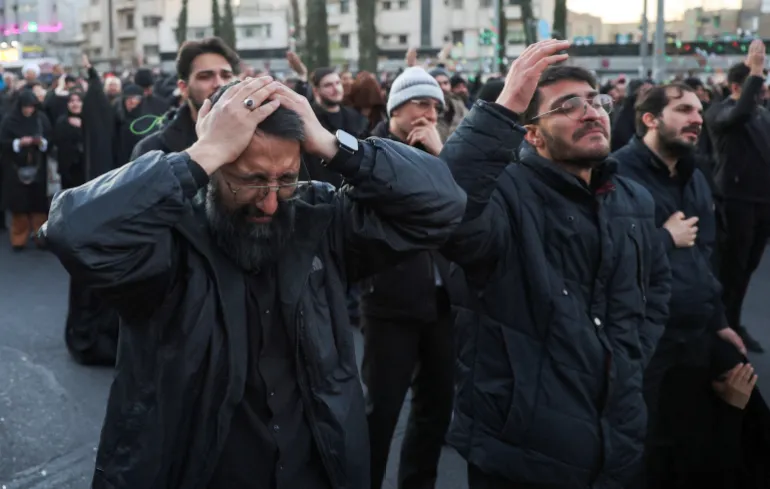
Reporting from Tehran, Al Jazeera’s Tohid Asadi said people were pouring into the streets of the capital following the news of Khamenei’s killing.
“There will be expected ceremonies,” he said, noting they would likely take place amid continuing bombardment across the country.
People mourn at the Enghelab Square in Tehran [Majid Asgaripour/West Asia News Agency via Reuters]
Protests denouncing Khamenei’s killing were also reported elsewhere, including Shiraz, Yasuj and Lorestan.
“There will be expected ceremonies,” he said, noting they would likely take place amid continuing bombardment across the country.
Footage aired by Iranian state media showed supporters mourning at the shrine of Imam Reza in Mashhad, with several people seen crying and collapsing in grief.
The killing also led to protests in neighbouring Iraq, which declared three days of public mourning. In Baghdad, protesters confronted security forces in the heavily fortified Green Zone, which houses Iraqi government buildings and foreign embassies.
Videos verified by Al Jazeera showed demonstrators waving flags and shouting slogans, with witnesses saying some were attempting to mobilise towards the US Embassy. Footage also showed protesters blocking vehicles at a roundabout near one of the entrances to the area.
Protesters demonstrate near the entrance of the Green Zone after the killing of Iran’s Supreme Leader Ayatollah Ali Khamenei, in Baghdad, Iraq, March 1, 2026 [Thaier Al-Sudani/Reuters]
There was also a protest in the Pakistani city of Karachi, where footage, verified by Al Jazeera, showed people setting fire to and smashing the windows of the US consulate.
However, there have also been reports of celebrations in Iran, with the Reuters news agency quoting witnesses as saying some people had taken to the streets in Tehran, the nearby city of Karaj and the central city of Isfahan.
Meanwhile, the official IRNA news agency reported that a three-person council, consisting of the country’s president, the chief of the judiciary, and one of the jurists of the Guardian Council, will temporarily assume all leadership duties in the country. The body will temporarily oversee the country until a new supreme leader is elected.
Khamenei assumed leadership of Iran in 1989 following the death of Ayatollah Ruhollah Khomeini, who had led the Islamic revolution a decade earlier.
While Khomeini was regarded as the ideological force behind the revolution that ended the Pahlavi monarchy, Khamenei went on to shape Iran’s military and paramilitary apparatus, strengthening both its domestic control and its regional influence.
Attacks across the region
Meanwhile, the Islamic Revolutionary Guard Corps (IRGC) pledged revenge and said it had launched strikes on 27 bases hosting US troops in the region, as well as Israeli military facilities in Tel Aviv.
Explosions have continued to be reported in Qatar and the United Arab Emirates, while security alerts are in place in several countries across the region.
US President Donald Trump, in a social media post on Sunday, warned Iran that it would be hit “with a force that has never been seen before” if it retaliated.
Iran’s retaliatory attacks since Saturday have targeted Israel and US assets across multiple Middle East countries, including Qatar, the UAE, Kuwait, Bahrain, Jordan, Saudi Arabia and Iraq.
Harlan Ullman, chairman of the strategic advisory firm Killowen Group and an adviser to the Atlantic Council in Washington, DC, said the US may have made a “big mistake” by killing Khamenei.
“Decapitation only works when you get all the leaders, and I don’t think that we got all the leaders,” Ullman said, adding that the US should not expect Iran’s leadership to enter negotiations in the immediate aftermath.
Iranian state media reported on Saturday at least 201 people have been killed in the joint US-Israeli attacks across 24 provinces, citing the Red Crescent. In southern Iran, at least 148 people were killed and 95 wounded in a strike on an elementary girls’ school in Minab on Saturday, with the toll continuing to rise, according to state media.
Figures from across the United States political spectrum have reacted to President Donald Trump’s joint attack with Israel on Iran, with Republicans largely expressing support and Democrats failing to offer a robust and unified response.
The attacks have reportedly killed at least 201 people, including more than 80 in a school in southern Iran, many of them children.
Recommended Stories
list of 3 itemsend of list
Iran has launched retaliatory strikes on Israel as well as US bases across the region, located in countries such as Bahrain, Qatar, the United Arab Emirates, Saudi Arabia, Jordan, and Kuwait, prompting fears that the conflict could spiral out of control and plunge the region into violence.
An initial YouGov poll conducted on February 28, after the strikes, suggested that 33 percent of US adults approved of the US attacking Iran, while 45 percent disapproved. Among Democrats and Independents, approval was just 10 percent and 21 percent, respectively, while 68 percent of Republicans expressed support.
Here’s how some of the US’s most prominent elected representatives and political figures have reacted.
President Donald Trump: “A short time ago, the United States military started major combat operations in Iran. Our objective is to defend the American people by eliminating imminent threats from the Iranian regime, a vicious group of very hard, terrible people. Its menacing activities directly endanger the United States, our troops, our bases overseas, and our allies throughout the world.”
Republican House of Representatives Speaker Mike Johnson: “Today, Iran is facing the severe consequences of its evil actions. President Trump and the Administration have made every effort to pursue peaceful and diplomatic solutions in response to the Iranian regime’s sustained nuclear ambitions and development, terrorism, and the murder of Americans—and even their own people.”
Republican Senate Majority Leader John Thune: “For years, Iran’s relentless nuclear ambitions, its expanded ballistic missile inventory, and its unwavering support for terror groups in the region have posed a clear and unacceptable threat to U.S. servicemembers, citizens in the region, and many of our allies. Despite the dogged efforts of the president and his administration, the Iranian regime has refused the diplomatic off-ramps that would peacefully resolve these national security concerns. I commend President Trump for taking action to thwart these threats.”
Democratic House Minority Leader Hakeem Jeffries: “Donald Trump failed to seek Congressional authorization prior to striking Iran. Instead, the president’s decision to abandon diplomacy and launch a massive military attack has left American troops vulnerable to Iran’s retaliatory actions. We pray for the safety of the men and women of the US military as they have been put into harm’s way in a dangerous theatre of war.”
Democratic Senate Minority Leader Chuck Schumer: “The administration has not provided Congress and the American people with critical details about the scope and immediacy of the threat. Confronting Iran’s malign regional activities, nuclear ambitions, and harsh oppression of the Iranian people demands American strength, resolve, regional coordination, and strategic clarity. Unfortunately, President Trump’s fitful cycles of lashing out and risking wider conflict are not a viable strategy.”
Democratic Representative Rashida Tlaib: “The American people do not want a war with Iran. Trump is acting on the violent fantasies of the American political elite and the Israeli apartheid government, ignoring the vast majority of Americans who say loud and clear: No More Wars.”
Democratic Representative Alexandria Ocasio-Cortez: “The American people are once again dragged into a war they did not want by a president who does not care about the long-term consequences of his actions. This war is unlawful. It is unnecessary. And it will be catastrophic. Just this week, Iran and the United States were negotiating key measures that could have staved off war. The president walked away from these discussions and chose war instead.”
New York City Mayor Zohran Mamdani: “Today’s military strikes on Iran — carried out by the United States and Israel — mark a catastrophic escalation in an illegal war of aggression. Bombing cities. Killing civilians. Opening a new theatre of war. Americans do not want this. They do not want another war in pursuit of regime change. They want relief from the affordability crisis. They want peace.”
Democratic Senator Bernie Sanders: “This Trump–Netanyahu war is unconstitutional and violates international law. It endangers the lives of U.S. troops and people across the region. We’ve lived through the lies of Vietnam and Iraq. No more endless wars. Congress must pass a War Powers Resolution immediately.”
Democratic Senator Chris Van Hollen: “Trump is lying to the American people as he launches an illegal, regime-change war against Iran. This is endangering American lives and has already resulted in mass civilian casualties. This is not making us safer & only damages the US and our interests. The Senate must immediately vote on the War Powers Resolution to stop it.”
Republican Senator Lindsey Graham: “I fervently pray that the long-suffering people of Iran will have their oppression ended soon. I also fervently pray that we’re on the verge of a new dawn in the Middle East, with historic opportunity for lasting peace and prosperity. As to our allies in Israel, President Trump and all under his command, your bravery has set in motion the end of evil and darkness, and the beginning of the light. Well done.”
Democratic Representative Ro Khanna: “Trump has launched an illegal regime change war in Iran with American lives at risk. Congress must convene on Monday to vote on Representative Thomas Massie and my WPR [War Powers Resolution] to stop this. Every member of Congress should go on record this weekend on how they will vote.”
Republican Representative Thomas Massie: “I am opposed to this War. This is not “America First.” When Congress reconvenes, I will work with Representative Ro Khanna to force a Congressional vote on war with Iran. The Constitution requires a vote, and your Representative needs to be on record as opposing or supporting this war.”
Republican Senator Tom Cotton: “Iran’s missile program poses an imminent threat to the United States and our allies. I’m thankful President Trump is taking necessary action to protect our homeland.”
Democratic Senator Adam Schiff: “Trump is drawing our country into yet another foreign war that Americans don’t want and Congress has not authorised. The Iranian regime is a brutal and murderous dictatorship. But that does not give Trump the authority to unilaterally initiate a war of choice.”
Democratic Senator John Fetterman: “Operation Epic Fury. President Trump has been willing to do what’s right and necessary to produce real peace in the region. God bless the United States, our great military, and Israel.”
Former Democratic Presidential Nominee Kamala Harris: “Donald Trump is dragging the United States into a war the American people do not want. Let me be clear: I am opposed to a regime-change war in Iran, and our troops are being put in harm’s way for the sake of Trump’s war of choice.”
Former Republican Representative Marjorie Taylor Greene: “We said “No More Foreign Wars, No More Regime Change!” We said it on rally stage after rally stage, speech after speech. Trump, Vance, basically the entire admin campaigned on it and promised to put America FIRST and Make America Great Again. My generation has been let down, abused, and used by our government our entire adult lives and our children’s generation is literally being abandoned.”
Major airlines including British Airways, Emirates and Qatar Airways have cancelled flights following joint US-Israeli strikes on Iran
23:55, 28 Feb 2026Updated 00:00, 01 Mar 2026
Numerous airlines have cancelled routes or altered flights in the wake of the US-Israeli attack on Iran (stock image)
Travel expert Simon Calder has forecasted when flights between the UK and the Middle East might recommence. Several leading airlines, including British Airways, Emirates, and Qatar Airways, have suspended flights in the wake of joint US-Israeli attacks on Iran.
It is estimated that hundreds of thousands of travellers are stuck in the region, with no immediate hope of return flights due to the unstable situation. Airports in Dubai and Doha have halted all operations after US bases in Bahrain, Qatar, the UAE and Kuwait were hit by Iranian retaliatory strikes.
British Airways has called off all flights to Tel Aviv and Bahrain until 3 March. Speaking on Radio 5 Live, Mr Calder admitted it was difficult to predict when flights would start again.
He stated: “It’s possible that flights will resume tomorrow (Sunday). Looking at what Emirates are saying in Dubai, it is possible there will not be any more flights until 3pm on Sunday afternoon – that is 11am GMT – with the implication that flights may well resume again then.
“Etihad, just down the road in Abu Dhabi, are saying that flights will be resuming at 2pm local time, so 10am tomorrow morning GMT. We will see if that happens. Quite a lot would need to be said and done to make the airlines confident that the airspace was safe.
“At the moment though, if I had a flight booked back from Doha then, my goodness me, my absolute sympathy with anybody who is stuck in a war zone with missiles coming in, it is unbelievable and I am so, so sorry it is happening, but I would think March 5 is not a bad day to have planned your escape.”
Airports across London and Manchester have reported disruptions, with one British Airways flight from London to Doha forced to turn back to Heathrow after three hours in the air.
Leading global carriers including Delta, Lufthansa, Cathay Pacific and Turkish Airlines have suspended services to the Middle East, alongside certain routes traversing the region.
The UK Foreign Office (FCDO) urged British nationals in affected nations to “immediately shelter in place” and steer clear of travel to Israel and Palestine. “Remain indoors in a secure location, avoid all travel and follow instructions from the local authorities,” the FCDO stated.
The department confirmed it was working tirelessly to bring home thousands of stranded Britons following the attacks. UK citizens are being encouraged to register via Register Your Presence and sign up for travel advisory emails to receive the most current updates from the Foreign Office.
1 of 3 | Rep. Thomas Massie, R-Ky., (L) and Rep. Ro Khanna, D-Calif., speak to reporters outside the Department of Justice offices in Washington, D.C., on February 9. Together, the two authored a war powers resolution. File Photo by Bonnie Cash/UPI | License Photo
Feb. 28 (UPI) — While congressional reaction to the U.S.-Israeli attack on Iran overnight was largely split along party lines, Democratic and some Republican lawmakers expressed concern that President Donald Trump ordered the strikes without first seeking congressional approval.
Lawmakers — who had already been pushing to limit Trump’s ability to carry out lethal strikes on suspected drug-smuggling boats in the Caribbean — said they would renew their efforts to pass a war powers resolution.
Reps. Thomas Massie, R-Ky., said he was “opposed to this war” in a post on X Saturday morning.
“When Congress reconvenes, I will work with [Rep. Ro Khanna, D-Calif.] to force a congressional vote on war with Iran,” he wrote.
“The Constitution requires a vote, and your representative needs to be on record as opposing or supporting this war.”
NBC News reported that Massie and Khanna together wrote a war powers resolution ahead of the Iran attack. Under Article 1 of the Constitution, Congress, not the executive branch, has the power to declare war on another country.
NPR reported that the White House notified the top eight leaders in Congress — known collectively as the Gang of Eight — shortly before the attack.
Speaker of the House Mike Johnson showed his support for Trump’s actions to limit Iran’s nuclear program.
“Today, Iran is facing the severe consequences of its evil actions,” Johnson said in a statement posted on X. “President Trump and the administration have made every effort to pursue peaceful and diplomatic solutions in response to the Iranian regime’s sustained nuclear ambitions and development, terrorism and the murder of Americans — and even their own people.”
Johnson said the Gang of Eight received a briefing earlier in the week about the potential military action.
Senate Democratic leader Chuck Schumer of New York, meanwhile, called on the Trump administration to brief the Senate on the threat. He said he had asked Secretary of State Mark Rubio to be transparent with Congress and the American people about the objectives of the strikes and the subsequent steps.
“The administration has not provided Congress and the American people with critical details about the scope and immediacy of the treat,” he said on X.
“Confronting Iran’s malign regional activities, nuclear ambitions and harsh oppression of the Iranian people demands American strength, resolve, regional coordination and strategic clarity.
“Unfortunately, President Trump’s fitful cycles of lashing out and risking wider conflict are not a viable strategy.”
Democrats are pushing for a vote next week on a resolution to curtail President Trump’s authority to conduct strikes in Iran, a move that would reassert Congress’ role in approving the use of military might.
The effort was already underway to force a vote on a war powers resolution, but it gained fresh momentum as the U.S. and Israel bombed Iran beginning early Saturday, an action that Trump referred to in a video shortly afterward as “war.” House Democratic leaders announced this week — before the strikes — that they would begin procedures to force a floor vote on a resolution for Iran.
The resolution directs Trump to terminate the use of armed forces against Iran, unless explicitly authorized by Congress. Presidents of both parties have skirted around war powers resolutions in the past.
Passage is uncertain in the Republican-controlled House and Senate, with GOP members of both chambers expressing initial support for the bombing of Iran. Senate Majority Leader John Thune (R-S.D.) praised the attacks Saturday and said to reporters that the administration “better well make it about getting new leadership and regime change.”
But the effort for a war powers vote has gained the support of at least two House Republicans, Thomas Massie of Kentucky and Warren Davidson of Ohio, making it possible for the measure to pass the House if enough Democrats support the measure and enough members show up for the final vote.
On the Senate side, Republican Rand Paul of Kentucky, who voted for an earlier war powers resolution, said he would “oppose another presidential war.”
House Democratic leader Hakeem Jeffries of New York said Iran “is a bad actor and must be aggressively confronted for its human rights violations, nuclear ambitions, support of terrorism and the threat it poses” to allies in the region.
“However, absent exigent circumstances, the Trump administration must seek authorization for the preemptive use of military force that constitutes an act of war,” Jeffries’ statement said.
Rep. Ro Khanna (D-Fremont), a California Democrat who is co-sponsoring the resolution with Massie, urged lawmakers to reconvene in Washington on Monday to vote, calling the strikes the launch of “an illegal regime change war in Iran with American lives at risk.”
Massie on social media described the attack as “acts of war unauthorized by Congress.”
The resolution faced initial opposition from staunch pro-Israel House Democrats Jared Moskowitz of Florida and Josh Gottheimer of New Jersey.
Senate Democratic leader Chuck Schumer of New York said the Senate should pass the resolution but didn’t outright oppose the strikes. He complained that the administration did not lay out its case to Congress or the public.
Trump would surely veto the resolution if passed, but substantial GOP votes for it could persuade him to limit the attacks on Iran. The Senate passed a procedural vote for a resolution against the strikes in January that culminated in the capture of Venezuelan leader Nicolas Maduro, after which the White House sent Secretary of State Marco Rubio to Capitol Hill to testify to members.
The U.S. Constitution gives Congress the power to declare war, but no president since Franklin D. Roosevelt in World War II has used that formal declaration, instead relying on less expansive authorization to deploy military force. Congress passed the War Powers Resolution in 1973 to slow the Vietnam War.
However, most presidents have sought some level of buy-in and approval from Congress, which approves the budget for the Pentagon.
“The Constitution is clear: The decision to take this nation to war rests with Congress, and launching large-scale military operations — particularly in the absence of an imminent threat to the United States — raises serious legal and constitutional concerns,” Sen. Mark Warner (D-Va.) said in a statement. “Congress must be fully briefed, and the administration must come forward with a clear legal justification.”
Other Senate Democrats, including Tim Kaine of Virginia and Andy Kim of New Jersey, have also urged their chamber to vote on a similar measure to put checks on Trump’s use of military force in Iran.
Rubio notified the so-called Gang of Eight — the top congressional leaders in the House and Senate and on the intelligence committees — of the strikes, the White House said.
Sen. Roger Wicker (R-Miss.), the chair of the Senate Armed Services Committee, defended the strikes as “pivotal and necessary.”
“The President has stated the operation’s goals clearly: thwart permanently the ayatollahs’ desire to create a nuclear weapon, degrade their ballistic missile force and their production capacity, and destroy their naval and terrorism capabilities,” Wicker said in a statement.
Sen. Chris Coons (D-Del.) noted in his statement: “This is not how a democracy goes to war.”
Commentators within Israel have described a sense of business as usual in the wake of the country’s joint attack with the United States against Iran.
“It’s Saturday, so the streets are naturally quiet,” political analyst Ori Goldberg said from outside Tel Aviv, as he returned from his shelter for the second time.
“I think, politically, there’s a sense of triumphalism, of having attacked an enemy regime. Not really because we’re greatly invested in the future of the Iranian people, but because, through the genocide on Gaza, we’ve devalued human life,” he said, referring to the Israeli attacks on the besieged territory since October 2023.
Returning to shelters around the country is now the stuff of everyday life for most Israelis, he said.
Israel has been on high alert since it launched a wave of attacks on Iran, the country that its leaders have consistently portrayed as its nemesis for decades.
Announcing the attack through a video post on X, Israeli Prime Minister Benjamin Netanyahu framed the attack in characteristically apocalyptic terms, saying Israel and the US had launched attacks to “remove the existential threat posed [to Israel] by the terror regime in Iran”, and going on to call upon the Iranian people to rise against their own leaders in response to the US and Israeli unprovoked strikes upon their cities.
Iran has retaliated with its own waves of missiles and drones against Israel and US assets in the region. At least one person was reported wounded in northern Israel.
But the latest strikes against Iran were met warmly by Israel’s political elite.
“I want to remind us all: The people of Israel are strong. The IDF [Israeli army] and the Air Force are strong. The strongest power in the world stands with us,” opposition leader Yair Lapid wrote on social media, referring to the US.
“In moments like these we stand together – and we win together. There is no coalition and no opposition, only one people and one IDF, with all of us behind them.”
In a subsequent post written in Farsi, he echoed the prime minister’s calls for Iran to enact regime change from within, a longstanding Israeli policy.
‘It’s crazy’
Accounts of the relative calm in Israel stand in sharp contrast to previous escalations, when sources described panic and bulk buying before an anticipated Iranian response to the wave of strikes Israel launched against targets in Iran.
“People here are well trained,” Aida Touma-Suleiman, a Palestinian member of the Israeli parliament representing the left-wing Hadash-Ta’al faction, which is almost alone in opposing the strikes, said from her apartment near Haifa, where she had just returned from her shelter.
“This is what they’re saying all the time in the media: How well-trained and ready we are. It’s crazy. I don’t think any country in the world has experienced more war than we have, so this is what they mean by ‘trained’,” she said, referencing the wars on Iran, Lebanon, Yemen and Gaza that Israel has waged since the Hamas-led attack of October 2023.
As Touma-Suleiman spoke, she was interrupted by an alarm on her phone. “That’s not the alert. That’s a warning on my phone telling me there’s going to be an alert and then I’ll have to return to the shelter,” she explained, laughing drily. “You see what I mean about being well trained?”
Texting from Israel, Ahron Bregman, a senior teaching fellow at the Department for War Studies at King’s College London, described the relative calm and almost relief felt by many within the country that the uncertainty over war with Iran was at an end.
“Both Israel and the US are after the Iranian leadership. They hope to weaken it substantially, though I doubt they could topple it from the air,” he said, raising the possibility of a prolonged conflict.
However, how ready Israel might be for a lengthy war, and to what degree that might be Israel’s choice, was far from certain, Touma-Suleiman said.
“It will be the United States that determines how long the war will be. They’ll continue until they’ve achieved whatever it is they want,” she said.
“I don’t think Israel is ready for that. People are exhausted. The army is exhausted. I don’t know if they even have the reserves to manage a long war, and this is what Netanyahu is willing to gamble with, just so he can say to the public before elections: ‘Here is at least one victory.’”
Embassy staffers and dependents evacuating, airlines suspending service, eyes in Iran warily turning skyward for signs of an attack.
The prospects of a showdown between the U.S. and Iran loom ever higher, as massive American naval and air power lies in wait off Iran’s shores and land borders.
Yet little of that urgency is felt in Iran’s government. Rather than quickly acquiescing to President Trump’s demands, Iranian diplomats persist in the kind of torturously slow diplomatic dance that marked previous discussions with the U.S., a pace that prompted Trump to declare on Friday that the Iranians were not negotiating in “good faith.”
But For Iran’s leadership, Iranian experts say, concessions of the sort Trump are asking for about nuclear power and the country’s role in the Middle East undermine the very ethos of the Islamic Republic and the decades-old project it has created.
“As an Islamic theocracy, Iran serves as a role model for the Islamic world. And as a role model, we cannot capitulate,” said Hamid Reza Taraghi, who heads international affairs for Iran’s Islamic Coalition Party, or Hezb-e Motalefeh Eslami.
Besides, he added, “militarily we are strong enough to fight back and make any enemy regret attacking us.”
Even as another round of negotiations ended with no resolution this week, the U.S. has completed a buildup involving more than 150 aircraft into the region, along with roughly a third of all active U.S. ships.
Observers say those forces remain insufficient for anything beyond a short campaign of a few weeks or a high-intensity kinetic strike.
Iran would be sure to retaliate, perhaps against an aircraft carrier or the many U.S. military bases arrayed in the region. Though such an attack is unlikely to destroy its target, it could damage or at least disrupt operations, demonstrating that “American power is not untouchable,” said Hooshang Talé, a former Iranian parliamentarian.
Tehran could also mobilize paramilitary groups it cultivated in the region, including Iraqi militias and Yemen’s Houthis, Talé added. Other U.S. rivals, such as Russia and China, may seize the opportunity to launch their own campaigns elsewhere in the world while the U.S. remains preoccupied in the Middle East, he said.
“From this perspective, Iran would not be acting entirely alone,” Tale said. “Indirect alignment among U.S. adversaries — even without a formal alliance — would create a cascading effect.”
We’re not exactly happy with the way they’re negotiating and, again, they cannot have nuclear weapons
— President Trump
The U.S. demands Iran give up all nuclear enrichment and relinquish existing stockpiles of enriched uranium so as to stop any path to developing a bomb. Iran has repeatedly stated it does not want to build a nuclear weapon and that nuclear enrichment would be for exclusively peaceful purposes.
The Trump administration has also talked about curtailing Iran’s ballistic missile program and its support to proxy groups, such as Hezbollah, in the region, though those have not been consistent demands. Tehran insists the talks should be limited to the nuclear issue.
After indirect negotiations on Thursday, Oman’s Foreign Minister Badr al-Busaidi — the mediator for the talks in Geneva — lauded what he said was “significant progress.” Iranian Foreign Ministry spokesman Esmail Baghaei said there had been “constructive proposals.”
Trump, however, struck a frustrated tone when speaking to reporters on Friday.
“We’re not exactly happy with the way they’re negotiating and, again, they cannot have nuclear weapons,” he said.
Trump also downplayed concerns that an attack could escalate into a longer conflict.
This frame grab from footage circulating on social media shows protesters dancing and cheering around a bonfire during an anti-government protest in Tehran, Iran, on Jan. 9.
(Uncredited / Associated Press)
“I guess you could say there’s always a risk. You know, when there’s war, there’s a risk in anything, both good and bad,” Trump said.
Three days earlier, in his State of the Union address Tuesday, said, “My preference is to solve this problem through diplomacy. But one thing is certain, I will never allow the world’s number one sponsor of terror, which they are by far, to have a nuclear weapon — can’t let that happen.”
There are other signs an attack could be imminent.
On Friday, the U.S. Embassy in Israel allowed staff to leave the country if they wished. That followed an earlier move this week to evacuate dependents in the embassy in Lebanon. Other countries have followed suit, including the U.K, which pulled its embassy staff in Tehran. Meanwhile, several airlines have suspended service to Israel and Iran.
A U.S. military campaign would come at a sensitive time for Iran’s leadership.
The country’s armed forces are still recovering from the June war with Israel and the U.S, which left more than 1,200 people dead and more than 6,000 injured in Iran. In Israel, 28 people were killed and dozens injured.
Unrest in January — when security forces killed anywhere from 3,000 to 30,000 protesters (estimates range wildly) — means the government has no shortage of domestic enemies. Meanwhile, long-term sanctions have hobbled Iran’s economy and left most Iranians desperately poor.
Despite those vulnerabilities, observers say the U.S. buildup is likely to make Iran dig in its heels, especially because it would not want to set the precedent of giving up positions at the barrel of a U.S. gun.
Other U.S. demands would constitute red lines. Its missile arsenal, for example, counts as its main counter to the U.S. and Israel, said Rose Kelanic, Director of the Middle East Program at the Defense Priorities think tank.
“Iran’s deterrence policy is defense by attrition. They act like a porcupine so the bear will drop them… The missiles are the quills,” she said, adding that the strategy means Iran cannot fully defend against the U.S., but could inflict pain.
At the same time, although mechanisms to monitor nuclear enrichment exist, reining in Tehran’s support for proxy groups would be a much harder matter to verify.
But the larger issue is that Iran doesn’t trust Trump to follow through on whatever the negotiations reach.
After all, it was Trump who withdrew from an Obama-era deal designed to curb Iran’s nuclear ambitions, despite widespread consensus Iran was in compliance.
Trump and numerous other critics complained Iran was not constrained in its other “malign activities,” such as support for militant groups in the Middle East and development of ballistic missiles. The Trump administration embarked on a policy of “maximum pressure” hoping to bring Iran to its knees, but it was met with what Iran watchers called maximum resistance.
In June, he joined Israel in attacking Iran’s nuclear facilities, a move that didn’t result in the Islamic Republic returning to negotiations and accepting Trump’s terms. And he has waxed wistfully about regime change.
“Trump has worked very hard to make U.S. threats credible by amassing this huge military force offshore, and they’re extremely credible at this point,” Kelanic said.
“But he also has to make his assurances credible that if Iran agrees to U.S. demands, that the U.S. won’t attack Iran anyway.”
Talé, the former parliamentarian, put it differently.
“If Iranian diplomats demonstrate flexibility, Trump will be more emboldened,” he said. “That’s why Iran, as a sovereign nation, must not capitulate to any foreign power, including America.”
Israel and the United States launched an air campaign against Iran on Saturday, striking Tehran and several other cities in what President Trump said was the start of “major combat operations.”
The attacks began with Israeli strikes Saturday morning — a workday in Iran — on Tehran, the capital, with residents speaking of attacks near the presidential palace and Iran’s National Security Council.
There were also reports of Israeli strikes on the Ministry of Intelligence, Ministry of Defense, the Atomic Energy Organization of Iran and a military complex.
Israel’s defense minister said the “pre-emptive strike” was to “remove threats against the State of Israel”.
It remains unclear the extent of the campaign and what its ultimate aim will be. But in an eight-minute recorded video message on Truth Social, Trump outlined a maximalist strategy that would see much of what he called “this very wicked, radical dictatorship from threatening America and our core national security interests.”
“We are going to destroy their missiles and raze their missile industry to the ground. … We are going to annihilate their navy. We are going to ensure that the region’s terrorist proxies can no longer destabilize the region or the world, and attack our forces,” he said. “And we will ensure that Iran does not obtain a nuclear weapon.”
He urged Iranians to take over their government.
“This will be probably your only chance for generations,” he said. “For many years, you have asked for America’s help, but you never got it. No president was willing to do what I am willing to do tonight.”
Trump also said U.S. military forces “may have casualties.”
Iran’s IRNA news agency quoted a source in the presidential office who said Iranian President Masoud Pezeshkian was unharmed in the strike.
Besides the capital, explosions could be heard in other the cities, including Isfahan, Karaj, Kermanshah and Qom, according to Iranian state media.
Both Israel and Iran shut down their airspace.
Cellphone and internet communications were disrupted shortly after the attacks began. Multiple Iranian state news websites also appear to have been hacked.
There was no immediate official response from Iran, but Ebrahim Azizi, the head of the Iranian parliament’s national security commission, vowed retaliation.
“We warned you!” he wrote on social media. “Now you have started down a path which end is no longer in your control.”
Residents reported hearing sounds of missiles flying over cities in Jordan, Syria and Lebanon in what was thought to be a missile barrage from Iran against Israel.
The attacks come two days after the U.S. and Iran concluded a third round of Oman-brokered negotiations in Geneva aimed at reducing tensions and stopping the prospect of war.
On Friday, Trump expressed displeasure with the pace of the talks, saying the Iranian side were not negotiating in “good faith” or giving in to U.S. demands. But Oman’s Foreign Minister Badr Albusaidi said a deal was “within reach.”
Weekly insights and analysis on the latest developments in military technology, strategy, and foreign policy.
Israel has launched an attack on Iran, striking targets in Tehran.
A U.S. official has confirmed to TWZ that the U.S. is attacking Iran. Including strikes from air and sea, the official said. See updates down below.
Details remain extremely limited at this time, but what we know is that Israel struck targets as part of what it is calling a preemptive strike. Images from the capital show smoke plumes rising in urban areas. In addition, we have seen video from Iraq showing what appear to be low flying cruise missiles or possibly fighter aircraft. Iraq has been the primary access point for the Israeli Air Force in past strikes on Iran.
BREAKING: Israel says it launched a preemptive strike against Iran and declares a nationwide state of emergency. Reports of explosions across the Iranian capital, Tehran. pic.twitter.com/mRXNHj3Yy8
Some of the ground are saying the strikes targeted Iranian leadership installations in the city, particularly those used by Supreme Leader Khamenei, although we cannot confirm that at this time. Geolocation info will soon be coming that should shed light on the target set.
The IDF posted the following on X, stating:
The State of Israel has launched a preemptive attack against Iran. Israel’s Minister of Defense, Israel Katz, declares a special and immediate state of emergency throughout the state The State of Israel has initiated a preemptive attack against Iran to remove threats directed against the State of Israel. As a result, missile and drone launches against the State of Israel and its civilian population are expected in the very near term. Therefore, pursuant to his authority under the Civil Defense Law, Minister of Defense Israel Katz has now signed a special order mandating the imposition of a special state of emergency in the Home Front throughout the State of Israel, effective immediately. The instructions of the Home Front Command and the authorities must be followed, and individuals must remain in protected areas.
U.S. Central Command has declined to comment on the strikes in response to our direct inquiry to them.
This is a rapidly developing situation and we are going into rolling coverage on it below. Newest updates will be posted on top.
UPDATE: 2:27AM EST—
Israel’s N12 is reporting that the operation name is “Roar Of The Lion.”
Strikes are occurring at sites throughout Iran. While these could be targeting time sensitive targets, many of these strikes would be used to prepare the battlefield for aircraft operations over Iran. In other words, degrading and destroying what’s left of Iran’s air defenses so strike aircraft can more safely operate over the country. These operations would likely occur tonight under the cover of darkness, where direct attacks on targets can be made.
UPDATE: 2:15AM EST—
A U.S. official has confirmed to TWZ that the U.S. is attacking Iran.
Meanwhile the Mossad is asking Iranians to “return Iran to its glorious days.”
As Israel launches strikes on Iran, the Mossad spy agency on its official Persian-language Telegram channel calls on Iranians to help “return Iran to its glorious days.”
“Our Iranian brothers and sisters, you are not alone! We have launched a highly secure and dedicated Telegram… pic.twitter.com/jnL937YR8e
We are getting unconfirmed reports that Israel has assassinated Iran’s defense minister.
UPDATE: 1:55AM EST—
Israel is preparing for a reprisal strike:
In the last few minutes, sirens were sounded all throughout Israel, with an advance instruction alert directly to cellular devices to stay within proximity to protected spaces. This is a proactive alert to prepare the public for the possibility of missiles being launched toward the State of Israel. The IDF emphasizes that the public is requested to stay in proximity to protected spaces.
In the last few minutes, sirens were sounded all throughout Israel, with an advance instruction alert directly to cellular devices to stay within proximity to protected spaces.
This is a proactive alert to prepare the public for the possibility of missiles being launched toward…
Flights are currently diverting away from the region and Iran has closed its airspace.
It appears the USAF transport aircraft are trying to leave the ground prior to any kind of reprisal strikes. One ACARS message told a C-17 crew to remain on the ground in Jordan for as little time as possible not long before the strikes.
It’s looking like a U.S. strike on Iran could go down at any moment
A U.S. Air Force C-17 Globemaster III strategic airlifter with identification number 06-6166 en route to King Abdullah II Air Base in Jordan has been instructed to keep its ground time to an absolute minimum.… pic.twitter.com/1GIXRN14jt
The daytime nature of the attacks would point to time sensitive targets being hit.
CNN is reporting that the U.S. was at least in coordination with Israel on the strikes, but that is not surprising at all even if Israel acted unilaterally in the kinetic action itself. There has been reports that the Trump administration favors Israel striking first so that it can then jump in once Iran responds with its own strikes.
A shelter in place order has been broadcasted in Qatar, home to the U.S. military’s largest installation in the region and what is presumed (and previously demonstrated) as the top U.S. target of Iran.
Message for U.S. Citizens:
The U.S. Embassy in Qatar is implementing a shelter-in-place for all personnel. We recommend all Americans do the same until further notice.
Actions to Take:
– Find a secure location within your residence or another safe building. Have a supply of… pic.twitter.com/ENogjpfK5r
An Israel KC-707 was seen departing today, likely to support the strike operation. Minister of Defense Gallant posted simply “Good luck” with U.S. and Israeli flags on his X account along with an image of an IAF F-15D and him talking to crews.
Weekly insights and analysis on the latest developments in military technology, strategy, and foreign policy.
With the U.S. Air Force now in the process of transitioning from the aging EC-130H Compass Call to the brand-new, bizjet-based EA-37B Compass Call, TWZ caught up with top executives from the two co-primes on the electronic attack aircraft program. In the process, we learnt more about its capabilities, related platforms, and other prospects for the future. We spoke with Jason Lambert, president of the intelligence, surveillance, and reconnaissance sector (ISR) at L3Harris Technologies, and Dave Harrold, who leads the Countermeasure & Electromagnetic Attack (CEMA) Solutions business area at BAE Systems.
EA-37B Compass Call (USAF) U.S. Air Force
TWZ: Can you give us a better understanding of what the EA-37B Compass Call does conceptually? There are clearly a lot of different parts to its mission, so I am just interested to hear that in your words.
Dave Harrold: This aircraft is the Department of War’s only long-range, electromagnetic spectrum aircraft. Interestingly enough, it used to be called the EC-37B until it was formally changed to the EA-37B, signifying that it is a dedicated electronic attack platform.
When I say electronic attack, what we’re talking about is really degrading, denying, and disrupting adversary communications. It’s about causing havoc in their command-and-control system, so that adversary leaders are unable to make clear decisions. So that’s about integrated air defense systems [IADS] and disruptions there. It’s about [disrupting] different communication nodes. This really is a dedicated counter-C5ISRT [command, control, communications, computers, cyber, intelligence, surveillance, reconnaissance, and targeting] platform. We’ve been doing this mission set for over 40 years with the EC-130H workhorse starring in every conflict since it was put in the inventory, particularly in the Global War on Terror.
We saw the need to be able to do that at a higher altitude, longer range, higher speed, if we were going to turn this capability toward other regions. And so the challenge was really around: how do you take all of that stuff on an EC-130H and package it down to an EA-37B? That has been a challenge of innovation and technology, for us to reimagine: how do you take that size and weight and reduce it, but not reduce the power? Because we need that power to be able to execute the kinds of techniques that we’re doing on the system. So really, it’s about controlling the electromagnetic spectrum, making sure we can enable our side and disable the other side.
Electromagnetic warfare, evolved
Jason Lambert: The EA-37B does that really on a theater level. There are other capability sets that the Department of War has in their inventory that are more of a point solution, whereas this is really a theater-level, strategic solution, dominating the electromagnetic spectrum and being able to defeat what’s happening on our adversary’s side, while our forces continue to operate in full, with what they need to do for their communications, with what they need to do with their command and control systems. Other systems out in the world are broad jammers. This is not that; this enables our assets to be able to continue to do their job in a non-degraded manner.
Dave Harrold: Yeah, this is really important. One of the strengths of the EA-37B is the simultaneity. What that means is we’ve got the power and the capability. We’re not in a one-versus-world anymore, or using a point solution: here’s a threat, here’s a technique. The threat environment is getting more and more sophisticated and challenging, and so it’s really about how many different techniques can you run at one time to neutralize or disrupt or deny how many different threats that are out there? That’s what’s important about the power and what distinguishes this platform from point solutions.
The 43rd Electronic Combat Squadron (ECS) took its final flight in the EC-130H Compass Call aircraft on February 15, 2024, at Davis-Monthan Air Force Base, Arizona. The 43rd ECS is the first squadron under the 55th Electronic Combat Group to move itself away from the EC-130H Compass Call aircraft to the new EA-37B Compass Call. U.S. Air Force photo by Airman 1st Class William Finn Charles Haymond
Jason Lambert: And it is all software-defined, which is a very important thing. The threats are evolving, and we’ve got the capability, and our Department of War has the capability, for some of our other platforms, our ISR platforms, specifically, to go out and collect on what those potential threats might look like and how those threats evolve over time. That information is able to be configured within the mission system that BAE Systems produces to be able to go and defeat those threats. It’s not like a one-off solution that’s going to be made obsolete. It’s a solution today that’s built for tomorrow and beyond, because it can continue to evolve based on the threats.
TWZ: Can you kind of indulge us in terms of what could it do? What’s a tangible thing this could actually go and do? Could it go and shut down a big part of an integrated air defense system [IADS] for example?
Jason Lambert: I’m gonna go back to one of the things I’ve already said: sophisticated comms networks. Our enemy adversaries have more and more sophisticated comms networks. We have to affect those comms networks in order to affect their overall capability. And, you know, you mentioned IADS, that is an original mission of the Compass Call platform, to disrupt the IADS.
Dave Harrold: Exactly, this is designed to break the kill chain. If there’s no command and control system to process the information for the kill chain, it won’t work. And you can do that significant range. That’s what it does.
U.S. airmen assigned to the 43rd Electronic Combat Squadron pose for a group photo before boarding the EA-37B Compass Call aircraft for its first official mission training sortie flight at Davis-Monthan Air Force Base, Arizona, May 2, 2025. U.S. Air Force photo by Airman Samantha Melecio Airman Samantha Melecio
TWZ: Can you explain a bit more about what you have to do to port these systems and capabilities from the EC-130H into the EA-37B?
Jason Lambert: L3Harris is the integrator. We purchase the aircraft either directly from Gulfstream or from the VIP market. Then we work with Gulfstream to do the conversion of the aircraft. We essentially time it back to what the plane was when it initially left the production line. Then we go and do the outer mold line shape; Gulfstream provides that to us at our facility in Waco, Texas. Then we do the integration of the BAE Systems mission system that Dave and his team provide.
Dave Harrold: We’re the prime mission equipment provider, so that’s our co-prime split, and we build all of that up in Nashua, New Hampshire. We build that equipment, we test it, we lay it out. We have an integration lab up there, where we actually lay it out as if it were in the aircraft, and then we ship that off to Jason’s team, who then lay it out to make sure it all fits again before they put it on the actual aircraft. It’s a very choreographed way to make sure that we’re hand in hand about building the equipment, that the cabling is all appropriate, and all that kind of stuff, so that Jason’s team can integrate it on the aircraft.
An unpainted EC-37B Compass Call arrives at Davis-Monthan Air Force Base, Arizona, August 17, 2022. U.S. Air Force photo by Airman 1st Class Vaughn Weber Senior Airman Vaughn Weber
Jason Lambert: The EC-130H is still in service today, but it is obviously a very different airplane in terms of the capability set. We think about it, we think about the SWAP — size, weight, and power are three constraints or criteria that we look at. Obviously, they are very different on a business jet platform, but we’ve successfully done that integration on the new system. Now we can, of course, put that all on an aircraft that’s got a much larger range, time on station, and altitude to be able to perform this mission.
The EC-130 Crew
TWZ: Returning to the EC-130H comparison. Can you compare the performance of the two platforms? How does that affect survivability?
Jason Lambert: From a speed perspective, the EA-37B flies at Mach 0.82… versus 300 miles an hour for the EC-130H. For altitude, the EC-130H flies at 20,000 feet. The EA-37B is going to be north of 40,000 feet. So we have double the altitude. And when we think about time on station, it’s not comparable. I mean, from a range perspective, we have more than double. We have around 2,300 nautical miles on the EC-130H and 4,400 nautical miles on the EA-37B. Couple that with additional content that can be put on from defensive perspective, and it’s far more survivable, no question about it. In terms of how it operates, the altitude it operates, the standoff range it can operate at, it’s a different plane
TWZ: Does greater altitude improve your ability to do this missions with greater standoff?
Dave Harrold: It actually does. Just the geometry of being at that higher altitude, you can get a far greater view to the horizon, and and not just on the ground, but communication at large. So think what might be above you as well as below you.
Returning to survivability, I think the other thing to remember is that the mission here is to degrade, disrupt, and deny the adversary’s ability to communicate. And so by doing that, we’re contributing to the survivability of the whole campaign, and by itself, also the platform itself, right? If I’m out there disabling different comms networks that are integral to threats actually being successful, the platform is making itself much more survivable through its actual core mission.
Turkish Air Force airmen receive a tour of a U.S. Air Force EA-37B Compass Call aircraft, assigned to the 55th Electronic Combat Group, Davis-Monthan Air Force Base, Arizona, at Ramstein Air Base, Germany, January 26, 2026. U.S. Air Force photo by Senior Airman Edgar Grimaldo Senior Airman Edgar Grimaldo
TWZ: Could it go and operate as an escort jammer? I mean, could it go and follow a package to a certain point to protect it?
Jason Lambert: I mean, I guess. I guess we use the word jammer. But it’s not just a simple jammer. It’s a very different mission set, a very discrete set of techniques. But it is absolutely essential to the overall strike package to make sure that that the goals of that package are achieved.
TWZ: Can we just talk a little more about some of the improvements in the EA-37B version of Compass Call? I guess one of the big improvements is the ability to rapidly insert new capabilities in the form of upgrades. Is there anything you can say about that?
Dave Harrold: I think as we move forward, the original baseline was really about just cross-decking the capability from the EC-130H. Now we’re moving into a much more software-defined radio architecture, an open systems architecture. The whole point there is that we go from SABER [BAE Systems’ Small Adaptive Bank of Electronic Resources], which is sort of what I would call Baseline 3.5, interim, the bridge, to get to Baseline 4, which is the fully open software-defined radio architecture. The whole point there is that it used to take months or longer to find a threat, get a new technique, and figure out how to put it on the hardware. Hardware now is all about adaptability and speed, and, more importantly, it’s not just about BAE Systems’ techniques that this open architecture allows for. Anybody who has the right technique can come and plug into our system. We’ve got a development kit that people can get access to, and they can write new skills that we can rapidly insert into the open architecture. As the threat environment gets more sophisticated, we have to get more sophisticated with how rapidly we can come forward with something to counter those threats.
A U.S. Air Force EA-37B Compass Call assigned to the 55th Electronic Combat Group lands at Kadena Air Base, Japan, September 27, 2025. U.S. Air Force photo by Senior Airman Melany Bermudez Senior Airman Melany Bermudez
TWZ: Just in terms of the CONOPS, does this airplane follow a scripted battle plan? Or can it do real-time adjustments, performing more dynamically?
Dave Harrold: It’s a sophisticated system that is adaptable and flexible to the combatant commanders’ needs, so it can be tasked in that way, to be used optimally, for whatever the commander needs. I also think the exploitation that the system needs to do is flexible enough to be able to change depending on if we are pre-war or at war.
TWZ: How do the mission players actually see the data? Is it processed on board, or can it be worked offboard as well?
Jason Lambert: We’ve got a crew of up to nine people on the aircraft. Of course, the pilot and co-pilot are responsible for the flying, but there are an additional seven members in the back that operate and employ the electronic attack mission system and equipment that’s permanently integrated into the mission and cargo compartment. That crew can include a mission crew commander, which would be an electronic warfare officer, and a weapon system officer. There are experienced cryptologists, linguists, analyst operators, and airborne maintenance technicians. So it’s an entire team that’s up there. The aircraft can process that work onboard, or it can send signals and content to other aircraft in the network.
BAE Systems Compass Call Jammer
TWZ: Can a ground operating team manipulate the Compass Call system? Or does it have to be done airborne?
Jason Lambert: I’m a little cautious on how to answer that question, just in terms of the nature of the classification. I’ll just say it is set up to operate in theater and on a network and so also autonomously. As we continue to evolve our solution set, not just for Compass Call, but what we’re doing on our other ISR platforms, AI is becoming a big part of that in terms of operator workload and being able to do more of the mission set with fewer individuals on the plane. That is evolving as the threat goes up.
TWZ: I think that’s an obvious thing, isn’t it, to want to have fewer operators on board?
Jason Lambert: It helps with weight. If you take out a member of the personnel and a mission crew station, now you can do the same on either a smaller platform, or you can bring more gear onto the same aircraft. There’s always that tradeoff.
An EC-130H Compass call aircraft, at left, alongside the initial EA-37B/EC-37B. L3Harris
TWZ: Can we go back very briefly to the point about reducing the personnel on board. How will you harness AI to do that?
Jason Lambert: It’s really through AI decision content provided to the operator. So think about it in terms of an AEW&C [airborne early waring and control] equation, and a little bit different in terms of what would happen in Compass Call. But in the AEW&C equation, your operators are looking at the number of assets to track. Think of aircraft, airborne assets. They could be ballistic threats, anything that’s been launched and in the sky. There’s a certain number per operator and that number is typically classified. But if you think about it in terms of the things that the human in the system can actually manage at any one point in time, the AI will help that human be able to do a lot more of that by giving the information, compacting the information, and the decision tools to enable them to do more. That’s really what AI does. It’s not a supplement. It’ss an enhancement for the operators.
TWZ: In terms of expandability, the nose and the tail are currently empty. Are you looking at putting anything in there? Is there a need for that? Could you add additional cooling, for example, in the future?
Jason Lambert: We have expansion options for additional content. So we’re continuing to look at that in terms of what you mentioned on the nose. In terms of cooling, there’s both air cooling and liquid cooling on the platform, and so we typically operate in both environments. More broadly, though, about expandability, we talk a lot with our customer about what a roadmap to additional capabilities might look like. Whether that’s new techniques because of emerging threats, prime mission equipment itself, or other capabilities that might take advantage of real estate on the platform. So we’re executing an existing program and at the same time talking about what incremental upgrades might look like in the future.
A U.S. Air Force EA-37B Compass Call aircraft sits on the flightline at Davis-Monthan Air Force Base, Arizona, May 2, 2025. U.S. Air Force photo by Airman Samantha Melecio Airman Samantha Melecio
TWZ: Could you expand the mission set by adding new sensors?
Jason Lambert: It’s actually not so much the hardware, it’s the software, right? And it’s all software defined. The expandability in the mission packages is really designed to evolve based on what the threat package looks like. And so the threat identification is more and more about the adversary, then we can involve the system through the software integration on the platform. It’s already like it’s designed to be self-expanded. Again, that’s why this simultaneity thing is really important, it’s because as new mission sets come on board, I don’t have to sacrifice one mission for another mission and I can simultaneously execute.
TWZ: The first export customer for the EA-37B is Italy, with two jets on order. Can you talk about those aircraft?
Jason Lambert: They will be the same. Italy may use a different nomenclature when the aircraft are delivered, but they will be EA-37B aircraft. We both co-prime this program for the U.S. Air Force. We also do that for Foreign Military Sales [FMS]. Italy is our first international customer, and there is some additional interest beyond that.
A rendering of an EA-37B Compass Call in Italian Air Force markings. L3Harris
TWZ: So you are going to build additional sets of the Compass Call kit to go in that?
Jason Lambert: We are. That particular contract, and the way we execute these programs on an international basis, is we do a hybrid contract. We do a direct commercial sale, typically on the airplanes, and then the mission system and integration are done on an FMS case through the U.S. Air Force. Of course, this has to go through U.S. government approvals with the State Department in terms of policy release and whatnot, for the technology, which has been approved for Italy. There are additional customers that are also interested on the international front.
TWZ: Presumably the benefit there is that the Italians already have G550s and the associated infrastructure?
Jason Lambert: We have an ISR program known as JAMMS [Joint Airborne Multi-Mission Multi-Sensor System]. When you think about a country that wants to go take on an electronic attack capability, the precursor to that is, typically, an ISR capability. They’ve got an aircraft known as JAMMS. We have a legacy program called SPYDR that we’ve done with the Italians. Understanding the signals that you want to go and eventually exploit and get dominance over in terms of the electromagnetic spectrum, having that understanding of them first through the ISR path is typically the starting point. In recent news you might have seen we have also successfully delivered MC-55A Peregrine to the Australians. That’s their foray into this space as well. And they’ve got interest in potentially looking at the EA-37B Compass Call downrange. But to start right now, it’s the ISR capability that’s been delivered.
The first MC-55A arrived at RAAF Base Edinburgh, South Australia, earlier this year. @airman941
TWZ: And so do other export customers for the EA-37B get a U.S.-standard Compass Call, or is it going to be a slightly different standard? How will they work alongside the U.S. Air Force jets?
Jason Lambert: It’s all subject to releaseability in the U.S. Air Force. But they will be getting the same capability. It’s helpful for the United States, because you want to have your partners involved in this. In an unclassified realm, right now, the need from the U.S. Air Force is over 20 planes. We’re currently under contract, in terms of the mission system, for 10. There are congressional plus-ups that have been looked at for FY 26. The budget’s been increased, and it looks like there’s going to be another two aircraft placed on order for this fiscal year. We’re excited about that. As industry, we’re always looking at how we can expand capacity to go address that need. But you think about a need of 20-plus aircraft in an unclassified space with 10 under contract, soon to be 12. Partners are a big part of how we can go address that global challenge, for the global threat. Italy is the foray into doing that in the EUCOM theater, and what could be done in the eastern realm of NATO. Now, potentially, we’re working with partners from PACOM.
Dave Harrold: The RC-135 Rivet Joint is another aircraft in the U.S. Air Force asset base. That is our intelligence, surveillance, and reconnaissance asset employed by the United States and United Kingdom. Again, that works hand in hand and collaboratively with the EA-37B feet. They will combine, and they can also provide information to each other.
A U.S. Air Force RC-135 Rivet Joint. U.S. Air Force photo by Staff Sgt. William Rio Rosado (U.S. Air Force photo by Staff Sgt. William Rio Rosado)
TWZ: In terms of the airframes, the G550 program has come to an end. Where will you source new aircraft from?
Jason Lambert: The G550 is currently out of production. Right now, on any given day, there are roughly a dozen aircraft that are available for sale. Think of it as high-net-worth individuals or corporations that want to trade up or trade in their business jet fleet. So we would go procure those aircraft as they were looking to go buy another asset from Gulfstream or another partner, and we would take those aircraft and work with Gulfstream to do that modification work and get ready to go host the BAE Systems mission kit. That’s how we grow the current G550 base with the used assets on the market.
Additionally, the U.S. Air Force has got 16 C-37 or G550 aircraft that they operate. There are discussions right now on a recap program. Not all those aircraft are a perfect fit for the mission system. They have to be above a certain serial number in terms of how they were produced. Five of the 16 are potential candidates that could be converted to Compass Call. That’s incremental, of course, on top of dozen or so the VIP market. But there are planes available for us to do the expansion. When Dave and I look out and we get the question from Air Force about how do we grow and expand, industry is ready to go do that. We know the need is for greater numbers and we have plans to be able to go execute that.
The C-37 variant of the Gulfstream 5 series in U.S. Air Force colors. U.S. Air Force
TWZ: So the extra two EA-37Bs for the Air Force will be existing airframes that you will harvest from somewhere else?
Jason Lambert: We will purchase those from the market. We’ve already identified owners and tail numbers. We’re ready to go.
We want to thank Jason Lambert and Dave Harrold for taking the time to answer our questions about the EA-37B and share their passion for the aircraft with our readers.
A woman who was mauled by a dog at a Los Angeles city animal shelter has been awarded $5.4 million by a jury.
Genice Horta, 51, said that neither the shelter nor the rescue group she worked for told her the dog, a Belgian Malinois named Maximus, had bitten a teenager and a shelter employee, sending both to the hospital.
After six surgeries to repair the bones and nerves in her right arm, Horta was left with permanent damage, according to a brief by her attorneys in the lawsuit she filed in 2022.
After a 10-day trial, the L.A. County Superior Court jury decided last week that the city was 62.5% liable, the rescue group was 25% liable and Horta was 12.5% liable for medical expenses and pain and suffering.
It was the third multi-million payout in recent years involving allegations that the city animal shelters failed to notify potential adopters that a dog had bitten and seriously injured someone, as required by state law.
Horta’s case “revealed a series of serious and preventable mistakes made with respect to warning about Maximus’ bite history and adopting out and failing to control a dangerous dog,” one of her attorneys, Ivan Puchalt, said in a statement.
A spokesperson for the L.A. City Attorney’s Office did not respond to requests for comment.
Agnes Sibal-von Debschitz, communications director for LA Animal Services, said in statement that according to department policy, “staff must provide a bite and behavioral disclosure to any person receiving an animal with a prior bite history.”
The policy was formally enacted last November in response to a $3.25-million settlement reached by the city with Kristin Wright, who was severely injured by a pit bull she adopted from the South L.A. shelter. Wright said the shelter didn’t inform her that the dog had bitten his previous owner’s elderly mother in the face.
The rescue group, HIT Living Foundation, did not respond to a request for comment.
HIT Living Foundation hired Horta to drive Maximus from the East Valley Animal Shelter to Arizona. She had no prior experience with shelter dogs, according to the city’s attorneys.
On Sept. 23, 2020, after a shelter employee told Horta that Maximus had “kennel anxiety,” she offered the dog a treat containing trazodone, a common anxiety medication for dogs, according to an amended complaint by Horta’s attorneys.
Maximus took the treat, then lunged and latched onto Horta’s right hand and arm. A fuzzy video of the attack was played in court during the trial.
Horta alleged that the shelter employee who brought Maximus to her car negligently failed to control him and never told her the dog could be dangerous. During the attack, the employee was gripping a metal pole with a cable looped around Maximus’ neck.
The employee, Jose Humildad, testified that he told Horta not to approach Maximus with the treat.
Maximus’ previous owners surrendered him to the shelter after he bit their 15-year-old daughter on the foot, leaving deep puncture wounds and requiring hospital treatment, according to the brief by Horta’s attorneys, and several weeks later, Maximus bit a shelter employee who went to the emergency room for a severe bite to the abdomen.
Horta said she never was told of the attacks, which made Maximus unsuitable for public adoption, and he was placed on the city’s New Hope list, which is accessible to registered nonprofit rescues.
Shelter employees had documented Maximus “viciously biting and snapping at people walking past his enclosure,” according to the brief by Horta’s attorneys. One employee wrote “USE EXTREME CAUTION!!!”
Horta’s attorneys argued that Maximus was so dangerous that he should have been euthanized.
The city pushed back on that interpretation.
L.A. animal shelters are not “death row in Mississippi at midnight,” Deputy City Atty. Joshua Quinones said in his closing argument Thursday afternoon. “This is a rescue operation.”
Quinones also argued that Maximus already had been sold to HIT Living Foundation when he bit Horta.
Trying to find Maximus a home, animal rescuers posted repeatedly on Instagram days before the 1-year-old dog bit Horta, describing him as a “handsome misunderstood pup” and a “young troublemaker” in danger of being euthanized.
The post said Maximus had a bite history but provided no details.