atkins

Sparks struggling to adjust to WNBA crackdown on physical play

WNBA games are being officiated differently this season and it’s been a struggle for the Sparks to adapt.

After complaints about the league being too physical last season, the WNBA created a task force of coaches and general managers to develop more consistent officiating.

Foul calls have been up so far this season, with officials focused on freedom of movement or letting offensive players move without being knocked away from the ball.

“It’s hard, especially when you’ve been playing for a certain way for a long time and then having to switch it up more often, in my opinion, as a defender, but it just is what it is,” Sparks guard Ariel Atkins said. “So, yeah, you just have to adjust.”

Across the league, teams are averaging 20.9 fouls per game. Last season, it was 17.5 per game. The Sparks are fouling 22.0 times per contest, the fifth most in the WNBA.

The Connecticut Sun led the WNBA last season with 19.6 fouls per contest. In 2026, 10 of the 15 teams are averaging more than 20 fouls against them per contest.

“I’m cool with it, as long as it’s called the same for 40 minutes, like both ways,” Sparks coach Lynne Roberts said. “I think the officials have been given a tough task that’s hard, but I think they’ve done a decent job of being pretty consistent with it. Players, coaches, you just have to adjust, and I think the one thing that I’d like to see us get better at is just [being] not so reactive, just have a little more toughness, in terms of not responding. That’s how they’re going to call it — we got to move on to the next play.”

The increase in calls seems to have given teams more room to score, as intended, despite more starts and stops to game flow.

Entering Sunday, four teams had offensive ratings more than 110 after Minnesota’s 109.5 was the best in the league in 2025. Indiana leads the league in pace at 99.50 after the Sparks led the league last season at 96.84. Five teams are working at a pace of 97 or higher, which would have placed last year’s Sparks at sixth.

One of the Sparks’ offseason priorities was improving their league-worst defense, but that’s been more difficult than ever with how the game is being called.

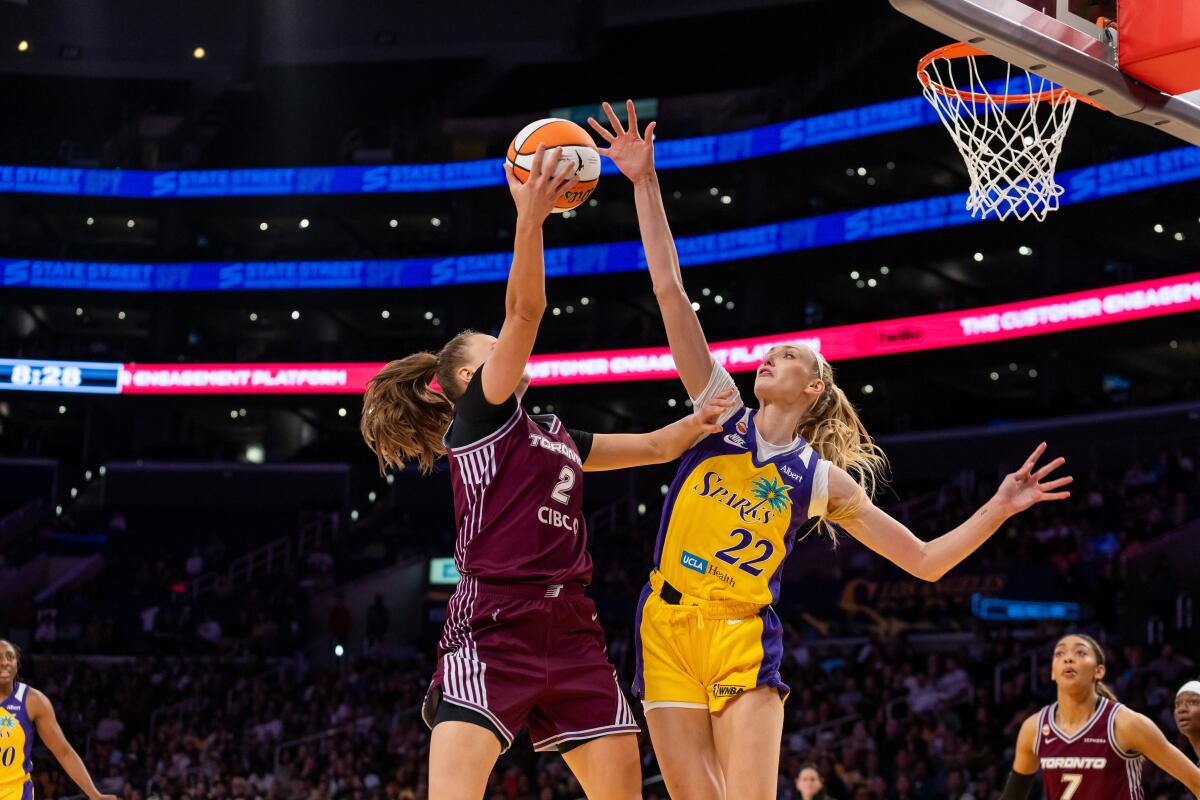
Sparks forward Cameron Brink blocks a shot from Toronto's Laura Juskaite during a game on May 15.

Sparks forward Cameron Brink blocks a shot from Toronto’s Laura Juskaite during a game on May 15.

(Jeff Lewis / Associated Press)

“Getting used to it as a player, kind of understanding the flow of the game, that’s probably the toughest part for me,” Atkins said. “There’s no real flow or like rhythm to it, right? I’m hoping that the corner turns or we both adjust on both sides.”

The Sparks’ pace is on track to be similar to last season at 97.67 — fifth in the WNBA — through nine games. Their offensive rating of 107.9 is eighth in the WNBA, but they’ve played half of their games without league-leading scorer Kelsey Plum.

Defensively, though, they haven’t made much of an adjustment. They have a league-worst 114.1 defensive rating.

Cameron Brink’s 4.0 fouls per game are the fifth most in the WNBA, and Atkins’ 3.6 also ranks among the bottom 10 players in the league. Plum is at 3.1 just below Atkins, Dearica Hamby isn’t far behind at 3.1 and Erica Wheeler is at 2.9, giving the Sparks the most players in the league in the bottom 30 on a single team.

“It’s hard, I think, on a defensive end, especially when you’re somebody that enjoys the physicality and you like to lean into it,” Hamby said.

The Sparks already had an uphill climb to improve on the league’s worst defense, but as they continue to adjust to the way games are being officiated, it’s all the more difficult.

Add it to the list of things the 4-6 squad needs to work on to climb back near the top of the WNBA.

“I try to not center officiating as a part of my experience,” Nneka Ogwumike said. “I know it’s part of the game, and something we can’t control, but I do think we can do better in our response to it.”

Source link

Kelsey Plum, Sparks leaders convinced free agents they can win now

The Sparks worked on building their 2026 roster long before the WNBA’s compressed free agency period tipped off.

Teams have had a little more than a week to prepare their training camp rosters between free agency, the league’s primary draft and an expansion draft. The Sparks have one of the more notable roster transformations in the league, adding Nneka Ogwumike, Erica Wheeler and Ariel Atkins.

On Sunday at the start of training camp in San Diego, Wheeler said Sparks returning guard Kelsey Plum sold her on the vision of the organization, and Ogwumike’s signing cemented it.

“KP played a big role in having me here,” she said, describing a lunch last season when Plum told Wheeler she wanted her to sign with the Sparks. “I think Nneka just was like the tip of the iceberg, like it was a no brainer. Once Nneka decides she wants to come here, because, as you know, president [of the WNBPA], life is always easier around her.

“We want to win the championship.”

Ogwumike’s return to Los Angeles was just one indicator that the Sparks are, as Wheeler put it, “going for gold.”

This year’s Sparks roster looks a lot more intentional than a couple of years ago. General manager Raegan Pebley said Atkins’ addition helps establish a deeper offense, while Rae Burrell playing at the three gives them more versatility.

There are still question marks. They don’t have a ton of ball-handling depth or much true-center play after Cameron Brink.

But Ogwumike has seen the changes internally and from afar, and she thinks the Sparks are ready to compete now.

“I didn’t actually want to leave, but I felt like I needed to, considering the growth that we wanted to see further in the organization, and I really wanted to come back,” she said. “… The timeline of a lot of things [in the offseason] accelerated, me narrowing down certain organizations, but L.A. was in the mix not because, not just because of the time that I’ve had here, but because of the amazing progress that I’ve seen in just the two years in my absence.”

Ogwumike said part of that was the investment in a practice facility, set to debut in 2027, and that the front office, led by Pebley, had a plan to build a winning team.

But the most important thing in bringing in the veteran trio was that the Sparks had a plan on the court, too.

“It’s really exciting when you can be in a place where everybody has the main thing being the main thing,” Atkins said. “And that’s not to say it wasn’t like that in the past, but it’s different when you have older players and vets around you that have done it before, because the way that they walk in, the way that they talk, there’s no uncertainty there, right? It’s like, this is how we need to get through, this is what we need to do, get it done so it really just be on us.”

Wheeler has only played in the WNBA postseason a handful of times between Indiana and Seattle and at 36 years old, she joined the Sparks led by coach Lynne Roberts with the intention of playing for a winner.

“I tell people all the time, I’m a businesswoman,” she said. “I have money. … So money don’t move me, [there] was a lot more money out there for me to go after. But I felt like Lynne is building a championship rock, and I want to be a part of that.”

Atkins was traded from Chicago for Rickea Jackson, a controversial move that shipped one of the best young players in the game away from the Sparks. On draft night, Pebley said the move helped them win games now and she reiterated that on Sunday.

“We were really aware of is that we were missing another counter punch with KP, she needed some support in terms of somebody that can take some pressure off of her, to have to score it, or to have to create for someone else to score it, that was a big reason of why Ariel, we feel, is a great fit,” she said. “And then Erica Wheeler is just a winner, and she’s going to bring some toughness and leadership there. So I think with those three at the one-two spot, we’re super excited about that.”

Atkins adds a defensive layer alongside Ogwumike for a team that was dead last in the WNBA in defensive points per game last season, and that’s one of those intentional, win-now kind of moves that has everyone in the organization excited.

The Sparks finished just two games out of a playoff spot last season. This year, expectations are far more than just finishing as a playoff team, and that messaging brought in one of the most cohesive rosters in the WNBA.

“I always say that the killer combination is investment and engagement, and so I’m seeing both at very high levels, and it permeates every aspect of the organization,” Ogwumike said. “Whether it’s basketball ops, front office, player experience, practice facility, it’s just something that I’ve always believed was our standard, and not only have we matched what our expectations were, but we’re now exceeding it in a timeline that I think is much faster than I ever expected.”

Source link