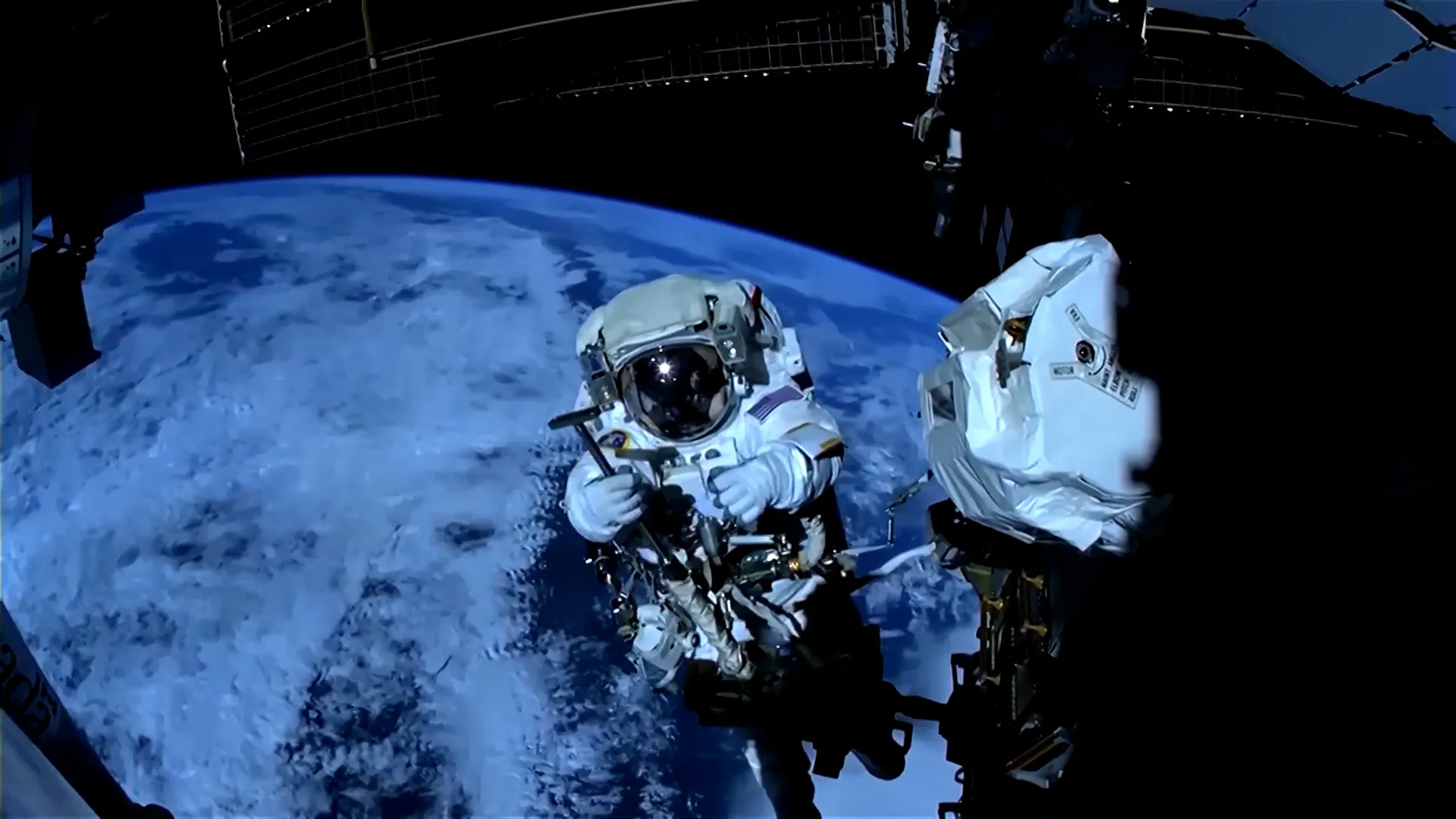
Footage shows two NASA astronauts stepping outside the International Space Station to replace a malfunctioning wrist joint on a robotic arm. The joint failed during normal operations and did not move as expected. It took 7 hours and 20 minutes.
The National Aeronautics and Space Administration, better known as NASA, has unveiled the crew for its upcoming Artemis III spaceflight, a preparatory mission as the United States plans to return to the Moon.
On Tuesday, it was revealed that astronauts Andre Douglas, Frank Rubio, Luca Parmitano and Randy Bresnik will be leading the flight. Serving as a backup is veteran test pilot Bob Heintz, who is able to substitute into any role.
Recommended Stories
list of 3 itemsend of list
Their two-week mission will focus on collecting research and practising in-space docking procedures in preparation for a future Moon landing.
While no women were named to the Artemis III flight, the newly announced crew represents a range of experiences and backgrounds.
Making his first spaceflight is Florida-born engineer Douglas, 40, who was a backup crew member for NASA’s last major spaceflight, Artemis II, which flew a loop around the Moon.
Douglas will serve as mission specialist on Artemis III, and his presence on the flight will make him one of roughly two dozen African American people to travel to space, out of a population of hundreds of space travellers so far.
Also serving as mission specialist will be Rubio, a 50-year-old Salvadoran American physician who used to pilot Black Hawk helicopters for the US Army. He currently holds the record for the longest single-duration spaceflight by a US astronaut, at 371 days.
The oldest member of the four-man crew is its 58-year-old commander, Bresnik. A former US Navy test pilot and Marine, Bresnik is the only Artemis III crew member to have participated in a space shuttle mission, back in 2009. That programme has since been retired.
More recently, in 2017, Bresnik served as the commander for the International Space Station.
The fourth and final member of the Artemis III mission is its pilot, Parmitano, 49. He will be the only astronaut on the mission who is not a US citizen.
Born in Paterno, Italy, Parmitano has a background in his country’s air force. In 2019, he too served as commander on board the International Space Station, becoming the first Italian to do so.
“ Each of you possess a unique background,” said NASA administrator Jared Isaacman, who introduced the astronauts. “Your vast experience and unwavering dedication to NASA’s mission enables you to help make us and take this next great step in space exploration.”
The Artemis III mission will be a public-private partnership. Three rockets will blast off as part of the initiative.
One will carry the four-man crew into orbit around Earth in an Orion spacecraft. Another two rockets will bear aloft Moon lander models from Blue Origin and SpaceX, private firms owned respectively by tech entrepreneurs Jeff Bezos and Elon Musk.
The Orion spacecraft will then practice rendezvous procedures with each of the two landers, in preparation for similar manoeuvres during future Moon missions. The Artemis III flight is set to take off before the end of 2027.
“Artemis III will be an extraordinary demonstration of what is possible when the greatest aerospace companies across the United States, alongside our European partners, come together to showcase the technological might and ambition of the free world,” said Isaacman, a Trump appointee who has experience commanding private space flights for SpaceX.
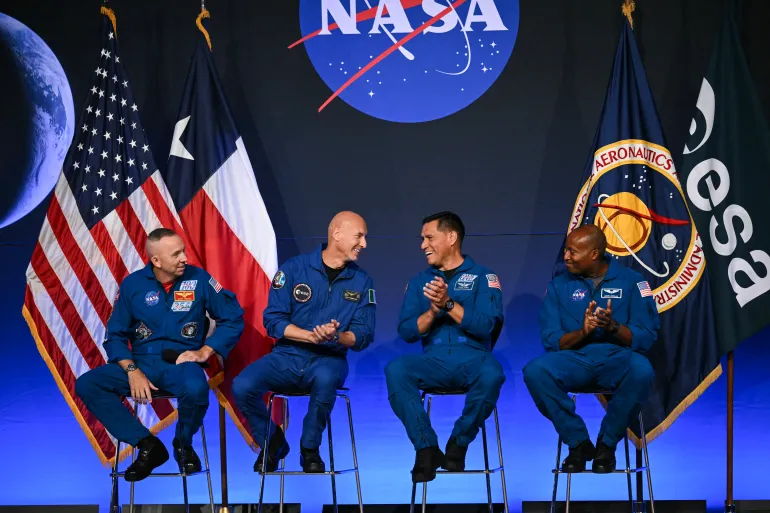
From left: Randy Bresnik, Luca Parmitano, Frank Rubio, and Andre Douglas speak during a news conference at NASA’s Johnson Space Center, on June 9, in Houston, Texas [AFP]
Explosion prompts concern
The mood at Tuesday’s unveiling ceremony was celebratory, as each newly announced astronaut took the stage to soaring music and standing ovations.
But looming over the event were concerns related to the explosion of an uncrewed Blue Origin New Glenn rocket in Florida on May 28.
That blast sent a mushroom cloud billowing above the city of Cape Canaveral, and it caused severe damage to a launchpad complex where the takeoff was scheduled.
Representatives from both NASA and Blue Origin, however, took the stage to wave aside any concerns.
“While we recognise there are questions about how Blue Origin’s recent anomaly impacts our plans, setbacks are a learning opportunity,” said Jeremy Parsons, NASA’s acting deputy administrator.
He added that NASA was taking an “active role” with its partners to “ensure the right outcomes are achieved”. The private firms, in turn, were granted “unparalleled access” to NASA experts, technology and test facilities.
“We are confident that New Glenn will be ready for Artemis III, together with Blue Origin,” Parsons said.
John Couluris, a representative for Blue Origin, likewise described the May 28 explosion as an “anomaly”.
“We’ve redoubled our efforts and are moving forward,” Couluris said, describing Blue Origin’s factories as “running around-the-clock shifts” to be ready for the Artemis III launch.
“We will measure ourselves not only by our successes but how we respond to setbacks.”
The Artemis II mission in April made a loop around the Moon, capturing images of Earth [File: NASA via AP Photo]
Race to the Moon
The race to beat China’s space programme was another theme that cropped up during Monday’s ceremony.
Several speakers alluded to China’s growing lunar landing programme, a rival to NASA’s efforts.
Earlier this year, the China Manned Space Agency announced its intentions to place a person on the Moon by 2030. Already, in 2024, China became the first country to retrieve soil samples from the far side of the Moon using robotics.
But lunar missions have been a point of pride for the US, which holds the distinction of completing the first crewed mission to the Moon in 1969.
Last April, the Artemis II flight marked the US’s return to lunar travel. For the first time since 1972, a crewed capsule flew beyond low Earth orbit, and it broke records for the farthest crewed flight into space.
Next year’s Artemis III mission is set to build on that effort. The administration of US President Donald Trump has signalled it would like to see astronauts land on the Moon before the Republican leader’s term ends in January 2029.
NASA officials have also described the Artemis programme as a stepping stone to establishing a permanent base on the Moon. Various speakers on Monday highlighted that vision.
Couluris, the Blue Origin representative, called the Moon an “eighth continent” for humans to explore.
NASA scientist Nicky Fox, meanwhile, described the Artemis III mission as part of the preparatory work that would enable the US “to plant astronaut boots back on the lunar surface — to stay”.
But the US’s lunar programme has faced numerous setbacks, as NASA engineers work to address technical issues that could otherwise cause life-threatening situations in deep space.
Originally, Artemis III was supposed to mark the US’s return to the Moon, bearing a crew to the lunar surface. But in February, that plan was scrapped in favour of the present-day project, which focuses on conducting practice drills in low Earth orbit.
“We will use this mission to reduce risk for our future crewed Moon missions with lander test articles from both Blue Origin and SpaceX, to ensure we will beat China back to the Moon,” Parsons said on Tuesday.
“This mission is deliberately designed to take calculated risks so that future crews will be safer and ultimately successful when we put boots on the lunar surface.”
Still, officials applauded Artemis III as a major step towards human beings reaching the Moon once more.
In a recorded statement, Senator Ted Cruz suggested that the Artemis III mission would also put the US a step ahead of China.
“At a time of growing competition with China in space, this mission will strengthen America’s leadership, expand our economy, and help secure a lasting American lunar presence,” he said.
“When America commits to a mission, we lead and we succeed.”