A World Cup referee shares his view of red cards, hydration breaks
“So close to glory.”
That’s how Iván Barton described the moment he heard his last name called during the 2026 World Cup referee assignment meeting. It wasn’t to ask a question or to correct some administrative detail.
The next sentence changed his career forever: “Barton, your match is France vs. Spain. … After that, I didn’t hear anything else. I didn’t even know who my assistant referees would be.” The World Cup semifinal — one of the biggest matches a referee can officiate — had just been entrusted to the Salvadoran.
“It’s like going into shock, but a good kind of shock. ‘This is happening — it’s really happening.’ Reaching a semifinal is coming within a hair’s breadth of glory, because after a World Cup final, there’s nothing left,” Barton said.

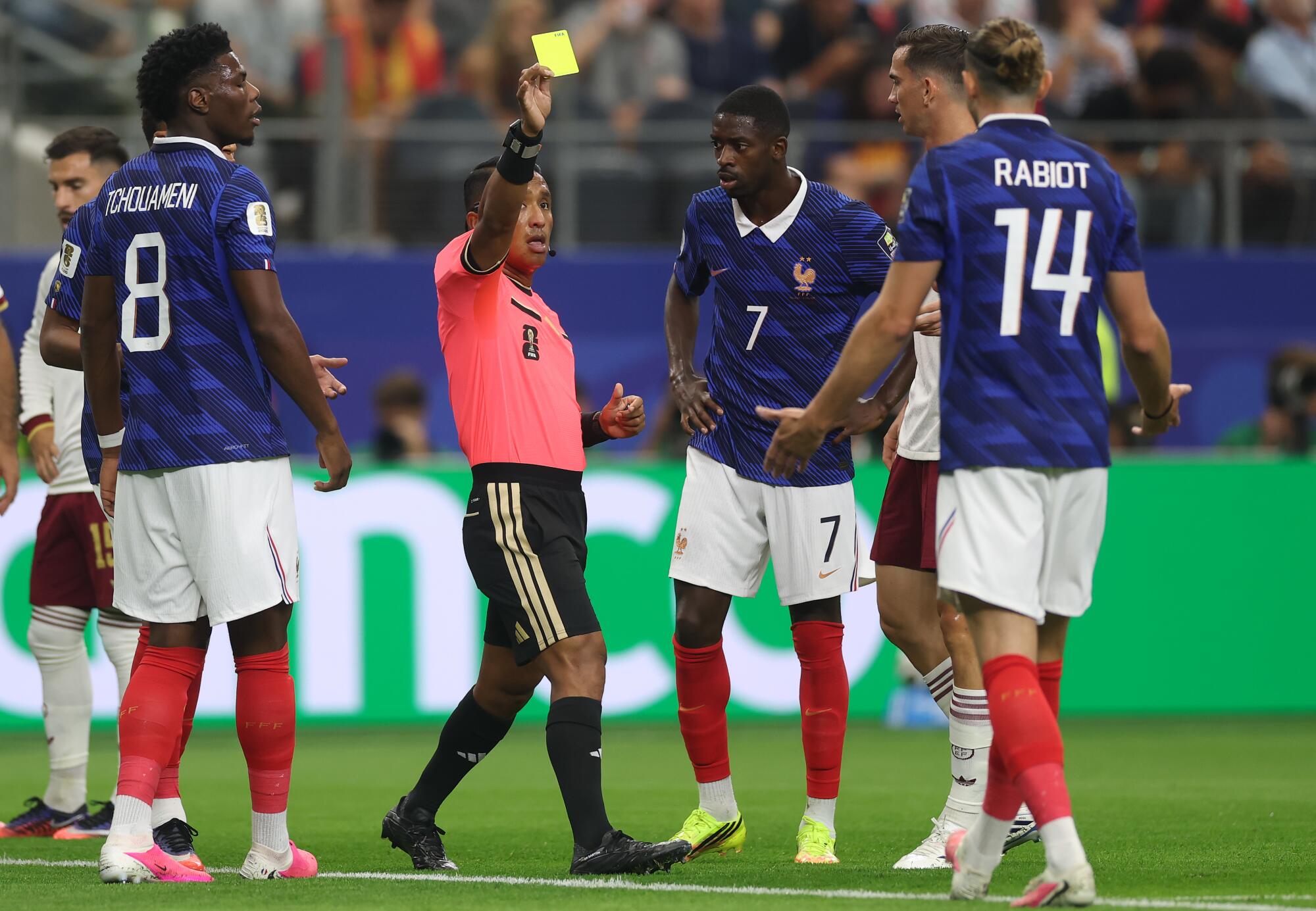
Referee Iván Barton issues a yellow card to France’s Adrien Rabiot during a World Cup semifinal match against Spain on July 14 in Arlington, Texas.
(Lars Baron / Getty Images)
There’s one detail in that scene that captures the magnitude of the moment. While waiting for the meeting to begin, Barton was checking the airline’s app on his phone. His ticket was still scheduled for a return flight to El Salvador the next day. He had already started packing, convinced that his World Cup was over.
“I was already mentally preparing to fly back to El Salvador the next day,” Barton recalled. “When I heard ‘Barton,’ I thought, ‘What happened?’ Then they said, ‘Spain vs. France, semifinal.’ I didn’t even hear the names of my assistants.”
The first thing he did after that was call his wife.
“That’s when the tears of joy came,” he said. “It was also a moment to thank God for what was happening and immediately start preparing for the match.”
For the first time, both World Cup semifinal matches were officiated by CONCACAF referees. Barton officiated the France-Spain match, while American Ismail Elfath refereed the England-Argentina match. The confederation described both appointments as an unprecedented event for the region.
Barton said he fulfilled a dream working during the 2022 World Cup in Qatar, but he and other CONCACAF referees were determined to show their ability to call the most important games.
“Qatar meant making a dream come true. Making it to 2026 was a huge challenge because the bar had been set very high,” Barton said. “There were high expectations. We approached it with a great sense of responsibility and humility.”
When the tournament ended, the feeling was different from that of his first World Cup.
“I feel happy, very proud to have placed our little El Salvador flag practically at the very top of world soccer,” he said. “That’s what fills me with the most pride. We continue to open doors not only for my country, but also for the entire region and for CONCACAF refereeing.”
The red card that made history
Among the four matches Barton officiated, the Turkey-Paraguay game went down in history at the 45+3-minute mark.
During a confrontation between Miguel Almirón and Turkey’s Mert Muldur, the Paraguayan star covered his mouth while speaking aggressively to his opponent.
Barton had to review the play via VAR, and as stipulated by the new amendment to Law 12, the incident resulted in a red card, since the situation had elements of confrontation and the gesture served to conceal provocative, derogatory or inflammatory communication.
The review confirmed his interpretation.

Referee Iván Barton issues a red card to Miguel Almirón for covering his mouth while confronting another player during a World Cup match.
(Dean Mouhtaropoulos / Getty Images)
Almirón became the first player sent off in a World Cup under this new provision.
For Barton, however, the story isn’t simply about a player covering his mouth.
“People get confused. It’s not just the act of doing it; it’s doing it in a confrontational situation against an opponent. That’s what changes the picture,” Barton explained.
Clarity is important.
The amendment aims to prevent players from hiding insults or other abuse — including discriminatory remarks — behind their hand, arm or jersey.
In Almirón’s case, Barton believed the conditions were met.
“In that match, it was clear that it had occurred during a confrontational situation in which the players were facing off,” Barton explained. “Seeing it on the VAR footage was clear. It was evident, and at no point was there any doubt about the decision that had to be made.”
The incident occurred shortly before halftime, when Paraguay was leading 1-0. The red card left Paraguay with 10 players for the entire second half, but the team went on to win the match 1-0.
For Barton, the red card illustrates something he believes the public still misunderstands: VAR does not eliminate the need for the referee to interpret the rules.
“VAR isn’t there to eliminate 100% of errors,” he said. “Errors will always be part of soccer because there are many issues open to interpretation, and that’s what the referee is there for — to interpret them.”
Breaks that changed the pace of the matches
There was another major change fans protested during the World Cup — the hydration breaks.
FIFA decided that during the 2026 World Cup, there would be a three-minute break midway through each half, regardless of the temperature or stadium conditions. The referee was required to stop the match around the 22nd minute of each half.
The decision was motivated by concerns about player welfare in some of the hottest venues and a committee agreed it would be best to use the breaks universally rather than whenever the weather conditions required it to assure no teams were hampered by not getting breaks, but the debate did not go away.
In some cases, the breaks interrupted the flow of the game just as a team was starting to take control.
Barton understands that criticism, but he also doesn’t believe the break necessarily has a favorable or unfavorable effect on a team.
“Team A is attacking, attacking, attacking Team B. Obviously, it won’t be beneficial for Team A because they’re at their peak. For Team B, it will be,” he said.
The scenario can change in the second half.
“And what if, in the second half, the roles are reversed and it’s Team B that’s attacking Team A? For Team A, it’ll be beneficial. It’s very relative. I don’t think you can generalize whether it’s positive or not because it depends on the circumstances of the game.”
There’s also a difference between analyzing the break from the spectator’s perspective and doing so from the field.
As a referee, Barton found an immediate benefit.
“For us as referees, it’s beneficial because having a break to rest a bit, regain our strength and get feedback from our colleagues to see if anything needs adjusting — well, of course that’s positive,” said Barton. “In the United States, summers are extreme and it often becomes very difficult to say, ‘In this game, yes; in this game, no,’ because that undermines the consistency that the application of a rule must have.”
The stars’ last names don’t change the rule
What happens when the player who needs to be disciplined is named Kylian Mbappé, Lionel Messi, Lamine Yamal or James Rodríguez?
In a stadium, those names carry weight. On the lineup sheet, according to Barton, they don’t.
“As a referee — contrary to what many people might think — you detach yourself from many situations, from the noise, from the pressure,” he said.
That doesn’t mean the referee is unaware of who’s on the field. According to him, it means he can’t let a player’s name influence his decision.
“On the field, there are no big names, no big teams. You see 11 players against 11 players,” Barton said.
The Salvadoran had already officiated games featuring Messi during his career in various tournaments and at the 2026 World Cup, he faced some of the most renowned soccer players on the planet.
“At no point do we think, ‘I’m not going to speak to him firmly or show him a card because it’s this player.’ No, absolutely not,” Barton stated.
The rules must apply equally to everyone.
“If you see an incident, a foul or something someone did, you make a decision regardless of who it is,” Barton said.
Barton explains the relationship in a way that makes it clear it’s not about ignoring the players’ status in the sport. It’s about understanding that, for those 90 minutes, roles are clearly defined.
“Obviously, we respect them for what they’ve achieved, for what they represent in soccer, but when it comes to applying the rules of the game, we see 11 players against 11 players — and that’s it,” he said.
Taking El Salvador to the biggest stage
Barton speaks little about himself and a lot about his country. Every assignment, he explains, ceases to be an individual endeavor.
“The higher you climb a mountain, the stronger the wind blows. The harder it is to maintain your balance,” he said.
His philosophy has changed little since he began his career.
“I haven’t achieved these things on my own. There’s a huge team behind me. … My family, CONCACAF, FIFA, the people who have always supported me,” Barton said.
The Salvadoran acknowledges that, during international competitions, he often finds that there are still people who don’t even know where El Salvador is located.
“When you get to competitions at this level, there are people who can’t even locate our country on a map,” Barton noted. “Serving as a means for others to learn about El Salvador and ensuring that representation is dignified is one of my greatest responsibilities.”
There’s a common perception among fans that FIFA assigns the matches each referee will officiate from the very beginning of the tournament.
Instead, each assignment depends on the performance shown during the previous match.

France captain Kylian Mbappe and Spain captain Rodri pose with referee Iván Barton and match officials before a World Cup semifinal.
(Florencia Tan Jun / Getty Images)
“First, you have to earn a spot in the World Cup. Then you have to earn the privilege of officiating a match. And after that, it depends entirely on how you perform in that match,” Barton said. “It’s just like the teams. No one is guaranteed to advance. Game by game, you prove whether you deserve to stay in the competition.”
After each match, there are technical sessions during which every major match decision is analyzed.
“We have debriefing sessions to review what we did well and what we need to improve,” he said. “We also work with a technical staff that conducts tactical analyses of the teams to prepare for the different scenarios a match might present.”
Although the semifinal against France and Spain holds a special place in his heart, Barton recalls other World Cup moments that will likely stay with him forever.
“The four walkouts before the matches were impressive. Hearing the World Cup anthem and walking out of the tunnel was always special,” he said.
“When the final whistle blew in the semifinal, I felt like I’d written my name into soccer history by representing my country. It was one of the most sublime moments of my career.”
Unlike many public figures, Barton decided to stay virtually off social media before and during the World Cup.
“Our minds are what we choose to feed them. If we feed them garbage, we’ll end up thinking that way,” he said.
Barton only opened official accounts after the tournament — and, according to him, not out of personal interest.
“There were too many fake profiles impersonating me,” Barton said. “I’m not swayed by flattery, just as I’m not affected by insults. … I’ve faced the most attacks in my own country, not abroad,” Barton confessed.
Even so, he insists on always responding with the same message.
“Behind the referee is a human being. There’s a father, a husband, a son,” he said. “It’s fine to criticize the work, but don’t cross the line into personal attacks.”