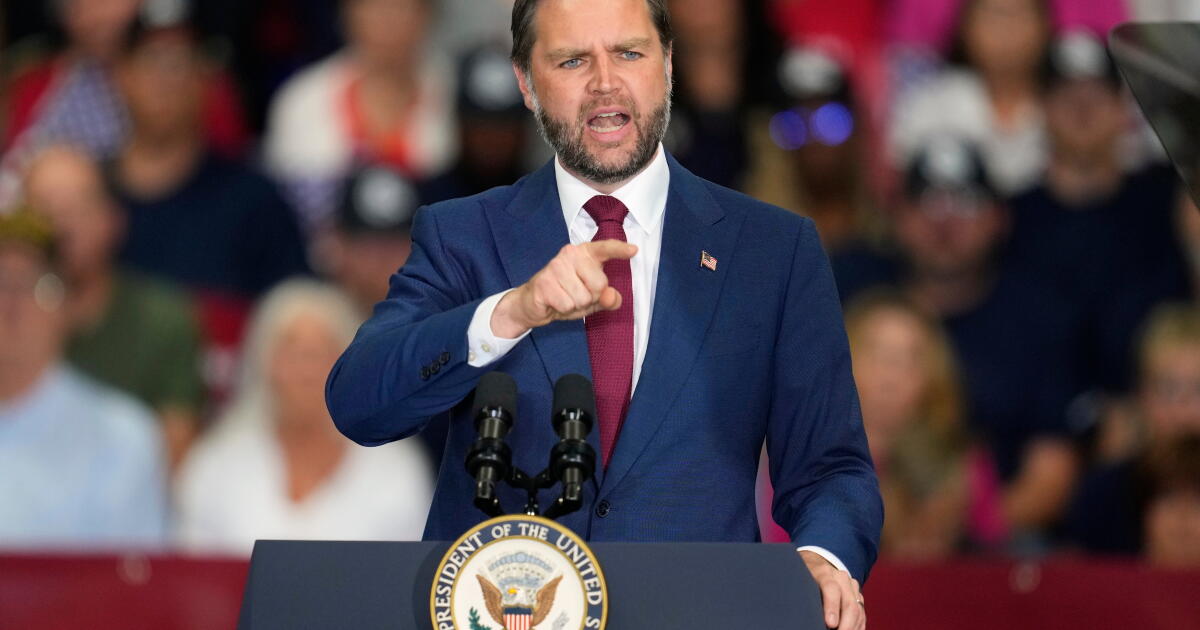
Vance talks about the end times and the attempted assassination of Trump in Christian podcast
Vice President JD Vance said in a podcast released Tuesday that if a 2024 assassination attempt had killed Donald Trump, he would have always wondered if it was part of a conspiracy and might not have accepted even another Republican as the next president.
Vance made the statement during a conversation with Christian podcaster Bryce Crawford. The vice president, who recently released a book detailing his own journey to Catholicism, also defended President Trump for posting an image of himself as Jesus and mused about whether artificial intelligence was a sign of the end times.
The conversation kicked off with a discussion of faith and the rush to scientifically explain away events that may be divinely touched. Vance cited the July 2024 assassination attempt in Butler, Pennsylvania, during which a bullet nicked Trump’s ear and a supporter was killed.
Trump has long talked about his survival as divinely guided, a theme Vance took up. The vice president said that if the bullet had killed Trump, “we would have had real civil strife in a way that I don’t know that the country could have ever come back from.”
Vance said many Trump supporters would have assumed a conspiracy had robbed them of their chosen president, and he said he would have also had those thoughts “in the back of my mind.”
“I would have assumed very dark forces had taken out Donald Trump, right as he was about to come back into the White House,” Vance said. “There would have just been an illegitimacy to our entire political system.”
Most of the hour-and-ten-minute conversation was an amiable chat about faith, Vance’s own spiritual journey, his Easter meeting with Pope Francis the day before the pontiff’s death last year, and human frailty and fallibility. But it occasionally touched on darker themes.
Crawford asked Vance whether, as vice president, he had ever been in a room that was “spiritually dark.”
“I’ve been in meetings with world leaders where various issues are being discussed, and somebody will say something or somebody will make an observation and I’ll feel some darkness about it, it sets off every spiritual alarm bell in my body,” Vance said. He added he also felt “a very dark spiritual energy” in Gettysburg, Pennsylvania, probably because of the carnage at the Civil War battlefield.
Vance cites AI during a discussion about ‘end times’
Crawford also asked Vance about his interest in the “end times,” which the vice president laughingly said had been more of an obsession in youth during the late 1990s, when people were abuzz about the possibility with the coming millennium. A chortling Vance recounted a story of a friend who was obsessed that the world would end in late 2007 and ran up major credit card debt.
“There are, like, things about the world that make me feel, like, not shocked if the Antichrist was walking among us, but, again I try not to focus too much on it,” Vance said. He cited “IT companies” and the use of artificial intelligence as a substitute for human interaction.
“I think that’s kind of satanic,” Crawford said when Vance recounted the story of one acquaintance using AI as a marriage counselor.
“Yeah, when you completely divorce the human from the social element that God made us for, OK that’s very, that’s very bad,” Vance said.
Crawford asked Vance about Trump’s post on social media of an AI-generated image of himself as Jesus earlier this year, which Crawford said offended him. Trump initially contended he thought the image was of him as a doctor, then took down the post amid widespread criticism from even some of his own backers.
Vance defended the president. “He did not mean to, like, mock or mimic God, that’s just not who he is,” Vance said, adding that the president often tries to keep things light and constantly makes jokes. “He’s a bit of a ballbuster, for those of us who work with him, and he just likes to have a good time. And I think that if people appreciated that, they would recognize, he’s not trying to offend people, he’s trying to keep things light.”
Riccardi writes for the Associated Press.