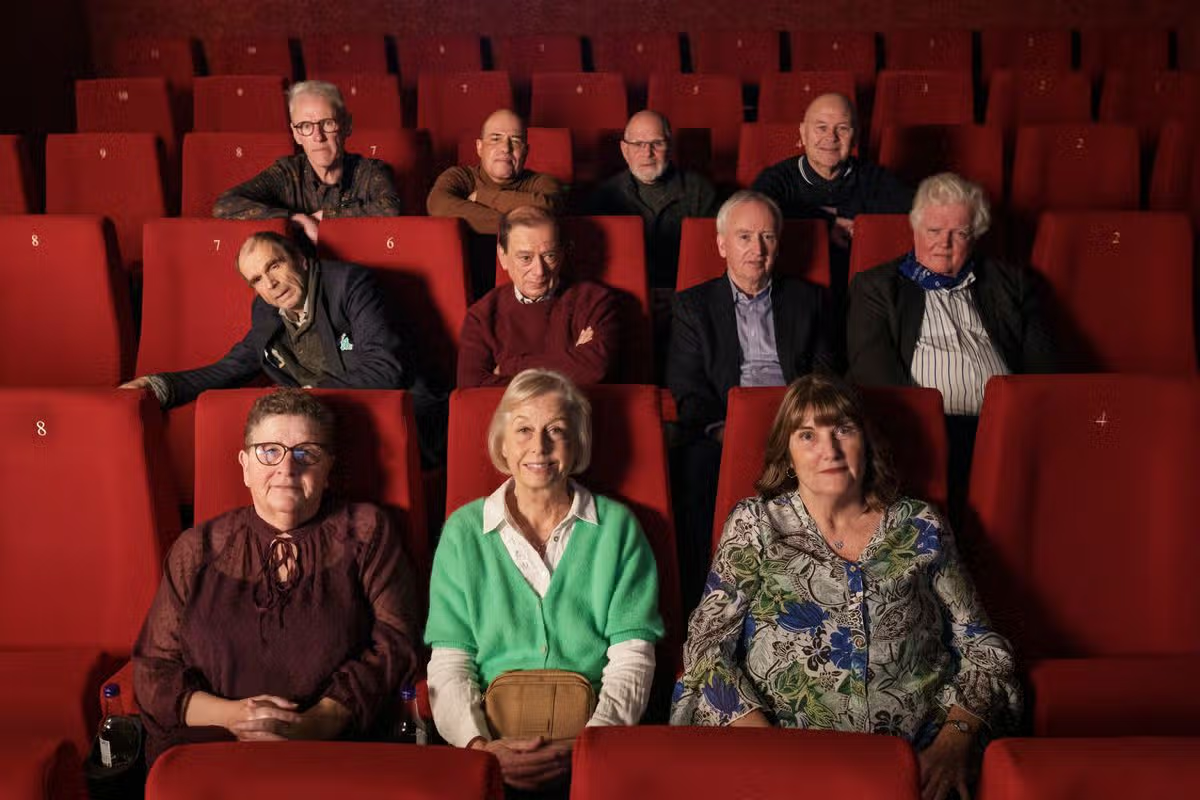
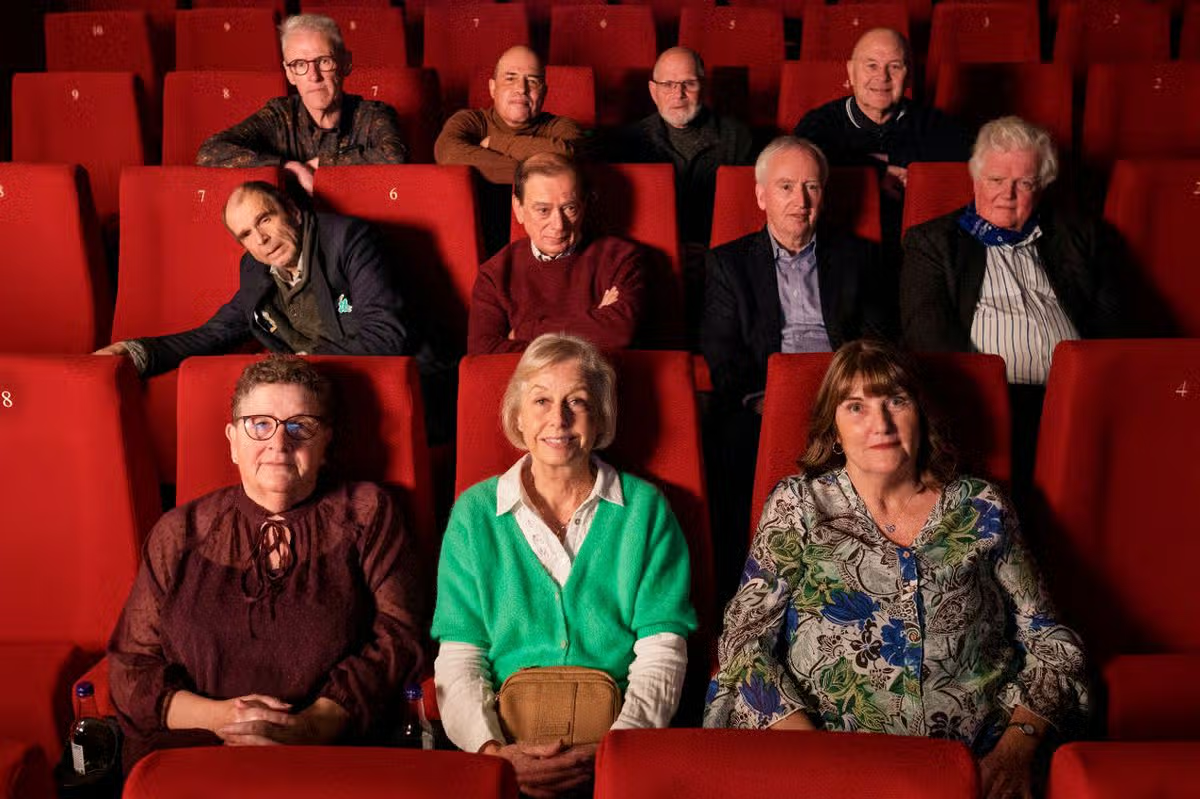
The original 7 Up kids have returned for one final series of the groundbreaking social experiment.
70 Up is coming to an end (Image: Nick Wall/ITV)
70 Up viewers have shared their reaction to the series coming to an end, as the groundbreaking social experiment reaches its final chapter.
14 children, consisting of ten schoolboys and four little girls, gave cameras an insight into their lives back in 1964. Every seven years since, they’ve continued to show a glimpse of their story, from education, their early careers, marriages, raising children and retirement.
ITV has now returned one final time, for 70 Up. The synopsis previously teased: “Seven decades. One extraordinary experiment. The groundbreaking documentary series returns to meet the people we first saw as 7-year-olds as they reflect on life at 70.”
As well as several of the original children returning, now in their 70s, the programme paid tribute to two who have died, Nick and Lynn, and features Charles, who stopped taking part in the franchise from his 20s.
Viewers have admitted they found the series “heartbreaking”, as one person said: “I’m bawling already knowing Nick is no longer with us.” Another agreed, saying: “I’ve watched this all my life, makes me sad and reflective I’m the same age.”
Someone else wrote: “I admit to having shed a few tears, watching tonight. I’ve grown up with them. It’s been wonderful.” Another commented: “Absolutely, life’s ups and downs, at 7 full of hope and life, I feel i know these people, I don’t.”
Someone else said: “All of it is making me very emotional. In the blink of an eye, hopes and aspirations are just distant memories and time has run out. Life is over so very quickly . Too quickly.”
Another said: “I hope you’re watching seventy Up It’s heartbreaking.” Another added: “The sadness in watching #70UP is not only the lives drawing to a close and the challenges facing individuals but also the knowledge that television will never again be this ambitious.”
One person added: “Ah even a glimpse of Neil on #70UP bring the tears, watched religiously with mum and dad growing up, comparing, dreaming, crying, feel so blessed watching but also wish these were longer eps, I could watch for hours more…. this programme was a huge part of how I learned about life and my country.”
Several others called Neil’s journey heartbreaking and sad, after he opened up about his loneliness and being homeless at times in his life, candidly sharing his struggles. One person said: “I’ve watched all of these series from the get go even though I’m no where near their age group, just to add! It’s made me feel quite reflective on my own life, quite emotional really. But watching Neil’s story has flawed me, big time! His loneliness is a hard watch.”
Another echoed: “Watching #70Up. Neil breaks my heart every 7 years. He was such a happy little boy.” Yet another wrote: “Ooh that was a hard watch at times.” One person added: “I was in tears even from the opening titles Such a touching and interesting series.”
Ahead of the series airing, Jo Clinton-Davis, controller of factual ITV and commissioner of 70 Up, said: “The 7 Up story is much more than a TV documentary, it’s a document of our times. A truly distinctive landmark piece of film-making that has become part of our cultural fabric.
“In the evolving stories of our cast we see the universal themes of life play out. It is the series that made me want to get into television. It is the series that I am beyond proud of having been involved in since 56 Up. It is a tribute to Michael Apted who will forever be associated with it and to the continued dedication and remarkable skill of Claire Lewis.
“Yet in Asif Kapadia we have an outstanding director who will bring his passion, creativity and incredible flair whilst safeguarding the very precious ‘Up’ legacy. Ultimately, this is a tribute to the courage of all the cast who continue to share their lives with us so we can see our lives in them.”
EXCLUSIVE: There were arguments aplenty and several walkouts – but Jackie Bassett and Peter Davies say they’d still do it all over again, given the choice
00:09, 07 Sep 2026Updated 07:30, 07 Sep 2026
The final emotional episodes go back over the lives of all of the contributors, since 1964(Image: Nick Wall)
In 1964, 14 children aged seven were plucked from obscurity to take part in the TV experiment Seven Up!, which would follow them every seven years to see how their different starts in life would affect them.
The nation has long been fascinated by these kids, who have now (mostly) reached the grand age of 70. Two of them have died, along with the show’s long-term director Michael Apted, who went on to have a career making films in Hollywood.
Two of the most outspoken were Jackie Bassett and Peter Davies – and both say that, despite everything they didn’t like over the decades, they’d do it all again.
Left-wing Peter, from Liverpool, was working as a teacher at a comprehensive in 1984 when 28 Up aired. He was vilified by the right-wing press for calling the Thatcher government “the most incompetent, uncaring bloody shower we’ve ever had” and pulled out for many years after that, not returning until 56 Up, when he realised it was a good way to promote the music he was releasing.
“I think for a long time I felt cynical about the programme and the way in which individual stories were shaped,” he says now. “I’m thinking particularly back to when I did 28 Up – I think one of the headlines was, ‘Would you let this man teach your children?’
“At the time I was quite shocked because I’d never experienced anything like that – the sheer level of vitriol involved in some of the comments. I was quite taken aback.”
He held Michael partly responsible for the way in which he was portrayed. “I actually spoke to Michael and said, ‘You know, you’ve really condensed me there almost to a caricature – the angry young man from the North of England.’”
But “on balance” he’d still do it all again, because of how it turned out. “It’s not a decision I’d have taken lightly because there has been a downside as well.” This downside, in turns out, is the fame that the show has inevitably brought the participants. “I’ve found that intrusion difficult at times,” he admits.
Jackie has now left Scotland, where she brought up her three sons, and moved to the Norfolk coast. “I love my children, I love my grandchildren, but it was time for me to have a life and that’s what I’m doing now,” she declares. “It only took me 65 years to get there, but I’m finally pleasing myself.” She agrees that sometimes the public’s reaction to the show can feel a bit much. “The thing is, they see you for 15 minutes on that screen and suddenly believe they know everything about you. And that’s ridiculous, as most normal people would understand.”
Peter feels the show’s aim of showing the class system evolved into “something much bigger” but still didn’t explore certain areas enough. “I think something they missed was the emergence of a new lower middle class perhaps – people like myself whose parents were working class, but who were able, by virtue of a properly resourced welfare state and state education system, to move out of that background, go to university, change our lives.”
Prior to film-maker Michael’s death in 2021, Jackie enjoyed sometimes putting him in his place, famously challenging him on camera in 2005 for asking the women about marriage and children rather than anything else.
Later, she would point blank refuse to speak about certain topics. “He never saw us, never had contact with us. So he’d come back from America to do a film with me, or Peter, or whoever, and he just sat down and started throwing questions at you. And sometimes he didn’t like the fact that we didn’t want to answer them. I was not going to talk about something that would affect my family, my children – so I basically just told him no. He didn’t like it, but there wasn’t much he could do about it.”
That said, she also had warm feelings for him, and knew he gave her opportunities she wouldn’t otherwise have had. “I probably would do it all over again yes,” she confesses. “Because Michael opened up a whole different world to me with the screenings of his films and things like that. Obviously there’s points on the programme that I’ve not enjoyed, usually because I sort of opened my mouth without engaging my brain, but I think I would do it.”
She thinks it was outrageous to only have four girls alongside ten boys – comprised of herself and two friends Lynn and Sue, all from the same primary school in working class East London, along with solo upper-class Suzy, who liked ballet and thought she’d probably hire a nanny one day.
“The quote wasn’t ‘show me the boy and I’ll give you the man,’ it just says ‘give me the child at seven’,” Jackie points out. “I think it was partly because at that time women were mostly at home looking after children. Women didn’t have careers – you may have had one or two, but they were few and far between. It was just, ‘well, we’ll keep it to a minimum because they’re not going to go very far and they’re not going to do very much.’ But they knew they made a mistake. They really did.”
Peter says Michael actually admitted he’d got that wrong. “It was outrageously sexist, but this was the early 60s and people behaved in outrageously sexist ways all the time.”
They have not yet seen the final films and know that watching themselves for a final time is going to feel emotional. “I’ve been told to take plenty of tissues. I have no idea what to expect, and it’s probably going to feel strange,” Jackie says. Peter believes it will be “momentous”, reasoning: “It’s just the culmination of so much, isn’t it?”
The pair of them enormously enjoyed making the double-bill 70Up finale, with new director Asif Kapadia. “I think it had become a little formulaic,” Peter says. “So having someone new on board was going to shake things up a bit. And I think he did. Some of the questions he asked were difficult to answer, but they were interesting and made me work a bit harder.”
Jackie concurs. “I’ll second that. I think it had got very staid and in its box, and Asif came in like a breath of fresh air. It was far more relaxed, nowhere near as formal. I think it actually should have worked pretty well, fingers crossed.”
They feel that now is the right time to pull the plug. “The last thing we want is us all walking in with Zimmer frames or in wheelchairs or whatever age does to us. I think it’s very appropriate to end on 70,” Jackie says., laughing: “I have no idea why it fascinates people, not really.”
“It can’t go on forever,” Peter agrees. “Two of the cast members have gone, Michael’s gone. So yeah, this feels like the right time to end it.”
Seven Up! launched in 1964 with 14 participants – 10 boys and four girls – picked to represent different elements of the UK’s class structure. They are:
Andrew Brackfield – Upper class schoolboy who read the Financial Times aged 7, went to Oxford and became a solicitor
Bruce Balden – Schoolteacher who attended a prestigious boarding school and wanted to be a missionary
Charles Furneaux – Kensington prep school boy who became a documentary producer and left after 21 Up, returns this time – but only in audio
Jackie Bassett – Working class schoolgirl from East London who moved to Scotland and had three sons
John Brisby – Upper class schoolboy whose father died when he was nine, he became a barrister and is angry over his portrayal
Lynn Johnson – Jackie and Sue’s friend Lynn died from a brain condition in 2013. She thought she would work in Woolworths but was a children’s librarian
Nick Hitchon – Yorkshire farm boy who became a nuclear scientist and moved to the US in 1982. He is featured despite his death, from throat cancer, in 2023
Paul Kligerman – A carehome resident who moved to Australia and settled in to family life
Peter Davies – A middle-class lawyer and musician from Liverpool who dropped out after 28 Up but returned for 56 Up
Neil Hughes – Peter’s classmate, wanted to be an astronaut but became a local politician and preacher and has experienced homelessness
Sue Davis – Jackie’s schoolfriend who was a single mum in 42 Up and became a university administrator who has remarried
Suzy Lusk– Upper class schoolgirl who dropped out of education at 16 and later became a bereavement counsellor
Symon Basterfield – Brought up in a Barnardo’s children’s home, he has fostered more than 120 children.
Tony Walker – Working class “cheeky chappie” from Essex who dreamed of being a jockey but became a London cabbie.
– 70 Up: The Final Chapter, 15 & 22 September, 9pm, ITV and ITVX