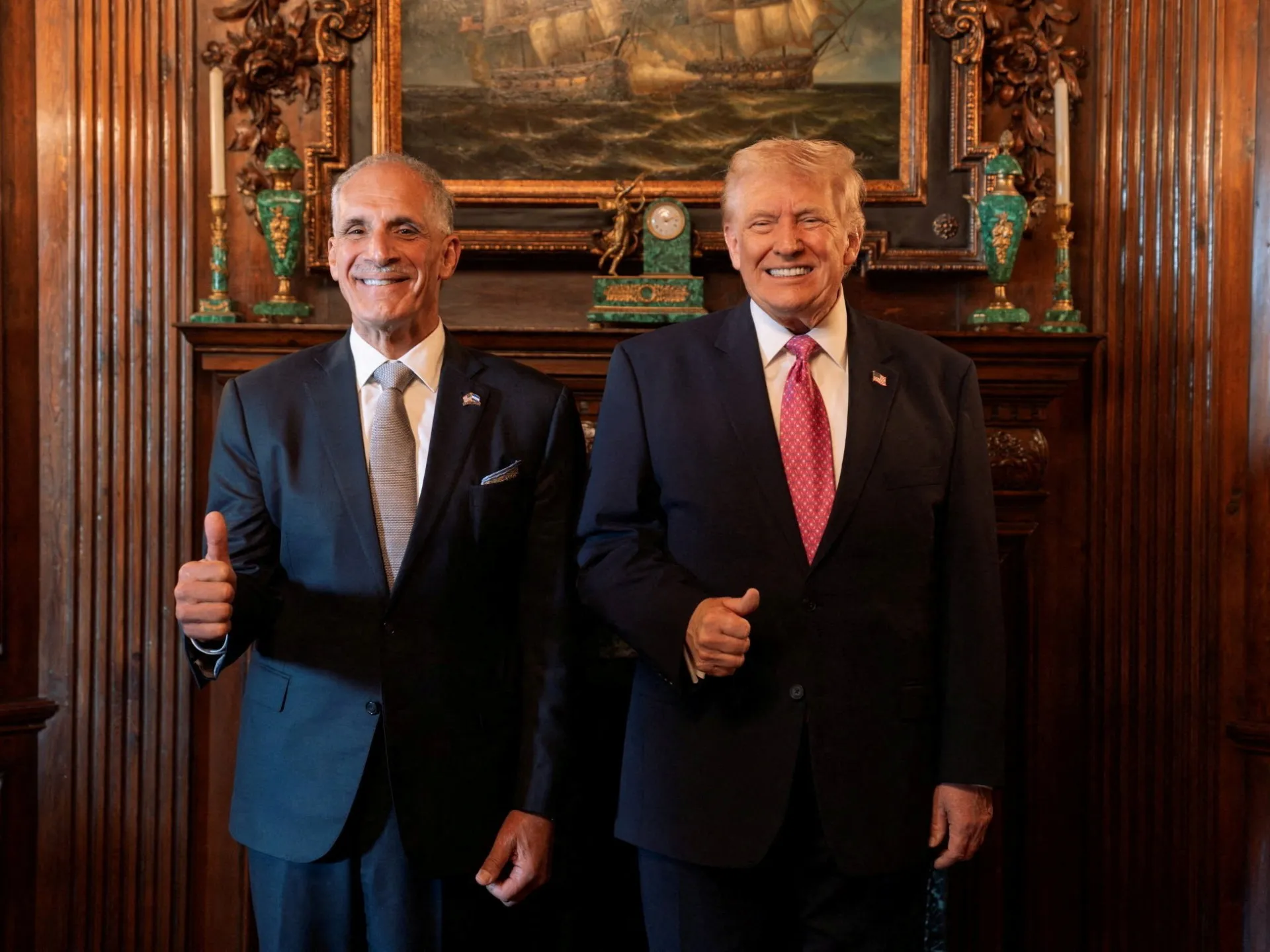
asfura

Marco Rubio congratulates Honduran President-elect Nasry Asfura | Elections News

Washington’s top diplomat says he thanked Asfura, who was backed by Trump, for ‘advocacy of US strategic objectives’.

United States Secretary of State Marco Rubio has congratulated Honduran President-elect Nasry Asfura, whom President Donald Trump had endorsed, for his victory in the Central American country’s contentious election.

The Department of State said on Friday that Rubio and Asfura in a phone call discussed collaboration on issues such as trade and security.

Recommended Stories

list of 3 itemsend of list

“Secretary Rubio commended President-Elect Asfura for his advocacy of US strategic objectives, including advancing our bilateral and regional security cooperation, and strengthening economic ties between our two countries,” the State Department said in a statement.

Asfura claimed a narrow victory on Wednesday in the November 30 election marked by Trump’s intervention on his behalf. Election authorities declared Asfura the winner after weeks of counting amid high tensions and allegations of fraud and impropriety from other candidates.

The right-wing Asfura, representing the National Party, edged out Salvador Nasralla of the centre-right Liberal Party with 40.27 percent of the vote to Nasralla’s 39.53 percent.

“Today, with deep gratitude, I accept the honour of being able to work for you. I extend my hand so we can walk together with determination to work tirelessly for Honduras. I will not fail you,” Asfura said in a video statement released on Wednesday night.

Both Nasralla and Rixi Moncada, the candidate for current President Xiomara Castro’s left-leaning LIBRE Party, who came in a distant third, have disputed the results of the election.

Nasralla said on Wednesday that election authorities had “betrayed the Honduran people”. He also took aim at Trump, who said before the election that a victory for anyone but Asfura would put US economic ties with Honduras at risk.

“Mr President, your endorsed candidate in Honduras is complicit in silencing the votes of our citizens,” Nasralla said in a social media post. “If he is truly worthy of your backing, if his hands are clean, if he has nothing to fear, then why doesn’t he allow for every vote to be counted?”

Honduras has experienced several contested elections since a US-backed coup in 2009. Protests over the November election have thus far remained peaceful.

Before the election, Trump also issued a criticised pardon for right-wing former Honduran President Juan Orlando Hernandez, who was convicted of crimes linked to the trafficking of drugs to the US during his time in office.

The pardon came as the US says it is shifting its foreign policy focus to the Americas.

Asfura, the former mayor of Honduras’s capital, Tegucigalpa, is of Palestinian descent. But his National Party is staunchly pro-Israel.

Under Hernandez in 2021, Honduras became only the fourth country to move its embassy in Israel to Jerusalem in breach of international law.

Asfura has also aligned himself with Trump and other right-wing leaders in the Americas, including Argentina’s Javier Milei.

Source link

Trump-backed candidate Nasry Asfura wins Honduras presidential election

Nasry Asfura has been declared the winner of Honduras’ razor-thin presidential election, after weeks of delays following technical problems and allegations of fraud.

The conservative National Party candidate – backed by US President Donald Trump – won with 40.3% of the vote, according to the National Electoral Council (CNE), edging out Salvador Nasralla of the centre-right Liberal Party, who got 39.5%.

In a post on X, Asfura said: “Honduras: I am ready to govern. I will not let you down.”

Meanwhile, Nasralla said at a press conference: “I will not accept a result built on omissions.” But he also urged his supporters to remain calm.

US Secretary of State Marco Rubio urged all parties to respect the result “so that Honduran authorities may ensure a peaceful transition of authority”.

But the president of the country’s Congress, Luis Redondo, posted saying the result was “completely illegal”.

The vote was held on 30 November but the count was delayed twice by technical outages, which electoral officials called “inexcusable”.

The president of the CNE, Ana Paola Hall, blamed the private company tasked with tabulating the results for the delay.

She said the firm had carried out maintenance without warning or checking with the CNE.

The stoppage came a day after the portal displaying real-time results had crashed.

Results of the election were tight and, because of the tumultuous nature of the processing system, around 15% of the tally sheets had to be counted by hand for the winner to be decided.

There have been tensions in Honduras as a result of the delays with protests held across the country last week.

Thousands of supporters of the governing Libre party demonstrated in the capital Tegucigalpa over what they considered fraud in the vote.

The outgoing President, Xiomara Castro, had alleged that an “electoral coup” was taking place and earlier this month said the election was being marred by “interference” from Trump.

When he endorsed Asfura for president, Trump said there would be “hell to pay” if his very narrow lead was overturned in the count.

He also threatened to withdraw financial support from the US if Asfura didn’t win.

In a surprise move, the US president also pardoned Juan Orlando Hernández, a member of Asfura’s National Party, who was serving a 45-year jail sentence in the US on drug and weapons charges.

Castro was barred by the constitution from standing for a second term.

Nine days after the vote, Nasralla accused “corrupt people” of manipulating the vote count in the Central American nation. He also said Trump’s comments had damaged his chances of winning.

In his statement following the announcement of the result, Rubio said the US would “look forward to working with his incoming administration to advance our bilateral and regional security co-operation”, adding the two countries would “end illegal immigration” to the US, while strengthening economic ties.

Source link

Honduras declares Trum-backed Asfura winner of presidential election

Honduran presidential candidate Nasry Asfura speaks during an election day event in Tegucigalpa on Nov. 30. He was declared the winner on Wednesday. Photo by EPA

Dec. 24 (UPI) — Nasry Asfura, with backing by U.S. President Donald Trump, on Wednesday was declared the winner of Honduras’ presidential election that took place one month ago and included fraud allegations.

The 67-year-old right-wing candidate received 40.27% of the vote, with center-right Salvador Nasralla getting 39.53%. The margin was 28,000 votes out of 3.7 million for the election on Nov. 30.

Naralla, 72, served as vice president in the current Liberty and Refoundation, or Libre, but joined the right-wing Liberal Party in his fourth bid for president. Nasralla is a sportscaster and host of the long-running game show on television.

Asfura, nicknamed Tito and Papi, is a construction magnate and former mayor of Tegucigalpa, the capital, from 2014 to 2022.

“Honduras, we now have the official declaration from the CNE [electoral council],” he posted on X. “I recognise the great work carried out by the councillors and the entire team that ran the election. Honduras: I am ready to govern. I will not let you down. God bless Honduras.

His four-year term will begin Jan. 27.

The electoral council declared him the winner before finishing an audit.

There was a review of all tally sheets under “special scrutiny” last week to recount ballots flagged as Inconsistent.”

The electoral council comprised three councillors: one aligned with Asfura’s party, one with Nasralla’s and one with the party of the leftist president, Xiomara Castro, whose candidate finished third, Rixi Moncada, with 19.2%.

Only two councillors declared him the winner. The representative linked to the president’s party alleged that an “electoral coup” was underway and filed a complaint with the public prosecutor’s office.

Nasralla, refusing to concede, alleged fraud in the counting process, including “forgery of public documents,” claiming “the data from the original tally sheets were altered.” He made the allegations in a series of posts on X.

The results could be challenged in court.

“I have not found proof of widespread or large-scale fraud,” Hector Corrales, the director of the Honduran research institute NODO, who worked for the European Union’s electoral observer mission, said Tuesday.

But there already were doubts about the election integrity, he said.

“That will have an impact on the government’s credibility,” Corrales said. “And that is going to ruin his administration if he doesn’t know how to handle it.”

The top two candidates were different politically than the leftist Libre party, focusing on concerns about crime and corruption.

U.S. Secretary of State Marco Rubio posted on X: The people of Honduras have spoken: Nasry Asfura is Honduras’ next president. The United States congratulates president-elect Asfura and looks forward to working with his administration to advance prosperity and security in our hemisphere.”

Like Asfura, Nasralla also tried to appeal to Trump. His wife was seen wearing a MAGA hat.

A few days before the election, Trump publicly backed Asfura, and the United States would only support the next government if he won. He called the other leading candidates communists or allies of Venezuela’s dictator, Nicolas Maduro.

On the day before the election, Trump pardoned former Honduran President Juan Orlando Hernandez, who was sentenced to 45 years in U.S. prison for allegedly creating a “cocaine superhighway to the United States.”

He was president for eight years until Jan. 27, 2022.

Source link

Trump-backed conservative Nasry Asfura wins Honduras election: Authorities | Elections News

Asfura says he is ready to govern after narrow vote as the US urges ‘all parties to respect the confirmed results’.

Nasry Asfura, a conservative candidate backed by United States President Donald Trump, has won the closely contested presidential elections in Honduras, the country’s election council has said.

The final results, announced on Wednesday – more than 20 days after the vote took place – are likely to lead to challenges in the Central American nation.

Recommended Stories

list of 3 itemsend of list

According to the electoral authority, known as the CNE, Asfura won 40.3 percent of the vote, edging out centre-right Liberal Party candidate Salvador Nasralla, who received 39.5 percent.

In a brief social media post, Asfura thanked the CNE on Wednesday. “Honduras: I am prepared to govern. I will not fail you,” he wrote.

Trump had come out strongly in support of Asfura, attacking Nasralla and left-wing candidate Rixi Moncada, who ended up garnering less than 20 percent of the votes.

US Secretary of State Marco Rubio was quick to congratulate Asfura on Wednesday, saying that Washington looks forward to working with him.

“The people of Honduras have spoken: Nasry Asfura is Honduras’ next president,” Rubio wrote in a social media post.

In a separate statement, Rubio urged “all parties to respect the confirmed results” of the elections.

Earlier this month, Trump pardoned former Honduran President Juan Orlando Hernandez – a member of Asfura’s National Party – who was serving a lengthy prison sentence in the US for drug trafficking.

Asfura, the former mayor of Honduras’s capital, Tegucigalpa, is of Palestinian descent. But his National Party is staunchly pro-Israel.

Under Hernandez in 2021, Honduras became only the fourth country to move its embassy in Israel to Jerusalem in breach of international law. Asfura has also aligned himself with Trump and other right-wing leaders in the Americas, including Argentina’s Javier Milei.

The Argentinian president hailed Honduras’s election results on Wednesday, calling it a victory against “narcosocialism”, although the National Party’s Hernandez is a convicted drug trafficker.

“The Honduran people expressed themselves with courage at the ballot boxes and chose to end years of authoritarianism and decay,” Milei wrote in a social media post.

“From Argentina, we celebrate the triumph of freedom and reaffirm our commitment to democracy, the popular will, and the unrestricted respect for institutions in the region.”

Asfura’s victory marks another win for right-wing candidates in Latin America over the past year. Chile and Bolivia have also elected ultraconservative presidents in 2025, and last year, El Salvador’s right-wing leader Nayib Bukele comfortably won re-election.

The results appear to reverse the “Pink Tide” – the wave of left-wing leaders who rose to power in the region in the early 2020s.

The rise of right-wing governments in the region coincides with a US pressure campaign against Venezuela’s left-wing President Nicolas Maduro.

Trump has imposed an oil blockade on Venezuela and amassed US troops and military assets near the country.

Source link