Weekly insights and analysis on the latest developments in military technology, strategy, and foreign policy.
A timeline has been provided for the arrival of Saab Gripen fighters in Ukraine, with the first jets to be delivered early next year. Significantly, as well as getting another modern Western combat jet, Ukraine expects to receive highly capable Meteor beyond-visual-range air-to-air missiles, Ukraine’s President Volodymyr Zelensky has announced.
After meeting Zelensky in the city of Uppsala, Sweden today, Sweden’s Prime Minister Ulf Kristersson announced that his country will donate up to 16 Gripen C/Ds to Ukraine. These will be secondhand jets drawn from Swedish stocks, to expedite delivery. Handover of the jets in Ukraine will take place in early 2027, Kristersson added.
Ukrainian President Volodymyr Zelensky (left) and Swedish Prime Minister Ulf Kristersson address a press conference in Uppsala, Sweden on May 28, 2026. Photo by Christine Olsson/TT / various sources / AFP via Getty Images
According to Swedish officials, the training of Ukrainian pilots and technicians on the Gripen C/D is already underway and will be expanded this fall.
In the longer term, Kristersson confirmed that Ukraine plans to acquire an initial batch of up to 20 of the more advanced Gripen E/F versions. Writing on X today, Swedish Minister for Defense Pål Jonson said that the Gripen E/F would be financed with a $2.9-billion European Union loan. The long-term ambition remains 100-150 Gripen aircraft, he added.
Ukraine intends to purchase 20 Gripen E/F aircraft. In conjunction with the sale, Sweden will donate up to 16 Gripen C/D, including advanced ammunition. To replace the donated aircraft, new modern Gripen E/F will be procured for the Swedish Air Force. https://t.co/kPHjVDXnSbpic.twitter.com/IxEhsy2yvN
— Försvarsdepartementet (@ForsvarsdepSv) May 28, 2026
Despite it having a similar outward appearance to the Gripen C/D, the Gripen E (and the two-seat Gripen F version) is regarded as a completely new aircraft type — as you can read about here.
A two-ship formation of Gripen E (left) and Gripen C (right). Saab
“Ukraine has clearly identified the Gripen aircraft as a priority option for its air force in the long term and intends to purchase the newest version, the Gripen E,” Kristersson said. “Negotiations are ongoing, and we will be able to transfer these aircraft by 2030.”
In a press release, Saab reiterated that it has not yet signed any contract nor received an order relating to the Gripen E/F for Ukraine, meaning this transfer only exists as a statement of intent for now.
This is truly a historic day for cooperation between Ukraine and Sweden.
Today, there is a new support package from Sweden, and this support opens up a new level for us in saving the lives of our people – in protecting our cities and communities. This package, worth $2.7… pic.twitter.com/MANYC96byu
— Volodymyr Zelenskyy / Володимир Зеленський (@ZelenskyyUa) May 28, 2026
According to Saab, “The next steps for the Ukrainian and Swedish authorities will be to complete the negotiations regarding Ukraine’s acquisition of Gripen E/F, which is expected to take place in batches, and Saab will support this process.”
In the meantime, the Swedish government has also announced that it will replace the donated Gripen C/D aircraft in the Swedish Air Force inventory. “Dialogue regarding Sweden’s replacement of the donated capability will be initiated soon,” Saab said.
A pair of Swedish Air Force Gripen Cs. Saab
Last October, as we reported, Kristersson and Zelensky signed a letter of intent (LOI) including a potential export deal covering “likely between 100 and 150 fighter jets,” according to Kristersson. The LOI was signed at Linköping, the site of Saab’s manufacturing facility for the Gripen.
As for second-hand Gripens, Ukraine has repeatedly been linked with a possible transfer of secondhand Swedish Air Force Gripen C/Ds, and Zelensky previously said he would like to see the first of these delivered from 2026.
While the Gripen C/Ds are now set to arrive later than hoped, it remains a big deal for the Ukrainian Air Force. Although the service has already received Western-supplied F-16s and a smaller number of Mirage 2000s, the Ukrainian Air Force still relies heavily on its Soviet-era fighters. The MiG-29, in particular, has been continually adapted to carry new weaponry, both Western-supplied and locally developed, but these are aging jets and the fleet has been steadily reduced by attrition.
Perhaps the most important part of the Gripen transfer will involve the armament for the fighter.
Zelensky specifically mentioned that he expects the Gripen C/Ds to be armed with the Meteor missile.
Swedish Minister for Defense Pål Jonson said that the Gripen C/D “can be delivered with weapons such as IRIS-T, AMRAAM, and the long-range Meteor missile. This is about aircraft, weapons, skills and sustainment.”
Training of Ukrainian pilots and technicians is already underway and will expand this autumn.
Gripen C/D can be delivered with weapons such as IRIS-T, AMRAAM and the long-range Meteor missile. This is about aircraft, weapons, skills and sustainment. (2/8)
Earlier this year, the Ukrainian Ministry of Defense confirmed that the Meteor was one of the weapons being lined up for the next Swedish security aid package for Ukraine.
As we have discussed in the past, the Meteor would provide Ukraine with a class of air-to-air weapon that it badly needs to redress the balance against Russian fighter jets.
Undoubtedly, the Meteor is among the most capable air-to-air missiles in operational service anywhere in the world. Thanks to its ramjet propulsion, which can be throttled during different phases of flight, the Meteor is generally considered to be effective against certain types of targets out to around 130 miles.
Meteor
The Meteor also features an active radar seeker for the terminal phase and a two-way datalink that feeds it with in-flight updates as it flies out to its target and provides information to the pilot in the launch aircraft.
The most capable AMRAAM identified as being used by Ukraine is the AIM-120C-8, which is generally assumed to be able to hit targets at a distance of between 75 and 100 miles.
The wreckage of an AIM-120C-8 missile, apparently found in the aftermath of a Russian air attack on Dnipro, last month. via Dnipro Main News/Telegram
Of course, in practical applications, the range of both the Meteor and AMRAAM is affected by a whole range of factors, above all, the energy and altitude state of the launching aircraft and the target.
However, the Meteor could bring a significant shift to the airpower balance over Ukraine.
Russia has repeatedly exploited the long range of its R-37M air-to-air missile, known to NATO as AA-13 Axehead, typically launching them from jets flying outside the range of the missiles carried by Ukrainian fighters, as well as from most ground-based air defense systems.
A Russian Su-35S launches an R-37M air-to-air missile. Russian Ministry of Defense screencap
With a reported range of 124 miles against certain types of targets, the R-37M flies to its target on a lofted trajectory, controlled by an inertial navigation system with mid-course radio correction, and uses an active radar seeker for its terminal phase attack.
As TWZ had previously pointed out, Meteor is the best candidate for Ukraine to try and redress the balance in the air war when faced by the far-reaching R-37M and would finally put Russian aircraft at risk within their own missile ranges.
At the same time, the Meteor would give Ukraine a weapon that can target Russian jets delivering standoff munitions, again from outside the range of Ukrainian air defenses. Zelensky today said the missile “would stop Russian glide bomb attacks,” something that has been a huge problem for Ukrainian air defenses since this class of weapons was introduced.
A Russian UMPK-series glide bomb under the wing of a Su-34 Fullback strike fighter. Russian Ministry of Defense screencap
Designed during the Cold War to meet the Soviet threat, the Gripen was engineered for efficiency, durability, and ease of operation under wartime conditions. It was specifically designed to be serviced and rearmed by small teams — often including conscript personnel — while operating from dispersed locations such as roads and improvised airstrips instead of traditional air bases. The aircraft’s entire concept centers on maintaining combat operations in demanding environments, including prolonged cold-weather conditions.
A Swedish Air Force Gripen C at a remote base. Saab
“Gripen was built for a country that may have to fight outnumbered, under pressure and from dispersed bases,” Swedish Minister for Defense Pål Jonson said. “That makes it highly relevant for Ukraine: high readiness, rapid turnaround, modern weapons and the ability to operate under constant threat,” he added.
Overall, the Gripen is particularly compatible with the decentralized and highly mobile style of warfare Ukraine is currently practicing.
At the same time, it should be noted that even with the F-16, the Ukrainian Air Force has developed tactics and equipment to operate these jets from dispersed locations around the country. Even before the current conflict, Ukrainian fighters were training to make use of highways as alternatives to traditional runways.
A video shows vehicles intended to help with distributed operations of Ukrainian F-16s:
Project 61: an ecosystem for F-16s by Come Back Alive Foundation
Ukraine’s Saab 340 AEW&C can function as an airborne fighter control platform by detecting and tracking Russian targets, prioritizing threats, and directing fighters to intercept them. Through its datalink system, the aircraft can also transmit mid-course guidance updates directly to missiles in flight. As a result, fighter pilots may not even need to activate their own radar when engaging a target. Instead, the missile can be assigned a target before launch, fired, and then continuously guided by updates from the AEW&C aircraft throughout its flight.
The first evidence of the Saab 340 AEW&C being used over Ukraine emerged in March this year, but its activities have remained closely under wraps.
Russians are posting footage they claim shows likely a Swedish Saab 340 AEW&C long-range radar and control aircraft flying over Ukraine. pic.twitter.com/XkFZlok2B3
Taken together, the arrival of the Gripen and Meteor missile would represent one of the most significant upgrades yet for the Ukrainian Air Force. Beyond simply adding another Western fighter type, the package would introduce a highly survivable, dispersed-operating combat jet paired with one of the world’s most capable long-range air-to-air missiles and supported by Swedish AEW&C assets.
Even without the Meteor, the Gripen C/D could help Ukraine challenge Russia’s long-standing advantage in beyond-visual-range air combat while fitting naturally into the more decentralized operating model the Ukrainian Air Force has already been forced to adopt throughout the war. At the same time, it will provide valuable experience for crews and serve as a stepping stone for the future Gripen E/F.
Muslim pilgrims have begun arriving in Mina, near Mecca, ahead of the start of Arafah Day during the annual Hajj pilgrimage. Pilgrims described feelings of peace and gratitude as they prepared for one of Islam’s holiest rituals.
More than 1.6 million Muslim pilgrims have arrived in Saudi Arabia for the annual Hajj pilgrimage, as authorities stepped up crowd-control measures across Mecca. Pilgrims from war-affected Sudan and Yemen spoke about overcoming challenges to reach Islam’s holiest site.
More than 30 Global Sumud Flotilla vessels have reached Marmaris on Turkiye’s coast, preparing for the final leg of their mission to break Israel’s siege of Gaza. At the end of April, Israel intercepted 22 boats off Greece and detained activists.
The much-revered broadcaster and natural historian has been sent hundreds of items in the post
17:01, 07 May 2026Updated 17:08, 07 May 2026
Sir David Attenborough thanks fans for 100th birthday wishes
As birthdays go, they don’t come much bigger than Sir David Attenborough turning 100 – as the postmen of Richmond-upon-Thames have discovered.
In the run up to the big day today (FRI) the BBC natural history star has been inundated with hundreds of cards, packages and gifts from across the UK – with some even coming from abroad.
Yesterday Sir David issued a statement of gratitude. In it, he admitted that he’d been hoping for his milestone anniversary to slip by unnoticed, but added that he’d been “completely overwhelmed” by the messages he’d received.
In a message recorded for social media he is shown holding a harvest mouse, from the Wild Isles series about British wildlife. He said: “I had rather thought that I would celebrate my 100th birthday quietly – but it seems that many of you have had other ideas.
“I’ve been completely overwhelmed by birthday greetings, from preschool groups to care home residents and countless individuals and families of all ages.
“I simply can’t reply to each of you all separately, but I would like to thank you all most sincerely for your kind messages and wish those of you who have planned your own local events tomorrow, have a very happy day.”
As the posties have arrived carrying armfuls and boxes of letters in recent days, Sir David has been seen answering the door to his home in Richmond, south west London, looking surprised and delighted by the scores of thoughtful messages people have sent for his birthday.
He will mark the day itself with close family in the daytime and then attend a live event staged in his honour at the Royal Albert Hall, to be shown on BBC1.
Called David Attenborough’s 100 Years on Planet Earth it aims to showcase his groundbreaking career at the forefront of natural history storytelling and will feature the BBC Concert Orchestra plus special guests expected to include Prince William.
The event will take audiences on “a journey through a century of exploration and discovery in the natural world, seen through the prism of David’s extraordinary life”. It will feature wildlife stories accompanied by live music from his programmes, plus reflections from leading advocates for the natural world and those he has collaborated with over the decades.
Accompanied by the BBC Concert Orchestra, it will feature original compositions from some of David’s best-known landmark series. Alongside the music, guests will include some of those he has collaborated with from the world of conservation and wildlife filmmaking.
It was commissioned by BBC specialist factual boss Jack Bootle who said at the time: “It’s impossible to overstate what Sir David Attenborough has given us. His programmes have changed how we see our planet and our place within it.”
He added: “It’s also a moment for all of us at the BBC to say thank you to David — for his generosity, for his brilliance, and for a lifetime spent bringing the wonders of nature into our homes.”
Two activists from the Global Sumud Flotilla arrived in the Netherlands after being released from Israeli custody. The flotilla was intercepted in international waters while carrying aid to the Gaza Strip. Two of their fellow activists remain in Israel for questioning.
Weekly insights and analysis on the latest developments in military technology, strategy, and foreign policy.
The U.S. Marine Corps wants to field its first conventional takeoff and landing Collaborative Combat Aircraft (CCA) drones in 2029, and is also looking at the possibility of fielding similar drones with short takeoff and landing capabilities. The news comes soon after the service outlined its plans for Kratos’ XQ-58 Valkyrie, and potentially other CCAs, to be paired with its F-35s as a “bridge” to an entire family of next-generation air combat capabilities, which could include a sixth-generation crewed fighter. You can read more about the implications of that in our previous coverage.
Updates on the latest developments within the Marine Corps’ CCA program were provided by Col. Scott Shadforth, a program manager for the Expeditionary and Maritime Aviation Advanced Development Team (XMA-ADT), at the annual Modern Day Marine conference in Washington, D.C., at which TWZ is in attendance.
An XQ-58A seen during the type’s first flight in Marine Corps service in October 2023. U.S. Air Force
The Corps’ CCA efforts currently fall under a program called Marine Air-Ground Task Force (MAGTF) Uncrewed Expeditionary Tactical Aircraft (MUX TACAIR). The MAGTF is the primary organizing concept around which the service deploys air and ground forces.
Shadforth defines the CCA program as “how the Marine Corps is going after increasing the lethality of existing and future tactical aircraft in a high-threat environment.”
The MUX TACAIR effort emerged out of a previous effort that the Marine Corps War Fighting Lab sponsored as part of a Rapid Defense Experimentation Reserve (RDER) with the Office of the Secretary of Defense (OSD). This earlier program was known as the Penetrating Affordable Autonomous Collaborative Killer — Portfolio (PAACK-P).
The Marine Corps is kicking off its CCA efforts with a landing gear-equipped version of the XQ-58. In contrast, the previous PAACK-P program involved the rocket-assisted takeoff (RATO) variant of the XQ-58. Meanwhile, the MQ-58 designation refers to Marine-specific variants of Kratos’ Valkyrie now in development, although it remains unclear how official this is.
An XQ-58 is seen being launched using the rocket-assisted method. U.S. Air Force/2nd Lt. Rebecca Abordo
As Shadforth explained, under MUX TACAIR, the Marine Corps is attempting to answer the question: “How do we take that essential [XQ-58] airframe itself and turn it into a conventional takeoff and landing [CTOL] platform so that it’s reusable at a higher rate?”
The OSD effort involved four flights of the XQ-58, culminating in the fall of 2024. At the beginning of this month, the Marine Corps completed a risk-reduction flight involving XQ-58 payloads and integration at China Lake.
Up to this point, the tests have all involved RATO variants of the XQ-58, but the Marines are targeting a first flight using conventional takeoff and landing sometime in the mid- to late summer of this year.
A rendering of a landing gear-equipped version of Kratos’ XQ-58 Valkyrie, which is set to be the Marine Corps’ first operational CCA-type drone. Kratos
Shadforth confirmed that the “ultimate goal” for the MQ-58 effort is to get its hands on “deliverable prototypes” in the summer of 2029. In an ideal case, he added, these would be delivered to VMX-1 in Yuma, “so the Marine Corps can actually get their hands on the aircraft and fly the aircraft in a tactical environment and develop the CONOPS for how they’re actually going to employ those.”
VMX-1, or Marine Operational Test and Evaluation Squadron One, has multiple aircraft types in its inventory and is responsible for tests and evaluations of all types of Marine aircraft and associated systems, while assisting in the creation of tactics, techniques, and procedures (TTPs). You can read more about its work here.
MUX TACAIR doesn’t start and end with the MQ-58, however.
Shadforth said that the Marine Corps is currently exploring further MUX TACAIR options with “several vendors,” including General Atomics and Anduril. Meanwhile, the branch is also working with Northrop Grumman as part of the MQ-58 effort.
As to how the CTOL MQ-58 will be best integrated with the fleet of Marine Corps F-35Bs, which feature short takeoff and landing (STOVL) at the heart of their capabilities, this is something the service is still weighing up.
According to Shadforth, the Marine Corps “is always going to be interested” in finding ways for fixed-wing aircraft to operate from shorter runways, suggesting that a STOVL-type CCA could well be part of its future plans. Of course, a return to the RATO-capable MQ-58 could be one way of achieving this.
The Marine Corps included this graphic in its 2026 Aviation Plan, showing general timelines for various planned capabilities, including multiple tranches of MUX TACAIR drones. U.S. Marine Corps
For now, the Marine CCA effort is squarely focused on the CTOL variant of the Valkyrie, but Shadforth said that it’s also looking toward the future, including “other vendor offerings, whether they exist in reality or not, that remove the need for landing gear.” CCAs that offer either runway independence or that are able to operate from shorter or improvised airstrips represent a capability “the Marine Corps will be interested in exploring,” Shadforth added. One obvious candidate here would be the X-BAT, the jet-powered autonomous stealth ‘fighter’ drone designed to take off vertically and land the same way, tail first, after completing its mission.
A scale model of the X-BAT on display at the Sea-Air-Space 2026 exposition near Washington, D.C, earlier this month. Jamie Hunter
At this point, it should be recalled that Kratos said earlier this year that the CTOL version of the Valkyrie being developed for the Marines will still be able to make rocket-assisted takeoffs from static launchers. This means the drone will retain a valuable degree of runway independence, though it will have to touch down on a runway at the end of its sortie.
Before that, Kratos also unveiled a special launch trolley that allows variants of the XQ-58 without landing gear to take off from traditional runways, though not land back on them, as seen in the video below.
Kratos Valkyrie Trolley Launch System
An aircraft with some kind of STOVL capabilities “just kind of opens up the world to us, where we don’t need 7,000-, 8,000-, 9,000-, or 10,000-foot paved runways. Those are always capabilities that we’re interested in,” Shadforth said.
Overall, this is a somewhat surprising route, considering that the XQ-58 in its basic form is already runway independent. This would suggest the Marines, in the future, are looking specifically for something that combines STOVL performance with faster sortie rates. After all, the XQ-58 also requires some infrastructure for that and requires a reset time. A STOVL or VTOL type of CCA would also be able to deploy and operate alongside the F-35B more seamlessly.
“As far as how CCA is envisioned integrating with existing STOVL-type platforms, the Marine Corps is kind of on the front end right now of getting CCA out to the operational forces. A lot of that’s going to come through experimentation and evaluation. As we target the 2029 timeframe to get prototypes out to VMX-1, part of their mission set is going to be: now we’ve physically got these things, how are we actually going to employ them with the various tactical aircraft we have available?” he continued.
A U.S. Marine Corps F-35C launches from the flight deck of the aircraft carrier USS Abraham Lincoln (CVN 72) in the Indo-Pacific region. U.S. Navy photo by Mass Communication Specialist 3rd Class Madison Cassidy
Shadforth continued: “Those are issues that are going to have to be explored and experimented with for how we’re going to see how those CCAs are going to operate. The point being there’s no set solution at the moment.”
In terms of missions, the Marine Corps is initially focusing MUX TACAIR on an “electronic warfare type platform,” Shadforth said. “Those are the payloads we’re interested in looking at at the moment.”
XQ-58A Valkyrie Demonstrator Inaugural Flight
But Shadforth confirmed that other efforts with different vendors are exploring how to use the space within the Valkyrie air vehicle to see what other payloads and capabilities are available to the Marine Corps. Not only usefulness but timeliness are important factors here, Shadforth added.
Kratos is known to be working on a miniature cruise missile called Ragnarok, which the XQ-58 can carry in its internal bay and externally under its wings, and you can read more about it here. Renderings have also shown Valkyries with AIM-120 Advanced Medium Range Air-to-Air Missiles (AMRAAM) under their wings. The drone can carry Small Diameter Bombs (SDB) internally, and has demonstrated drone launch — launched effects are therefore almost certain to be included for the electronic warfare mission.
Ragnarok missiles, or mockups thereof, seen loaded in the internal bay of an XQ-58, as well as under its wing. Kratos
Within all this, it is important to remember that, at this point, the Marine CCA effort is still very much in the prototyping phase, led by the MQ-58. As Shadforth noted, the service has “not entered into a specific acquisition-type construct yet,” beyond developing these prototypes. Nevertheless, with a timeline now in place to get the first MQ-58s to Yuma, and with conventional takeoff and landing trials expected in the next few months, MUX TACAIR reflects the overall acceleration of the Corps’ CCA program.
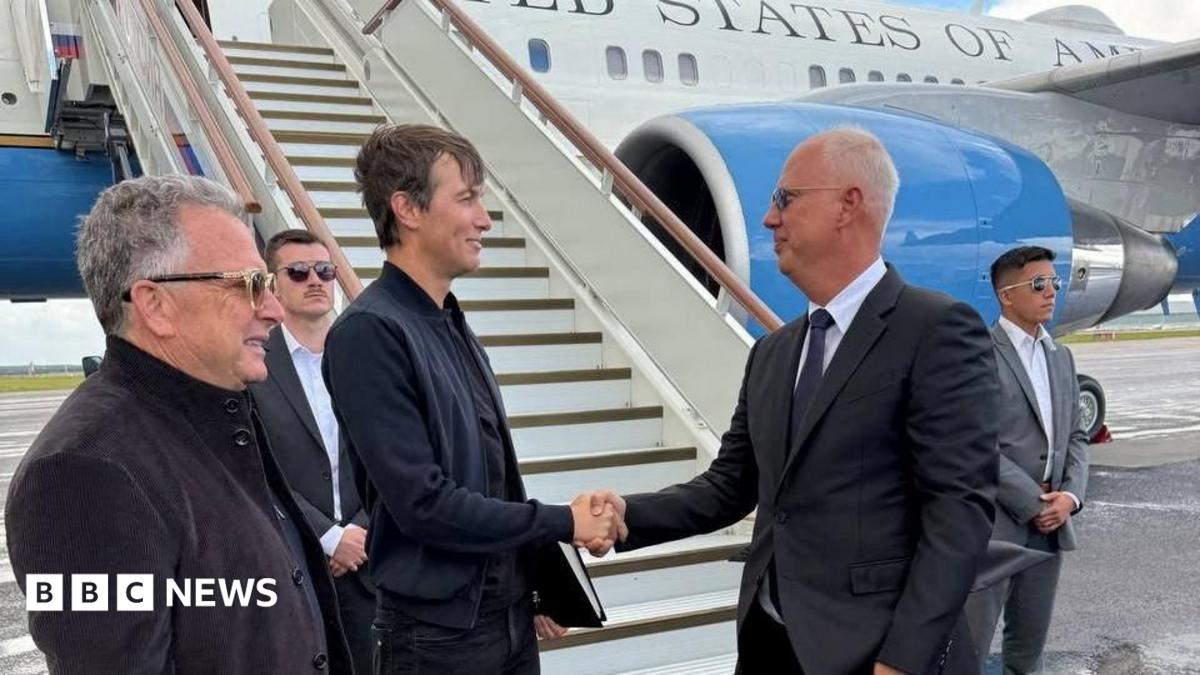
April 27 (UPI) — British King Charles III and Queen Camilla arrived in the United States for a state visit Monday as President Donald Trump issued public assurances that the monarch would “be very safe.”
The British Ambassador to the United States Christian Turner and U.S. Chief of Protocol Monica Crowley greeted Charles and Camilla after they landed at Joint Base Andrews on Monday afternoon.
President Trump and first lady Melania then welcomed them at the South Portico of the White House, where they posed for photos outside, NBC News reported.
Following discussions between Buckingham Palace and the White House following Saturday’s shooting at the White House Correspondents’ Association Dinner in Washington, Buckingham Palace announced Sunday that Charles and Queen Camilla would be going ahead with the visit, with some very minor changes.
The president told CBS’s 60 Minutes on Sunday that the White House, which King Charles will visit, was “really safe.”
“I think it’s great, he’ll be very safe… the White House grounds are really safe. This area of not very many acres is really safe. And he’ll be staying here, I believe he’s going to a couple of other locations because he’s here for a few days,” Trump said.
“They called him and they are so looking forward to being here. We spoke this morning.”
The palace said in a statement Sunday that the royal couple was eagerly anticipating their trip.
“Following discussions on both sides of the Atlantic throughout the day, and acting on advice of the government, we can confirm the state visit by their majesties will proceed as planned. The king and queen are most grateful to all those who have worked at pace to ensure this remains the case and are looking forward to the visit getting underway tomorrow.”
Preparations for the visit, which is in reciprocation for Trump’s state visit to Britain in September and to mark the United States’ 250th anniversary, were at an advanced stage when Saturday’s incident occurred, with Britain’s Union Jack flag flying alongside the Stars and Stripes in the streets around 1600 Pennsylvania Avenue.
Turner said Prime Minister Keir Starmer called Trump on Sunday to wish him well following the shooting and that the visit would go ahead largely unchanged.
Charles and Camilla also contacted the Trumps privately following Saturday’s attack to express their sympathy.
Turner said the focus of the visit would be “renewing and revitalising a unique friendship.”
The “shared history, shared sacrifice and common values” of the two countries would be on display, highlighting a partnership that made the people of both the United States and Britain “safer, richer and happier,” he added.
After an official welcoming ceremony and events at the White House on Tuesday, Charles is expected to then head to Capitol Hill to address both houses of Congress, before Trump and first lady Melania Trump host an official state dinner for the royal couple in the East Room of the White House in the evening.
On Wednesday, the royal couple will go on to New York where Charles will be hosted by New York Mayor Zohran Mamdani for a wreath-laying ceremony to commemorate the 67 British victims of the September 11, 2001, attacks.
Charles and Camilla return to Washington for their formal parting with their hosts on Thursday before heading to Virginia and then onwards to the British overseas territory of Bermuda.
The visit comes at a time when trans-Atlantic relations have been strained over the United States’ war with Iran, with Trump angered that Britain has not supported it, although it has allowed U.S. military aircraft to use British air bases in Britain and in Diego Garcia.
Trump has repeatedly attacked Starmer over his refusal to back the U.S. military offensive but the pair are also at odds over “opening” North Sea oil and gas fields, with Trump saying it was imperative Britain resumed drilling and extraction, and immigration, where he said Starmer needed to emulate the “strong” policies of the United States.
London is hoping the royal visit will go some way to smoothing over the difficulties, particularly given Trump’s well-known admiration for the British monarchy.
Asked by the BBC on Thursday whether the king coming to the United States would heal the rift, Trump said it was very likely to.
“Absolutely. He’s fantastic. He’s a fantastic man. Absolutely the answer is yes. I know him well, I’ve known him for years. He’s a brave man, and he’s a great man. They would absolutely be a positive.”
However, he was less positive regarding his relationship with Starmer but said he still had a chance to recover from a domestic crisis over his appointment of Peter Mandelson as ambassador to Washington if he changed direction on energy and immigration.
President Donald Trump speaks during a Health Care Affordability event in the Oval Office at the White House on Thursday. Trump announced announced a new drug price deal with Regeneron. Photo by Will Oliver/UPI | License Photo
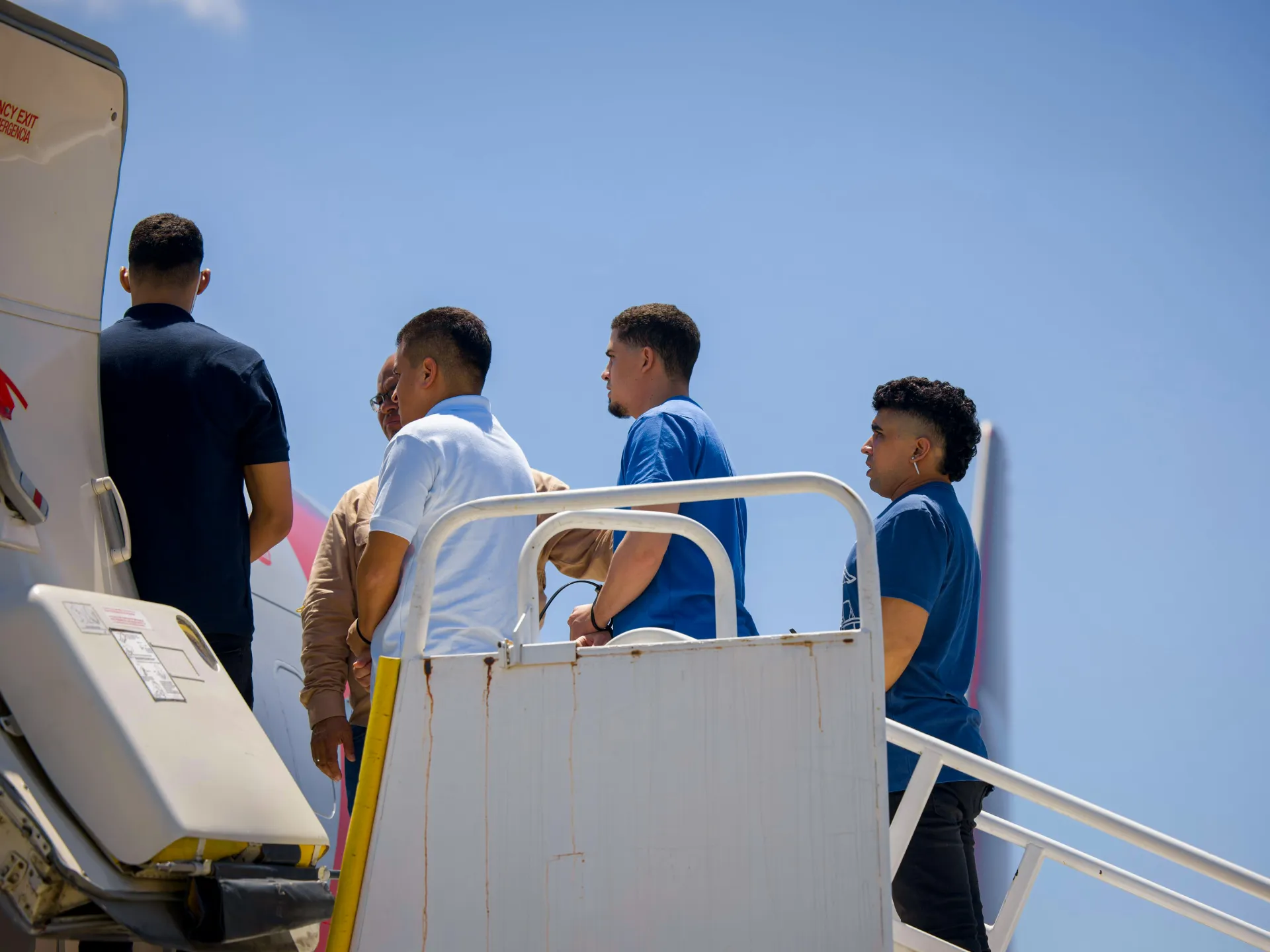
KINSHASA, Congo — Around 15 people deported from the United States landed in Congo’s capital Kinshasa early Friday, one of their lawyers told the Associated Press.
It was the latest example of the Trump administration using agreements with African countries to accelerate migrant removals that have raised questions about respect for the migrants’ rights.
An official at the Congolese migration agency confirmed the arrivals but didn’t provide details.
The deportees are all from Latin America and the Congolese government plans to keep them in the country for a short period, said U.S. attorney Alma David, who represents one of the deportees. She has been speaking with her client since arriving in Kinshasa.
All the deportees are believed to have legal protection from U.S. judges shielding them against being returned to their home countries, David said. The deportees are believed to be staying at a hotel in Kinshasa.
The International Organization for Migration, a United Nations-affiliated agency, will be involved to offer “assisted voluntary return,” David told AP.
“The fact that the focus is on offering them ‘voluntary’ return to their home country when they spent months in immigration detention in the U.S. fighting hard to not have to go home is very alarming,” she said.
An International Organization for Migration spokesperson said the organization was providing humanitarian assistance to the deportees at the request of the Congolese government. It said it may also offer assisted voluntary return, which is “strictly voluntary and based on free, prior and informed consent.”
Congo’s Ministry of Communications said in a statement earlier this month that it will receive some migrants as part of a new deal under the Trump administration’s third-country program.
It described the arrangement as a “temporary” one that reflects Congo’s “commitment to human dignity and international solidarity.” It would come with zero costs to the government with the U.S. covering the needed logistics, it said.
The statement said no automatic transfer of the deportees is planned, adding: “Each situation will be subject to individual review in accordance with the laws of the Republic and national security requirements.”
The U.S. has struck such third-country deportation deals with at least seven other African nations, many of them among countries hit hardest by the Trump administration’s policies restricting trade, aid and migration.
The Trump administration has spent at least $40 million to deport about 300 migrants to countries other than their own, according to a report released recently by the Democratic staff of the Senate Foreign Relations Committee.
Lawyers and activists have raised questions over the nature of the deals with countries in Africa and elsewhere. Several of the African nations that have signed such deals have notoriously repressive governments and poor human rights records — including Eswatini, South Sudan and Equatorial Guinea.
Kamale and Banchereau write for the Associated Press. Banchereau reported from Dakar, Senegal. AP writer Saleh Mwanamilongo in Bonn, Germany contributed to this report.