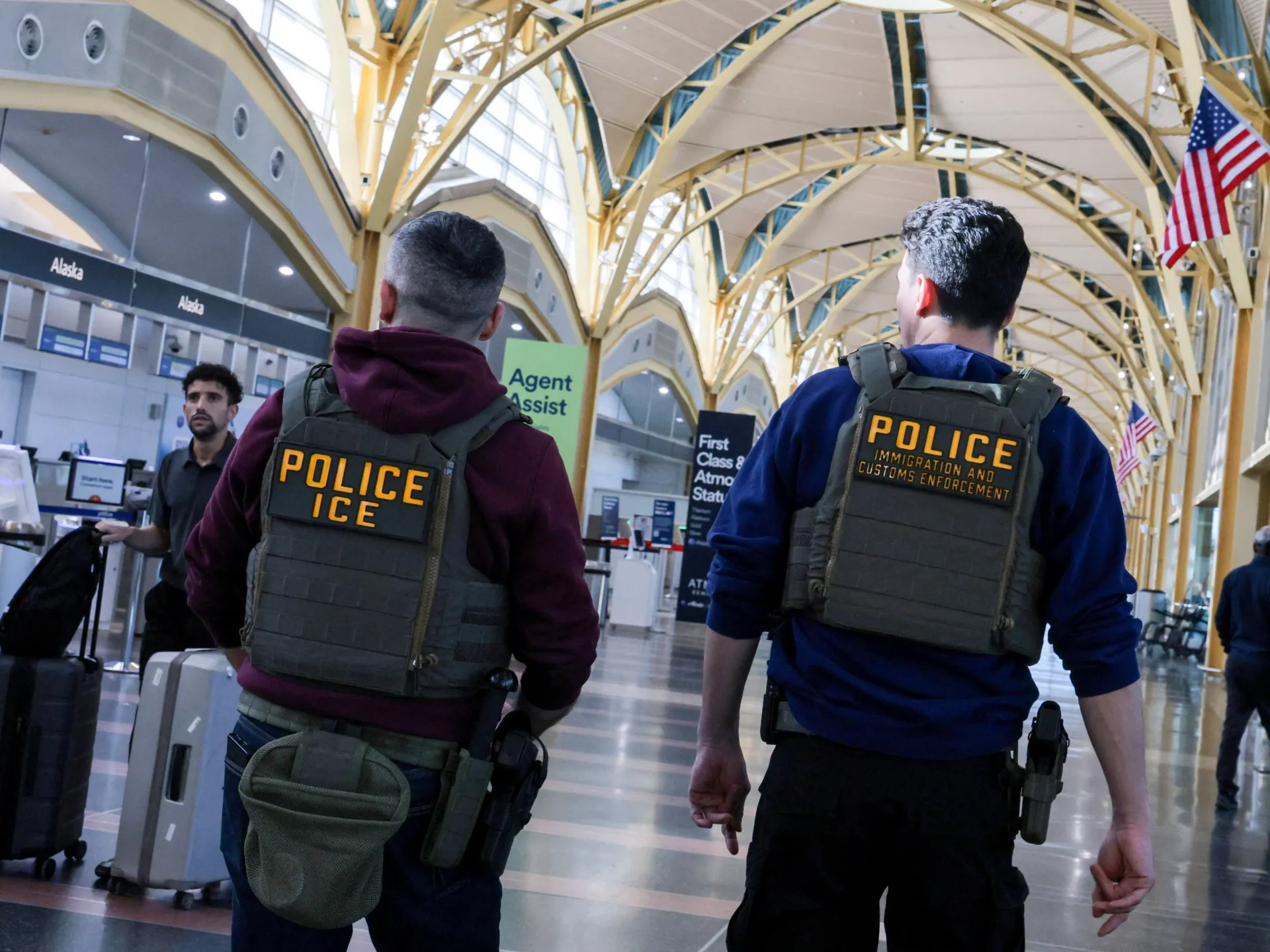


MINNEAPOLIS — Immigration officers with guns drawn arrested activists who were trailing their vehicles on Tuesday in Minneapolis, a sign that tensions have not eased since the departure last week of a high-profile commander.
At least one person who had an anti-ICE message on their clothing was handcuffed while face down on the ground. An Associated Press photographer witnessed the arrests.
Federal agents in the Twin Cities lately have been conducting more targeted immigration arrests at homes and neighborhoods, rather than staging in parking lots. The convoys have been harder to find and less aggressive. Alerts in activist group chats have been more about sightings than immigration-related detainments.
Several cars followed officers through south Minneapolis after there were reports of them knocking at homes. Officers stopped their vehicles and ordered activists out of a car at gunpoint. Agents told reporters at the scene to stay back and threatened to use pepper spray.
There was no immediate response to a request for comment from the Department of Homeland Security and Immigration and Customs Enforcement.
A federal judge last month put limits on how officers treat motorists who are following them but not obstructing their operations. Safely following agents “at an appropriate distance does not, by itself, create reasonable suspicion to justify a vehicle stop,” the judge said. An appeals court, however, set the order aside.
Border Patrol commander Greg Bovino, who was leading an immigration crackdown in Minneapolis and other big U.S. cities, left town last week, shortly after the fatal shooting of Alex Pretti, the second local killing of a U.S. citizen in January.
Trump administration border czar Tom Homan was dispatched to Minnesota instead. He warned that protesters could face consequences if they interfere with officers.
Grand jury seeks communications, records
Meanwhile, Tuesday was the deadline for Minneapolis to produce information for a federal grand jury. It’s part of a U.S. Justice Department request for records of any effort to stifle the Trump administration’s immigration crackdown. Officials have denounced it as a bullying tactic.
“We have done nothing wrong and have nothing to hide, but when the federal government weaponizes the criminal justice system against political opponents, it’s important to stand up and fight back,” said Ally Peters, spokesperson for Mayor Jacob Frey, a Democrat.
She said the city was complying, but she didn’t elaborate. Other state and local offices run by Democrats were given subpoenas, though it’s not known whether they had the same deadline. People familiar with the matter have told the AP that the subpoenas are related to an investigation into whether Minnesota officials obstructed enforcement through public statements.
No bond for man in Omar incident
Elsewhere, a man charged with squirting apple cider vinegar on Democratic U.S. Rep. Ilhan Omar will remain in jail. U.S. Magistrate Judge David Schultz granted a federal prosecutor’s request to deny bond to Anthony Kazmierczak.
“We simply cannot have protesters and people — whatever side of the aisle they’re on — running up to representatives who are conducting official business, and holding town halls, and assaulting them,” Assistant U.S. Attorney Benjamin Bejar said Tuesday.
Defense attorney John Fossum said the vinegar posed a low risk to Omar. He said Kazmierczak’s health problems weren’t being properly addressed in jail and that his release would be appropriate.
Murphy, Raza and Karnowski write for the Associated Press. Raza reported from Sioux Falls, S.D. AP reporters Ed White in Detroit and Hannah Fingerhut in Des Moines, Iowa, contributed to this report.
Making his first major post-arrest television interview Monday on “Jimmy Kimmel Live!,” Don Lemon detailed the moments surrounding his incarceration and his experience as a journalist becoming the center of a news story.
“There’s a lot that I cannot say,” Lemon told Kimmel. “But what I will say is that I’m not a protester. I went there to be a journalist. I went there to chronicle and document and record what was happening … I do think that there is a difference between a protester and a journalist.”
The appearance arrived less than a week after the former CNN anchor — now an independent journalist who hosts a YouTube show — was arrested by federal agents in Los Angeles following his coverage of an anti-ICE protest at a Minnesota church earlier this month. Lemon, 59, was released without bond Friday and is expected to plead not guilty, according to his attorneys.
On Monday’s show, Kimmel began the conversation by asking Lemon how he was feeling: “I don’t know — that’s an honest answer,” Lemon said. “I’m OK. I’m not going to let them steal my joy, but this is very serious. These are federal criminal charges.”
Lemon was arrested — along with three others in attendance at the protest — at the direction of Atty. Gen. Pam Bondi, who said on X that it was in connection to what she described as a “coordinated attack” on the church, located in St. Paul. Lemon is charged with conspiracy to deprive the church congregants of their rights and interfering by force with someone’s First Amendment rights. Lemon has denied participating in the protest at the church — assembled to decry that an Immigration and Customs Enforcement field officer apparently serves as a pastor there — saying he was present in a journalistic capacity.
Playfully acknowledging that he hasn’t been a favorite of President Trump’s since his time on CNN, Lemon said he hadn’t been concerned about his possible arrest — even with a re-post by Trump calling for it — until it gained steam by members of Trump’s cabinet, including Bondi and Todd Blanche, the U.S. deputy attorney general. Lemon said that after retaining a lawyer and volunteering to turn himself in to handle the matter without fanfare, he “never heard back from them.”
“That is customary in a situation like this, that someone would be allowed to turn themselves in,” Lemon said. “People who are who are accused of much worse things than I am accused of doing, they are allowed the courtesy. I mean, Donald Trump was allowed the courtesy to turn himself in …”
Lemon went on to detail the moments leading up to his arrest Thursday, which came after a night of covering a Grammys event for the Black Music Collective and attending a post-party celebration.
“I got back to the hotel, I walked in with my swag bag from the thing … and I pressed the elevator button and all of a sudden I feel myself being jostled, people trying to grab me and put me in handcuffs,” he recounted. “And I said, ‘What are you doing here?’ And they said, ‘We came to arrest you.’ I said, ‘Who are you?’ Then finally they identified themselves. And I said, ‘If you are who you are, then where’s the warrant?’ And they didn’t have a warrant, so they had to wait for the someone from outside, an FBI guy, to come in to show me a warrant on a cell phone … They took me outside FBI guys were out there. It had to be maybe a dozen people, which is a waste, Jimmy, of resources … They want to embarrass you. They want to intimidate you. They want to instill fear.”
He said he hadn’t realized how much attention his arrest had generated until he saw CNN broadcasting the story on a TV monitor where he was being held.
“I could see ‘Former CNN anchor Don Lemon arrested in Los Angeles,’” he said. “I said to the guy, ‘Is that happening a lot?’ He goes, ‘You’ve been on all morning, yeah. And he says, ‘This is a big deal.’”
During the conversation, Kimmel criticized what he felt was a lack of attention to the recent search by FBI agents of the home of a Washington Post reporter who covers the federal government. Lemon, who parted ways with CNN in 2023, attributed it to a fear among the leaders of corporate press enterprises.
“Corporate media has been neutered right now. They are afraid, and that’s the reason I’m so happy with what I do, because I’m closer to the ground,” he said. “This is not time for folly. It’s not time for false equivalence, and putting people on television and on news programs, giving them a platform, who come on just to lie. …. Some things are objectively bad and I think its important in this time to point that out.”
Lemon hitting the late-night circuit intensifies its spotlight as a free-speech battleground. The Trump era has prompted more pointed and passionate takes from most of the major hosts that, in turn, have captured the attention and ire of the president, who has provoked threats against them and their broadcasters.
Last year, CBS announced it was canceling “The Late Show” after a three-decade run — a decision the company attributed to financial reasons and not, as many have speculated, because of host Stephen Colbert’s criticism of a settlement between the Trump administration and Paramount, the parent company of CBS, over a 2024 “60 Minutes” interview with then-Vice President Kamala Harris.
More recently, Kimmel faced a brief suspension last fall over comments regarding the killing of right-wing activist and influencer Charlie Kirk (ABC ultimately reinstated Kimmel following public backlash.) In fact, Lemon referenced that situation prior to his arrest, when a judge dismissed prosectors’ initial charging effort: “This is not a victory lap for me because it’s not over. They’re gonna try again,” Lemon told his followers on his YouTube show after the judge’s ruling. “Go ahead, make me into the new Jimmy Kimmel, if you want.”
Last Friday, addressing a crowd outside the courthouse upon his release, Lemon said, “There is no more important time than right now, this very moment, for a free and independent media that shines a light on the truth and holds those in power accountable. I will not stop now, I will not stop ever.”
Leading Democrats have rolled out a new and unvarnished message — that the U.S. Department of Justice cannot be trusted.
“Let’s be really clear: We can’t trust anything the DOJ does. The DOJ is corrupt. They’re corrupt on every major issue in front of this country,” Rep. Robert Garcia (D-Long Beach), ranking member on the House Oversight Committee, said Friday at a news conference in his district.
“We cannot trust the Department of Justice. They are an illegitimate organization right now under the leadership of [Atty. Gen.] Pam Bondi and the direction of Donald Trump,” House Minority Leader Hakeem Jeffries (D-N.Y.) said during his own news conference in Washington, D.C.
The remarks — which hold profound implications in a two-party democracy meant to be protected and served by a nonpartisan justice system, and which a White House spokesperson called “shameful” — followed a week of equally stunning actions by the Justice Department, where President Trump has installed staunch loyalists, including Bondi, to high-ranking positions.
In recent days, the Justice Department has resisted launching civil rights investigations into two fatal shootings of U.S. citizens in Minneapolis by federal immigration agents. It has since reversed course and launched such an investigation into the second of those incidents, in which 37-year-old Alex Pretti was shot while surrounded by agents, on the ground and disarmed, but has held firm in its decision not to investigate the earlier shooting of 37-year-old Renee Good, who was shot while trying to drive away from a tense exchange with agents.
On Wednesday, the FBI raided and seized voter ballots and other information from the election headquarters of Fulton County, Ga., long a target of Trump’s baseless and disproven claims that widespread voter fraud helped Democrats steal the 2020 election. Bondi was an early backer of those baseless claims, as were other Justice Department appointees.
On Friday, federal agents arrested former CNN anchor Don Lemon and other journalists after their coverage of a protest at a conservative church in Minneapolis. Justice Department officials rejected the defense that Lemon and the other journalists were exercising their 1st Amendment rights as journalists, and accused them of violating the rights of churchgoers.
Also Friday, Justice Department officials released more documents from the Epstein files — a trove of records related to the sexual abuse of minors by the late, disgraced billionaire financier Jeffrey Epstein. Democrats argued that the release was still not complete, in violation of a law passed by Congress mandating that they be made public.
In a statement to The Times, White House spokesperson Anna Kelly dismissed Jeffries’ and Garcia’s remarks as “shameful comments by Democrats who cheered on Joe Biden’s weaponization of the Department of Justice against his political enemies, including President Trump,” and said Trump, Bondi and other administration officials “have quickly Made America Safe Again by taking violent criminals off the streets, cracking down on fraud, holding bad actors accountable, and more.”
The Justice Department did not respond to a request for comment, but officials there have broadly defended the department’s actions as not only justified but necessary for ensuring the rule of law and holding alleged criminals to account.
Thad Kousser, a political science professor at UC San Diego, said both the actions of the Justice Department and the latest statements from Democrats ratcheted up the stakes in the nation’s already tense political standoff — as institutions such as the Justice Department “need to be trusted in the long term” for American democracy to be successful.
“Trust goes up and down in the people in institutions over history, but there’s been a baseline level of support for our Constitution, the way our government is built, and the seal on the building — even if people didn’t trust who was in that building,” Kousser said. “What we may be risking as a country is losing the trust in the building itself, if people think that the might of the federal government is being used to pursue a narrow agenda of one party or one leader.”
Jeffries’ assertion that the Justice Department can’t be trusted came as he denounced Lemon’s arrest. Jeffries said there was “zero basis to arrest” Lemon, and that the arrest was an attempt by the Trump administration to weaponize government against people they disagree with.
Jeffries added that distrust in the federal agency is one of the reasons why House Democrats are pushing for legislative action to require independent investigations by local and state law enforcement in cases when federal agents engage in violent incidents and are accused of wrongdoing — such as the shootings in Minneapolis.
Other leading Democrats have also slammed the Justice Department over the journalists’ arrests.
“The American people deserve answers as to why Trump’s lawless Justice Department is arresting journalists for simply doing their jobs,” said Sen. Alex Padilla (D-Calif.).
“The arrest of journalists for covering a protest is a grave attack on the 1st Amendment and freedom of the press,” said Sen. Adam Schiff (D-Calif.). “And proof the Trump administration is not de-escalating.”
Garcia’s comments came in a wide-ranging news conference at which he also discussed taking on a leading role in impeachment proceedings against Homeland Security Secretary Kristi Noem, who has been overseeing the Trump administration’s mass deportation efforts, including through the deployment of Immigration and Custom Enforcement and Customs and Border Protection agents to Minneapolis, Los Angeles and other major cities.
Garcia denounced the Trump administration’s handling of the Good and Pretti shootings, arguing that independent investigations were needed — as he said were conducted after police shootings in Long Beach when he was mayor there.
“They should bring in either a special counsel [or] some type of special master to oversee an independent investigation,” he said.
He said that was especially necessary given the fact that Noem and other administration officials immediately bad-mouthed Good and Pretti as violent actors threatening agents before any of the facts were gathered — and in direct contradiction to video evidence from the scenes.
“What happened to Renee Good and Alex Pretti was murder by our own government, and our committee is working right now on a major report on both of those incidents so that those that are responsible are held accountable,” Garcia said.
He also called Lemon’s arrest “horrifying,” saying Lemon was “out there reporting” and is now being “essentially attacked” by the Justice Department. “The arrest of Don Lemon might be the single largest attack on the free press and the 1st Amendment in the modern era.”
Garcia noted that the Justice Department had first shopped Lemon’s arrest around to multiple judges, who denied issuing a warrant for his arrest. Administration officials said a federal grand jury handed down an indictment for the journalist, but Garcia suggested the indictment was fraudulently obtained based on the government putting forward information “we cannot trust.”
Decisions around the two Minneapolis shootings and the arrest of the journalists would have passed through the office of Assistant Atty. Gen. Harmeet Dhillon, who heads the Justice Department’s Civil Rights Division.
Dhillon did not respond to a request for comment Friday. However, she has broadly defended her office’s actions online. For days before Lemon’s arrest, she had slammed his actions, writing on X that she and Bondi “will not tolerate harassment of Americans at worship — especially from agitators posing as ‘journalists.’”
Deputy Atty. Gen. Todd Blanche — a former personal attorney to Trump — has broadly defended the department’s actions in Minneapolis, where he said a civil rights investigation into Good’s shooting was unwarranted, and on the Epstein files, which he said have been released in accordance with the law and Trump’s own demands for transparency.
The latter was also something Garcia took issue with Friday, slamming the Justice Department for continuing to withhold some of the files.
“Donald Trump and the Department of Justice just made it clear right now that they intend to withhold approximately 50% or half of the Epstein files while claiming to have fully complied with the law. This is outrageous and incredibly concerning,” Garcia said.
He said his committee subpoenaed all of the files over the summer, and Bondi has yet to comply with that subpoena in violation of the law.
Previously released Epstein records included allegations that Trump was involved in Epstein’s schemes to abuse young women and girls, which Trump — once a friend of Epstein’s — has strenuously denied.
The Justice Department has also taken the unusual step of defending the president in the matter directly, including by releasing a statement last month that the released documents “contain untrue and sensationalist claims made against President Trump.”
“To be clear: the claims are unfounded and false, and if they had a shred of credibility, they certainly would have been weaponized against President Trump already,” the department’s statement said.
Kousser, the politics professor, noted that this is not the first time that concerns about partisanship within the Justice Department have been voiced. He said similar concerns were raised by many Republicans when the Justice Department was prosecuting Trump during the Biden administration.
Such arguments raise serious alarms, he said, regardless of which way they are directed politically.
“If people feel like the Justice Department is only doing the bidding of whoever won the last election, that moves it from a law enforcement body to a political operation in the eyes of average Americans,” he said. “And that would be a huge loss for our democracy.”
The ICE officers descended on Compton, targeting immigrants convicted of theft, child abuse and selling drugs.
There were no protesters. No whistles alerting targets to the officers’ presence. No face masks. In some cases, residents opened their doors to let the officers inside their homes. One man thanked them for not arresting him in front of his children.
The Los Angeles area operation ended with 162 arrests, including a Mexican national convicted of rape and a Salvadoran national convicted of voluntary manslaughter. Immigration and Customs Enforcement said almost 90% of the people arrested had criminal convictions.
It was June 2018, more than a year into Donald Trump’s first term as president. More than seven years later, carrying out the same operation in L.A. or other U.S. cities feels almost impossible without drawing angry crowds and requiring multiple officers, at times across federal agencies, to detain a single target.
In the years since Trump’s first term, ICE and the government’s immigration enforcement apparatus expanded raids well beyond those against known criminals or suspected ones. Increasingly, immigrants with no criminal records and even legal residents and U.S. citizens found themselves stopped and sometimes arrested.
The uncertainty over who is being targeted has fueled a growing pattern of community protests and rapid response mobilizations, even when officials say they are targeting convicted felons, reflecting a widening gap between how enforcement is described and how it is experienced. That gap has become most visible on the ground.
In recent months, sightings of ICE or other federal agents have drawn crowds of protesters, legal observers and community organizers. In many cases, residents say they can’t distinguish between targeted enforcement actions — against child molesters, human smugglers and other serious criminals — and broader sweeps, responding instead to the mere presence of agents whose role and authority are no longer clearly understood.
Experts say the Trump administration’s hostile rhetoric against immigrants and often seemingly indiscriminate targeting of people in neighborhoods has hurt the reputation of its immigration enforcement agencies, including ICE and Border Patrol, like never before. And it has inspired a mass movement of resistance that has seen Americans shot by federal immigration officers. In the last month, two U.S. citizens — Renee Nicole Good and Alex Jeffrey Pretti — were shot dead by ICE and Border Patrol agents in Minneapolis.
The fatal shootings forced Trump to recalibrate his immigration enforcement tactics, in part by sidelining Border Patrol Cmdr. Gregory Bovino, who first launched the aggressive raids in California, and putting border policy advisor Tom Homan in charge.
“I’m not here because the federal government has carried out this mission perfectly,” Homan said during a Thursday news conference. “Nothing’s ever perfect, and anything can be improved on. And what we’ve been working on is making this operation safer, more efficient, by the book.”
He said street operations in Minnesota would “draw down” if the agents were given access to local jails and that agents would focus on specific targets.
“We will conduct targeted enforcement operations — targeted,” he added. “That has traditionally been the case and that’s what we’re going to continue to do and improve upon that with the priority on public safety threats.”
An internal memo reviewed by Reuters showed ICE officers operating in the state were directed to avoid engaging with “agitators” and only target “aliens with a criminal history.”
Even if the Trump administration were to pull back ICE and Border Patrol’s aggressive tactics to focus more on known criminals, experts question whether too much damage has been done to their reputations.
“The brand of the agency is becoming so toxic,” said John Sandweg, who headed ICE under President Obama. “It’s going to impact the agency for years to come. It’s going to take a long time for that trust to rebuild.”
Another former ICE official, who asked not to be named out of fear of retaliation, said the agency used to be able to say it was focused on criminals and wasn’t conducting random sweeps.
“For years we always said, ‘We don’t have the resources to go after everybody, so we’re going to focus on just the worst of the worst,’” he said. “They can’t say that now. They’re still trying to do that, but it’s getting overshadowed by Home Depot and car washes and all this other stuff and Border Patrol’s heavy-handed tactics. Now it’s leading to shootings and all these other things. It’s just horrible.”
In Willowbrook, an unincorporated neighborhood nestled in South L.A., just blocks from Compton city limits, federal agents found themselves locked between angry crowds recording them last week. Two people held a sign that read: “ICE / Soldiers off our streets.”
Federal agents clear the way for an authorized car to pass while investigating a shooting involving a federal agent in Willowbrook.
(Genaro Molina/Los Angeles Times)
The agents were there to arrest a man they say had been “involved in human trafficking” and had a final removal order. They alleged the man had two prior arrests for domestic violence. Homeland Security officials later said the man used his vehicle to ram federal agent vehicles in an attempt to evade arrest, prompting an agent to open fire.
But as news spread that the operation was targeting a suspected criminal living in the country illegally, most residents shrugged it off. They said federal officials had made false claims against other people they had arrested or shot at, including labeling Good and Pretti as domestic terrorists.
“They’ve shown us that they’re not trustworthy,” Rosa Enriquez, 39, said while holding a Mexican flag.
Similar scenes have played out across the country. This month, a journalist posted a video of agents — who she identified as working for ICE — calling out a driver for honking during an operation St. Paul, Minn.
“We’re here to arrest a child sex offender and you guys are out here honking,” the agent said. “That’s who you guys are protecting. Insane.”
“Just go. You’re lying!” a woman shouts.
Homeland Security has made it a point to tout the arrests of criminals across the country. The “worst of the worst arrests” in L.A. this month, according to the agency, included a man convicted of second-degree murder, another for voluntary manslaughter and one with multiple convictions for driving under the influence and disorderly conduct.
“We will not let rioters or agitators slow us down from removing murderers, rapists, pedophiles, gang members, and terrorists,” Homeland Security spokesperson Tricia McLaughlin said in a statement.
But experts say the general public has clearly witnessed a shift in who is being targeted.
In May, White House Deputy Chief of Staff Stephen Miller reportedly directed top ICE officials to go beyond target lists and have agents make arrests at Home Depot or 7-Eleven convenience stores as they sought to crank up their daily arrest numbers to 3,000.
Border Patrol commander Gregory Bovino, center, marches with federal agents to the Edward R. Roybal Federal Building.
(Carlin Stiehl/Los Angeles Times)
The following month, Border Patrol agents led by Bovino were on the ground in L.A., tackling car wash workers, arresting street vendors and chasing down day laborers.
“The pressure of those numbers on enforcement agencies and mobilizing the whole of government and other law enforcement agencies, well beyond the traditional ICE and CBP, has created pressures that have led to extensive overreach,” said Doris Meissner, a senior fellow at the Migration Policy Institute, a nonpartisan think tank in Washington. Customs and Border Protection, or CBP, is the agency that includes ICE and Border Patrol.
At the peak of arrests in L.A in June, around 75% of people had no criminal conviction. A Times analysis found that in the administration’s first nine months, from Jan. 1 to Oct. 15, of the more than 10,000 Los Angeles residents who were arrested in immigration operations, about 45% had a criminal conviction and an additional 14% had pending charges.
In November the Cato Institute, a libertarian think tank, reported that, nationwide, 5% of detainees from Oct. 1 to Nov. 15 had been convicted of violent crimes. Most detainees with convictions were found guilty of vice, immigration or traffic infractions.
“They’ve painted to the American people that they were going after the worst of the worst, and that is nothing like what is happening,” said Assemblymember Mike A. Gipson (D-Carson), who represents the district where the recent shooting in L.A. unfolded. “We have seen all across America where they have harassed, they have murdered, assassinated not only citizens but also people who have not had any arrest, who have not fit the bill or the description of what they have painted to the American people.
“When you turn on the news right now, the trust is absolutely gone. We don’t trust the White House, we don’t trust ICE, and the people are afraid because the trust is gone.”
Santa Maria Councilmember Gloria Soto echoed that sentiment, in part because she has seen raids in her Central Coast town.
“That’s part of the frustration,” Soto said. “There’s no transparency. There’s no information being shared before or after these enforcements have taken place.”
“We know for a fact that there are individuals who are getting picked up who did not have a criminal record, whose only quote-unquote crime was, you know, either having an expired visa, or crossing without the required immigration documentation that is needed, so it makes it really difficult for us, for me as an elected official, to trust what this agency is doing because so far there is no communication,” she said.
The challenges ICE officers are facing appear to center on cities that have been targeted with surge operations — like in Minneapolis, Sandweg said. Across the country, he said, officers are conducting operations “but not with the same amount of controversy.”
People take part in a vigil at a memorial for Alex Pretti in Minneapolis.
(Eric Thayer/Los Angeles Times)
“In Minneapolis we’re at the point now when, if agents are going to go after someone with a very serious violent criminal history, they’re likely to pick up observers and a lot of attention,” he said. “The way in which they wanted to do these operations in such an overt, in-your-face kind of fashion, has created a dynamic that makes it really hard for the agents to execute their duties. … You have these protests following the agents everywhere they go.”
While there has always been consternation over immigration enforcement, Sandweg said that “the widespread tactics and the targeting of people with no criminal record just really galvanized people in a way they’ve never been galvanized before.”
“To where now it probably is starting to bleed into and impeding operations that most of those protesters are probably not opposed to — the idea of ICE getting someone with a violent criminal history off the streets,” he said. “I think it’s created an environment where it puts the officers and the public in harm’s way.”
This week, protesters came out in force when word spread that ICE officers were eating at a restaurant in Lynwood. A video shows the crowd jeering at the officers as they’re being escorted out of the area by Los Angeles County sheriff’s deputies.
Almost immediately, Lynwood City Councilmember Luis Gerardo Cuellar posted a video on Instagram to inform the public.
“This was not ICE, these were … TSA air marshals.”
For years at CNN, Don Lemon had been a thorn in the side of President Trump, frequently taking him to task during his first term over his comments about immigrants and other matters.
On Friday, the former CNN anchor — now an independent journalist who hosts his own YouTube show — was in a Los Angeles federal courtroom and charged with conspiracy and interfering with the First Amendment rights of worshippers during the Jan. 18 protest at the Cities Church in St. Paul.
Lemon was arrested by federal agents in Los Angeles on Friday, along with a second journalist and two of the participants in the protest of the federal government’s immigration enforcement tactics in Minneapolis.
Lemon identified himself at the protest as a journalist. His attorney said in a statement Lemon’s work was “constitutionally protected.”
“I have spent my entire career covering the news,” Lemon told reporters after he was released on his own recognizance Friday afternoon. “I will not stop now. There is no more important time than right now, this very moment, for a free and independent media that shines a light on the truth and holds those in power accountable. Again, I will not stop now. I will not stop, ever.”
The scene of a reporter standing before a judge and facing federal charges for doing his job once seemed unimaginable in the U.S.
The arrest marked an extraordinary escalation in the Trump administration’s frayed relations with the news media and journalists.
Earlier this month, the FBI seized the devices of Washington Post reporter Hannah Natanson in a pre-dawn raid as part of an investigation into a contractor who has been charged with sharing classified information. Such a seizure is a very rare occurrence in the U.S.
Last spring, the Associated Press was banned from the White House. The AP sued White House press secretary Karoline Leavitt and two other administration officials, demanding reinstatement.
Even the Committee to Protect Journalists, an organization that monitors and honors reporters imprisoned by authoritarian government regimes overseas, felt compelled to weigh in on Lemon’s arrest.
“As an international organization, we know that the treatment of journalists is a leading indicator of the condition of a country’s democracy,” CPJ CEO Jodie Ginsberg said in a statement. “These arrests are just the latest in a string of egregious and escalating threats to the press in the United States — and an attack on people’s right to know.”
For Lemon, 59, it’s another chapter in a career that has undergone a major reinvention in the last 10 years, largely due to his harsh takes on Trump and the boundary-pushing moves of his administration. His journey has been fraught, occasionally making him the center of the stories he covers.
“He has a finely honed sense of what people are talking about and where the action is, and he heads straight for it in a good way,” said Jonathan Wald, a veteran TV producer who has worked with Lemon over the years.
A Louisiana native, Lemon began his career in local TV news, working at the Fox-owned station in New York and then NBC’s WMAQ in Chicago where he got into trouble with management. Robert Feder, a longtime media columnist in Chicago, recalled how Lemon was suspended by his station for refusing to cover a crime story which he felt was beneath him.
“A memorable headline from that era was ‘Lemon in Hot Water,’ ” Feder said.
But Lemon’s good looks and smooth delivery helped him move to CNN in 2006, where his work was not always well-received. He took over the prime time program “CNN Tonight” in 2014 and became part of the network’s almost obsessive coverage of the missing Malaysian Airlines Flight 370. (Lemon was ridiculed for asking an aviation analyst if the plane might have been sucked into a black hole).
Like a number of other TV journalists, Lemon found his voice after Trump’s ascension to the White House. He injected more commentary into “CNN Tonight,” calling Trump a racist after the president made a remark in the Oval Office about immigrants coming from “shit hole countries” to the U.S.
After George Floyd was murdered by a police officer in Minneapolis in May 2020, Lemon’s status as the lone Black prime time anchor on cable news made his program a gathering place for the national discussion about race. His ratings surged, giving CNN its largest 10 p.m. audience in history with 2.4 million viewers that month.
Lemon’s candid talk about race relations and criticism of Trump made him a target of the president’s social media missives. In a 2020 interview, Lemon told the Times that he had to learn to live with threats on his life from Trump supporters.
“It’s garnered me a lot of enemies,” he said. “A lot of them in person as well. I have to watch my back over it.”
Lemon never let up, but CNN management had other ideas. After Warner Bros. Discovery took control of CNN in 2022, Chief Executive David Zaslav said the network had moved too far to the political left in its coverage and called for more representation of conservative voices.
Following the takeover, Lemon was moved out of prime time and onto a new morning program — a format where CNN has never been successful over its four decade-plus history.
Lemon’s “CNN Tonight” program was built around his scripted commentaries and like-minded guests. Delivering off-the-cuff banter in reaction to news of the moment — a requirement for morning TV news — was not his strong suit.
Lemon had a poor relationship with his co-anchors Poppy Harlow and Kaitlin Collins. The tensions came to a head in Feb. 2023 after an ill-advised remark he made about then Republican presidential contender Nikki Haley.
Lemon attempted to critique Haley’s statements that political leaders over the age of 75 should undergo competency testing.
“All the talk about age makes me uncomfortable — I think it’s a wrong road to go down,” Lemon began. “She says politicians, or something, are not in their prime. Nikki Haley isn’t in her prime — sorry — when a woman is considered to be in her prime in her 20s and 30s, maybe 40s.”
Harlow quickly interjected, repeatedly asking Lemon a couple of times, “Prime for what?” Lemon told his female co-anchors to “Google it.” It was one of several sexist remarks he made on the program.
Lemon was pulled from the air and forced to apologize to colleagues, some of whom had called for his dismissal. He was fired in April 2023 on the same day Fox News removed Tucker Carlson .
Lemon was paid out his lucrative CNN contract and went on to become one of the first traditional TV journalists to go independent and produce his own program for distribution on social media platforms.
“Others might have cowered or taken time to regroup and figure out what they should do,” said Wald. “He had little choice but to toil ahead.”
Lemon first signed with X in 2024 to distribute his program as the platform made a push into longer form video. The business relationship ended shortly after new X owner Elon Musk sat down for an interview with Lemon.
Musk agreed to the high-profile chat with no restrictions, but was unhappy with the line of questioning. “His approach was basically ‘CNN but on social media,’ which doesn’t work, as evidenced by the fact that CNN is dying,” Musk wrote.
An unfazed Lemon forged ahead and made his daily program available on YouTube, where it has 1.3 million subscribers, and other platforms. He has a small staff that handles production and online audience engagement. In addition to ad revenue from YouTube, the program has signed its own sponsors.
While legacy media outlets have become more conscious of running afoul of Trump, who has threatened the broadcast TV licenses of networks that make him unhappy with their coverage, independent journalists such as Lemon and his former CNN colleague Jim Acosta, have doubled down in their aggressive analysis of the administration.
Friends describe Lemon as relentless, channeling every attempt to hold him back into motivation to push harder. “You tell him ‘you can’t do it,’ he just wants to do it more,” said one close associate.
Wald said independent conservative journalists should be wary of Lemon’s arrest.
“If I’m a conservative blogger, influencer, or YouTube creator type, I would be worried that when the administration changes, they can be next,” Wald said. “So people should be careful what they wish for here.”
The arrest of independent journalists Don Lemon and Georgia Fort, in connection with an anti-ICE protest that interrupted a church service in Minnesota, is a test for the American people. Well, some of us. Many of us already didn’t like what we saw happening across the country. Many believed the un-American threats during the campaign and voted against this regime in 2024.
So this is a test for the Americans who — after seeing law enforcement seemingly use a 5-year-old as bait and shoot Renee Good and Alex Pretti to death — still said they’re on board with everything.
The voters who agreed with Donald Trump when he said “they’re bringing drugs, they’re bringing crime” back in 2015, and were OK with him 10 years later, popping up in the Epstein files and pardoning criminals — including a corrupt former Latin American leader who took bribes to let 400 tons of cocaine be smuggled into the U.S.
This isn’t a test for the voters whose biggest concern was the price of groceries or border security. This is a test for the voters who used that rhetoric about groceries and the border as cover for their unsavory feelings about immigrants. The same feelings that greeted other groups — the Jews, the Italians, the Irish — when they first came to this land. The ethnicity may be different, the conspiracy theories may be new, but at the end of the day, it’s the same old predictable story.
So, if you’re the type to cast a ballot just to own the libs, the arrest of journalists is a test for you.
On Jan. 18, protesters — believing one of the pastors at Cities Church in St. Paul was also the acting field director of the local Immigration and Customs Enforcement office — entered the building and disrupted a service. The only reason anyone outside of St. Paul knew any of this is that we have freedom of speech and freedom of the press. Because people like Lemon and Fort had the courage to be there, knowing they had 250 years of American tradition backing up their right to do their jobs. That’s the point of the 1st Amendment.
Remember, if we don’t have journalists like Fort and my friend Lemon — people who are willing to do the work required to document history, or read legislation, or hold elected officials accountable — then you no longer have freedom of the press. You have state-controlled media by way of oligarchy. That may feel good to some factions now, but the problem with “now” is that it never lasts. The Constitution, though, has a real opportunity to stick around. But it needs constant protection.
In the old days, the ultra-rich used to buy local media companies to make money or for prestige in the community. Now it feels as if many owners’ goal is to control and curb journalism. Once the free press is in a cage, free speech has little room to fly. That is the byproduct of this wave of media consolidation, whether the billionaires who are engaged in these acquisitions planned to do that or not.
In addition, historically journalism has been under attack by governments not because it was a threat to society, but because it threatens those who want to control society. The reason most presidents spar with journalists is that they want to control the narrative.
But it appears the current president wants to control reality.
The impulse to rewrite reality is why Trump established Truth Social. It’s why the administration posts AI-generated images and doctored photos.
The sense that the president can create his own truth is why one day, the administration can defend the 2nd Amendment, and the next, suggest that legally carrying a weapon is a fatal mistake. After all, if he is free to trample the 1st Amendment, what’s the problem with kicking the 2nd around whenever he needs to?
Trampling the rights of the people: that is the test — for the rapidly dwindling minority of Americans who still stand behind Trump. He’s experimenting to see if enough of his supporters will accept having their rights taken away so long as the theft appears not to hurt them.
For the many Americans who have never voted for Trump, the arrests of Lemon and Fort are not a total shock. We have seen the “Trump 2028” hats and take this thinly veiled threat against the 22nd Amendment seriously.
But for the Americans who vehemently denounced President Obama for wearing a tan suit, where exactly is “arresting journalists for doing their job” on the threat-to-democracy scale? And why do you think Trump is doing this now?
Nearly a year ago, Atty. Gen. Pam Bondi said she had the Epstein client list on her desk for review. Then the administration waffled and refused to turn over its files. On Friday, it finally did release 3 million pages of documents.
And on Thursday night, knowing that release was imminent, the Justice Department just happened to arrest journalists.
That doesn’t feel like a coincidence.
It doesn’t even feel like politics. It all feels like a test democracy desperately needs America to pass.
At a recent training session for 300 immigration activists in Los Angeles, the main topic was Minnesota and the changes to federal immigration tactics.
For the last few months, federal law enforcement officers have intensified their efforts to locate and deport immigrants suspected of living in the country illegally. They have used children as bait, gone door-to-door and at times forcibly stormed into people’s homes without judicial warrants.
But it was the fatal shootings of Renee Good and Alex Pretti, two U.S. citizens protesting immigration raids in Minnesota, that sparked a growing backlash of the federal government’s aggressive actions and caused activists to reconsider their own approach when monitoring Immigration and Customs Enforcement.
“One quick note about de-escalation,” Joseline Garcia, the community defense director for City Council District 1, told a crowd at St. Paul’s Commons in Echo Park. “What we would do when it came to de-escalation is we’d tell people their rights, try to get their information and try to reason with the ICE agents and pressure them to leave.”
“Things have changed a ton in the past two months, so that’s not something we’re willing to put you all at risk to do,” she added. “There is risk here and we are always encouraging people to stay safe and please constantly be assessing the risks.”
The immigration crackdown began in Los Angeles last summer but has continued in the region even after the national focus shifted to Chicago and now Minneapolis. The last month has seen a new series of arrests and actions that have left local communities on edge.
While the scope of the sweeps and the number of arrests in Los Angeles appear to be down overall compared with last summer, daily immigration operations are being documented across the city, from street corners in Boyle Heights to downtown L.A.’s Fashion District.
Federal agents carry less-lethal projectile weapons in Los Angeles in June.
(Carlin Stiehl / Los Angeles Times)
A spokesperson from the Department of Homeland Security did not respond to The Times’ requests for comment. In a previous statement the department said Border Patrol agents were continuing to operate in the city to “arrest and remove the worst of the worst criminal illegal aliens.”
Earlier this month, renewed fears spread among shoppers in the Fashion District after federal agents conducted an immigration sweep that shut down local commerce to check vendors’ proof of citizenship. Days later a federal agent opened fire at a suspect, who the Department of Homeland Security said rammed agents with his vehicle while attempting to evade arrest, during a targeted operation in South Los Angeles.
Local immigration activists say they have noticed a change in immigration agents’ tactics. The change has forced activists to also adjust their tactics.
“What we’re seeing now are large numbers of officers to grab anywhere from one to five people, not necessarily questioning them, and then moving out as quickly as possible,” said Juan Pablo Orjuela-Parra, a labor justice organizer with the National Day Laborer Organizing Network.
Maribel C., associate director of Órale, a Long Beach-based immigrant advocacy group that was established in 2006, said rapid response volunteers in Long Beach have reported similar tactics by immigration agents.
“In as fast as 30 seconds” a target can be “literally taken off the streets” by federal agents, leaving no time for a rapid response volunteer to relay “know your rights” information or get the detainee’s name, said Maribel, who is not providing her full name to protect her safety.
Immigrant rights advocates say one thing that has not changed is federal officials continue to detain immigrants with no criminal history.
On Jan. 20, exactly one year into the Trump administration’s second term, the U.S. Department of Homeland Security said about 70% of people whom the agency has arrested have been convicted or charged with a crime in the United States.
In the first nine months of the administration’s immigration crackdown, from Jan. 1 to Oct. 15, a Times analysis of nationwide ICE arrests found that percentage to be about the same.
In Los Angeles, the same analyses found that of the more than 10,000 Los Angeles residents who were arrested in immigration operations, about 45% were charged with a criminal conviction and an additional 14% had pending charges.
Between June and October of last year, the number of arrests has fluctuated significantly.
The arrests peaked in June with 2,500 people who were apprehended — including those who have pending criminal charges or were charged with immigration violations — but the following month the number fell to slightly more than 2,000. After further drops, a small spike in arrests occurred in September, with more than 1,000 arrested and then dramatically dropped in October with fewer than 500 arrests.
Officials have not released detailed data since then.
“I think what’s happened in Minnesota is terrifying for everyone in the country because those tactics that are being implemented in Minnesota are going to be the same tactics that are going to be implemented elsewhere,” Maribel said.
Bovino led and participated in highly visible immigration operations in Los Angeles, Chicago, Charlotte, N.C., and Minneapolis, sparking outrage and mass demonstrations.
At the training event in Echo Park, organizers said the recent events in Minnesota are jarring and forcing them to reconsider the safety of activists who protest or document immigration raids. Those activities will continue, they said, but with a focus on safety.
“Over the past two weeks, we saw that they’re escalating to the point of killing people that are exercising their rights,” Garcia said.