Armys

The Army’s Plan For Employing LUCAS Kamikaze Drones Against Its Adversaries

America’s adoption of long-range one-way attack munitions like the Low-Cost Uncrewed Combat Attack System (LUCAS) is evolving quickly. Training on how to fold these relatively low-cost, but potentially highly destructive systems into a joint force playbook for targeting adversaries on land and at sea, from the Pacific to Europe, and anywhere in between, continues.

How exactly LUCAS drones, and other types to come, will be used in future fights globally was highlighted during a panel at the Association of the U.S. Army’s (AUSA) main annual symposium earlier this week, at which TWZ was in attendance. The discussion was centered on how Army training is changing to meet the extreme combat demands of the future.

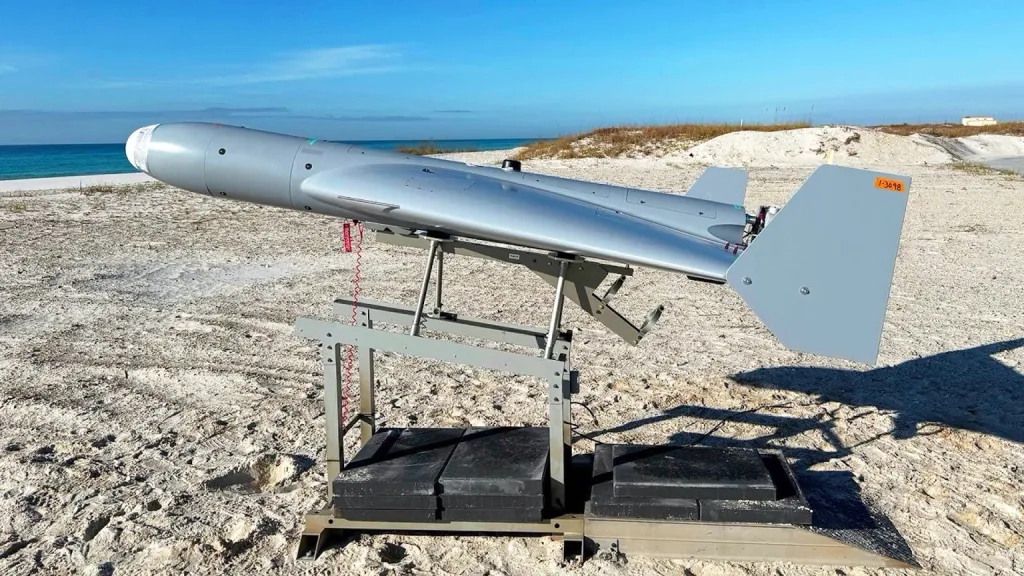
The U.S. military first announced it had begun fielding LUCAS, which was reverse-engineered from the Iranian-designed Shahed-136, in December 2025. This came just months after TWZ laid out a detailed case for why the U.S. military should start acquiring Shahed-136 clones in large volumes. LUCAS made its official combat debut in the opening phases of major combat operations against Iran earlier this year. The pusher-propeller, combustion-engine-powered kamikaze drones, which are employed from static launchers that can be positioned on the ground or installed on ships, and with the help of a small rocket booster, were subsequently praised as “indispensable” by America’s top commander in the Middle East.

A LUCAS drone on a static launcher. Shield AI

With all that in mind, “long-range strike drones like LUCAS, how is that fitting into your planning and training?” our Howard Altman asked the panelists at AUSA.

“We’ve taken our Bayonet Academy, as we call it, a training area at JBLM [Joint Base Lewis-McChord in Washington State], and have started incorporating the employment of long-range one-way attack. Like, how do I maintain it? How do I employ it? How does that then get orchestrated in order to achieve that effect?” Maj. Gen. Bernard Harrington, head of the 7th Infantry Division, responded. “So we see that playing a key role in order to be able to achieve that effect at mass, … [and] in an affordable manner, while also being able potentially to preserve something that’s more exquisite for something that requires an exquisite munition.”

Earlier this year, the Army brought the 7th Infantry and the 1st Multi-Domain Task Force together under the umbrella of what it now calls the Multi-Domain Command-Pacific (MDC-PAC). Maj. Gen. Harrington is also now the commander of MDC-PAC, and has talked previously about how he sees uncrewed capabilities as critical to overwhelming adversaries in future conflicts. The service’s MDTFs, of which there are now four, have been at the leading edge of fielding new long-range strike and other advanced capabilities.

In his response to Altman’s question, Harrington elaborated more on how he sees long-range one-way attack munitions like LUCAS factoring specifically into future fights in the Pacific, such as one against China. The Chinese People’s Liberation Army (PLA) has already established extensive anti-access and area denial (A2/AD) bubbles in the Western Pacific and is continuing to expand on that strategy.

A map showing Chinese military outposts in the Spratly Islands at the southern end of the South China Sea, including those seen in the pictures in this story, as well as other non-Chinese facilities in the hotly contested region. This gives a good sense of the anti-access/area denial bubbles that China has already established and continues to expand upon. DOD

“So as we start modeling out what it looks like to be able to penetrate a portion of the anti-access/area denial network in support of the joint task force in the PACOM [U.S. Pacific Command] area of operations, we started looking at, well, how do I bend – how do I achieve mass at a cost curve?” the 7th Infantry and MDC-PAC commander explained. “What effect am I really trying to achieve on a system in order to provide that window of opportunity for that joint force commander?”

“So maybe I don’t necessarily need to sink a ship, but if I take out certain systems on that vessel, well then it creates this temporal window opportunity,” he continued. “Then that joint force commander can surge in that carrier strike group or bomber task force.”

What the general is describing here is typically referred to as a mission kill. For years now, TWZ has repeatedly highlighted how long-range one-way attack drones and loitering munitions could be used in exactly this way against even larger warships. Damaging or destroying radars, communications antennas, and other subsystems could severely degrade a ship’s combat effectiveness and increase its vulnerability to follow-on attacks. The time and effort required for repairs could keep it sidelined for a protracted period of time.

A LUCAS drone seen being launched from the stern flight deck of the US Navy’s Independence class Littoral Combat Ship (LCS) USS Santa Barbara during a test. NAVCENT/C5F/U.S. Army Spc. Kayla Mc Guire

“So when we started looking at that, we saw great value. That maybe I don’t have to use specifically or unmask an exquisite system to achieve that effect,” Harrington added. “If I can achieve [the] effect of mass utilizing lower cost systems, hey, maybe that will get me there. So we modeled that, and what we saw was, particularly with our unmanned surface vessels [USV], long-range one-way attack, long-range launch effects, the ability to synchronize and mass that could potentially get us to achieve that effect.”

As with long-range one-way attack drones, the adoption of kamikaze USVs by the U.S. military is evolving rapidly. America’s first use of this capability in real combat also came against Iran in July.

The term “launch effects” that Harrington used here is a catch-all term the U.S. military now routinely applies to a diverse array of uncrewed aerial systems designed to be launched from other platforms in the air, on the ground, and/or at sea. This includes loitering munitions, but also designs configured for surveillance and reconnaissance, electronic warfare, signal relay, and other tasks. The lines separating long-range one-way attack drones, launched effects, and traditional cruise missiles and decoys are in many cases now very blurry.

None of this is limited to the Pacific region or the Middle East, either.

“So, in terms of launch effects, I think you mentioned LUCAS. Covenant’s out there. There’s other systems that are out there,” Brig. Gen. Steven Carpenter, head of Multi-Domain Command-Europe (MDC-E), another one of the panelists, also said in direct response to Howard Altman’s question. “In Europe, we like that, more than accepting risk in an area, maybe we’re disintegrating an anti-access/area denial bubble in the center, and then way up north, we’re going to go ahead and accept some risk there. We like to use those systems to create counter-fire parity, long-range fires parity with an adversary.”

Similar to the establishment of MDC-PAC, MDC-E was formed last year by blending together the 56th Artillery Command and the 2nd MDTF, both of which are forward-deployed in Germany.

The “Covenant” mentioned by Carpenter is a U.S.-Israeli company that has been developing a long-range strike weapon system called Anthem. It was just confirmed in September that the U.S. Army has been actively engaged in testing of Anthem. This includes a live-fire demonstration in Morocco earlier this year. You can read more about Anthem and the current plans for it here.

An example of Covenant’s Anthem long-range strike weapon, seen here being tested by the US Army. US Army

“The reason we like those types of systems is because they’re EMI [electromagnetic interference] resilient, they’re longer range, and they’re higher yield, so they can go ahead and destroy like SS-26 systems, SS-21 systems,” the MDC-E commander added.

SS-26 Stone and SS-21 Scarab are the NATO reporting names for Russia’s Iskander-M and the older Soviet-designed OTR-21 Tochka short-range ballistic missiles, respectively. They are both fired from road-mobile launchers. Russia and Ukraine have employed Tochka in the course of their ongoing conflict, though their role on both sides has steadily diminished amid shrinking inventories. Tochka is also increasingly limited in service elsewhere globally. Iskander-M is a much more capable design that has factored heavily into U.S. military planning in Europe for years now. The U.S. military has previously acknowledged that war in Ukraine has led to improvements to that missile that make it even more dangerous and difficult to intercept.

A stock picture of an Iskander-M short-range ballistic missile being fired from a road-mobile transporter-erector-launcher. Russian MoD

Long-range one-way attack munitions like LUCAS are well suited to striking surface-to-surface and surface-to-air missile launchers, along with other high-value and time-sensitive targets, as TWZ highlights regularly. It’s also worth noting that Iran’s Shahed-136, specifically, traces its roots back to pioneering Israeli developments in munitions of this kind, where the focus initially was explicitly on finding new avenues to neutralize hostile air defenses. Iran has shown Shahed-136s and other related designs being employed in exactly this way in large-scale exercises in the past, as seen in the video below.

Shahed 136 drone Great Prophet 17 drill thumbnail

Shahed 136 drone Great Prophet 17 drill

More recently, Iranian forces demonstrated just how effective these capabilities could be in a real-world context in retaliatory attacks on prized air defense radars on the opposite side of the Persian Gulf after the United States and Israel launched their open waves of strikes back in February. TWZ previously explored the far-reaching ramifications of this in a detailed feature that you can find here.

Overall, as we’ve previously written:

“When it comes to this class of drone, speed and advanced guidance concepts do not define its utility. Range and cost do. Survivability comes in numbers, and due to their smaller size, use of composite materials, and small internal combustion engine, as well as their slow speed. These attributes, along with their low-altitude flight profile, mean they possess a reduced signature and general level of detectability that can be a challenge for traditionally configured ground-based radars. Despite their smaller signature, the fact that they are still somewhat vulnerable to interception is actually a positive, but we will get to that in a moment.”

“Above all else, the Shahed-136 and other long-range one-way attack drones exist to put a relevantly-sized warhead on a target far from their launch position at the lowest possible cost. It was previously estimated that the Russian Shahed-136 variant costs around $50,000 per copy, with some estimates being far lower. This cost has also likely declined significantly since Russia has mastered the design and drastically ramped up serial production. By comparison, traditional cruise missiles with similar range have costs in the millions of dollars per round, so the price differential is very dramatic. The Shaheds are also just far easier to build and can be produced in much less time than a typical cruise missile.”

Another look at a LUCAS long-range one-way-attack drone. Mark Schauer/US Army

The ‘mass’ afforded by LUCAS and other long-range kamikaze drones also imposes problematic cost calculations for opponents when it comes to the air defense equation, and offers a way to rapidly drain an opponent’s stocks of vital interceptors. These are realities the U.S. military is currently grappling with after expending thousands of anti-air interceptors in conflict with Iran and in other crises in the Middle East in recent years, as well as supporting allies and partners, such as Ukraine.

LUCAS, specifically, is already in line to become even more capable through the introduction of a swarming capability, made possible by the Hivemind autonomy software package from Shield AI. As we’ve explained before:

“Using the software, multiple LUCAS drones will be able to share tasks and maneuver cooperatively, making saturation attacks even more effective. As well as the drones dynamically rerouting, avoiding air defenses, and otherwise adapting to changing battlefield conditions, an AI pilot makes it easier for missions to continue despite hostile jamming or loss of datalink connectivity. Indeed, using AI, drone swarms can maintain near-perfect combat efficiency even if it loses members. Drones can be configured with all different payloads, with the swarm’s makeup tailored to each mission, and the AI system can maximize their collective effectiveness at all times.”

The U.S. Army still has many questions to answer about how it will field LUCAS and other long-range one-way-attack drones on a more widespread basis, as well as train personnel to employ them. As evidenced by the establishment of the MDTFs, and now the MDC-PAC and MDC-E formations, the underlying force structure that will go along with all of this is still evolving, as well.

The remarks from Maj. Gen. Bernard Harrington and Brig. Gen. Steven Carpenter at AUSA this week show senior Army leaders are working hard now to lay the groundwork to answer these questions. A clear vision for how LUCAS and similar weapons will be employed in future fights against land-based and maritime threats is taking shape already.

Contact the author: joe@twz.com
Joseph is TWZ’s Deputy Editor, helping to oversee the site’s highly experienced and dedicated team, while also writing informative and impactful defense and national security content. He lives right in the thick of it in the Washington, D.C. area.


Howard is a Senior Staff Writer for TWZ. He writes frequently about conflict, focusing heavily on the Middle East and Ukraine, and interviews with military and intelligence officials and industry leaders from around the globe. He lives near Tampa, Florida, home of U.S. Central Command, U.S. Special Operations Command.


Source link

What The Army’s Pacific Commanders Are Learning From Ukraine And Iran Conflicts

Army leaders preparing for a potential fight in the Pacific told us that some of the biggest lessons they’ve learned from the war in Ukraine and America’s now-paused fight against Iran are to move around assets that you can and find a better way to camouflage those that you can’t. While seemingly common sense, these lessons come from watching how war is now waged. The ubiquity of drones in Ukraine providing constant overwatch and strike capabilities, and U.S. troops killed and equipment destroyed or damaged by massive Iranian barrages on static installations are informing changes to how the Army trains, equips and operates.

These conversations took place during the recently wrapped Association of the U.S. Army (AUSA) annual convention in Washington, D.C., which TWZ attended.

“A lot of the things that are happening right now in terms of long-range fires, integrated air and missile defense, and the lessons that we’re learning from them, we’re able to bring a lot of that to our potential challenges in the Pacific,” Gen. Ron Clark, commander of U.S. Army Pacific (USARPAC), told us at a media roundtable. “Specifically, I am thinking through mobility and camouflage. So it’s one of those age-old Army forgotten sciences of how to hide in plain sight and how to camouflage ourselves from observation, because the ability to be able to see surface entities is almost ubiquitous.”

“Our ability to be able to use electronic warfare, to be able to use just good old-fashioned camouflage, and the ability to deceive our adversary is a must,” Clark added. You can read more about the U.S. military’s camouflage and deception efforts in our story here.

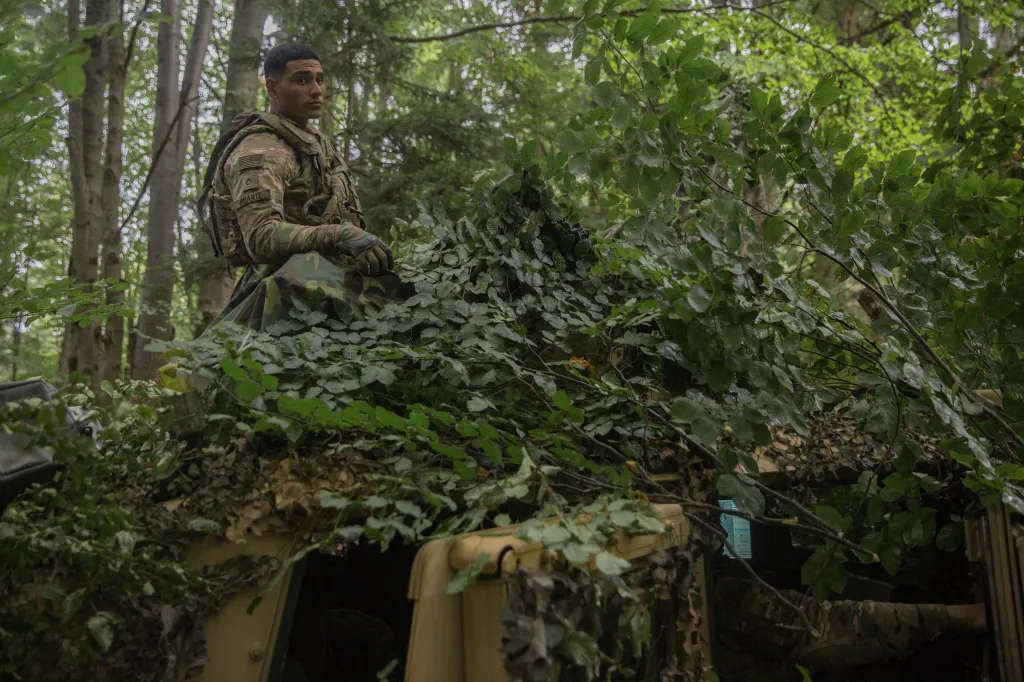
U.S. Army Soldiers of Brigade Engineer Battalion camoflages humve while conducting preperations during exercise Combined Resolve VII at the U.S. Army’s Joint Multinational Readiness Center in Hohenfels Germany, Sept. 5, 2016. Combined Resolve VII is a 7th Army Training Command, U.S. Army Europe-directed exercise, taking place at the Grafenwoehr and Hohenfels Training Areas, Aug. 8 to Sept. 15, 2016. The exercise is designed to train the Army’s regionally allocated forces to the U.S. European Command. Combined Resolve VII includes more than 3,500 participants from 16 NATO and European partner nations. (U.S. Army photo by Pfc. Randy Wren)
U.S. Army soldiers of Brigade Engineer Battalion camouflages a Humvee while conducting preparations during exercise Combined Resolve VII at the U.S. Army’s Joint Multinational Readiness Center in Hohenfels Germany. (U.S. Army photo by Pfc. Randy Wren) Spc. Randy Wren

As we have frequently reported about the Ukraine war, both sides have been using a variety of “old-fashioned” tactics to duck, dodge and hide. They range from practices like smokescreens to hide from drones to updates on measures from the past like paint schemes designed to obfuscate vehicles and other equipment from AI-enabled targeting systems.

Several images showing the unusually painted Russian trucks have appeared on social media channels in recent days. So far, examples of Ural and KAMAZ heavy-duty truck designs have appeared. There are at least two distinct patterns so far: a zebra-style application of broadly straight lines, and a more organic leaflike, swirling design. In both cases, they extend over most external surfaces, including the wheels and tires. The white paint is simply applied over the base color of dark green.
A Russian heavy-duty truck painted with zebra-style stripes to confuse AI-assisted target seeking equipment. via X

 As tough as things have been for Ukraine and for U.S. forces in the Middle East, the challenges will be even greater in the Pacific, Clark warned.

In Europe and the Middle East, “it’s not a near-peer adversary that we will be working against,” said Clark, referring respectively to Russia and Iran.

“Whereas in our theater, it absolutely is,” the USARPAC commander noted in a reference to China without naming the country. “So our ability to scale that and to think through the problem sets of how do we fight Type One, Type Two UAS? How do we think through ballistic missile defense holistically in the region? We spend a lot of time working with the joint force for solutions associated with that. How do we maneuver inside an archipelagic environment?”

BEIJING, CHINA - SEPTEMBER 03: DF-17 medium-range hypersonic ballistic missiles of the hypersonic missile formation attend V-Day military parade to commemorate the 80th anniversary of the victory in the Chinese People's War of Resistance against Japanese Aggression and the World Anti-Fascist War on September 3, 2025 in Beijing, China. (Photo by Sheng Jiapeng/China News Service/VCG via Getty Images)
DF-17 medium-range hypersonic ballistic missiles on display during the V-Day military parade in Beijing. (Photo by Sheng Jiapeng/China News Service/VCG via Getty Images) China News Service

For the Army, any fight in the Pacific will require soldiers to be able to hop islands and move through vast swaths of ocean, constantly hunted and frequently inside the Chinese weapons engagement zone. Clark said that the Army’s organic fleet of ships like landing craft, small tugs, and modular causeway systems operated by the service’s 8th Theater Sustainment Command will be vital for maneuver.

The Army, however, is struggling to keep its aging fleet of 70 of these vessels in the water and it got rid of a number of others over the years. Concerns about this underappreciated force have been something TWZ has raised for years.

Two U.S. Army Landing Craft Utility (LCU) vessels. (U.S. Army) www.twz.com

“But we also have to be able to conduct tactical maneuver with forces on the ground that can provide long-range precision fires, as an example, and then move so that fires, radars, sensors are not easily targeted,” Clark added. “Because if they can see you, they can hit you. And if you know they have an opportunity to return fire, they will. So our lessons that we’re learning are, in some cases, are very, very relevant. In some cases, we can learn from some of the changing characteristics of war.”

Still, the wide-open plains and dense cities of Ukraine are quite different from the beaches and jungles of the Pacific, Clark reminded us.

U.S. Army Soldier assigned to the 1st Battalion, 27th Infantry Regiment, 2nd Mobile Brigade, 25th Infantry Division, observes a linear danger area during the Joint Pacific Multinational Readiness Center Rotation (JPMRC) 26-01 at Schofield Barracks, Hawaii, Nov. 6, 2025. The United States Army Pacific (USARPAC) conducted Joint Pacific Multinational Readiness Center (JPMRC) Rotation 26-01 from Nov. 3 - 17, 2025, in and around the Hawaiian island chain. This exercise is designed to validate the combat readiness of the 3rd Mobile Brigade (3MBDE), 25th Infantry Division Artillery (DIVARTY), and the 125th Division Signal Battalion in a joint, multinational, multi-domain training environment. JPMRC 26-01 integrated U.S. forces, multinational partners, and joint capabilities to train tactics, techniques, and procedures required to dominate jungle and archipelagic terrain during large-scale combat operations. The exercise underscores the U.S. Army’s commitment to ensuring regional security and strengthening partnerships in the Indo-Pacific area of responsibility. (U.S. Army photo by Sgt. Duke Edwards)
A U.S. Army soldier assigned to the 1st Battalion, 27th Infantry Regiment, 2nd Mobile Brigade, 25th Infantry Division, observes a linear danger area during the Joint Pacific Multinational Readiness Center Rotation (JPMRC) 26-01 at Schofield Barracks, Hawaii, Nov. 6, 2025. (U.S. Army photo by Sgt. Duke Edwards) Sgt. Duke Edwards

“The way we generally fight does not equate specifically in the Ukraine piece to the maneuver that you would see out of U.S. forces if deployed in a conflict like that,” the USARPAC commander explained. “To be able to use operational maneuver and tactical maneuver in a way that it’s not just simply drone on drone or firing long range fires at one another at scale for an extended period of time. We find our way to work through that problem set and maneuver to positions of advantage and to prevail.”

Regardless of the terrain, the ubiquity of drones in the Ukraine war has made maneuver and resupply deadly endeavors, with much of the front lines bogged down with limited territorial advances by either combatant.

When we pushed further on that point, Gen. Xavier T. Brunson, commander of United Nations Command, Combined Forces Command and United States Forces Korea, weighed in.

“To be able to move with sensors everywhere at all times causes us to achieve positions of advantage from distributed locations,” Brunson pointed out. “So the fight is: you look at maneuver. You might maneuver to a position of advantage, knowing that you’re going to change that again. The ability to utilize not only joint sensors but joint effectors, if you will, joint fires, to be able to use those things from different positions changes the shape of the operating environment.”

The bottom line, he added, is that “maneuver is always going to be maneuver. You’re going from A to B, but you might go from A to A1 to A2 to A3 to get to B, and that’s what I think we realize in this distributed fight that’s going on in Ukraine, and so we continue to watch to see what lessons might be coming back into” effect.

In part reacting to lessons learned from Ukraine and the Middle East, the Army is also changing how it trains, Clark stated. In South Korea, he said the service has to get out of the habit of concentrating so heavily on just two annual major training exercises.

“We recognize… that largely the two big exercises every year in Korea focus on large command posts,” Clark proffered. “We’ve got to move away from that. So what we intend to do is take advantage of the knowledge that we have of the threats that exist or that prevail in the Ukraine fight.”

Republic of Korea Army 5th Engineer Brigade, K1A2 tank crosses a U.S. Army Improved Ribbon Bridge (IRB) during joint wet gap training as part of Freedom Shield 25 at Yeoncheon-gun, Republic of Korea, Mar. 20, 2025. Freedom Shield 25 is an annual combined military training exercise integrating ground, air, naval, space, and cyberspace elements to showcase capability, lethality, and enhance readiness through realistic combat scenarios. (U.S. Army photo by Sgt. Daniela Lechuga Liggio)
A Republic of Korea Army 5th Engineer Brigade, K1A2 tank crosses a U.S. Army Improved Ribbon Bridge (IRB) during joint wet gap training as part of Freedom Shield 25 at Yeoncheon-gun, Republic of Korea, Mar. 20, 2025. (U.S. Army photo by Sgt. Daniela Lechuga Liggio) Sgt. Daniela Lechuga

Clark said these discussions are underway with his deputy commander, Republic of Korea Army Gen. Sungmin Kim.

“We talk about how we would operate in a distributed fashion. You know as well as I do, there’s a location that we go to to train every year in Korea, and we stay in that place,” Clark said in response to a question from another reporter. “What would it look like if we train from Jeju all the way up to Gyeonggi Province in the north? What would that look like, just with our headquarters alone?”

“So just imagine,” Clark postulated, “if we train across the entirety of the peninsula, and got ourselves in the shape where we would say [to North Korea], ‘You can’t utilize the things that you’ve learned in the fight and the battlefield in Ukraine on us, because we learned the same lessons and we’ve distributed ourselves in such a way that we don’t make ourselves the target. We won’t be moored in place,’ and that’s what I’m talking about when I talk about positional advantage. It might not be the same place to the continuum. It might not be the same place when you’re in crisis or conflict or competition. We might have to change that, and that’s what we’re learning.”

South Korea. (Google Earth)

Another lesson from Ukraine that Army leaders should be paying attention to, said another panelist, is how both sides are using aerial and ground drones to supply frontline forces and evacuate the wounded because human efforts have now become too deadly, thanks to drones.

“I think you also can’t talk about Ukraine without talking about autonomy,” said Tara Murphy Dougherty, CEO of a company called Air, which provides AI-based sustainment solutions to the Army.

“One of the advantages that you get from using simulation and automation, and really using models and compute in order to create convoy plans, as opposed to humans with Excel spreadsheets, is you are able to do many fewer actual convoys because you’re using all of your capabilities so much more effectively and efficiently,” Dougherty posited. “And while it’s an indirect example, I think it does tie to soldier protection because you’re putting fewer soldiers out there in vulnerable settings. I see that not as an end-goal outcome; we need convoys.”

Ultimately, however, the Army will have to advance what Ukraine and Russia are doing with the deployment of aerial drones and uncrewed ground vehicles for logistics by creating “convoys” of autonomous vehicles.

“I see the end goal outcome as having as many autonomous convoys as possible, and we’ve heard today already at this event some of those ideas,” the CEO added. “In the interim, until we get to more autonomy in medevac and more autonomy in convoys when it’s non-soldier material that’s going out to the battlefield, let’s try and put fewer out there while actually getting more material and capability into the force where it needs to be.”

A Hunter Wolf unmanned ground vehicle assigned to Charlie Battery, 3rd Battalion, 320th Field Artillery Regiment, 3rd Mobile Brigade, 101st Airborne Division (Air Assault), holds a steady overwatch position with a mounted remote operated .50-caliber machine gun during a combat simulation exercise at the Joint Readiness Training Center, Fort Polk, Louisiana, April 13, 2026.. The Hunter Wolf platform has been selected by the U.S. Army for the Small Multipurpose Equipment Transport (S-MET) program. (U.S. Army photo by Master Sgt. Anthony Hewitt)
A Hunter Wolf unmanned ground vehicle assigned to Charlie Battery, 3rd Battalion, 320th Field Artillery Regiment, 3rd Mobile Brigade, 101st Airborne Division (Air Assault). (U.S. Army photo by Master Sgt. Anthony Hewitt) Master Sgt. Anthony Hewitt

The Iranian missile and drone barrages on fixed U.S. bases across the Middle East have created some very costly lessons for American forces. As we noted earlier in this story, several troops were killed and critical air defense radars, aircraft and other important equipment were destroyed or damaged. U.S. installations across the region have also suffered damage.

In another media session, we pressed Army officials operating in South Korea about what they learned from watching the destruction caused by Iran and what they are doing to address it.

You can see a satellite image of damage to a U.S. radar site in Jordan below:

“We certainly are watching what’s happening, and we are learning from what is happening in Operation Epic Fury,” Lt. Gen. Joseph “Joe” Hilbert, commanding general of Eighth Army, stationed in South Korea, told us. “We’re learning what’s happening in Ukraine, and we are working through changes in our own tactics and techniques and procedures to be able to react to those threats and to be able to defend against them.”

For more details, he turned the microphone over to Col. Rosanna “Ro” M. Clemente, commander of the 35th Air Defense Artillery Brigade in South Korea.

“Drawing from those lessons learned, a lot of it is trying to understand how our systems are being hunted by the adversary,” she told us. “So, strictly into all of our training plans, and as we conduct our own internal exercises, all of our air defenders are practicing something as simple as mobility and survivability jumps, which is being able to reposition and displace your systems to different alternative locations based on any type of threat warnings that we receive. They’re very, very well trained. I think all of our soldiers know how to move their systems extremely, extremely well. They move them quickly, and they are able to move them and reposition them into different locations across the peninsula that still maintains that ballistic missile defense coverage.”

U.S. Army Pvt. Nathaniel Mullins, assigned to the 35th Air Defense Artillery Brigade, analyzes a Sentinel A4 air and missile defense radar during a training exercise at Camp Humphreys, South Korea, April 22, 2026. The training highlighted Eighth Army’s continued modernization efforts by preparing Soldiers to operate the new radar system. (U.S. Army photo by Cpl. Luciano Alcala)
U.S. Army Pvt. Nathaniel Mullins, assigned to the 35th Air Defense Artillery Brigade, analyzes a Sentinel A4 air and missile defense radar during a training exercise at Camp Humphreys, South Korea, April 22, 2026. The training highlighted Eighth Army’s continued modernization efforts by preparing soldiers to operate the new radar system. (U.S. Army photo by Cpl. Luciano Alcala) Sgt. Luciano Alcala

In addition, “we also have to rely on the other pillars of integrated air and missile defense, most specifically the passive defensive measures that we also have in place,” she added.

Those measures involve “a little bit more than just hardening – but a couple of other techniques that we’ve learned from the Russia-Ukraine war in terms of deception, how to move things around, create distractions, and make sure that we create different types of dilemmas for the adversary in terms of where our capabilities are and where are they positioned to protect its defended assets.”

Contact the author: howard@twz.com

Howard is a Senior Staff Writer for TWZ. He writes frequently about conflict, focusing heavily on the Middle East and Ukraine, and interviews with military and intelligence officials and industry leaders from around the globe. He lives near Tampa, Florida, home of U.S. Central Command, U.S. Special Operations Command.


Source link