Armored

No, The Army Isn’t Fielding New AMPV Armored Vehicles With 30mm Cannons

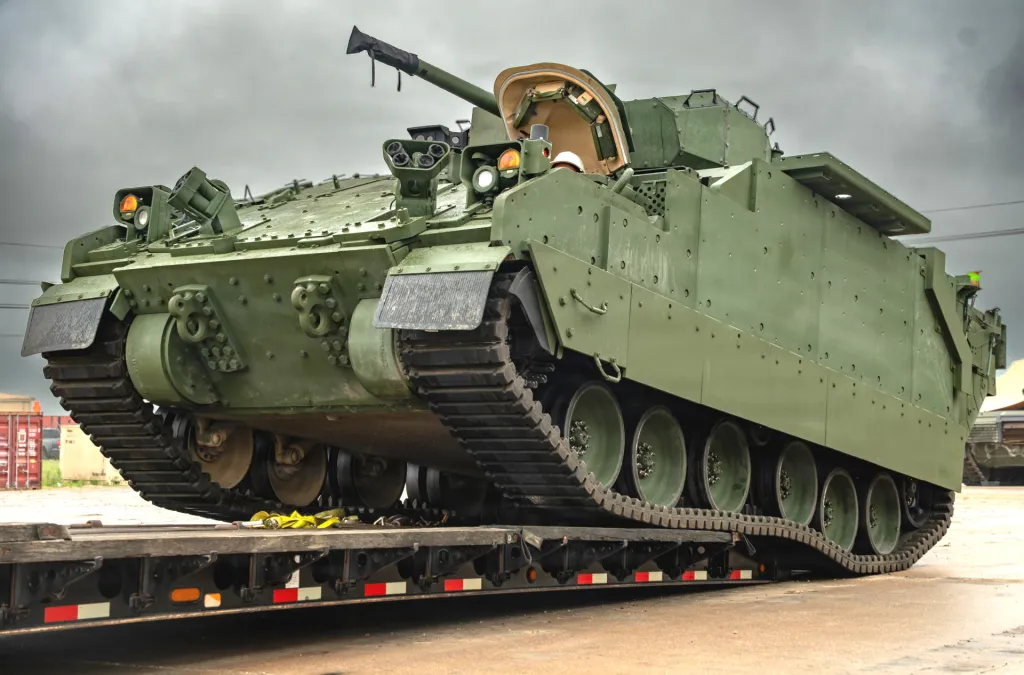
The U.S. Army’s 1st Cavalry Division turned heads yesterday with social media posts that seemed to suggest the unit had begun fielding a new version of the Armored Multi-Purpose Vehicle (AMPV) armed with a turreted 30mm cannon. Multiple outlets and large social media channels subsequently reported the news this way. TWZ asked the Army and defense contractor BAE Systems for more information, and both have clarified that the two AMPV 30s delivered this week are company-funded prototypes that are only set to be tested.

The Army will evaluate the AMPV 30s as part of the Transformation In Contact (TIC) 2.0 initiative. TIC efforts, in general, have been focused on helping accelerate the fielding of new and improved capabilities, as well as tactics, techniques, and procedures to go with them. However, presently, the service has no plans to acquire this variant of the AMPV.

Another view of one of the AMPV 30s being delivered to the 1st Cavalry Division this week. US Army/Spc. Michelle Lessard-Terry

The Army selected the Bradley-based AMPV as the replacement for its long-serving M113 family of armored personnel carriers and related vehicles in 2014. The service’s current program of record includes five AMPV variants, all of which are turretless. The M1283 general-purpose personnel carrier, the M1284 medical evacuation vehicle, the M1285 medical treatment vehicle, the M1286 command and control version, and the M1287 mortar carrier vehicle.

A graphic giving a general overview of the five AMPV variants the US Army is currently acquiring. US Army

So it came as something of a surprise when the 1st Cavalry Division announced the arrival of the AMPV 30s yesterday.

“Big news! The 1st Cavalry Division has just received the Army’s FIRST AMPV 30mm prototypes,” a post from the 1st Cavalry Division’s official account on X had declared. “Our troopers are leading the charge once again by integrating this next-generation capability into the formation and transforming how armored Divisions fight.”

Big news! The 1st Cavalry Division has just received the Army’s FIRST AMPV 30mm prototypes. Our troopers are leading the charge once again by integrating this next-generation capability into the formation and transforming how armored Divisions fight. #BeLegendary #PegasusCharge pic.twitter.com/Ny1gDRA796

— 1st Cavalry Division (@1stCavalryDiv) April 30, 2026

The 1st Cavalry Division, which is based at Fort Hood in Texas, also shared a set of pictures of the vehicles yesterday through the U.S. military’s Defense Visual Information Distribution Service (DVIDS) website. “The AMPV features a remote 30mm turret capable of using programmable airburst ammunition, designed to target small drones and unarmored ground threats, embodying the Transforming in Contact initiative to dominate the modern battlefield,” per a common caption attached to all of these images.

As an aside, some were quick to point out a certain irony in the idea that the Army had fielded a new version of the AMPV with a cannon-armed turret. An AMPV in this configuration looks very similar to the Bradley on which the original turretless variants were based.

Despite the phrasing of the 1st Cavalry’s social media posts, the AMPV 30s are “an internal research and development type effort from BAE Systems,” an Army spokesperson told TWZ today. “It is not something the Army procured, nor is there a requirement for the system at this time.”

“This system will be participating in TIC, but again, there is no Army requirement,” the spokesperson added.

“BAE Systems provided two prototype AMPV 30s to the U.S. Army to participate in the upcoming Transformation in Contact (TiC) 2.0 initiative,” the company told TWZ in a separate statement. “The vehicles were developed through self-investment and based on the proven chassis of the Armored Multi-Purpose Vehicle (AMPV). Over the next several months, the Army will run the AMPV 30s through field evaluations to benchmark the platform’s capabilities against what Soldiers require to maintain advantage on the modern battlefield.”

US Army personnel at Fort Hood check out an AMPV 30, at right, as it is delivered on April 30, 2026. A Bradley Fighting Vehicle is seen in the background. US Army/Spc. Michelle Lessard-Terry

“Our mission was speed and innovation, and we delivered beyond expectations. With today’s battlefield evolving faster than ever, it’s paramount that Soldiers have the capabilities they need to win the fight,” a BAE Systems spokesperson also told TWZ today. “Throughout this effort, our team demonstrated how we can integrate new design solutions in a time-effective and more cost-efficient manner for the Army.”

BAE Systems also confirmed that the turret on these up-gunned AMPVs is the Medium Caliber Turret-30 (MCT-30) from Norway’s Kongsberg Defense. This is a remotely operated design that contains a Mk 44 Bushmaster II automatic cannon, as well as a fire control suite that includes electro-optical and infrared cameras. It is interesting to note that the Marine Corps is in the process of acquiring a variant of its 8×8 wheeled Amphibious Combat Vehicle (ACV) equipped with MCT-30. BAE is also the prime contractor for the ACV family. In addition, the Army has two variants of the 8×8 Stryker wheeled armored vehicle armed with XM813 cannons, which are based on the Mk 44, but neither uses the MCT-30 turret.

A Marine ACV-30 prototype with the MCT-30 turret. USMC

An AMPV equipped with the MCT-30 was first shown publicly back in 2024. The turret in that case was also fitted with a Javelin anti-tank guided missile launcher. BAE Systems also previously announced the development of what it calls the External Mission Equipment Package (ExMEP) for these vehicles, which consists primarily of a new top plate that allows for the relatively rapid integration of various turrets. The company has said in the past that ExMEP can accommodate “more than 30 turret systems.”

In 2024, BAE had delivered another AMPV variant to the Army for evaluation, which was armed with a turreted 120mm rapid-firing mortar called NEMO (a contraction of “NEw MOrtar”). Patria in Finland, in cooperation with Kongsberg, supplied the mortar turret. The Army has not yet moved to acquire that version, either.

Armored Multi-Purpose Vehicle - Patria NEMO 120mm Mortar Variant thumbnail

Armored Multi-Purpose Vehicle – Patria NEMO 120mm Mortar Variant


What interest the Army might ultimately have in the AMPV 30 remains to be seen. The service continues to operate Bradley variants and is working to update them with new capabilities, including Iron Fist active protection systems (APS). A test last year also demonstrated the ability of the vehicle to fire a loitering munition from its TOW missile launcher, which could open up new operational possibilities. The Army is also pursuing a separate replacement for the Bradley, tentatively designated the XM30, which will be armed with a larger 50mm cannon as its main weapon.

A Bradley Fighting Vehicle fires a Raytheon Coyote LE SR loitering munition during a demonstration in 2025. US Army

The mention of the counter-drone mission in relation to the prototype AMPV 30s delivered to the 1st Cavalry Division could point to a potential use case for the Army. The service previously had an air defense variant of the Bradley, the M6 Linebacker, which had a launcher for Stinger short-range heat-seeking surface-to-air missiles rather than TOWs. The last M6s were converted into standard M2 Bradley Infantry Fighting Vehicles in the mid-2000s, and no direct replacement for that capability was ever acquired.

An M6 Linebacker. US Army

In the meantime, the threat posed by drones has continued to grow, prompting a surge in demand across the U.S. military and elsewhere globally for new capabilities to shoot them down or otherwise defend against them. The ongoing conflict in Ukraine, in particular, has underscored the critical importance of protecting heavy armored vehicles from uncrewed aerial attackers.

A Ukrainian drone from the 79th Air Assault Brigade drops a 40mm HEDP grenade on a Russian UR-77 Meteorit, causing a catastrophic payload explosion. pic.twitter.com/SsaQCKXsNL

— OSINTtechnical (@Osinttechnical) August 14, 2023

BAE Systems has previously shown another version of the AMPV in a more dedicated air defense configuration with a turret armed with a 30mm XM914 cannon, which fires a smaller round than the XM813, as well as Stinger missiles. The vehicle, seen in the picture below, also featured several small-form-factor radars to help spot and track incoming threats. An AMPV in a counter-drone or more general anti-air configuration would also be better able to keep up and otherwise operate with Army units equipped with other variants of that vehicle.

BAE Systems A prototype of a variant of the AMPV armored vehicle with the same turret as the Stryker M-SHORAD vehicle. BAE Systems

The Army could also have different demands for new, turreted AMPVs depending on how the XM30 effort continues to evolve. Designs from American Rheinmetall and General Dynamics Land Systems have been competing to secure that contract. However, a program pause and a new request for information for a different, but very similar-sounding vehicle earlier this year have raised questions about the XM30’s overall future.

Cost and other factors have scuttled several previous Bradley replacement efforts. If serious issues arise with the latest XM30 program plans, it might lead to at least a portion of the Bradley fleet ultimately being replaced by turreted AMPV variants instead.

A positive Army assessment of the AMPV 30 could be a boon for BAE, even if the service does not buy any of those vehicles, in the end, too. The combat effectiveness of older Bradley variants has recently been demonstrated in the conflict in Ukraine, and other potential customers could be attracted to the idea of a derivative with a new turret and other more modern features.

For now, anyway, the Army is set to put the AMPV 30 through its paces, but has no plans to buy any of them for its own use.

Contact the author: joe@twz.com
Joseph has been a member of The War Zone team since early 2017. Prior to that, he was an Associate Editor at War Is Boring, and his byline has appeared in other publications, including Small Arms Review, Small Arms Defense Journal, Reuters, We Are the Mighty, and Task & Purpose.


Howard is a Senior Staff Writer for The War Zone, and a former Senior Managing Editor for Military Times. Prior to this, he covered military affairs for the Tampa Bay Times as a Senior Writer. Howard’s work has appeared in various publications including Yahoo News, RealClearDefense, and Air Force Times.


Source link

Ukraine’s M113-Inspired Armored Personnel Carrier In Testing

Ukraine has begun testing a new homegrown armored personnel carrier, a tracked vehicle named Skif (Scythian, an ancient warrior tribe that also lived in parts of modern Ukraine). The development underscores the fact that, despite extensive losses of legacy tracked APCs, this is a class of vehicle that the Ukrainian Armed Forces still prioritizes as it tries to hold off the Russian invasion.

According to reports, UkrArmoTech has begun factory testing a prototype of the Skif, which has apparently been developed in direct response to the requirements of the Ukrainian Armed Forces, drawing from lessons learned since the full-scale Russian invasion in February 2022.

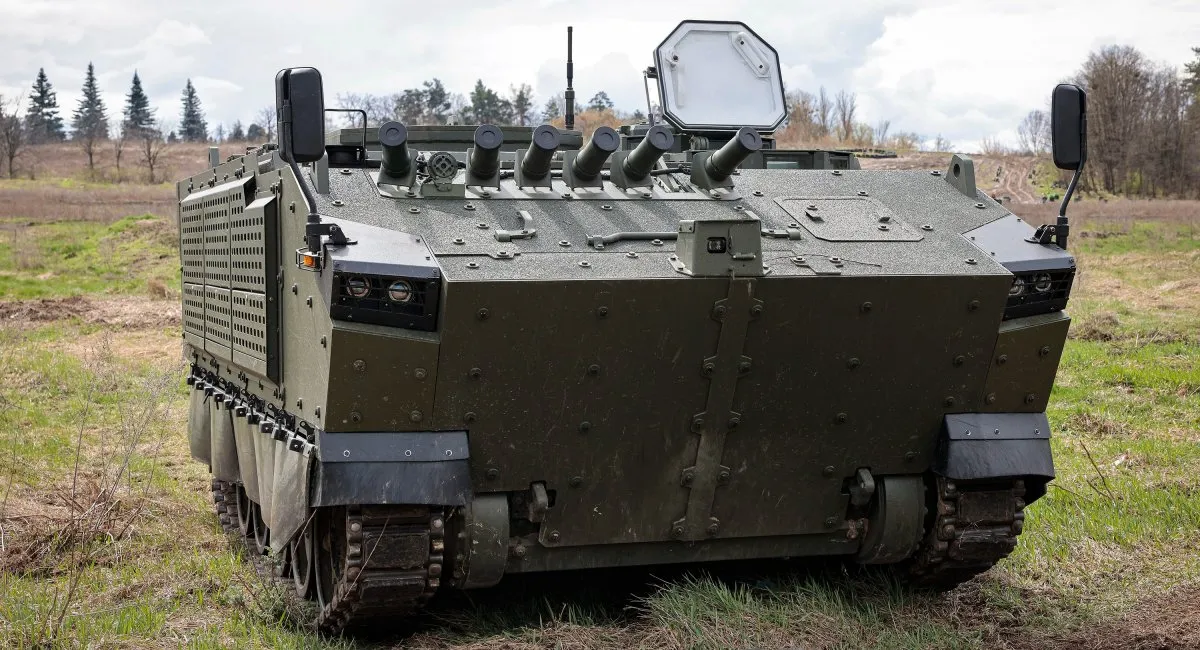
The first prototype of the Skif. UkrArmoTech

UkrArmoTech is among the leading developers and manufacturers of armored vehicles for the Ukrainian Armed Forces, but has, to date, focused on wheeled models such as the Desna, Gyurza, and Tisa. With that in mind, the Skif marks a new direction for the company.

“First and foremost, we relied on our contacts with the military, our understanding of their needs, and our experience with the use of wheeled vehicles on the battlefield,” UkrArmoTech CEO Hennadii Khirhii told the Ukrainian Defense Express website. “Active combat operations in Ukraine have demonstrated the need for a significant number of armored vehicles to ensure and maintain the mobility of units and formations of the Armed Forces and Defense Forces.”

The design of the Skif is heavily influenced by the U.S.-developed M113, a Cold War-era tracked APC, many hundreds of which have been supplied to Ukraine since February 2022.

DONETSK OBLAST, UKRAINE - JULY 4: Ukrainian soldiers exit on the M113 armored personnel carriers in a column for tasks on a military outdoor firing range during exercises on July 4, 2023 in Donetsk Oblast, Ukraine. (Photo by Viktor Fridshon/Global Images Ukraine via Getty Images)
Ukrainian soldiers ride on M113 armored personnel carriers in a column after live-firing exercises in July 2023 in the Donetsk region, Ukraine. Photo by Viktor Fridshon/Global Images Ukraine via Getty Images VIPAVLENKOFF

Despite its age, it seems the M113 has been a success in Ukrainian hands, offering a useful combination of reliability, maintainability, troop-carrying capacity, and off-road mobility.

The designers of the Skif were therefore instructed to produce a vehicle that matched the M113’s mobility while improving on its levels of protection and firepower.

According to reports, the Skif makes use of off-the-shelf components and assemblies from foreign manufacturers involved in the production of armored vehicles that are “descendants” of the M113.

The first prototype of the Skif alongside a U.S.-made Humvee. UkrArmoTech

It’s unclear if this implies that the Skif uses components from Western manufacturers that have built the M113 and its derivatives, or if the Ukrainian vehicle employs parts from other Western-made APCs. Noteworthy is the fact that members of the broader M113 family have been built under license in Belgium, Germany, Italy, the Netherlands, and Turkey, as well as several other countries outside Europe.

Reportedly, 60 percent of the vehicle’s components will initially be imported, and these will include the engine, transmission, suspension components, transfer case, and tracks. If production is launched, an increasing proportion of the components will be made locally.

In its basic form, the Skif is intended to transport soldiers from mechanized units across the battlefield and to provide them with fire support. As well as three crew (driver, commander, and gunner), located in the front section behind the power module, the Skif can accommodate eight soldiers in the rear troop compartment. The troops enter and exit via a rear ramp, as on the M113.

The Skif prototype with the rear ramp open. UkrArmoTech

The prototype of the Skif has an aluminum hull, reportedly the first time this has been used on a Ukrainian combat vehicle. However, a series-production version will likely feature an armored steel. While steel offers better ballistic resistance and is easier to repair in the field, it comes with a significant weight penalty.

With the aluminum hull, the Skif weighs around 15 tons and is driven by a 360-horsepower diesel engine. The modular design means that different engines can be installed, for example, if more power is needed for a steel hull, or when fitted with heavier weapons.

In its basic form, the Skif has a Ukrainian-made remotely controlled combat module on the hull roof. This can be armed either with a 12.7mm or 14.5mm heavy machine gun paired with a 7.62mm auxiliary machine gun. As seen in the photos, the prototype does not currently have the combat module fitted.

A diagram of the Skif with the remotely controlled combat module on the hull roof. UkrArmoTech

Armor protection is in line with NATO STANAG 4569 Level 4 over the frontal section (withstanding, for example, 14.5mm machine gun fire, or a 155mm artillery projectile detonating at 25 meters), and Level 3 on the sides and rear (resistant to 7.62mm gunfire, or a 155mm artillery projectile detonating at 60 meters). Mine protection below the hull is rated at Levels 3a and 3b. The vehicle is expected to withstand the detonation of around 13 pounds of explosives under the hull or tracks.

It’s unclear what kinds of protection are provided against the threat of attack drones, but some type of electronic warfare gear is included; it would also be expected that the vehicle receives a purpose-designed ‘cope cage’ of the kind that has appeared on most Ukrainian and Russian combat vehicle types during the conflict. Otherwise, the Skif is equipped with communications, navigation, situational awareness, and fire-control systems of Ukrainian origin. A bank of smoke grenade launchers is fitted across the front of the hull on the Skif prototype.

UNSPECIFIED, UKRAINE - NOVEMBER 2: Soldiers of the Połk Kalinoŭskaha (Kastuś Kalinoŭski Regiment) reload tracked vehicles at night on November 2, 2025 in Unspecified, Ukraine. The Kastuś Kalinoŭski Regiment is a group of Belarusian opposition volunteers, which was formed during the Russian-Ukrainian war to defend Ukraine against the Russian invasion in 2022. The unit is armed with armored personnel carriers: the US M113 and the British FV103 Spartan. All vehicles are equipped with protection against drones. The main task is logistics on the front line: delivering soldiers to the front line, rotating groups and transporting ammunition. This vehicle also takes the wounded from the battlefield directly under heavy enemy fire. (Photo by Sushchyk Kanstantsin/Global Images Ukraine via Getty Images)
Soldiers of the Połk Kalinoŭskaha (Kastuś Kalinoŭski Regiment) operate an M113 at night in November 2025. The vehicle is equipped with cage-type protection against drones. Photo by Sushchyk Kanstantsin/Global Images Ukraine via Getty Images Global Images Ukraine

The modular design means that the Skif can be adapted for other missions. These are likely to include vehicles equipped for command and control, reconnaissance, anti-armor, mortar carrier, medical evacuation, and more.

With the continued debate over wheeled versus tracked combat vehicles, it is interesting to note that Ukraine, after focusing on the local production of wheeled fighting vehicles, continues to see the necessity for tracked APCs. While heavier, more complex, and more costly, they are better able to deal with the brutal mud that is a feature of Ukrainian winters. They are also generally better in terms of armor protection.

SUMY, UKRAINE - JANUARY 15: A Ukrainian Kozak armored vehicle gets stuck in black soil mud, on its way from positions of American Bradley Fighting Vehicles used during Ukraines on-going cross-border operation into Russias Kursk region, where Ukrainians have fought both Russians and an estimated contingent of 12,000 North Korean troops, on January 15, 2025 in Sumy, Ukraine. Ukrainian officers of the 4th Company, 1st Battalion, 82nd Separate Air Assault Brigade say that this American military hardware has been crucial to their ability to cross into Russia last August, as well as to Ukraines border defense against Russias all-out invasion in February 2022. Senior Ukrainian commanders and officials have expressed concern that deep U.S. military and financial support will ease up or stop with the incoming Trump Administration, which has stated that it would swiftly end the three-year war. (Photo by Scott Peterson/Getty Images)
A Ukrainian Kozak wheeled armored vehicle gets stuck in black soil mud, in Sumy, Ukraine, during the cross-border operation into the Kursk region of Russia, in January 2025. Photo by Scott Peterson/Getty Images Scott Peterson

For that reason, the aging M113 and the Soviet-era MT-LB remain popular choices for the Ukrainian Armed Forces.

KHARKIV, UKRAINE - OCTOBER 25: Two Ukrainian army mechanics repair a broken MT-LB (light armored multi-purpose towing vehicle) in the Donetsk region in Kharkiv, Ukraine on October 25, 2024. Originally designed in the 1960s during the Soviet era, the vehicle entered service a decade later and was manufactured in Kharkiv. (Photo by Fermin Torrano/Anadolu via Getty Images)
Two Ukrainian Army mechanics repair a broken MT-LB armored multi-purpose vehicle in the Donetsk region in Kharkiv, Ukraine, in October 2024. Photo by Fermin Torrano/Anadolu via Getty Images Anadolu

According to the Oryx open-source tracking group, since the start of the current conflict, more than 500 Ukrainian M113s and more than 150 MT-LBs have been confirmed destroyed or damaged. The actual figures are certainly higher, as Oryx only tallies losses that are confirmed with visual evidence.

Despite the need for a vehicle in this class, there remain significant challenges in getting it into production. Very likely, Ukraine will have to rely heavily on foreign funds and expertise if it is to put the Skif into quantity production. Should that prove realistic, Ukraine will likely also seek to sell the Skif to foreign customers, too.

The rear view of the Skif prototype during factory trials. UkrArmoTech

Continued factory testing of the Skif prototype should provide a practical assessment of the new platform’s design maturity, including whether its mobility and running performance meet local requirements. Certainly, the new tracked APC is a bold venture for Ukraine’s war-ravaged industry, but it represents a class of vehicle for which there is a near-insatiable local demand.

Contact the author: thomas@thewarzone.com

Thomas is a defense writer and editor with over 20 years of experience covering military aerospace topics and conflicts. He’s written a number of books, edited many more, and has contributed to many of the world’s leading aviation publications. Before joining The War Zone in 2020, he was the editor of AirForces Monthly.


Source link