Armed

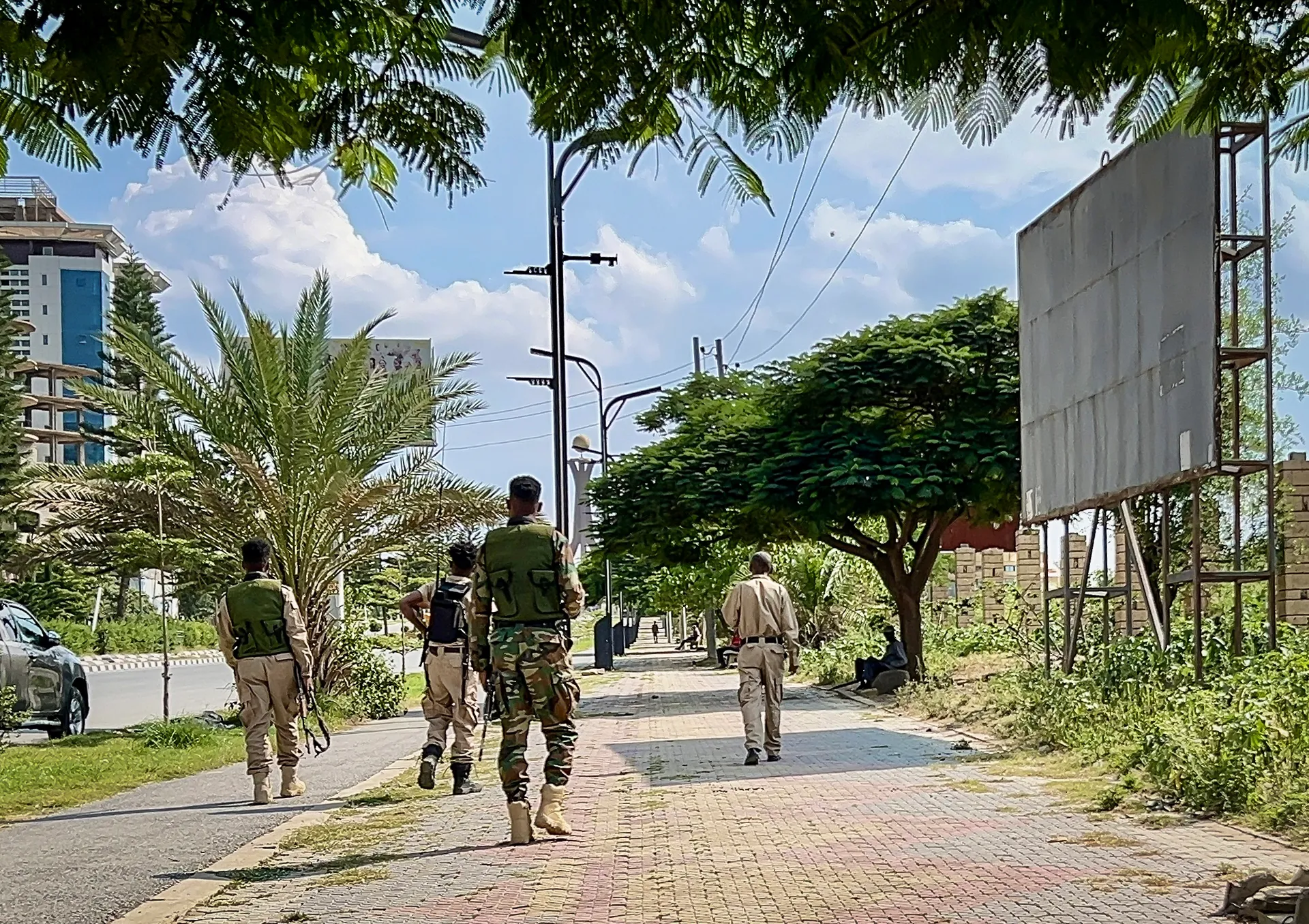
Armed Forces Retake Strategic DR Congo Town After M23 Withdrawal 

The armed forces of the Democratic Republic of Congo (DRC) have taken over the town of Luvungi in the Rusizi Plain of Uvira territory in South Kivu after M23 fighters vacated the area. Following the fierce battle for control among the warring parties, the Rwandan troops and their M23 allies retreated, succumbing to military and diplomatic pressure.

The Congolese army officially retook control of the town on Monday, May 12, restoring the blurry hope of civilians trapped under the violent rule of the rebels.

“We do not know yet whether this withdrawal by the Rwandan army and their M23 surrogates is in respect of various UN resolutions and international demands for the Rwandan army to withdraw from zones they occupy in the DR Congo, or it is just a tactical military withdrawal,” a senior official of the armed forces declared in Kinshasa, the country’s capital city.

Some members of the M23 group and Rwandan fighters are reportedly still present in Katogota, a neighbouring town to Luvungi. The Congolese army has stated that rebel reinforcements have arrived in Kamanyola, which is a strategic border town in South Kivu.

Reagan Mbuyi Kalonji, the spokesperson for Operations Sukola 2, a military campaign aimed at neutralising rebel groups in South Kivu, has revealed that Rwandan forces have deployed heavy weapons on the Bugarama hills. This positioning is intended to maintain their military and strategic control over Kamanyola and its surrounding areas.

The entry of Congolese troops into Luvungi signifies the culmination of troop movements observed in the Rusizi Plain and the upper plateau of South Kivu. Since Saturday, May 9, the Congolese army has been systematically occupying positions left vacant by the M23 fighters, moving from Sange to Mutarule and finally to Luvungi.

The army attributes the withdrawal of Rwandan troops and their M23 allies to “intense military and diplomatic pressure,” while the M23/AFC describes their withdrawal as a “repositioning and a gesture of goodwill” towards the peace process. 

The armed forces of the Democratic Republic of Congo (DRC) have regained control of the town of Luvungi in South Kivu from M23 fighters after a prolonged battle, resulting in the retreat of Rwandan troops and their allies.

This takeover on May 12 brings hope to civilians who were previously under the rebels’ rule. However, there is uncertainty over whether the retreat aligns with UN resolutions for troop withdrawal or if it is a tactical move.

Despite this victory, M23 and Rwandan fighters remain in nearby Katogota, with reinforcements reportedly reaching the strategic border town of Kamanyola. The spokesperson for Operations Sukola 2 reported that Rwandan forces have stationed heavy weaponry on the Bugarama hills to maintain their strategic hold.

The Congolese army’s advance into Luvungi marks a systematic occupation of areas vacated by M23, attributed to intense military and diplomatic pressure, while M23 claims it as goodwill for peace efforts.

Source link

Three police officers killed in car bomb attack in northwest Pakistan | Armed Groups News

Bomber and several fighters detonate explosives-laden vehicle near security post in Bannu, Khyber Pakhtunkhwa, near Afghanistan.

A car bombing at ⁠a police post followed by an intense firefight has killed at least three officers ⁠in northwestern Pakistan, according to police and security sources.

The attack took place in Bannu, a district in Khyber Pakhtunkhwa province bordering Afghanistan, late on Saturday.

Recommended Stories

list of 3 itemsend of list

Police official Zahid Khan told The Associated Press that a suicide bomber and several fighters detonated an explosives-laden vehicle near a security post. Shortly after, multiple explosions were heard and the security post collapsed from the impact of the blast, he said.

Pakistan’s Dawn reported that nearby civilian areas also suffered severe damage due to the blasts, and two civilians were injured.

The Reuters news agency, citing security officials, reported that after the bombing, there was an ambush on police personnel rushing ⁠to the scene to provide backup.

Police official Sajjad Khan told Reuters that more casualties were feared. He added that fighting was ongoing and the extent of the damage would only be known once ‌the operation was over.

Police sources told Reuters ⁠the aggressors also used drones in the attack.

Ambulances from ⁠rescue agencies and civil hospitals were dispatched to the scene, with officials saying a state of emergency has been declared in government hospitals in Bannu.

No group immediately claimed responsibility. However, such attacks have the potential to reignite fighting along Pakistan’s border ⁠with Afghanistan.

The worst fighting in years erupted ⁠between the allies-turned-foes in February, with Pakistani air strikes inside Afghanistan that Islamabad said targeted fighters’ strongholds.

Fighting has since eased, with occasional skirmishes breaking out along the border, but no official ceasefire ‌has been brokered.

Islamabad blames Kabul for harbouring armed groups who use Afghan soil to plot attacks in Pakistan. The Taliban has denied the allegations and ‌said ‌militancy in Pakistan is an internal problem.

The Pakistan Taliban, known as Tehrik-e-Taliban Pakistan (TTP), and allied fighter groups have carried out similar attacks in the past. The Pakistan Taliban is a separate group but is often aligned with the Afghan Taliban, who seized power in Afghanistan in 2021.

Source link

UFC 328: Khamzat Chimaev kicks Sean Strickland despite armed police presence after ugly exchange

Khamzat Chimaev kicked Sean Strickland – despite the presence of armed police on stage – as the pair faced off following an ugly news conference before UFC 328 on Saturday.

A bitter and personal exchange escalated even further when Chimaev, despite being held back by UFC security, beckoned Strickland towards him as the pair traded insults, before launching a kick at the American.

As the crowd roared, security and armed police escorted each fighter off stage in separate directions as they continued to hurl expletives at each other.

Tensions have threatened to boil over throughout fight week, with Russian-Emirati middleweight champion Chimaev set to defend his belt against American Strickland in Newark, New Jersey on Saturday.

It is not uncommon for UFC fighters to insult each other in the hope of building hype around a fight, but Strickland has been particularly volatile while addressing Chimaev – launching derogatory and racist comments which have attacked his religion and heritage.

Last week, Strickland threatened to shoot Chimaev if the 32-year-old and his team-mates confronted him in the build-up to the fight.

In response, the UFC has hired extra security to protect each fighter and reportedly kept the pair in separate hotels.

Chimaev has been calm and reserved during fight week, despite Strickland’s derogatory comments, but was animated during the news conference.

Before the pair had even taken their seats, security had to intervene and, as Strickland continued to goad Chimaev, he responded with ugly comments about childhood trauma which the American has spoken about in the past.

“You’re making fun of child abuse,” replied Strickland, who followed up with further expletives.

When asked if he enjoyed the bitter rivalry between Chimaev and Strickland, UFC president Dana White – who was stood between the pair – responded “it is what it is”.

He previously described it as a “top-three” heated rivalry of all time in the UFC.

Despite the offensive comments from Strickland and Chimaev, it is unlikely the UFC will take any disciplinary action with White a vocal supporter of free speech.

“I think probably the most important free speech to protect is hate speech,” White said last year.

“Because when a government or a certain person can come out and determine saying ‘this is hate speech’, it’s a very slippery slope and it’s dangerous, in my opinion.”

Strickland did not appear to be hurt by Chimaev’s kick and afterwards wrote “exactly what I expected a coward to do”, on social media.

It is unclear whether the New Jersey Athletic Control Board will punish Chimaev for the altercation.

Source link

Mali rattled by ongoing armed attacks: What to know | Politics News

Mali has been rattled by coordinated attacks carried out by several unidentified ⁠armed groups beginning on Saturday, escalating the political and security crisis in the country, which has been under military rule for most of the past 14 years.

On Sunday, a military source told Al Jazeera that Mali’s Defence Minister Sadio Camara had been killed amid coordinated attacks on military sites across the country, including the capital, Bamako. His residence in Kati was attacked on Saturday.

Recommended Stories

list of 3 itemsend of list

“The General Staff of the Armed Forces informs the public that unidentified armed terrorist groups targeted certain locations and barracks in the capital and the interior early this morning, April 25, 2026. Fighting is ongoing,” Mali’s military said in a statement on Saturday.

Al-Qaeda-linked group Jama’at Nusrat al-Islam wal-Muslimin (JNIM) has claimed responsibility for attacks in Kati, near the capital, as well as the Bamako airport and other locations further north, including Mopti, Sevare and Gao. Tuareg rebels also claimed participation in the latest assaults.

The current military ruler, Assimi Goita, came to power in the 2021 coup on the promise to boost security amid the growing influence of armed groups in one of the most impoverished nations in the world. Goita has yet to make a public statement.

So, what is the latest situation in the country and have the armed attacks been contained?

Here’s what we know:

What happened?

On Saturday morning, Mali’s army said unidentified ⁠“terrorist” groups ⁠had attacked several military positions in ‌Bamako and the country’s interior.

Two loud explosions and sustained gunfire were heard shortly before 6am (06:00 GMT) near Mali’s main military base, Kati, just north of the capital. Soldiers were deployed to block roads, witnesses said.

There was similar unrest at around the same time in the central town of Sevare, and Kidal and Gao in the north.

Gunfire ⁠could be heard near a military camp close ⁠to the Bamako airport, where Russian mercenary forces are based, a resident told the Reuters news agency.

Heavy gunfire was also reported in Kati, where Goita also has his residence, witnesses told the AFP news agency.

AFP reported that Kati residents uploaded images on social media showing their homes destroyed. “We are holed up in Kati,” one resident said.

The military said in a statement it had killed “several hundred” assailants and repelled the assault, which hit multiple sites in or near Bamako. It is unclear how many assailants were killed.

It said the situation was under control, adding that a large-scale sweep operation was also under way in Bamako, the nearby barracks town of Kati and elsewhere in the gold-producing country.

Reporting from Dakar, Senegal, on Saturday, Al Jazeera’s Nicolas Haque said the scale and coordination of the attack appeared to be unprecedented.

He said, despite the situation having come under control, “there’s an unprecedented level of panic in the military ranks”.

The African Union, the secretary-general of the Organisation of Islamic Cooperation and the United States Bureau of African Affairs have condemned the attacks.

Indications that different armed groups launched a coordinated attack in Mali signal a “very dangerous development”, according to Ulf Laessing, Sahel analyst at the German think tank Konrad Adenauer Stiftung.

He told Al Jazeera on Saturday that since the crisis began in 2012, security has been “degrading” every year, and the government has little control over large areas of the country.

Mali’s democratically elected President Amadou Toumani Toure was deposed in a coup led by soldiers in May 2012. His government was accused of failing to handle a Tuareg-led rebellion in the north.

Since then, the country has been experiencing a severe security and political crisis, armed rebellions and two military coups.

Mali is “a vast territory, twice the size of France. Most people live in the south, the north is desert and mountains … it’s impossible to control it, not even the French could do it, let alone the Russians”, Laessing said.

“There’s no military solution”, and armed groups are “entrenched” in the countryside.

“The only good news is, so far, they [armed groups] haven’t been able to control … larger cities,” he added.

Who is behind Saturday’s attack?

The JNIM and Tuareg rebels have claimed responsibility for the attacks.

In a statement published by SITE ‌Intelligence Group, JNIM claimed attacks in Kati, Bamako and in localities further north, including Mopti, Sevare and Gao.

JNIM is the Sahel affiliate of al-Qaeda and the most active armed group in the region, according to conflict monitor ACLED. Since September, JNIM fighters have been attacking fuel tankers, bringing Bamako to a standstill in October 2025.

It also imposed an economic and fuel blockade by sealing off major highways used by tankers transporting fuel from neighbouring Senegal and the Ivory Coast to the landlocked Sahel country.

For weeks, most of Bamako’s residents were unable to buy any fuel for cars or motorcycles as supplies dried up, bringing the normally bustling capital to a standstill.

Despite several months of calm, Bamako residents faced a diesel shortage in March, with fuel prioritised for use in the energy sector.

On Saturday, the JNIM said the city of Kidal was “captured” in an operation coordinated with the Azawad Liberation Front (FLA), a Tuareg-dominated rebel group.

Mohamed Elmaouloud Ramadane, a spokesperson for FLA, said on social media ⁠that the group had taken control of multiple positions in Kidal and Gao. Al Jazeera could not independently verify the claim.

Videos posted online and verified by Al Jazeera showed armed men entering the National Youth Camp of Kidal on Saturday.

Al Jazeera’s Haque noted that it seems the FLA is gaining ground in the north of the country.

“There’s video footage circulating on social media showing some of these fighters entering the residence of the governor of Kidal,”  he said.

“Kidal is not the biggest town in the north, but it’s high in symbolism because whoever holds the town of Kidal controls the north,” he added.

Ibrahim Yahaya Ibrahim, deputy director for the Sahel at the International Crisis Group, says Malian authorities appear to have been caught off-guard by the latest wave of attacks.

Speaking to Al Jazeera from Dakar on Saturday, Ibrahim said the offensive fits into a broader pattern of escalating violence.

“Even though it is hard to say that it is totally a surprise, I think it is just another dramatic episode in a series of spectacular attacks that we have witnessed in recent years by JNIM attacking the government,” he said.

What role did Russian mercenaries play during the attacks?

Witnesses told Al Jazeera’s Haque that Russian mercenaries were involved in fighting in Bamako, around the airport, where they have one of their headquarters.

“But because there’s been so much pressure on the Russia-Ukraine front, some of these Russian mercenaries are being pulled out from Mali, which is affecting the security situation in Mali now,” Haque said.

Al Jazeera’s Haque said that “the Russian mercenaries seem to have surrendered the town of Kidal or at least the military camp where they were with the Malian forces”.

“The Tuareg fighters had asked them to surrender weapons. It is unclear whether they did that or not but what’s clear is that the Russians are stepping out of the town of Kidal,” he said, adding that “Russian mercenaries not fighting against armed fighters “is something significant”.

In June last year, Russia’s Wagner group said it would withdraw from Mali after more than three and a half years on the ground. The paramilitary force said it had completed its mission against armed groups in the country.

But Wagner’s withdrawal from Mali did not mean the departure of Russian fighters. Russian mercenaries have remained under the banner of the Africa Corps, a separate Kremlin-backed paramilitary group created after Wagner founder Yevgeny Prigozhin led a failed mutiny against the Russian military in June 2023.

Besides Mali, Africa Corps is also active in other African countries, including Equatorial Guinea ⁠and the Central African Republic.

What does all this mean for Mali’s and the Sahel’s security?

Since gaining independence in 1960, the West African country has experienced alternating cycles of political stability and instability, punctuated by rebellions, financial woes and military coups.

In 2012, ethnic Tuareg separatists, allied with fighters from an al-Qaeda offshoot, launched a rebellion that took control of the country’s north.

But fighters from the armed group Ansar Dine swiftly pushed out the Tuareg rebels and seized key northern cities, triggering French military intervention in early 2013 at the request of the government. Ansar Dine and several other groups later merged to form the JNIM.

In September 2013, Ibrahim Boubacar Keita was elected as president. His fragile democratic rule ended in 2020. Under his government, the United Nations brokered a peace deal between the government and northern Tuareg groups fighting for an independent Azawad in 2015.

President Keita was deposed in a military coup in August 2020 following months of mass protests over severe economic woes in the country and the advance of armed groups in the north. In September that year, Bah Ndaw, a retired colonel, was sworn in as interim president, with Goita as vice president, to lead a transitional government.

In May 2021, Goita, the leader of the previous year’s power grab and vice president of the interim government, seized power in a second coup. Mali is currently being run by Goita’s military government. Initially, the military government pledged to return to civilian rule in March 2024, but it has not kept the promise.

Goita invited Russian mercenaries to support the military administration in its fight against armed groups in December 2021 after asking the French troops to leave the country. This created a security vacuum. In January 2024, Mali’s rulers also terminated the 2015 peace deal with Tuareg rebels, accusing them of not complying with the agreement. This led to a breakdown in the country’s security situation once again.

In September 2025, the JNIM began a fuel import blockade, crippling life in Bamako.

Mali, along with Niger and Burkina Faso, formally split last year from the West African regional bloc ECOWAS to form the Alliance of Sahel States (AES).

However, earlier this week, Malian Foreign Minister Abdoulaye Diop attended a security forum in Senegal where he said the withdrawal was “final”, but added that the AES could maintain a constructive dialogue with ECOWAS on freedom of movement and preserving a common market.

“Even for the Malian minister to come to this conference signals that they are afraid for themselves and they need to open up,” Adama Gaye, political commentator on the Sahel and West Africa, told Al Jazeera. “It is also an indication that they want to reach out to ECOWAS.”

Gaye added that the Goita-led military government “cannot have legitimacy in their own country”.

“They have been terrible in economic progress, peace and stability,” he added, describing the ongoing situation in Mali as “very dire”.

“These attacks will be another negative aspect to their claims that they can control Mali,” he said.

Source link

What is really happening in northern Nigeria | Armed Groups

In recent months, the frequency and intensity of attacks in northern Nigeria have shattered the comforting illusion that the region’s long insurgency has receded into the background of national life. As violent incidents have proliferated, many Nigerians have refused to confront this uncomfortable reality and have opted instead to embrace conspiracy theories suggesting that the resurgence is somehow tied to renewed American involvement in Nigeria’s  counterterrorism efforts.

It is not difficult to see why the theory of foreign collusion with terrorist groups resonates in Nigeria. In February 2025, United States Congressman Scott Perry claimed that the US Agency for International Development (USAID) had funded Boko Haram, but offered no evidence for the allegation. Richard Mills, then the US ambassador to Nigeria, rejected Perry’s statement, but by then the claim had already acquired a life of its own in the public space and on social media.

Then, American officials like Congressmen Ted Cruz and Chris Smith made statements that fuelled the “Christian genocide” narrative, which falsely claims that the killings in Nigeria exclusively target Christians.

Attacks on Christians have happened, including most recently on a church in Kaduna state on Easter Sunday, but Muslim communities have also been regularly targeted. The truth is that terrorist groups have long operated indiscriminately.

What this moment demands, therefore, is to go beyond the seduction of easy explanation, and embark on serious analysis of what is really happening in northern Nigeria.

That diagnosis must begin with clarity about what the attacks reveal. First, they reveal that the insurgency has adapted in both form and method. Second, northern Nigeria’s insecurity can no longer be understood in isolation from the rest of the region; it is part of the wider regional disorder across the Lake Chad basin and the Sahel. And third, the violence continues to feed on deeper domestic vulnerabilities that extend far beyond the battlefield: chronic poverty, educational exclusion, weak local governance, and the long erosion of the social contract in parts of the North.

Let us begin with the first point. Recent attacks demonstrate that the insurgent ecosystem has learned, adapted, and expanded beyond the old image of a crudely armed rebellion fighting in predictable ways. The ISIL affiliate in West Africa Province (ISWAP), in particular, has become more adaptive in structure and tactics, while its conflict with Boko Haram has weakened the latter and left ISWAP as the more organised and deeply entrenched threat in the Lake Chad region. It has consolidated its presence in parts of the Lake Chad basin and expanded into Sambisa Forest, widening the space from which it can threaten civilians and military formations alike.

This matters because insurgencies are sustained not by ideology alone, but by terrain, supply routes, local economies, and the ability to move men and materiel through spaces where the state is weak or absent. In that sense, the insurgency is no longer merely surviving in familiar hideouts; it is entrenching itself in a broader and more fluid battlespace, with ISWAP’s control of trade in and around Lake Chad now a major pillar of its resilience.

ISWAP has also refined the way it fights, demonstrating a growing capacity for coordinated assaults, night raids, ambushes, and operations designed not merely to inflict casualties, but to isolate military positions and slow the movement of reinforcements. This challenge is magnified by the sheer scale of the theatre itself.

Borno, Yobe, and Adamawa states are each comparable in size to entire European countries: Borno is slightly larger than the Republic of Ireland; Yobe is roughly the size of Switzerland; and Adamawa is slightly larger than Belgium. Policing territories of that scale would test any state, all the more so when they border a fragile regional neighbourhood.

The terrain has also shaped the rhythm of the conflict, with the dry season, particularly the first quarter of the year, ushering in an intensification of attacks.

At the heart of this adaptation is the evolution of technology. What once seemed unthinkable in this theatre has now entered the insurgent repertoire. Drones, including commercially available models modified for combat, are now part of the operational environment. The significance of this shift is not merely technical; it is also psychological and strategic.

Beyond technology, the insurgency’s growing mobility has sharpened the threat further. Rapid assaults by motorcycle-mounted units demonstrate the extent to which insurgent violence now depends on speed, concentration, and dispersal. Fighters can assemble quickly, strike vulnerable locations, and disappear into difficult terrain before an effective response can take shape.

The advantage here lies not in holding territory in the conventional sense, but in imposing uncertainty, stretching the state’s defensive attentions, and proving that the insurgents can still choose where and when to shock the system.

Perhaps the most dangerous dimension of this adaptation is the infiltration of foreign fighters. Their significance lies not only in their numbers, but in what they bring with them: technical knowledge, battlefield experience, tactical imagination, and links to wider militant networks.

Their presence points to a deeper cross-fertilisation between local insurgency and global terrorist currents. More troubling still, they are now playing a more active role in the conflict, not only refining tactics and skills but also participating directly in combat.

That is why the regional dimension must be central to any serious analysis. The weakening of regional cooperation has come at the worst time, creating openings that insurgents are only too ready to exploit. A threat that has always been transnational becomes harder to confront when neighbouring states no longer act with sufficient cohesion.

Niger’s withdrawal from the Multinational Joint Task Force after the reaction of the Economic Community of West African States (ECOWAS) to the military coup there has sharpened that challenge and weakened the perimeter defences of the north-east theatre. The force, comprising troops from Nigeria, Niger, Cameroon, and Chad, with a smaller Beninese contingent at its headquarters in N’Djamena, was instrumental in earlier gains and remains vital for reinforcing positions, conducting operations in difficult terrain, denying insurgents safe havens, and intercepting the movement of foreign fighters.

Yet even regional analysis, necessary as it is, does not fully explain the problem. Insurgencies endure not only because they move across borders, but because they can recruit, regroup, and exploit social weakness at home.

Violence in northern Nigeria is sustained by a combination of doctrinal extremism, chronic poverty, educational exclusion, and a state whose presence is often too limited to command confidence in the communities where armed groups seek recruits. The argument, therefore, cannot remain confined to the military sphere.

Poverty and lack of education do not directly produce terrorism, but they increase vulnerability, especially where alienation, weak institutions, and manipulative ideological narratives are already present. This is why the educational crisis in northern Nigeria should be seen not only as a developmental challenge, but as part of the wider security landscape. Education does more than impart literacy and numeracy; it provides structure, routine, and pathways to self-actualisation and social belonging.

It is important to note that the government is not without a response. In 2024, President Bola Ahmed Tinubu signed the Student Loans (Access to Higher Education) Act into law, and the rollout of the Nigerian Education Loan Fund has since opened a wider path to post-secondary education and skills development. But the more decisive educational challenge lies earlier, at the basic level, where literacy begins, habits are formed, and attachment to institutions is either built or lost. By the time a young person reaches the threshold of higher education, the foundational work has already been done or neglected.

This is why local governance matters more to security than is often recognised. In Nigeria’s federal structure, primary education sits closest to the weakest and most politically distorted tier of government. If local government remains fiscally weak, administratively paralysed, or politically captured, one of the country’s most important long-term defences against radicalisation will remain fragile.

That is why local government autonomy, though often framed in dry constitutional terms, has direct implications for security. President Tinubu, an ardent champion of local autonomy, welcomed the Supreme Court’s July 2024 judgement affirming the constitutional and financial rights of local governments and has pressed governors to respect it. Resistance, however, is unsurprising: many governors have long treated local governments as subordinate extensions of their authority.

So what does the present moment demand from Nigeria? It demands, certainly, continued military pressure on insurgent sanctuaries. It demands stronger force protection, sharper intelligence, surveillance and reconnaissance, improved rural and urban security, and a more serious approach to trans-border diplomacy. It demands that regional diplomacy be treated not as a luxury of peacetime statecraft, but as part of the operational infrastructure of security.

But the crisis cannot be addressed by military action alone. It also calls for social, institutional, and educational measures across all tiers of government. The state must confront extremism not only through force, but through education and functioning local institutions. It must rebuild governance, restore trust, and close the social and institutional fractures through which violence renews itself.

The views expressed in this article are the author’s own and do not necessarily reflect Al Jazeera’s editorial stance.

Source link
