Somalia races to save Radio Mogadishu’s fading archive | Media News
Mogadishu, Somalia – Thousands of reel-to-reel tapes sit in an air-conditioned room in the archive of Somalia’s public radio, Radio Mogadishu, stacked on steel shelves and lined up like old manuscripts beneath a thick layer of dust.
Each reel contains a small fragment of Somalia’s 20th-century history, from news bulletins to speeches, music and voices that were once beamed out across the nation’s airwaves, some dating back to the early 1950s.
Recommended Stories
list of 3 itemsend of list
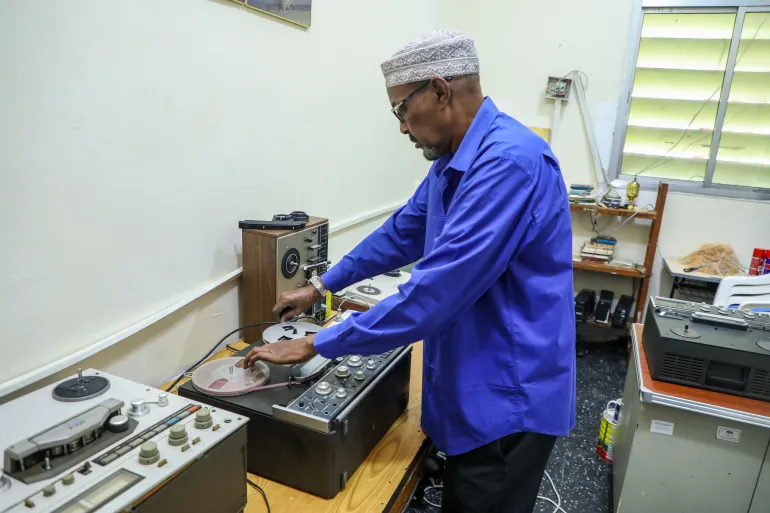
Abdiqadir Geedi Robleh, an archivist at Radio Mogadishu, threads a reel onto an old tape machine, connects it to a computer, and records the contents of each tape. A tape with a love song by Mohamed Mooge Liban, a prominent singer fills the room, and Robleh is transported, he says, to his youth.
He is working with a small team to digitise and methodically order approximately 400,000 hours of broadcasts, officials here say, before the magnetic tape deteriorates beyond recovery, taking with it a crucial record of the country’s past.
![Abdiqadir Geedi Robleh cues up a tape, ready to hear a recording for the first time in years. [Abdimajid Abdillahi Farah/Al Jazeera]](https://i0.wp.com/occasionaldigest.com/wp-content/uploads/2026/07/2F3A0163-1783253287.jpg?w=640&ssl=1)
“This is the world’s largest store of Somali language music, culture, dramas and everything else, and at the moment it is locked away from the public in a kind of prison,” Robleh tells Al Jazeera. “We’re working to preserve it but also open it up in future to the public.”
Founded in 1951 during the Italian colonial era, Radio Mogadishu would grow into Somalia’s largest and most important public broadcaster. It initially broadcast in Italian and Somali before introducing foreign language services, including everything from Swahili and Oromo to English and Arabic.
In its heyday, it was among the most influential and distinctive voices in East African media, reaching audiences as far afield as Tanzania, Ethiopia, and the Middle East with a style of radical pan-African broadcasting reminiscent of Radio Cairo in the Nasser years.
With the exception of a brief hiatus in the 1990s, when it fell under the control of a warlord, it has served not only as a key source of news for Somalis and audiences across the region, but also as a vital repository of the country’s collective memory.
The effort to preserve its archives has gathered new momentum this year.
In early June, Somalia’s information ministry and the UNESCO regional office for Eastern Africa – the UN’s heritage agency – brought archivists from across the country to a workshop in Mogadishu, aimed at eventually registering its contents with UNESCO’s Memory of the World programme, which catalogues archives of important historical value.
“Protecting this knowledge isn’t just relevant for Somalia, but it is relevant for everyone,” said Guilherme Canela, a senior UNESCO official who is overseeing the project.
![Thousands of tapes fill the shelves of Radio Mogadishu's archive, holding decades of Somali history. [Abdimajid Abdillahi Farah/Al Jazeera]](https://i0.wp.com/occasionaldigest.com/wp-content/uploads/2026/07/2F3A0155-1783253271.jpg?w=640&ssl=1)
An expert assessment carried out in April counted roughly 45,000 tapes and reels, representing an estimated 400,000 hours of material recorded since the station’s founding. More than 85 percent remain playable, but around one in 10 has deteriorated with age, and more than 5 percent has been destroyed or severely damaged, according to UNESCO.
Radio Mogadishu’s collection was recognised both for its size and because so much of what it holds exists nowhere else.
Some were damaged in an electrical fire in 2018, Robleh says, while others were lost during fighting in 1992, when US forces battled Somali militias in the streets of Mogadishu.
During the worst of the civil war, police colonel Abshir Hashi Ali risked his life to prevent the contents of the archives from being looted. When fighting engulfed Mogadishu following the 1990 collapse of the government, he said he ran back “with the aim of conveying to Somalis the wealth that is stored here”.
Abdi Jeite, the station’s director, says the digitisation drive began as early as 2012, but has been held back for years by a lack of resources. By his estimate, only approximately 10 percent of the archive has so far been converted.
“We’ve got some new tools, and more training for our archivists, but there is still a lot of support needed,” he says.
![An old reel-to-reel machine used to play and digitise tapes at Radio Mogadishu's archive in Mogadishu. [Abdimajid Abdillahi Farah/Al Jazeera]](https://i0.wp.com/occasionaldigest.com/wp-content/uploads/2026/07/2F3A0085-1783253236.jpg?w=640&ssl=1)
To understand why the archive matters so much, it helps to understand what radio once meant in Somali life.
“Radio Mogadishu was arguably the preeminent media institution in post-independence Somalia,” Iman Mohamed, an assistant professor at the University of Minnesota and historian of Somalia, tells Al Jazeera.
“In a society that prizes orality above the written word, radio was uniquely effective at creating a common public sphere through which ordinary people could feel bonded to one another and to a shared sense of nationhood,” Mohamed adds.
Though Somali audiences could also access BBC Somali, Radio Hargeisa, and opposition stations when the government began to deteriorate in the latter part of the 20th century, it was Radio Mogadishu that dominated the “soundscape of urban Somalia”, Mohamed said.
That dominance made Radio Mogadishu a national factory of talent. “If you were a musician, poet, playwright or producer, Radio Mogadishu was the platform you wanted to appear on,” Robleh, the archivist, said. “It made Somalia’s stars.”
![Robleh points to the label on a tape of a love song recorded at Radio Mogadishu in 1974. [Abdimajid Abdillahi Farah/Al Jazeera]](https://i0.wp.com/occasionaldigest.com/wp-content/uploads/2026/07/2F3A0122-1783253259.jpg?w=640&ssl=1)
Robleh, the archivist, added that many BBC Somali journalists who went on to have distinguished careers first cut their teeth at Radio Mogadishu, which became an important pipeline for Somali-language talent to the BBC.
Hassan Dahir, a former journalist at the station, was one of many Somali children who grew up dreaming of working there. For years, he recalled, Radio Mogadishu was virtually the only source of news for millions, “the eyes and ears of the community”, he told Al Jazeera.
“Its reach was so extensive that even nomadic herders followed events as far afield as the Vietnam War and the American Civil Rights Movement,” Dahir said.
Under Siad Barre, the military officer who seized power in a 1969 coup and ran Somalia for two decades under a self-styled socialist, revolutionary government, the station became an instrument of state ideology, mixing news, drama and religious programming with nationalist and anti-colonial content.
The station beamed pan-African songs Oh Africa, still asleep by Halimo Khalif Magool, which spurred the continent’s inhabitants to awaken and take charge of their own destinies. Mahamud Abdullahi Sangub’s Reject the Color of Imperialism was another popular song of the era in this same tradition of politically charged music, with lyrics like: “Africans listen to each other, reject the colour of imperialism, reject it, reject it, reject it!”
Many of those songs have been covered, sampled or repurposed since, and younger Somalis often encounter them with no idea who performed the originals, or the politics that shaped them, say Mohamed.
Its news coverage focused on anti-colonial wars in places such as Mozambique against Portugal, the struggle against apartheid in Rhodesia and South Africa and the Civil Rights Movement in the US. It covered everything from colonial battles in Guinea-Bissau to the arrest of African American political activist and author Angela Davis.
“We were telling the stories of people resisting their oppressors”, said Dahir.
![After seizing power in a 1969 coup, Major General Mohamed Siad Barre used Radio Mogadishu as a key instrument for disseminating his regime's messages. [Abdimajid Abdillahi Farah/Al Jazeera]](https://i0.wp.com/occasionaldigest.com/wp-content/uploads/2026/07/2F3A0132-1783255045.jpg?w=640&ssl=1)
![Portraits of Somalia's presidents line a wall at Radio Mogadishu. [Abdimajid Abdillahi Farah/Al Jazeera]](https://i0.wp.com/occasionaldigest.com/wp-content/uploads/2026/07/2F3A0102-1783253246.jpg?w=640&ssl=1)
The station was a “mouthpiece of the government”, cautions Mohamed, but took on a crucial role of inculcating “a patriotic and revolutionary ideological orientation in the Somali people”.
One of the most important projects the radio supported was the Somali mass literacy campaign, when the government sent students to rural Somalia in 1972 to teach the newly developed Somali script. The campaign led to a dramatic increase in literacy across the country.
It also became deeply entangled with Somalia’s regional foreign policy, as the government spent much of the 20th century at loggerheads with Ethiopia before eventually invading in 1977.
That rivalry led Radio Mogadishu to dedicate airtime to Ethiopia’s marginalised ethnic communities, as well as armed rebel movements, particularly those from Eritrea. Among its most notable initiatives were broadcasts in Oromo and Sidama.
Dahir, the former Radio Mogadishu journalist who covered Ethiopia, told Al Jazeera that these were the first-ever radio programmes in either language, both of which had been suppressed for many years in Ethiopia under policies that privileged Amharic, the language of the country’s elite.
The station itself has taken on a far smaller role in Somali life since.
The collapse of the central government in 1991 broke the state’s grip on broadcasting, opening space for private radio, television and online outlets, which have proven popular with the Somali public.
It has lost most of its foreign-language programming, and with it, much of its revolutionary edge. The Somali state also continues to be constrained by limited resources as it rebuilds after decades of conflict.
![The entrance to Radio Mogadishu's studios. [Abdimajid Abdillahi Farah/Al Jazeera]](https://i0.wp.com/occasionaldigest.com/wp-content/uploads/2026/07/2F3A0182-1783253368.jpg?w=640&ssl=1)
In November 2021, the al-Qaida-affiliated armed group al-Shabab, which has waged a long rebellion against Somalia’s government, assassinated the station’s then-director, Abdiaziz Mohamud Guled, in a suicide bombing in Mogadishu.
Iman Mohamed, the historian, says that with the civil war in the country, now in its third decade, preserving the archive for posterity has become more urgent.
“The destruction of archives during the civil war has left an enormous gap in Somalia’s documentary record, which means that anyone researching the country’s history is almost entirely reliant on foreign archives or oral history,” Mohamed said.
“That is especially problematic for young people,” she adds. “Recovering what we can matters for the youth who will never have known the world that Radio Mogadishu broadcast in its heyday.”