Antonio González: ‘The Left Must Push Human Rights Beyond the Liberal Conception’
Antonio González Plessmann. (Venezuelanalysis)
Antonio González Plessmann is a Venezuelan leftist and human rights activist. Previously a vice rector at Venezuela’s National Experimental University of Security (UNES), established amid a wide-reaching police reform, he is currently co-director of the Surgentes human rights collective and a member of the Comunes left-wing coalition. In this interview, González discusses Venezuela’s current legal context, US influence, and building “bridges” between the left and human rights discourse.
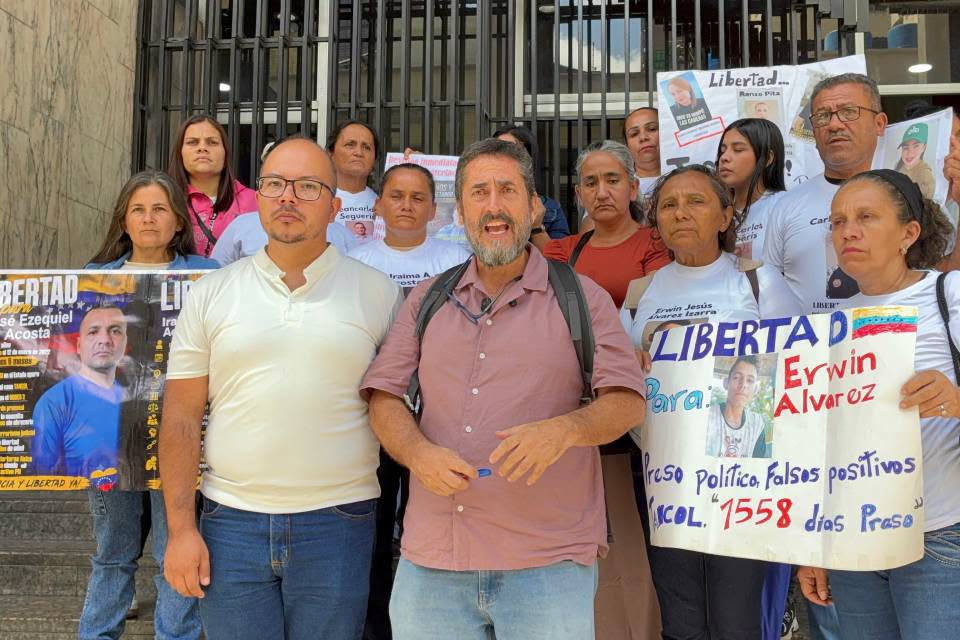
Surgentes has been following the so-called “TANCOL” case in recent months, both through public events and in meetings with judicial authorities. Can you give us an overview of this case?
In 2021, the Nicolás Maduro government coined the acronym TANCOL. It stands for “armed Colombian drug-trafficking terrorist.” The official narrative claimed that there was a strategy led by the Colombian oligarchy to infiltrate these armed groups across the border to destabilize Venezuela.
Under the guise of this narrative, there was a massive military and police deployment in the border states, with mass arrests targeting any armed group except the [National Liberation Army] ELN. What lay behind the operation was a reconfiguration of the border territories. The government allied itself with the ELN to combat and displace FARC dissidents and other irregular groups.
Now, in that war, as is often the case, the “casualties” come from poor sectors of society. In practice, in all those states, Táchira, Apure, Zulia, Amazonas, Barinas, and Bolívar, campesinos, fishermen, laborers, civil servants, and others were detained and accused of being terrorists. But in most cases, they were people from highly marginalized areas along the border, with very little social capital and very limited ability to hold institutions accountable.
How many cases are we talking about?
We are directly supporting 70 cases, but we estimate there are at least 300, based on conversations with the individuals themselves and reports from family members. All are accused of terrorism. And it’s important to note that in 90% of the cases, the detainees were tortured after being arrested.
The majority of the detentions took place between 2021 and 2022, and people remained silent for four years. We began to learn about some of these cases last year, but people only decided to come forward this year. This is an indicator of the marginalization of these sectors, where family members did not dare to report the situation. In many cases, the ELN itself directly detained people, tortured them, and then handed them over to the [military intelligence] DGCIM on charges of “belonging to the guerrillas.”
That is the context. It’s not that there isn’t a security crisis at the border; of course there is. Indeed, FARC dissidents had killed Venezuelan soldiers earlier in 2021. It is legitimate for the Venezuelan government to have a security policy. What is not legitimate is criminalizing the poor because the military and police agencies, under pressure from above, had to show success in their operations and did so through these mass arrests.
We argue that this is the logic of “false positives”: arresting people who have nothing to do with the conflict, or who, at most, have some connection simply because they are in an area controlled by armed groups. But there are cases of people imprisoned simply because they had a guerrilla fighter’s contact information on their phone, or because they sold them beer.
Now, the opposition and the US do not defend these people. Nor do many human rights organizations, because these are highly marginalized people from remote areas with little influence, and their cases end up being overlooked.
We have proposed to the government that, if it truly wants to tackle the criminalization of poverty, it must start with the most emblematic cases. Some are political prisoners like these – because by accusing them of terrorism, they were turned into political prisoners – but most are common criminals.
In recent weeks, we have been in dialogue with the Peace and Coexistence Program, the Human Rights Directorate of the Attorney General’s Office, and the Ombudsman’s Office. Every time the authorities hear about these cases directly from the families’ own voices, it becomes very clear that the people they are detaining are campesinos, highly marginalized individuals, who were tortured, held incommunicado, and in some cases disappeared for a period of time. The officials we talked to have committed to taking steps to facilitate the review of these cases and work toward justice. We haven’t made much progress. We’ve secured the release of 15 people, although their trials are still ongoing. And two were released on time served.

These cases were not included in the Amnesty Law. What is your assessment of this initiative?
The Amnesty Law was exclusionary from the outset. By restricting the cases to be reviewed to specific time periods, it immediately excluded everyone else. For example, people detained for incitement to hatred were not included, nor were a significant number of military personnel. So, the exclusion of the TANCOL cases was by design. It wasn’t an accident. It’s not that it’s a bad law, but rather that it was conceived this way, as a conflict-management mechanism, releasing some actors while keeping others in prison. The law does not address the crime of “terrorism,” which has been applied in an absolutely excessive manner in recent years.
Another significant problem: the law employs rhetoric that perpetuates the criminalization of sectors whose rights – to freedom, due process, and so on – have been violated. And one problem, in my view, is that the law does not establish any mechanisms for verification, transparency, or accountability. Thus, the government declares that X number of people have been released, but it remains unclear who they are. That said, it is positive that the law did indeed allow for the release of many people from prison, alleviating their suffering and that of their families.
In July, the Venezuelan government announced its withdrawal from the Rome Statute and the International Criminal Court (ICC). How do you interpret its motivations, considering both the official rhetoric and other factors?
This must be viewed in two ways. First, in terms of the weakening of guarantees for the protection of rights. As a criminal justice system that exerts pressure on decision-makers, it ultimately protects people, even if only out of fear of being charged by the ICC. So, the first thing to note is that the Venezuelan people are losing guarantees of rights protection, just as they did when Venezuela denounced the OAS Charter and withdrew from the Inter-American Human Rights System.
These are systems that, with all their flaws, protect rights. But local courts may also have their own flaws.
Now, why is the government making this decision, and why at this particular moment? The current context is one in which Venezuelan foreign policy is fully aligned with the United States. And which countries are leading the campaign against the International Criminal Court? The United States and Israel, especially following the arrest warrant issued against Netanyahu.
Venezuela’s withdrawal from the Rome Statute and the ICC does not affect proceedings already underway. It is therefore part of this foreign policy realignment, which has in fact been evident in many instances. For example, in September, Venezuela joined Israel and the United States in boycotting the 25th anniversary commemoration of the Durban Conference.
However, we could argue that the ICC has historically only served to mete out “justice” against those who lost out in confrontations with imperialism. You mentioned the case of Netanyahu, where there is an arrest warrant but no way to enforce it. Is it still “justice” if it is applied so selectively, leaving out the most egregious culprits?
The fact is that every criminal justice system is selective, whether national or international. None of them prosecute all crimes or all criminals. Rather, they respond to the balance of power and the institutional mechanisms behind them. By the same logic, we could argue that national courts should be discarded because the rich never go to prison and the poor are criminalized. But that is not the point, I believe.
The issue, for me, is to analyze power and class relations in order to highlight the exclusions and discrimination within criminal justice systems. I agree with you. The ICC has followed this selective pattern, which does not mean that the individuals investigated and convicted did not in fact commit crimes against humanity. But Netanyahu is precisely the one who comes along to expose this contradiction. When the interests of the mighty are at stake, the United States criminalizes the International Criminal Court.
So, the discussion is not about the ICC itself or the other protection mechanisms. The argument could be extended to international law itself. We could also say that international law is, or has always been, a dead letter, and that there is no point in defending it. Now, another way to approach this is to understand that this law has served, in some cases, to curb abuses, and in others, to bring them to light and denounce them. It serves to fight against the powerful oppressors, even with all its limitations. The alternative is to accept the law of the jungle as inevitable. And those who mock international law the most are precisely the United States and its satellites.

You participated in the police reform (CONAREPOL) that began during the Chávez presidency in 2006. Looking back, what aspects of that project do you consider truly transformative? And are there any shortcomings you identify in hindsight?
The police reform began with a very broad public consultation process, involving experts from across the political spectrum. Opposition leaders such as Leopoldo López, opposition human rights NGOs, and even business leaders and the church participated in CONAREPOL. There was a scientific assessment of the problem, conducted in collaboration with the country’s criminology schools, involving extensive research on the issues facing the police in Venezuela, in addition to public consultations. All of this was systematized and served as input for the development of a new policing model.
The process experienced both progress and setbacks, depending on political shifts, until it was definitively abandoned in 2013, already under Maduro’s presidency.
The pillars of that model are external and internal controls. Internal mechanisms were strengthened through a unified system and indicators to ensure proper police conduct. And external controls, such as citizen committees to monitor police conduct, were set up as well. The demilitarization of the police was another fundamental component: imposing civilian command and creating a police career path. The UNES was created, introducing a training framework to support police activities and promotions.
All of the issues identified remain in place and the proposed solutions remain appropriate. The assessment we made in 2006 and 2007 still holds true, and the situation has worsened. The policy to address these problems is laid out in documents, books, and manuals for the police themselves, establishing standards on all the issues, from the use of force to crowd control.
As for the shortcomings, I believe a major one was, during the Chávez era, failing to resist popular pressure. For example, the Bolivarian National Police was beloved in the western Caracas neighborhood of Catia when it was first established. There was very, very strong pressure for rapid expansion, and that led to a loss of standards.
The left has historically struggled to engage with the field of human rights, for various reasons, including the presence of NGOs linked to external powers. From your perspective, what is the way forward? How can we link the struggle for human rights to popular struggles for collective rights?
This is a relationship marked by tension, but also by mutual reinforcement. The left struggles to deal with human rights; there are ideological differences that can be traced back to Marx and his interpretation of certain bourgeois rights. But that is only part of the story. The other part is that the left has forged human rights. Human rights, in social, economic, and cultural terms, as they exist today, along with the entire body of international treaties, cannot be understood without the left. The Mexican Revolution created rights that later became human rights.
So, first we must put that supposed distance into perspective. Then we could seek common ground between the left and human rights. If a revolution advocates for human emancipation, it shares objectives with the human rights discourse. When we talk about human dignity and the buen vivir, both individual and collective, that’s where bridges become more apparent. This includes moving beyond Western liberal logic, which conceives of dignity in individual terms, whereas in other cultures, conceptions of dignity are collective. The issue isn’t necessarily to discard human rights, but to push them beyond the liberal framework.
Another point is that even bourgeois rights are necessary for current struggles. For example, the presumption of innocence or due process. Now, what I do believe is that rights can be radicalized. The liberal conception of human rights does not sufficiently safeguard them. The problem is not freedom of speech in itself; the problem is that freedom of speech is reserved for the owners of the media. The challenge is to democratize the means of producing information if we want to guarantee equal access.
The same is true about political participation. It can be interpreted in terms of representative democracy, or it can be interpreted in terms of self-government as participatory democracy, where political rights entail the possibility of exercising power directly in various ways, including at the communal level. That would be another point of convergence between the left and human rights.
