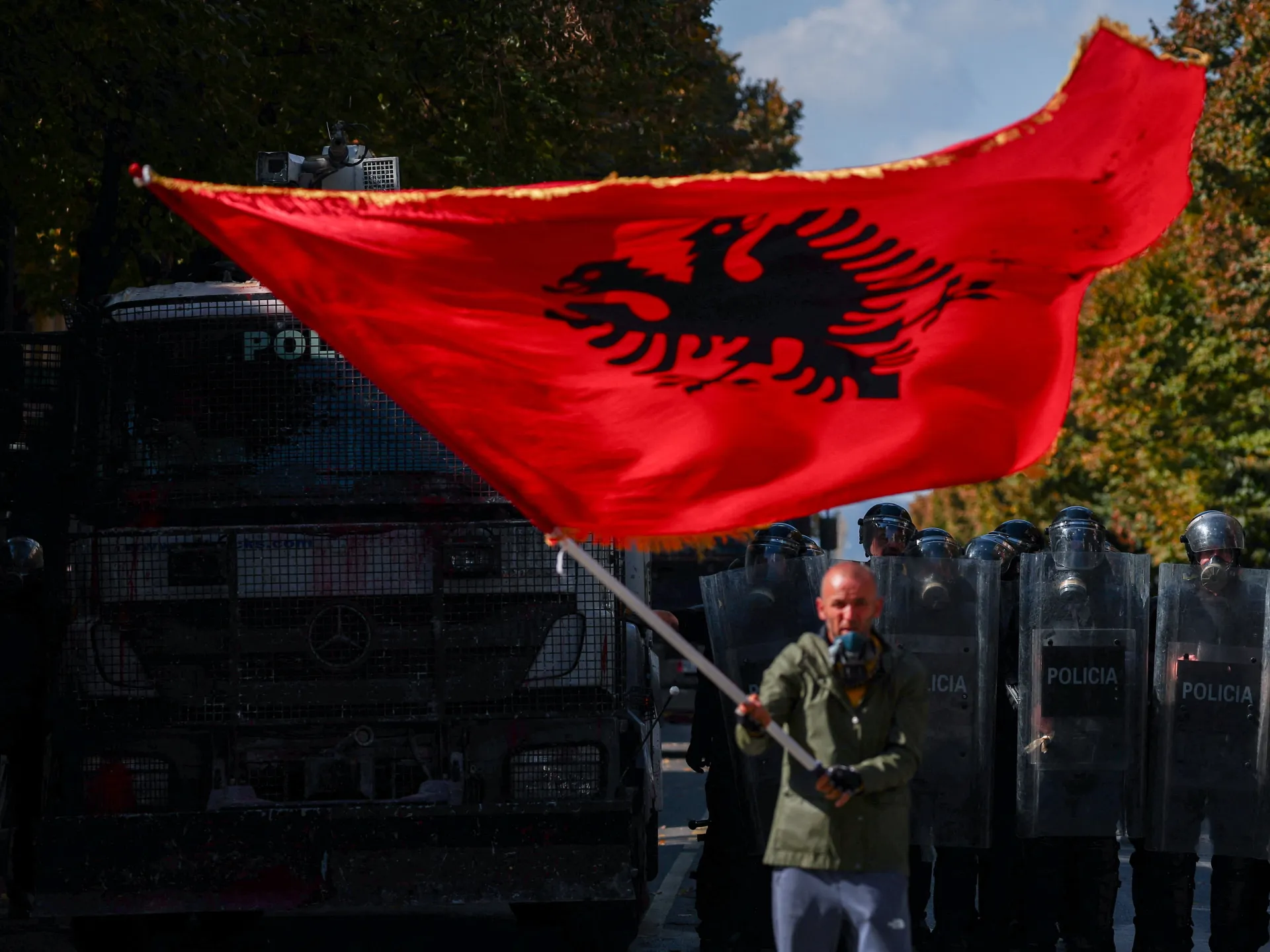
antigovernment

Tens of thousands rally in Serbia for antigovernment demonstrations | Protests News

The student-led movement, which began after the Novi Sad rail station disaster in November 2024, is pushing for early elections.

Tens of thousands of people, led by university students, have rallied in the Serbian capital to protest against the government and call for early elections.

The Novi Sad rail station disaster in November 2024, which killed 16 people, sparked anticorruption protests, calling for a transparent investigation, forcing then-Prime Minister Milos Vucevic to resign.

Recommended Stories

list of 4 itemsend of list

Serbia’s President Aleksandar Vucic later pushed back hard against the protesters.

With students leading the anticorruption movement, the demonstrations have snowballed into a campaign to push Vucic to call early elections.

Vucic said this week that the ballot could be held between September and November this year.

Anti-government protesters take part in a rally led by Serbia's protesting university students who are pushing for major political changes in the Balkan country run by President Aleksandar Vucic, in Belgrade, Serbia, Saturday, May. 23, 2026. (AP Photo/Armin Durgut)
Antigovernment protesters take part in a rally led by Serbia’s protesting university students who are pushing for major political changes in the Balkan country run [Armin Durgut/AP]

‘Students win’

Protesters streamed into a central square in the capital, Belgrade, from several directions, many carrying banners and wearing T-shirts inscribed with the “Students win” motto of the youth movement.

Columns of cars drove into Belgrade from other Serbian towns earlier in the day.

Protester Maja Milas Markovic said students “managed to gather us here with their youth and wonderful energy; I really believe that we have [the] right to live normally.”

Serbia’s state railway company cancelled all trains to and from Belgrade on Saturday, in a bid to stop at least some of the people from coming from other parts of the Balkan country.

Vucic’s loyalists, meanwhile, gathered in a park camp outside the Serbian presidency building that he set up before another big antigovernment rally last March as a human shield against protesters. Folk music blared from a fenced area surrounded by riot police in full gear.

Students have said their rally will be peaceful. But there are concerns of violent conflict with Vucic’s loyalists, who are often hooded and masked and who have attacked student protesters in the past.

CORRECTION / People march during an anti-government protest decrying corruption and calling for early elections following the collapse of a railway station canopy in Novi Sad that killed 16 in November 2024, in central Belgrade on May 23, 2026.
People march during an antigovernment protest decrying corruption and calling for early elections in central Belgrade [AFP]

The protests have “huge support from the public, and that’s because they’re an all-encompassing movement … against the government,” Tetyana Kekic, a journalist in Belgrade, told Al Jazeera.

She said the challenge for the protesters is that they do not have a “clear political platform or policies … and they do not have a leader or a personality which could really challenge the president”.

Serbia’s push to join the EU

The Serbian president has faced international scrutiny for his hardline approach towards the demonstrators.

The Council of Europe commissioner for human rights, Michael O’Flaherty, criticised Serbia’s government in a report this week and said he “will monitor the situation closely” on Saturday.

Serbia is formally seeking entry into the European Union, but it has maintained close ties with Russia and China.

The democratic backsliding under Vucic could cost the country about 1.5 billion euros ($1.8bn) in European Union funding, the EU’s top enlargement official warned last month.

The venue on Saturday is Belgrade’s Slavija Square, the scene of a huge antigovernment protest in March 2025. That rally ended in sudden disruption that experts later said – and the government denied – involved the use of a sonic weapon against peaceful demonstrators.

Students now say they plan to challenge Vucic in approaching elections later this year or next, which they hope will oust the right-wing populist government.

Vucic, government officials, and the pro-government media have branded critics as “terrorists” and foreign agents who wish to destroy the country – rhetoric that has ramped up political polarisation.

Source link

Bolivia’s president reshuffles cabinet amid anti-government protests | Politics News

NewsFeed

Bolivian President Rodrigo Paz has announced a cabinet reshuffle and other measures as protests demanding his resignation continue. Paz said the government wants to build a collaborative government with broader participation from social and economic groups.

Source link

Bolivian president to reshuffle cabinet amid antigovernment protests | Protests News

Rodrigo Paz is under pressure from weeks of demonstrations and poor economic conditions.

Bolivia’s right-wing President Rodrigo Paz has said he will reorganise his cabinet as he faces calls to resign amid weeks of widespread protests.

During a news conference on Wednesday, Paz said he would reshuffle his ministers in a bid to ease tensions with antigovernment protesters.

Recommended Stories

list of 3 itemsend of list

“We need to reorganise a cabinet that must be able to listen,” Paz told reporters.

Since taking office in November, Paz and his government have faced backlash to economic restructuring measures, including controversial cuts to fuel subsidies. The country is in one of its worst economic crises in decades.

Protesters have taken to the streets to express frustration with Paz’s free-market reforms. His inauguration ushered in a period of right-wing leadership after nearly two decades of governance by the Movement for Socialism (MAS).

Thousands of farmers, labourers, miners and teachers have denounced Paz’s reforms. Riot police clashed with protesters again in the capital, La Paz, earlier this week.

While Paz acknowledged frustrations in his remarks on Wednesday, his government has depicted the protests as dangerous and anti-democratic.

Minister of Foreign Affairs Fernando Aramayo said earlier in the day that the mass protests and roadblocks were aimed at destabilising the country and “disrupting the democratic order”.

Former leftist President Evo Morales, who continues to exert influence over the country’s politics, has expressed support for the demonstrations.

The Paz government, meanwhile, has accused Morales of fomenting unrest. The former socialist president faces charges of statutory rape and has an arrest warrant out against him. His allies, however, say the charges are part of an effort to remove him from political life.

The administration of US President Donald Trump has expressed support for Paz, whose election is seen as part of a regional shift to the right.

“Let there be no mistake: the United States stands squarely in support of Bolivia’s legitimate constitutional government,” Secretary of State Marco Rubio said in a social media post on Wednesday. “We will not allow criminals and drug traffickers to overthrow democratically elected leaders in our hemisphere.”

Paz also slammed Colombian President Gustavo Petro, who has frequently feuded with right-wing governments in the region, for recent comments describing the protests as a “popular insurrection”.

The Bolivian Ministry of Foreign Affairs announced on Wednesday that it would ask the Colombian ambassador to leave the country, citing interference in domestic political affairs.

“If they expel the ambassador simply for proposing dialogue and mediation, it means we’re sliding towards extremism that could lead to a very difficult situation for the Bolivian people,” Petro said in an interview with the local radio station Caracol.

Source link

Explosions heard as mining groups stage antigovernment protest in Bolivia | Protests News

Protesters have demanded the resignation of President Rodrigo Paz, who was elected on a platform of economic reform.

Demonstrators, led by mining groups and rural unions, have clashed with law enforcement in Bolivia as tensions simmer over the country’s economic crisis, the worst in decades.

On Thursday, small explosions were heard in the midst of the protest in La Paz, credited to miners setting off small sticks of dynamite. Some protesters were reported as attempting to breach the presidential palace.

Recommended Stories

list of 3 itemsend of list

The unrest follows weeks of road blockades, as miners, farmers, teachers and rural workers express frustration over the country’s ongoing economic turmoil.

Bolivia used to be a major exporter of natural gas, but in recent years, its reserves began to shrivel, and its production has plummeted. Now, rather than being a fuel exporter, it has become a net importer, reliant on oil and natural gas from abroad.

The collapse of the natural gas industry has been coupled with dwindling supplies of foreign currency in the country. The result has been soaring inflation, supply shortages and higher prices.

Bolivians have experienced long lines for fuel, and hospitals have reported a lack of basic supplies like oxygen and medication.

Demonstrators from mining unions take part in a protest against President Rodrigo Paz's government amid an ongoing economic and fuel crisis, in La Paz, Bolivia, May 14, 2026. REUTERS/Claudia Morales
Demonstrators from mining unions take part in a protest against President Rodrigo Paz’s government in La Paz, Bolivia, on May 14 [Claudia Morales/Reuters]

Centre-right leader Rodrigo Paz was elected in October last year in part on a promise to address the economic tailspin.

His victory marked a political sea change in Bolivia. For much of the past two decades, except for a brief period in 2019, the country has been governed by the Movement Towards Socialism (MAS).

The decline of MAS has been credited, in part, to the uproar over the economy.

But on Thursday, Paz likewise faced calls from protesters for his resignation, just as his MAS predecessor, Luis Arce, had.

Earlier in the day, a group of 20 miners were invited to the presidential palace to meet with Paz and discuss their demands, according to the Reuters news agency.

Ahead of the meeting, Economy Minister Jose Gabriel Espinoza said his government was “open to dialogue”.

Among the issues reportedly discussed were fuel subsidies, welfare benefits and changes to an agrarian reform measure, Law 1720, that was repealed on Wednesday after outcry.

Still, officials have refused demands that Paz step down. “The president is not going to resign,” Mauricio Zamora, the minister of public works, services and housing, said earlier this month.

Some of Paz’s allies have blamed the unrest on former President Evo Morales, a former trade union leader who continues to draw popular support in Bolivia’s rural areas.

Morales, who led Bolivia from 2006 to 2019, previously supported protests against Paz’s predecessor Arce, after splitting from MAS.

He is also the subject of an arrest warrant: Morales has been accused of statutory rape and was held in contempt of court for failing to show up to a hearing last week.

A prolific social media user, Morales posted multiple times on Thursday about the protests, accusing the government of using him as a scapegoat. He also echoed calls for officials to address the shortages of food, fuel and other basic supplies.

“They believe that the thousands of Bolivians currently protesting — in the streets and on the roads — are merely obeying a single individual,” Morales wrote in one post.

“The outraged are driven by their social conscience and their fury against a government that, from day one, betrayed its constituents and the nation.”

Source link