American evacuated from Antartica in rare winter rescue mission

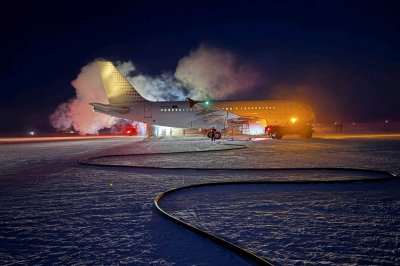
Australian specialist aviation operator Skytraders evacuated an American from McMurdo Station in Antartica on July 31. The American was transported to Christchurch, New Zealand, where they were receiving medical treatment as of Friday. Photo courtesy Skytraders
Aug. 7 (UPI) — An American was evacuated from Antarctica to a New Zealand hospital last week for medical treatment, officials said Friday.
The rare mid-winter operation was conducted July 31 by the Australian Antarctic Division, the Australian government agency responsible for running the Australian Antarctic Program, with aviation partner Skytraders, an Australian specialist aviation operator, AAD said in a statement.
The extent of the medical emergency was not immediately clear. UPI has contacted the U.S. Antarctic Program, which requested the evacuation, for comment.
Skytraders told UPI in an emailed statement that it deployed an Airbus A319 Long Range aircraft from Hobart, Tasmania, after receiving an urgent request for assistance.
The plane, known as Snowbird 1, departed Hobart at 2:44 a.m. AEST on July 31 during what Skytraders called “a narrow weather window” during the Antarctic winter, and landed in the dark at McMurdo Station five-and-a-half hours later.
Skytraders said its flight crew and operational support and medical teams worked in temperatures as low as -45.4 degrees Fahrenheit to transfer the patient to the plane, which departed before conditions deteriorated further.
The aircraft landed in Christchurch, New Zealand, on the afternoon of July 31, it said. AAD said the American was “now receiving medical treatment.”
“Every Antarctic mission demands absolute precision, but winter operations raise the complexity significantly. The conditions we encountered were right on the edge of even the most specialized aircraft capability,” Capt. Al Wallach, Snowbird 1’s pilot for the mission, said in a statement.
“Our focus throughout the mission was the safety of the patient and our crew. Our thoughts remain with the patient and we wish them a full recovery.”