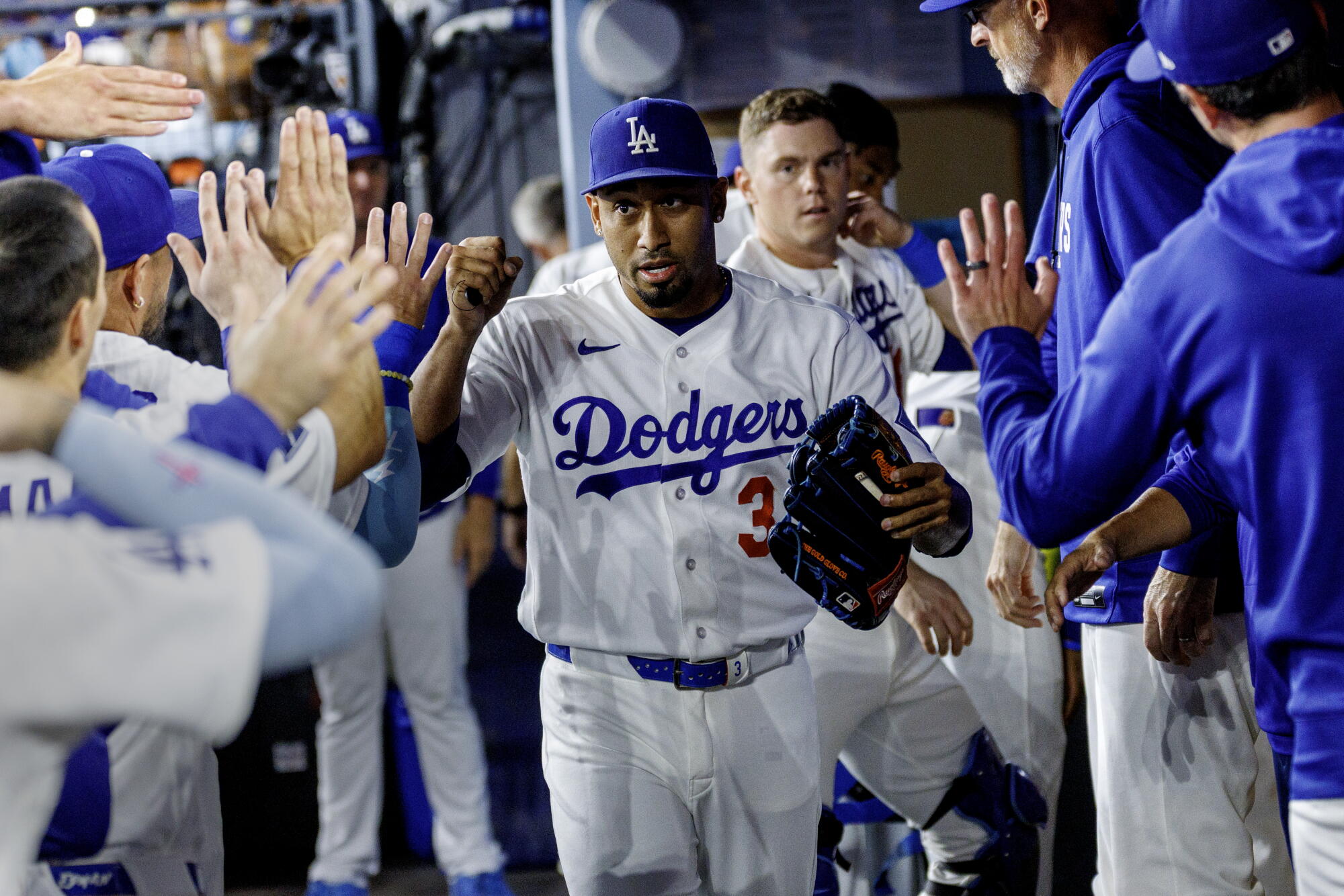
andrew friedman

Dodgers fans should still fear a team sale by Mark Walter

First inning, Shohei Ohtani walks, steals second, jogs to third on a single by Freddie Freeman, scores on a grounder by Mookie Betts.

That’s great, but is Mark Walter selling the Dodgers?

Second inning, Blake Snell gives up a one-out single to Spencer Horwitz, who advances to second on a passed ball, but Snell strands him with a strikeout of Billy Cook.

Lovely, but what happens if Mark Walter sells the Dodgers?

Third inning, Bryan Reynolds draws a two-out walk, but Snell strands him with a flyout to left by Brandon Lowe.

Walter, Lakers, feds, billions, sell?

On a blistering Sunday afternoon at Dodger Stadium, the Dodgers defeated the Pittsburgh Pirates 4-0 to complete a three-game sweep, but the rumblings beneath Chavez Ravine indicated there was much more at stake.

This is a solid franchise fighting for its footing. This is a powerful dynasty that could be undone by paper.

So, seriously, are the Dodgers getting sold?

Nobody knows, but a reasonable guess would be yes.

The Dodgers, of course, say no way, no how, no chance. Stan Kasten, the Dodgers’ president, even met with the media Friday specifically to say it’s not happening.

“The Dodgers are not being sold,” Kasten said. “They’re not going to be sold. They’re not for sale. There’s no process that has been started to sell [the franchise]. Period.”

Period? Kasten is a busy man, and there’s seemingly no way he holds even an impromptu meeting with reporters about a possible sale if that “period” wasn’t a “question mark.”

It is indeed a huge question mark, one that suddenly appeared less than two weeks ago when Walter stunningly sold the Lakers just 14 months after buying them.

A federal investigation into insurance companies Walter controls may have led to the Lakers sale, and there’s since been plenty of confusing talk about related-party transactions and holding companies and invested assets.

Translated for Dodgers fans?

The owner of your team also owns another business facing a big legal problem that requires billions to fix. And the only way he can raise those billions is to sell his assets. And the $2.5 billion he will receive from the Lakers flip is only a drop in the bucket.

Which means the Dodgers could be next.

There are reports that Walter is selling his shares in the Chelsea Football Club of the English Premier League, but that won’t cut it.

He could sell some of his smaller properties such as the WNBA’s Sparks, the Cadillac Formula 1 racing team, and the entire Professional Women’s Hockey League, but that might not cut it, either.

His richest, most lucrative, and perhaps most expensive property is the Dodgers. A source told The Times’ Bill Shaikin they could be worth between $10 billion and $13 billion, which would be a record price for a baseball team.

Though no charges have been filed against Walter or anyone associated with his businesses, one could imagine Walter pulling the trigger on the Dodgers sale simply to keep the feds at bay.

“I wanted you to hear it definitively: We are not selling the Dodgers,” Kasten repeated. “We are continuing with our plans going forward, like we always have had them. This comes from Mark. He’s gung ho about continuing to try to win, again, including next year, subject to whatever next year’s climate looks like.”

This full-speed-ahead attitude by Dodgers management is what makes it so hard to imagine the team being owned by someone other than Walter.

Without Walter, there is no dynasty. Without Walter, there is no richest team in baseball. Without Walter, there is no happiest fan base in baseball.

Dodgers owner Mark Walter helps Shohei Ohtani put on a jersey during a news conference.

Dodgers owner Mark Walter helps Shohei Ohtani put on a jersey during a news conference on Dec. 14, 2023, after the two-way star signed a 10-year, $700-million deal with the team.

(Wally Skalij / Los Angeles Times)

Since Walter and his Guggenheim Baseball Management Group purchased the team in 2012, they have spared no expense in winning 12 of the last 13 National League West championships and three World Series titles.

Nobody in baseball spends like Walter, or will ever spend like Walter. From allowing the team to travel on two planes to adding baseball’s highest-paid player and relief pitcher last winter — Kyle Tucker and Edwin Díaz have been busts, but there’s time for redemption — nobody is willing to pay more for success than Walter.

Fans benefit from a Walter partnership on a daily basis. Witness Snell’s six shutout innings against the Pirates on Sunday. The Dodgers swept the three-game weekend series against the supposed contenders behind three starting pitchers who will lead off the playoffs yet who would not all be here if Walter didn’t own the joint.

Who else could pay to acquire superstars Yoshinobu Yamamoto and Snell while building up a farm system that could produce prospects who were used to acquire Tarik Skubal?

The three starters combined to allow the Pirates just five runs in 19 innings with 26 strikeouts and five walks, and how good is that going to look in October?

While Andrew Friedman supplies the talent and Kasten works the business, none of it is possible without the seemingly endless flood of money approved by Walter.

Well, the end might be near.

If Walter sells the team, they could possibly lose their two MVPs — Friedman and Ohtani. Unless the new owners give Friedman a piece of the team, he could set off to build another dynasty elsewhere. And Ohtani has a clause famously included in his contract that allows him to leave if either Friedman or Walter leaves. If Walter goes, Ohtani could demand a new contract with terms that a new cash-strapped owner cannot afford.

As of last week, there is so much at stake, so many reasons to worry, and even all the winning by baseball’s best-run team won’t offer much relief.

Now baseball’s best owner is suddenly its most embattled owner, and Dodgers fans should be afraid.

Very afraid.

Source link

Letters: Is UCLA doomed with Bill Plaschke’s bold prediction?

p]:text-cms-story-body-color-text”>

I was feeling good about UCLA football, until Bill Plaschke promised Bruin greatness. Hey, Uncle Bill, could you please retract your prediction, considering your track record? Maybe then, the Bruins will have a chance!

Jack Wolf
Los Angeles


Despite his middling record, Times columnist Bill Plaschke has once again entered the prediction business. Unrestrained as ever, he predicts greatness for UCLA football, courtesy of its new head coaching hire, Bob Chesney. However, Bill fails to quantify what he expects the team to achieve? Is it simply a winning record? A victory over crosstown rival USC? Or, dare I mention, a national championship? I guess we’ll all have to wait.

Rob Fleishman
Placentia


Bob Chesney has won before. Winning at UCLA is another matter. But when Bill Plaschke starts pumping sunshine, history warns against climbing aboard the Bruin bandwagon unless it comes with an extended warranty and roadside assistance. Until then: “Westwood Ho!”

Steve Ross
Carmel

Source link

Dodgers’ Andrew Friedman addresses Shohei Ohtani’s knee injury and trade deadline approach

Dodgers president of baseball operations Andrew Friedman all but confirmed Wednesday that the team would be in contact with the Tigers to gauge their asking price for reigning AL Cy Young winner Tarik Skubal.

“There just aren’t that many star-level players in the game,” Friedman said Wednesday afternoon when asked how aggressive the Dodgers would be in pursuing big-name players. “Any time one is available, we’re always going to participate in those conversations. We’ve shown to be very aggressive in the past. … We’ve traded a lot of really talented young players.

“But we’re able to be in those conversations because of the incredible work by our scouts and our front office and our player development group that has our farm system in such a strong spot to be able to talk to any team basically about any player.”

All that was expected. Checking in is simply due diligence.

Friedman avoided showing his hand when asked the odds of the Dodgers acquiring a player like that at the deadline.

“I don’t know,” he said. “I’m not in the handicapping business.”

Part of the calculation, with the Tigers on a skid that could push them to sell at the deadline, will be the health of the Dodgers’ pitching staff, which is steadily improving. So, instead of trying to fill specific holes, the Dodgers have the luxury of reading the market and being “a little bit more selective and opportunistic.”

Before the Dodgers’ game against the Mariners on Wednesday, they activated closer Edwin Díaz and designated left-hander Charlie Barnes for assignment. Right-handed starter Tyler Glasnow (back spasms) threw two innings of live batting practice, and right-handed reliever Blake Treinen (right elbow inflammation) threw one simulated inning.

Over in Class-A Ontario, left-hander Blake Snell (arthroscopic elbow surgery) was set to make what could be his last rehab start before being reinstated from the IL, although Friedman said the team was still talking through the next steps.

Two-way star Shohei Ohtani’s timeline back to the mound is the biggest unknown, but Friedman insisted that his lingering knee injury didn’t change the Dodgers’ evaluation of its rotation heading into the deadline.

“I don’t think it puts it in an acute need at all,” Friedman said. “We’re confident he’s going to come back. Again, if there was something structural, then we would be much more concerned with that. But there’s not. And the fact that it does keep improving suggests that we’re on the right path and feel very confident that he will be back.

“And then that’s also where it gets to the depth that we have and the talented arms that have stepped up with some of our injuries, that we feel like deserved an opportunity to keep going. So it just doesn’t fall into acute. That being said, we’re always open-minded to different things.”

Friedman also offered some insight on Ohtani’s right biceps injury, which he first publicly acknowledged on July 3 and that he said Tuesday night was not 100%. Ohtani hasn’t pitched in a game since that July 3 start, when the biceps issue flared in his last at-bat.

“If it weren’t for the knee, he would be pitching right now, he would be making his regular turn [in the rotation],” Friedman said. “We kept the arm going. Does he feel 100% in his arm? No. But neither does any pitcher in late July. But this is around the knee and making sure that we can get it to a place where there’s just no compensation. So exactly when that is, I’m not sure. But I feel confident that relatively soon, he’s going to start getting out and start ramping up for catch play and bullpens and getting him back.”

Ohtani’s timeline, however, hasn’t progressed the way the Dodgers initially expected since receiving an Orthovisc injection to lubricate his knee at the beginning of the All-Star break. They’d hoped he’d return to the rotation in its first turn out of the break. Instead, he threw a bullpen in Philadelphia last week, and then his throwing program stalled.

It’s also unclear what version of Ohtani the Dodgers will get when he returns to the mound.

“There’s no question it got significantly better,” Ohtani said in Japanese of the effects of the injection. “But after talking with the doctors, I don’t think it’s realistic to expect the pain to be zero. That may end up being something that has to wait until the offseason. In the meantime, I’ll keep working through my rehab program and try to get it as close to zero [pain] as possible.”

While playing through the knee injury, and searching for a mechanical adjustment to take some pressure off it, Ohtani’s execution has wavered. He had a 4.38 ERA in his last four starts, compared to 0.74 in his first 10.

“I think it speaks to the knee and the delivery and just the challenge of repeating it over and over and over again,” Friedman said, “and more speaks to why we are doing this and making sure that we get it calmed down and in a good spot so he can repeat. Then I’ll bet on him to execute.”

Source link

For Dodgers, getting to playoffs is not good enough for Mark Walter. For Lakers?

Here’s a bit of Dodgers trivia for the bandwagon fans in our midst: Who was the manager before Dave Roberts?

That was 11 years ago. He is Don Mattingly, who returns to Dodger Stadium on Friday as manager of the Philadelphia Phillies.

The Phillies were 9-19 when they fired Rob Thomson and replaced him with Mattingly. They are 20-8 since then, a better record than the Dodgers have posted over the same span.

In Philadelphia, Mattingly got his chance because the Phillies were losing. In Los Angeles, Mattingly departed amid a run of winning.

For Mark Walter and what was then a new Dodgers ownership group, that was not enough. As Walter enters his first offseason as the Lakers’ controlling owner, it’s worth keeping that in mind.

“They have a hunger for victory that is the greatest I’ve ever seen, without exaggeration,” former Dodgers general manager Ned Colletti told me.

In two seasons with Rob Pelinka as president of basketball operations and JJ Redick as coach, the Lakers won division titles both times, failing to get out of the first round of the playoffs one year and failing to get out of the second round of the playoffs the next.

In 2013 and 2014, with Colletti as GM and Mattingly as manager in the first full seasons of Walter’s ownership, the Dodgers won division titles both times, failing to get out of the first round one year and failing to get out of the second round the other.

The Dodgers replaced Colletti with Andrew Friedman.

In 2015, the Dodgers won the division but failed to get out of the first round of the playoffs. Friedman offered Mattingly a short-term extension, and Mattingly opted for a long-term deal to manage the Miami Marlins.

After Walter and Co. took over the Dodgers, Mattingly told me Wednesday, there was one year he thought he might be fired: 2013, when the Dodgers started 30-42 and fell 9 1/2 games out of first place in mid-June. The Dodgers then reeled off 42 wins in 50 games and won the division by 11 games.

He appreciated that Walter, team president Stan Kasten and eventually Friedman did not simply bring in a new manager at their first chance.

“You get to evaluate and see,” Mattingly said, “and you have your vision for where you want it to go, and sustain it. That’s the thing they’ve been great at: sustaining it. It’s been year after year. You can’t really doubt what they’re doing.”

Kasten’s first move was not to fire Colletti, but to ask what ownership could provide for him so that he could do a better job. The owners quickly responded by funding the addition of impact players (Adrián González and Hanley Ramirez), extending the contract of a popular home-grown player (Andre Ethier), revitalizing the Dodgers’ Latin American talent pipeline (Yasiel Puig and Julio Urías), renovating the clubhouse and, at Mattingly’s suggestion, refreshing the family room.

“We started to be able to compete with a different mindset, which was invaluable,” Colletti said.

Similarly, with Friedman and former Dodgers general manager Farhan Zaidi as consultants, the Lakers have added two positions for assistant general managers, overhauled the scouting staff, created more room at team headquarters by relocating their G League affiliate to the Coachella Valley, and borrowed from the Dodgers’ playbook in modernizing medical and biomechanical facilities.

This summer could be critical in determining the future of the Lakers, including who runs them. Walter can spend all he wants, as he does with the Dodgers, but the luxury-tax penalties in the NBA are more severe than in baseball and could restrict the roster flexibility so coveted by the likes of Friedman and Zaidi. A star-studded roster beyond Luka Doncic — say, a trade for Giannis Antetokounmpo? — could require the Lakers to sacrifice the draft picks that also would limit roster flexibility.

The Lakers will have the resources. Walter will want to see the creativity and the championships — or, at least, the path to them. Ultimately, he will decide what he did with the Dodgers: Does he have the best people he can get running the team?

“You see many organizations that win, and then they take a step back,” Colletti said. “They feel like they have some goodwill in the bank, they don’t have to chase the biggest free agents, and they don’t need to re-invest in the team or the stadium.

“From my vantage point, all the way up and down that organization and especially at the ownership level, it’s almost like they’ve never won, and they’re hungry to get there. To be there and be unsatisfied — that quest to be as great as you can be — is one of the great indicators of the excellent ownership it is.”

In the meantime, any advice for Pelinka and Redick? Colletti let out a hearty laugh.

“Do your best,” he said, “and turn it up a notch.”

Source link