Column: What the audience has learned since the first ‘Devil Wears Prada’
Each of us has a shortlist of movies we find ourselves rewatching, movies we will finish even if they’re half-over when we tune in. Even if it’s being streamed with commercials. Even if it’s playing on a 19-inch black-and-white television with no sound in a crowded dive bar.
For the past 20 years, “The Devil Wears Prada” has been one of those films for me and other Americans who entered the workforce just in time to say goodbye to pensions and hello to increases in student loan debt. Generation X had the highest homeownership rate relative to their age, so when the housing bubble popped in 2008, it hit Gen X the hardest. And yet this same group of workers is also shouldering the care of aging parents and adult children. According to Pew Research, more than half of 40-year-olds (“elder millennials”) and more than a third of 50-year-olds fall into this category, doing so with shrinking financial margins because wages have lagged behind the cost of living our entire adult lives.
While the current No. 1 movie at the box office — the biopic chronicling Michael Jackson’s rise from Gary, Ind., in 1966 to headlining stadiums in 1988 — may evoke a sense of nostalgia for Gen X, the sequel to “Devil” (which opens in theaters Friday) feels more like a peer review.
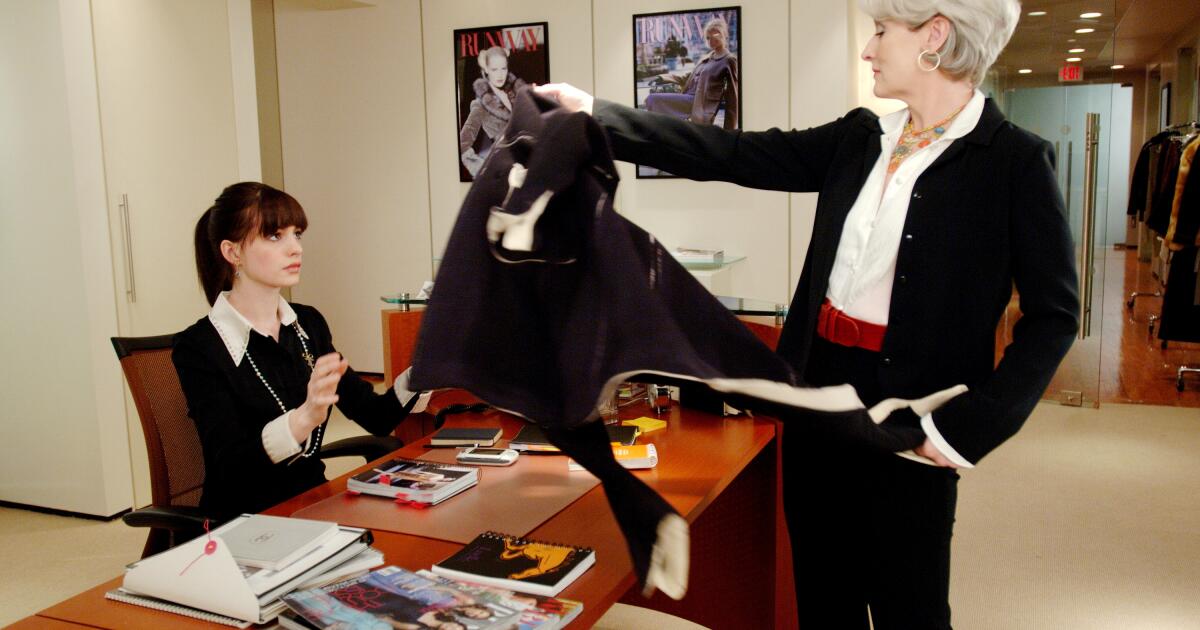
Twenty years ago, when we last saw our protagonist, Andrea Sachs, she had decided to leave her big corporate job because success in that environment required her to be someone she didn’t like or respect. As young professionals, seeing a fictional character like Sachs leave a toxic work environment felt like a satisfying conclusion in 2006. However, over the decades, you learn work/life balance is an oxymoron and characteristics such as integrity and loyalty are often valued but rarely useful on a spreadsheet.
Don’t get me wrong — I love the campy humor, the fashion and soundtrack of the first “Devil.” However, the thing that elevated the Oscar-nominated film to its cultlike status is the same thing that lifted similarly edgy coming-of-age stories such as “The Graduate” in 1967, “American Graffiti” in 1973 and “Fast Times at Ridgemont High” in 1982: truth. Despite the fantasy elements of beautiful and talented people dressed in clothing designed by the upper echelon of the fashion industry, “Devil” has a sequel because what Sachs was experiencing felt real. Many of us have been there — behind on rent, desperately trying to build a career, navigating friends and romance.
The line the character Nigel told an overwhelmed Sachs in the original — “let me know when your whole life goes up in smoke … means it’s time for a promotion” — was more than a humorous quip. It was also foreshadowing for the young professionals in the audience who had not yet learned that being good at your job, or even great, wasn’t enough to keep it.
We know that all too well now. Just this week, the Wall Street Journal reported corporate layoffs in the first quarter of 2026 surpassed 200,000. Of course, it wasn’t always like this.
According to the Economic Policy Institute, in the immediate three decades after World War II, workers saw their hourly compensation in line with the country’s productivity growth. That’s because during the height of the Cold War — when employers offered employees pensions and union participation was at its peak — corporate America was incentivized to offer labor a larger share of the profits as a way to counteract communism. However, when the Soviet Union fell in the early 1990s, so did the motivation from domestic CEOs to share profits with workers. The split between capital and labor began measurably in 1970, and the gap has only increased since.
Twenty years ago — before the 2008 recession, the pandemic and the nearly $1-trillion price tag stemming from the Afghanistan war — it was believable a young professional like Sachs would walk away from a good corporate job for the sake of her integrity. However, given how fraught the current work environment feels, with the shadow of artificial intelligence looming over entry-level positions across multiple disciplines, would we find Sachs’ actions believable today? Or laudable? Or would we demand that she compromise her principles because it’s pragmatic to let go of the idealism of youth? Time has forced many of us to begrudgingly accept that possibility. Our younger selves might not approve, but our older selves know that’s how most people survive long enough in their careers to have a sequel.
YouTube: @LZGrandersonShow