ANC

South Africa’s ANC suffers worst-ever local elections result | Elections

South Africa’s African National Congress (ANC), the party once led by Nelson Mandela, has suffered its worst-ever local elections result, securing just 30% of the vote. Al Jazeera’s Clement Manyathela reports on the historic setback.

Source link

South Africa’s ANC on track for new lows in local polls | Elections News

The ANC was on about 32 percent of the vote after almost half of the votes were counted in municipal elections.

South Africa’s early municipal election results have shown the African National Congress (ANC) with a sharply reduced vote share, weakening the long-dominant party’s control of key cities such as Johannesburg.

The ANC was on about 32 percent of the vote, with the Democratic Alliance (DA) in second place at 25 percent, after more than 60 percent of the votes had been counted in this week’s municipal elections, data from the election commission showed late on Thursday.

Recommended Stories

list of 3 itemsend of list

Meanwhile, former President Jacob Zuma’s breakaway opposition uMkhonto weSizwe (MK) party was in third place with 8.5 percent, below levels suggested by opinion polls.

About 15.9 million of 29.2 million registered voters cast ballots, the electoral commission said, putting turnout at an estimated 54.5 percent, up from 46 percent in the pandemic-hit 2021 local elections.

The ANC, which has been South Africa’s largest party since it led the country out of apartheid in 1994, has tended to do worse in municipal elections than nationally and has acknowledged its failures in local governance.

From nearly 70 percent of the national vote in 2004, the ANC fell below 50 percent for the first time in the 2021 municipal elections, winning 46 percent.

At the 2024 national elections, it managed just more than 40 percent and was forced to accept a unity government with nine other parties, including the DA.

The party, now led by President Cyril Ramaphosa, has borne the brunt of criticism about years of municipal mismanagement that have left South Africans grappling with failing water supplies, persistent power cuts and crumbling public services.

It has also faced corruption allegations, while splinter parties have eaten away at its support base.

The results of this week’s local ballot will offer a key measure of voters’ sentiment ahead of the 2029 general election.

Control of the country’s eight major metropolitan municipalities is up for grabs, alongside dozens of district and local councils.

The MK party had been tipped as one of the few parties capable of securing an outright majority in the eastern port city of Durban.

But projections by the Council for Scientific and Industrial Research (CSIR), a state-funded research body, put its support there at 32 percent.

The DA, meanwhile, was forecast to retain control of tourist magnet Cape Town with 56 percent of the vote, with its leader, Geordin Hill-Lewis, already declaring victory.

The party was also leading with 34 percent in Johannesburg, the country’s financial capital, after running a spirited campaign spearheaded by its former leader, Helen Zille, 75, according to CSIR projections.

With outright majorities far from assured in several major cities, the results could usher in another round of complex coalition negotiations, with parties bargaining to assemble the alliances needed to govern.

Final results are expected on Sunday.

Source link

South Africans vote in local elections seen as test for embattled ANC | Elections News

Polls suggest the governing party could fall below 40 percent as voters weigh failing services.

South Africans are voting in local elections widely seen as a verdict on the African National Congress (ANC), the party that led the country out of white minority rule in 1994 but has steadily lost support over the past decade.

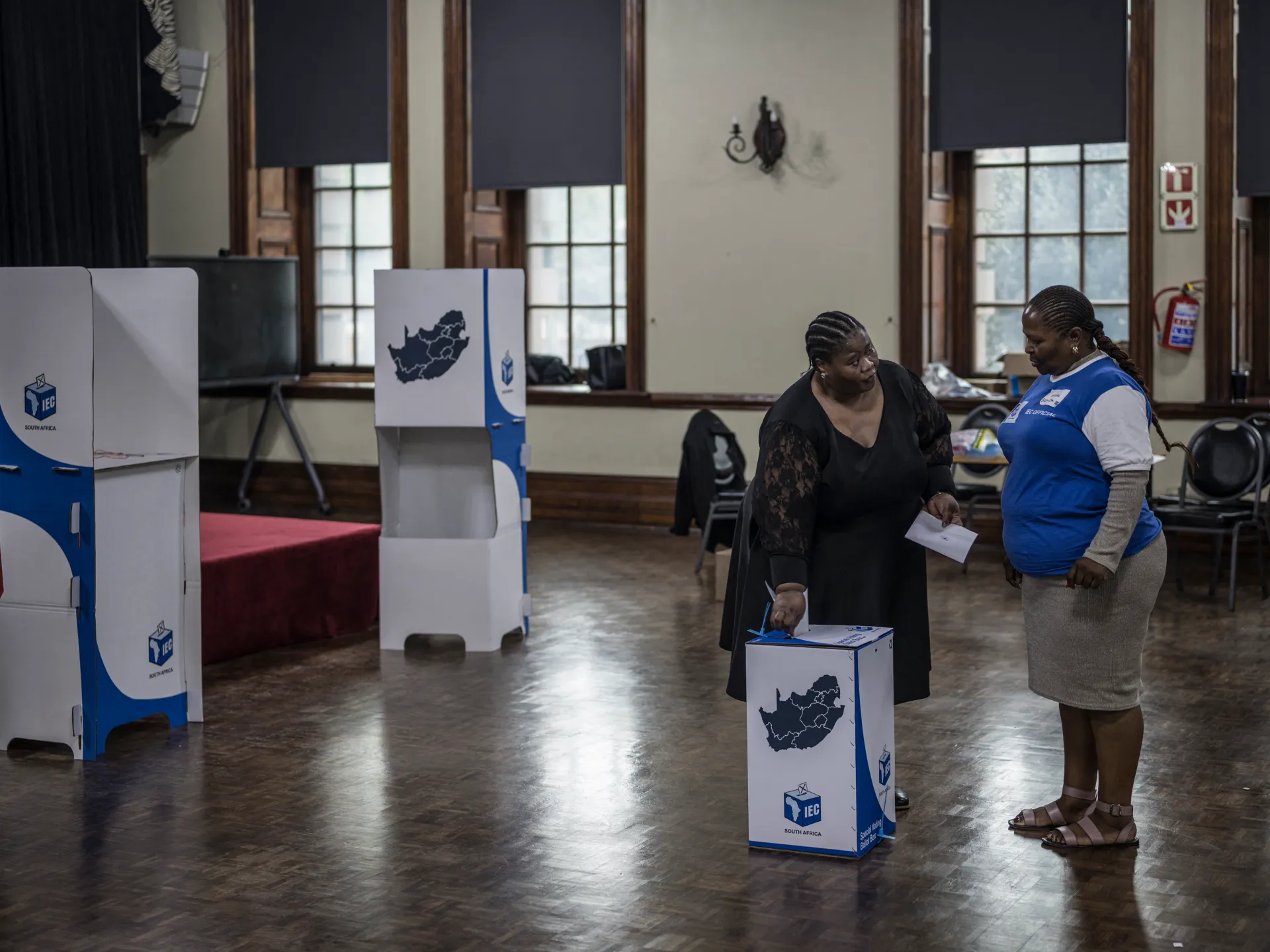
Polls opened at 7am (05:00 GMT) on Wednesday and close at 9pm (19:00 GMT). A record 29.2 million people are registered to vote at 23,696 voting stations, according to the Electoral Commission of South Africa (IEC). More than 1.4 million special votes were cast on Monday and Tuesday.

Recommended Stories

list of 3 itemsend of list

Voters are electing councils for the country’s eight metropolitan municipalities, 44 district councils and 205 local councils. Those councils then choose mayors.

The ANC fell below 50 percent in municipal polls for the first time in 2021. In the 2024 national election, it lost its parliamentary majority and was forced into a coalition government with the Democratic Alliance (DA) and other parties. Polls suggest the ANC’s support could drop below 40 percent this time.

“Municipal failures have contributed to declining public trust and confidence in democratic governance,” President Cyril Ramaphosa said in his weekly newsletter, “From the Desk of the President”.

Ramaphosa is due to vote at Hyde Park High School in Johannesburg, the presidency said.

Johannesburg is the biggest prize in this election. The country’s financial capital has had five mayors in four years.

The DA has fielded its 75-year-old former leader, Helen Zille, for the city’s top job. Her campaign stunts included snorkelling in a mud-filled trench that was flooded by a burst municipal water pipe.

A News24 poll put Zille at 36 percent, meaning she would need coalition partners, particularly the ANC, to govern. Zille told the Associated Press news agency that the ANC was “in free fall”.

This is the first local vote for former President Jacob Zuma’s uMkhonto weSizwe (MK) party, which is mounting a strong challenge in the coastal city of Durban.

“We are going to start by taking back our country here,” Zuma told supporters in the city on Sunday, the AFP news agency reported. Durban has become a centre of anti-migrant sentiment, a prominent theme in the campaign.

Turnout may be a concern. Only 46 percent of registered voters took part in the 2021 municipal elections.

Coalition government is already widespread: 74 of the country’s 257 municipalities were run by coalitions or minority administrations as of February, according to the Mapungubwe Institute for Strategic Reflection.

Security has also been tightened. Police said 21 election-related cases have been recorded since Sunday. KwaZulu-Natal has 165 voting stations classed as high risk, the most of any province.

Final results are expected on Sunday. They are expected to shape the race to succeed Ramaphosa as ANC leader at the party’s conference in December 2027.
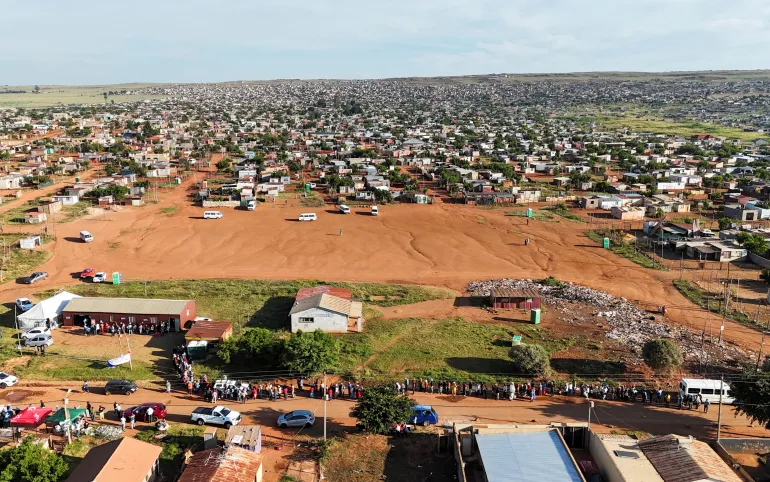
A drone view shows people queuing to vote outside a polling station during local government elections in the Lawley informal settlement, south of Johannesburg, South Africa, November 4, 2026. REUTERS/Siphiwe Sibeko
A drone view shows people queueing to vote outside a polling station during local government elections in the Lawley informal settlement, south of Johannesburg, South Africa, November 4, 2026 [Siphiwe Sibeko/Reuters]

Source link