Amphibious

Marine Amphibious Combat Vehicles To Get Missile-Swatting Active Protection Systems

The U.S. Marine Corps is working toward adding an active protection system (APS) capability to its fleet of 8×8 wheeled Amphibious Combat Vehicles (ACV). APSs on the market today are generally designed to defeat incoming anti-tank guided missiles and other infantry anti-armor weapons. However, many of them also have the inherent ability to down incoming drones or are being modified to address this ever-growing threat, something TWZ previously explored in a detailed feature. The Marines are already exploring additional options to improve the ACV’s defenses against uncrewed aerial attackers, as well as other upgrades to the vehicles.

Chris Melkonian, the Marine Corps’ current Program Manager for Advanced Amphibious Assault (PM AAA), talked today about APS for the ACV fleet and other plans for those vehicles at the annual Modern Day Marine exposition, at which TWZ is in attendance.

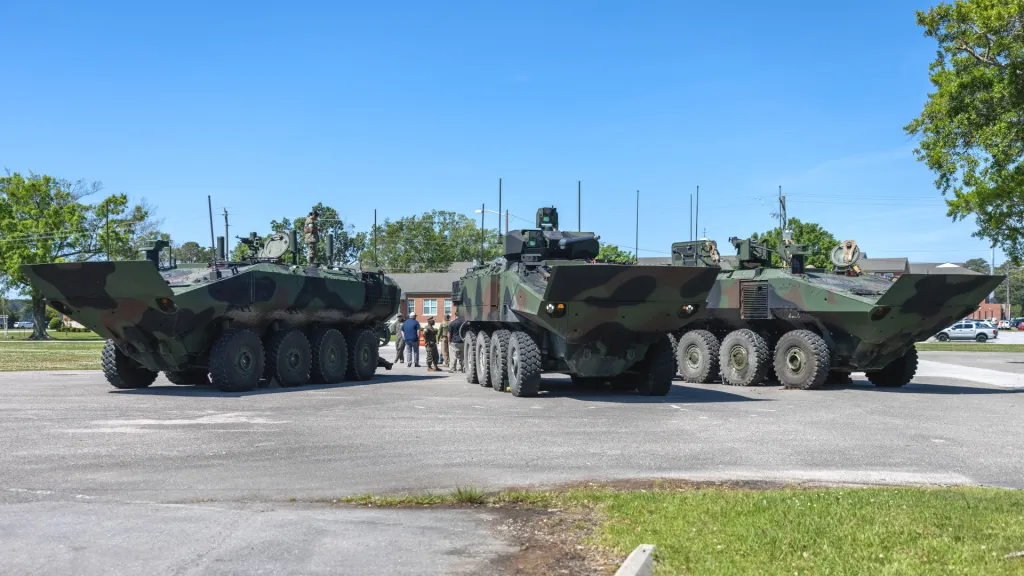
The Marines currently field two ACV variants, the baseline personnel carrier type (ACV-P) and a version optimized for command and control tasks (ACV-C). The service is in the process of acquiring two more variants, one armed with a turreted 30mm cannon (ACV-30) and a recovery vehicle version fitted with a crane and other specialized features (ACV-R). The Corps is presently targeting 2028 for reaching initial operational capability with the ACV-30 and the ACV-R.

From left to right, an Amphibious Combat Vehicle command and control variant (ACV-C), a 30mm cannon-armed ACV-30, and a standard ACV personnel carrier version (ACV-P). The ACV-R recovery variant is not shown here. USMC/Sgt. Alexis Sanchez

The Marines view the entire ACV family as central to its ability to conduct amphibious operations, as well as for providing additional lethality and other support to forces once ashore. At present, the service is planning to acquire a total fleet of 608 ACVs, consisting of 389 ACV-Ps, 33 ACV-Cs, 152 ACV-30s, and 34 ACV-Rs. Prime contractor BAE Systems has also proposed additional variants, including ones configured for electronic warfare or dedicated to the counter-drone role.

This briefing slide, giving a general overview of the Marine Corps’ current plans for the ACV fleet, was shown at the annual Modern Day Marine exposition today. Eric Tegler

In 2018, the Corps announced it had selected the ACV as the replacement for its Cold War-era tracked Assault Amphibious Vehicle (AAV) family. The service announced the formal retirement of the AAV last fall.

Marine AAVs maneuver at Camp Pendleton, California, during the retirement ceremony in 2025. USMC

There are already “things that we’re doing today to make the ACV family vehicles even more capable,” Melkonian said at Modern Day Marine. “The analogy I use is the ACV that Marines are using today is not the ACV that they’re going to use in the future.”

This includes an “active protection system,” he added. “We’re working with the vendor to mature that capability. We’re going to move that right into production.”

Recently released budget documents also say that the Marines are asking for $28.35 million in Fiscal Year 2027 for “Ancillary Equipment” for the ACV fleet, which “is primarily attributed to the procurement of Special Mission Kits for the Active Protective System (APS).” Those same documents further note that the “funding provides APS production kits, integration kits, installation labor, countermeasures, and spares for 21 ACV-P vehicles and will add a new defensive capability to existing vehicles.”

However, neither Melkonian nor the budget documents have said what specific type of APS the ACVs are now in line to get, or when. TWZ has reached out to the service for more information.

This is certainly not the U.S. military’s first foray into APSs for armored vehicles. The U.S. Army previously integrated the Israeli-designed and combat-proven Trophy APS onto a portion of its M1 Abrams tanks.

A US Army M1 Abrams tank fitted with the Trophy APS. US Army via Leonardo An M1 Abrams tank with the Trophy APS installed. U.S. Army via Leonardo
TROPHY is the world's ONLY operational APS (Previous Version – Updated Video Available) thumbnail

TROPHY is the world’s ONLY operational APS (Previous Version – Updated Video Available)


That service is also now in the process of adding another Israeli-developed APS, Iron Fist, onto at least some of its Bradley Fighting Vehicles. The Army’s version of Iron Fist, now designated as the XM251, is also set to be fitted to next-generation M1E3 tanks and a planned replacement for the Bradley family, tentatively designated the XM30.

A US Army M2A4E1 Bradley with the Iron Fist APS. US Army
An official US Army overview of what it has now designated the XM251 Active Protection System, a version of the Israeli-designed Iron Fist. US Army

There are other APS designs on the market today that the Marines could have chosen for integration onto the ACV, as well.

As noted, APSs available today are generally designed to neutralize anti-tank guided missiles and other infantry anti-armor weapons. They typically achieve this through the use of ‘hard-kill’ projectiles designed to destroy targets either using an explosive warhead or via the sheer force of impact. Hard-kill APSs use a mixture of sensors, which can include small-form-factor radars and electro-optical/infrared cameras, to cue those interceptors to engage incoming threats.

From when the Marines first announced the selection of BAE’s ACV back in 2018, TWZ has noted that an APS could provide the vehicles with a valuable extra layer of defense against anti-armor missiles and rockets. More capable infantry anti-armor weapons continue to be developed and proliferate globally. Those threats present additional challenges in beach landing scenarios for amphibious vehicles like the ACV, which move much more slowly in the water than they do on land.

The threat that drones pose, and to armored vehicles in particular, which TWZ has been sounding the alarm on for years, has also now been fully rammed into the public consciousness. This is thanks largely to the stark visuals of tanks and other vehicles being attacked by uncrewed aerial systems (UAS) that emerge on a daily basis now from the ongoing conflict in Ukraine.

A Ukrainian drone from the 79th Air Assault Brigade drops a 40mm HEDP grenade on a Russian UR-77 Meteorit, causing a catastrophic payload explosion. pic.twitter.com/SsaQCKXsNL

— OSINTtechnical (@Osinttechnical) August 14, 2023

Drones are an ever-more common and still evolving threat across a growing number of conflict zones worldwide. First-person view (FPV) type kamikaze drones controlled via fiber optic cable have become a particular point of concern, since they are impervious to radio frequency jamming. In turn, this has already prompted the development of a variety of active and passive countermeasures for armored and unarmored vehicles. We will come back to this in a moment.

TWZ has previously laid out a detailed case specifically for using hard-kill APSs to provide added counter-drone defense for armored vehicles. The Israeli firms behind Trophy and Iron Fist have both now notably demonstrated the ability of their respective systems to defeat uncrewed aerial threats in certain envelopes, as can be seen in the videos below. It should be noted that Trophy, Iron Fist, and other hard-kill APSs have a limited number of engagement opportunities and are not really intended to defeat large volumes of threats simultaneously, such as drones attacking in swarms.

Trophy® APS - The land maneuver enabler thumbnail

Trophy® APS – The land maneuver enabler


Iron Fist APS | Active Protection System for Armored Vehicles thumbnail

Iron Fist APS | Active Protection System for Armored Vehicles


When it comes to the APS capability now planned for Marine ACVs, “that is not going to be the end-all, be-all,” Melkonian, the Marine Corps’ Program Manager, said today. “We’re constantly looking at what the next generation of APS is and how we can get that onto the platform in a lightweight form factor.”

Melkonian also highlighted other potential counter-drone and more general survivability upgrades that could be on the horizon for ACV. This could include the integration of directed energy weapons and some form of added overhead protection. Top-down attacks on vehicles where the armor is typically thinnest can be very threatening, in general.

As an aside, the Army has already been working to acquire hundreds of Top Attack Protection (TAP) add-on armor systems for installation on its M1 Abrams tanks and other armored vehicles. This reflects an expanding global trend in the integration of so-called ‘cope cage’ type armor around the turrets and other areas of armored and unarmored vehicles, primarily to protect against drone attacks. The first cope cages appeared on Russian tanks in the lead-up to the all-out invasion of Ukraine in 2022. This kind of armor does present tradeoffs, including the potential to interfere with other capabilities, such as APSs.

A Ukrainian M1 Abrams with cope cage-style add-on armor around its turret. Metinvest

Improved “situational awareness, that’s kind of a gateway to counter-UAS, in terms of the ability to sense your environment,” Melkonian also noted today while talking about other possible upgrades for the ACV. “Take all that video on board and then be able to feed that into [a] counter-UAS system.”

Melkonian highlighted several other areas of interest where the Marines are looking to improve the ACV’s capabilities. His list included things like reducing the vehicle’s signatures to make it harder for enemies to spot, improving its mobility while in the water, and upgrades to just help keep everything inside dry.

Another briefing slide shown at Modern Day Marine during the ACV program presentation, laying out areas of interest for future upgrades. Eric Tegler

“Marines operate in very humid, very difficult environments,” he explained. “The ability to dehumidify the vehicles is a critical enabler, being able to improve the maintenance strategy and keeping [sic] those components running for as long as they need to.”

A Marine ACV hits the water after leaving the well deck of an amphibious warfare ship. USMC/Cpl. Osmar Vasquez Hernandez

Broadly speaking, the Marines are interested in new “lightweight solutions, advanced technology, and anything that’s going to be marinized. It must be marinized,” he added. “I can’t tell you how many solutions have been picked, and that’s one of the first questions we ask, and sometimes the solutions are designed for a marinized environment, sometimes they’re not. Marines go where no one else goes, and we’ve got to be able to make sure that our capabilities can support their needs.”

The core marinization requirement will apply to the APS integration just like any other upgrades for Marine ACVs.

Altogether, the addition of active protection systems looks to be just one important upgrade for the Marine Corps’ ACV fleet now on the horizon.

Eric Tegler contributed to this story.

Contact the author: joe@twz.com

Joseph has been a member of The War Zone team since early 2017. Prior to that, he was an Associate Editor at War Is Boring, and his byline has appeared in other publications, including Small Arms Review, Small Arms Defense Journal, Reuters, We Are the Mighty, and Task & Purpose.


Source link

South Korea stages joint amphibious drill in Pohang

KAAV amphibious assault vehicles and an LSF landing craft carrying Marines moving toward a beach in Pohang, about 270 kilometers southeast of Seoul, South Korea, 26 April 2026 (issued 27 April 2026). The Navy and Marine Corps launched a weeklong regular amphibious landing exercise to maintain combat readiness against evolving threats in future warfare. Photo by ROK MARINE COMMAND YONHAP / EPA

April 27 (Asia Today) — South Korea’s Navy and Marine Corps conducted a major joint amphibious landing drill in Pohang, testing combined operations involving manned and unmanned assets, the military said Monday.

The exercise, held on the coast of Dokseok-ri in Pohang, North Gyeongsang Province, involved about 3,200 troops from the Army, Navy, Air Force and Marine Corps.

The drill included Korean Amphibious Assault Vehicles, the large transport ship Marado, MUH-1 Marineon helicopters, P-8A maritime patrol aircraft, KF-16 fighter jets, AH-64E attack helicopters and drones operated by the Drone Operations Command.

The exercise focused on “decisive action,” a key phase of amphibious operations in which Marine landing forces secure a beachhead with support from naval gunfire and air power before transitioning to ground operations.

A New Zealand Army platoon joined the landing force for the first time, operating with South Korean Marines. The New Zealand troops trained for two weeks before the landing, including urban operations, combat shooting and boarding and dismounting drills using amphibious vehicles.

The South Korean military said the exercise also tested responses to enemy drones, mine-clearing operations, anti-submarine warfare and air defense procedures.

Logistics drones were used to deliver ammunition, combat rations and medical supplies to units operating deep in enemy territory. U.S. Navy 7th Fleet personnel also took part in mine countermeasure operations.

Special operations forces used first-person-view drones for the first time during advance force operations, collecting real-time intelligence while infiltrating target beaches and clearing obstacles.

“This exercise strengthened the Navy and Marine Corps’ joint operational capability as one team and verified the practicality of manned-unmanned combined forces using advanced science and technology,” said Navy Capt. Hwang Sang-geun, commander of the amphibious task force.

— Reported by Asia Today; translated by UPI

© Asia Today. Unauthorized reproduction or redistribution prohibited.

Original Korean report: https://www.asiatoday.co.kr/kn/view.php?key=20260428010008699

Source link

USS Boxer The Second Amphibious Assault Ship Now Heading To Middle East (Updated)

The Pentagon is reportedly sending the Wasp class amphibious assault ship USS Boxer and the rest of its Amphibious Ready Group (ARG), loaded with elements of the 11th Marine Expeditionary Unit (MEU). This comes as the Trump administration is reported to be increasingly considering seizing or blockading Iran’s highly strategic Kharg Island in the Persian Gulf as part of a new phase of Operation Epic Fury.

It has now been widely reported that what is described as an “accelerated” deployment of the Boxer Amphibious Ready Group and the 11th MEU from the West Coast will be in support of Operation Epic Fury.

#BREAKING #EXCLUSIVE
The US military has accelerated the deployment of thousands of Marines and sailors to help reinforce US troops in the Middle East amid the war against Iran.

Four officials tell Newsmax the Boxer Amphibious Ready Group and the embarked 11th Marine…

— Carla Babb (@CarlaBNewsmax) March 19, 2026

The Boxer Amphibious Ready Group also includes two other amphibious warfare ships, the San Antonio class USS Portland and the Whidbey Island class USS Comstock. The 11th MEU has roughly 2,500 personnel, in total, and includes air and ground components.

This follows reports last week that the America class amphibious assault ship USS Tripoli and its ARG, carrying elements of the 31st MEU, had also begun moving from the Pacific toward the Middle to support ongoing operations against Iran.

Axios reported today that the Trump administration could be leaning toward establishing a blockade around Iran’s Kharg Island, through which it exports much of its oil, or occupying it, citing unnamed officials. The central goal of doing this would be to step up pressure on the regime in Tehran to, in turn, force it to reopen the Strait of Hormuz. Traffic through that waterway has come to a virtual halt, which is causing massive reverberations across global energy markets.

“[Trump] wants Hormuz open. If he has to take Kharg Island to make it happen, that’s going to happen. If he decides to have a coastal invasion, that’s going to happen,” one official said, according to Axios. “But that decision hasn’t been made.”

The U.S. military carried out extensive strikes on Kharg Island this past weekend. A deployment of U.S. ground troops there would be a major escalation that could have significant ramifications, including domestically.

Last night, U.S. forces executed a large-scale precision strike on Kharg Island, Iran. The strike destroyed naval mine storage facilities, missile storage bunkers, and multiple other military sites. U.S. forces successfully struck more than 90 Iranian military targets on Kharg… pic.twitter.com/2X1glD4Flt

— U.S. Central Command (@CENTCOM) March 14, 2026

“We’ve always had boots on the ground in conflicts under every president, including Trump. I know this is a fixation in the media, and I get the politics, but the president is going to do what’s right,” a second official, who also said no decision has yet been made, said, per Axios.

A senior official told Axios: “We’ve always had boots on the ground in conflicts under every president, including Trump. I know this is a fixation in the media, and I get the politics. But the president is going to do what’s right.” https://t.co/6dbDy9zCHr

— Axios (@axios) March 20, 2026

Just yesterday, TWZ spoke with Joseph Votel, the former commander of U.S. Central Command, with a particular focus on the tumultuous Strait of Hormuz, through which around 20 percent of the world’s oil passes. You can read that interview here.

In the meantime, publicly available flight-tracking data indicates that the U.S. Navy is using MQ-4C Triton intelligence, surveillance, and reconnaissance drones to monitor Kharg Island as part of their patrols of the northern Persian Gulf.

A US Navy MQ-4C Triton UAV just completed a reconnaissance mission of the northern Persian Gulf and Kharg Island.

The drone orbited off Iran’s largest oil terminal at Kharg Island. pic.twitter.com/062HrbdEt8

— OSINTtechnical (@Osinttechnical) March 20, 2026

Trump has warned that he might consider targeting oil facilities on the island if Iran or other countries “do anything to interfere” with the safe passage of ships through the strait.

Destroying or damaging oil infrastructure on Kharg could have unintended side effects, however. On the one hand, it would further push up global oil prices. The complex nature of infrastructure might take years to repair, which would compound this. In the long term, there is also the question of whether oil infrastructure here should be preserved for the benefit of a potential new Iranian government.

Any successor to the current regime would lose out on vital oil income, potentially driving further internal strife.

There is also the possibility that seizing the island and cutting off the current Iranian government from its most vital source of revenue could be used as a catalyst to bring about its fall.

Then there is the huge question about the kind of military effort that would be required to seize Kharg. This would require a large-scale, sustained operation and would be brought with risk. The island is only 20 miles from the Iranian mainland, putting whatever U.S. force is there at extreme risk of bombardment of multiple types. Getting amphibious assault ships through the Strait and into the Gulf would be an issue, as well, and those ships would be heavily targeted during transit and especially once inside the Gulf. With this in mind, a longer-range aviation assault would be most likely.

A naval blockade of the island might be easier to achieve in the short term, but it would run the risk of Iranian attacks, likely involving uncrewed surface vessels (USVs), drones, and other asymmetric options, as well as anti-ship cruise missiles, the use of which has been limited up to this point, as you can read about here.

As already noted, additional U.S. forces are headed to the region in the form of the Tripoli ARG and the 31st Marine Expeditionary Unit (MEU). While the deployment of the big-deck amphibious assault ship USS Tripoli had already been reported, we now know it is being supported by the amphibious transport docks USS San Diego (LPD-22) and USS New Orleans (LPD-18), thanks to publicly available ship-tracking data.

USS Tripoli (LHA 7) America-class amphibious assault ship westbound in the Singapore Strait – March 17, 2026 SRC: INST- sgshipspotting pic.twitter.com/iC4qBZUZML

— WarshipCam (@WarshipCam) March 17, 2026

ARG TRANSIT: Likely spot of the USS New Orleans

Mar 19 imagery caught a San Antonio-class LPD operating ~109 km North of Banda Aceh (6.545, 95.538), right on the edge of the satellite pass.

Based on the last known AIS ping, and speed of the USS Tripoli (19 knots on her last AIS… pic.twitter.com/aAl5jUTuB1

— MT Anderson (@MT_Anderson) March 19, 2026

What exactly the next phase of Operation Epic Fury will look like could be clearer as the Navy amphibious warfare ships and the thousands of Marines they are carrying get closer to the Middle East.

UPDATES

UPDATE: 6:16 PM EST

There are some mixed messages coming out of Washington about the future of Epic Fury.

President Donald Trump said he is considering “winding down” the war on Iran. His comments, delivered on his Truth Social account, come even though two Marine Expeditionary Units (MEUs) are steaming toward the Middle East and the Pentagon has reportedly drawn up plans to put American troops into Iran with the president’s approval.

Trump added that the U.S. could end the war effort even with the Iranians still closing the Strait of Hormuz.

“We are getting very close to meeting our objectives as we consider winding down our great Military efforts in the Middle East with respect to the Terrorist Regime of Iran,” Trump proclaimed.

He stated that the U.S. has: “(1) Completely degrading Iranian Missile Capability, Launchers, and everything else pertaining to them. (2) Destroying Iran’s Defense Industrial Base. (3) Eliminating their Navy and Air Force, including Anti Aircraft Weaponry. (4) Never allowing Iran to get even close to Nuclear Capability, and always being in a position where the U.S.A. can quickly and powerfully react to such a situation, should it take place. (5) Protecting, at the highest level, our Middle Eastern Allies, including Israel, Saudi Arabia, Qatar, the United Arab Emirates, Bahrain, Kuwait, and others.”

The Strait, Trump added, “will have to be guarded and policed, as necessary, by other Nations who use it — The United States does not! If asked, we will help these Countries in their Hormuz efforts, but it shouldn’t be necessary once Iran’s threat is eradicated. Importantly, it will be an easy Military Operation for them.”

Since Day One of Operation Epic Fury, President Trump clearly outlined the U.S. Military’s objectives to end the threat of the Iranian terrorist regime.

The President and the Pentagon predicted it would take approximately 4-6 weeks to achieve this mission.

Tomorrow marks week… pic.twitter.com/A5F8UTxpPZ

— Karoline Leavitt (@PressSec) March 20, 2026

Our coverage has ended for the day. Stay tuned for more.

UPDATE: 5:15 PM EST –

Retired Marine Gen. James Mattis, who served as Defense Secretary and CENTCOM commander, weighed in on the war, saying he doesn’t believe regime change is likely.

Former General Jim Mattis says that it’s “very unlikely” that this Iranian regime falls right now.

“They’ve told the Iranian parents, don’t let your sons and daughters demonstrate because we will shoot them. We will go after them. So no, they’re not going to go away anywhere… pic.twitter.com/gq3RzIpPlZ

— Firing Line with Margaret Hoover (@FiringLineShow) March 20, 2026

Iranian state media warns Iran will target the UAE’s industrial port city of Ras Al-Khaimah if Iranian islands are again attacked from that nation, Arab News reported.

UPDATE: 4:20 PM EST –

Trump ruled out any ceasefire with Iran.

.@POTUS: “We can have dialogue, but I don’t want to do a ceasefire. You don’t do a ceasefire when you’re literally obliterating the other side… we’re not looking to do that.” pic.twitter.com/g2Yjik41GS

— Rapid Response 47 (@RapidResponse47) March 20, 2026

He suggested that re-opening the Strait is “a simple military maneuver.”

.@POTUS on opening the Strait of Hormuz: “It’s a simple military maneuver, it’s relatively safe, but you need a lot of help in the sense that you need ships, you need volume. NATO could help us but they so far haven’t had the courage to do so… it would be nice if the countries,… pic.twitter.com/KDOWOI3rgx

— Rapid Response 47 (@RapidResponse47) March 20, 2026

The president also declined to say if he will order troops into Iran.

REPORTER: Are you deploying additional troops to the region for deterrence or to optimize your operational capabilities?@POTUS: “I would say this, that if I told you the answer to that question, my military people wouldn’t be very happy — but we have a lot of troops, we have… pic.twitter.com/2jX7t4tgqq

— Rapid Response 47 (@RapidResponse47) March 20, 2026

CBS News is reporting that Pentagon officials have made detailed preparations for deploying U.S. ground forces into Iran. The network cited multiple sources briefed on the plans.. 

“Senior military commanders have submitted specific requests aimed at preparing for such an option as President Trump weighs moves in the U.S.-Israel-led conflict with Iran, the sources said,” according to CBS. The news outlet’s sources do not specify how those troops would be used. Meanwhile, the Trump administration hasn’t committed to any such plan to put boots on the ground, which would greatly escalate the war.

CENTCOM provided us an update of the number of troops wounded so far in Epic Fury. To date there have been 232 wounded, up from about 200 on Monday. Of those troops, 207 returned to duty. The number of seriously wounded has held steady at 10. The Associated Press was the first to report these details.

The command also shared video of what it says was an attack on The Esfahan Khomeynishahr Drone Production Plant that produced Shahed one-way attack drones.

The Esfahan Khomeynishahr Drone Production Plant produced Shahed one-way attack drones that have been used by the Iranian regime to attack targets across the region. The photo dated March 3, 2026, shows the plant before U.S. strikes. The photo taken on March 12, 2026 shows the… pic.twitter.com/nXxYpv2eyw

— U.S. Central Command (@CENTCOM) March 20, 2026

New video shows another Iranian cluster munition exploding over Israel. There were no reports of injuries from the attack, which was the ninth so far this evening, according to Times of Israel military correspondent Emanuel “Mannie” Fabian in a post on X.

One of the missiles launched by Iran at central Israel a short while ago carried a cluster bomb warhead, footage shows.

There are no reports of injuries in the attack, the ninth from Iran since midnight. pic.twitter.com/pH2IMCmSOq

— Emanuel (Mannie) Fabian (@manniefabian) March 20, 2026

NATO provided us a statement about pulling its forces out of Iraq as Iranian-backed militias have carried out several attacks there:

“‘I would like to thank the Republic of Iraq and all the Allies who assisted in the safe relocation of NATO personnel from Iraq,’ said Gen. Alexus Grynkewich, Supreme Allied Commander Europe. “‘ would also like to thank the dedicated men and women of NATO Mission Iraq, who continued their mission throughout this period. They are true professionals.’

The last NATO Mission Iraq personnel departed the country on March 20.

NATO Mission Iraq will continue from Joint Force Command Naples. NMI is a non-combat advisory and capability-building mission to assist Iraq in building more sustainable, transparent, inclusive and effective security institutions and forces, so that they themselves are able to stabilise their country, fight terrorism, and prevent the return of ISIS/Daesh.”

Amidst the conflict in the Middle East, the NATO Mission in Iraq has relocated its personnel from the Middle East to Europe, per a release from NATO’s SHAPE page. pic.twitter.com/lSNZ4tH8Kh

— OSINTdefender (@sentdefender) March 20, 2026

Iraq ​​declared a ‌”force majeure” ⁠on all oilfields developed ​by foreign oil companies, ⁠as attacks in ⁠the ‌region have ‌disrupted navigation through ‌the ‌Strait ​of ⁠Hormuz,” Al Arabiya reported on X. This is ​”preventing most of ​the country’s crude exports from ⁠moving,” oil ministry sources told the outlet.

A force majeure is a contractual clause freeing parties from liability due to extraordinary, unavoidable events, like the war.

‌Iraq ​​declares ‌force majeure ⁠on all oilfields developed ​by foreign oil companies, ⁠as attacks in ⁠the ‌region have ‌disrupted navigation through ‌the ‌Strait ​of ⁠Hormuz, ​preventing most of ​the country’s crude exports from ⁠moving, oil ministry sources say. pic.twitter.com/8mFHXiaRBP

— Al Arabiya English (@AlArabiya_Eng) March 20, 2026

The U.K. Defense Ministry offered its latest update on the war.

The Iranian space program, one of the most advanced in the Middle East, has suffered extensive damage from US and Israeli airstrikes, Bloomberg News reported. The attacks are “potentially driving Tehran to deepen cooperation with China and Russia,” the outlet posited.

The Iranian space program, one of the most advanced in the Middle East, has suffered extensive damage from US and Israeli airstrikes, potentially driving Tehran to deepen cooperation with China and Russia https://t.co/aApWOdfCao

— Bloomberg (@business) March 20, 2026

UPDATE: 2:12 PM EST –

Earlier in our story, we noted that the USS Boxer (ARG) was deploying to the Middle East. Images emerged on line of the Boxer, the Portland and the Comstock departing San Diego.

The USS Boxer Amphibious Ready Group and the 2,500 Marines from the 11th MEU are heading to the Middle East as the US builds up its amphibious assault capabilities in the region.

The USS Boxer, USS Portland, and USS Comstock departed San Diego over the past 48 hours. pic.twitter.com/SKWTleAbG7

— OSINTtechnical (@Osinttechnical) March 20, 2026

Ukrainian President Volodymyr Zelensky is once again touting a deal to provide drones to the U.S., an arrangement Trump has so far dismissed.

“I am very interested in signing this agreement with our close partner – the United States of America,” Zelensky stated on X. “So when President Trump is ready, I will definitely be ready. Our negotiating team will discuss this issue at the meeting in the United States.”

As early as a year ago, we proposed a Drone Deal to the United States of America, because it is our key partner.

The agreement is not only about interceptor drones. First and foremost, it includes naval drones and long-range drones that have been proven in the war. It also…

— Volodymyr Zelenskyy / Володимир Зеленський (@ZelenskyyUa) March 20, 2026

Jerusalem’s Old City, home to some of the most sacred sites in Christianity, Islam and Judaism, was reportedly hit by missile shrapnel that fell near the Al-Aqsa Mosque compound. The official Turkish Anadolu news outlet reported that missile fragments also fell in the Jewish Quarter near Jerusalem’s Old City, amid heightened tension and a security alert in the area.

Shrapnel landed in several locations across Jerusalem, with no immediate details available on the extent of the damage, Anadolu added, citing Israeli media.

Another video shows the moment a fragment from an Iranian ballistic missile struck Jerusalem’s Old City this afternoon. pic.twitter.com/qNvTXmRDr6

— Emanuel (Mannie) Fabian (@manniefabian) March 20, 2026

Shipping giant Hapag-Lloyd provided us with a statement on the current state of their maritime commerce.

“We are monitoring the situation very closely, but the situation in the Middle East remains very fluid. Based on our current risk assessment, we have suspended all transits through the Strait of Hormuz and the Suez Canal as well as bookings from and to the Upper Gulf region. As a result, schedules and port calls may change at short notice, and some services will be adjusted. We have contingency plans in place, and the safety of our people on ground and ocean remains our top priority. Our teams are working closely together to find the best possible solutions for our customers’ shipments.”

A Greek-owned medium-sized cargo vessel, also known as a panamax, became the first bulk carrier to transit the Strait of Hormuz with its Automatic Identification System on since March 2, according to Lloyd’s List.

A Greece-owned panamax has become the first bulk carrier to transit the Strait of Hormuz with its Automatic Identification System turned on since March 2. pic.twitter.com/gfNjJsz517

— Lloyd’s List (@LloydsList) March 20, 2026

Moscow proposed a quid pro quo to the U.S. under which the Kremlin would stop sharing intelligence information with Iran, such as the precise coordinates of U.S. military assets in the Middle East, if Washington ceased supplying Ukraine with intel about Russia, according to a report from Politico. The outlet cited two people familiar with the negotiations.

Moscow proposed a quid pro quo to the US under which the Kremlin would stop sharing intelligence information with Iran – such as the precise coordinates of US military assets in the Middle East – if the US ceased supplying Ukraine with intel about Russia.https://t.co/rpN0x8XqOZ

— POLITICOEurope (@POLITICOEurope) March 20, 2026

UPDATE: 1:00 PM EST –

The Israel Defense Forces (IDF) and Iranian media have both reported the death of Iran’s Islamic Revolutionary Guard Corps (IRGC) spokesperson, Ali Mohammad Naeini. The Israeli military said in a post on X that he was killed in an overnight airstrike.

Just before his death, Naeini issued a statement insisting Iran was still able to produce missiles despite the attacks from Israel and the United States.

Naeini made the comment in response to a claim by Israeli Prime Minister Benjamin Netanyahu that Iran could no longer build missiles. Referencing how Iranian schools consider a 20 as a perfect score, Naeini said: “Our missile industry score is 20 and there is no concern in this regard because we are producing missiles even during war conditions, which is amazing, and there is no particular problem in stockpiling.”

Naeini joins a growing list of high-profile Iranian regume figures who have been killed so far in the conflict, others including the former supreme leader Ali Khamenei, the security chief Ali Larijani, head of the paramilitary Basij force, Gholamreza Soleimani, and the intelligence minister, Esmail Khatib.

Tehran has accused the United Kingdom of “participation in aggression,” reflecting the fact that the country has permitted the U.S. Air Force to use its airbases as a launchpad for bombing missions over Iran.

Iranian Foreign Minister Abbas Araghchi warned his British counterpart, Yvette Cooper, and insisted on his country’s right to self-defence. “These actions will definitely be considered as participation in aggression and will be recorded in the history of relations between the two countries. At the same time, we reserve our inherent right to defend the country’s sovereignty and independence,” Araghchi said on his official Telegram channel.

⚡️🇺🇸🇬🇧🇮🇷 Footage of a US Air Force B-52H bomber returning to the UK following a reported strike mission linked to operations against Iran.

US B-52 and B-1 bombers have been deployed to RAF Fairford and are known to be conducting long-range strike missions. pic.twitter.com/m3sj39PHc3

— War Monitor (@monitor11616) March 20, 2026

U.S. Central Command says that it has destroyed an Iranian ballistic missile plant in Karaj, to the west of Tehran. The plant was used to “assemble ballistic missiles that threatened Americans, neighboring countries, and commercial shipping,” CENTCOM said.

Prior to Operation Epic Fury, the Iranian regime used the Karaj Surface-to-Surface Missile Plant to assemble ballistic missiles that threatened Americans, neighboring countries, and commercial shipping. The photo dated March 1, 2026, shows the plant prior to U.S. strikes. The… pic.twitter.com/QEs5toZQpX

— U.S. Central Command (@CENTCOM) March 19, 2026

Satellite imagery from Bandar Abbas suggests that airstrikes have targeted the naval base and port facilities once again. The imagery below shows fires burning at several different structures, although the level of overall damage is not entirely clear.

BDA Update: Bandar Abbas Southern Fleet HQ
Mar 18 high-res imagery confirms another wave of strikes near the primary navy piers

➡️Impacts focused heavily on the infrastructure and support buildings just off the waterfront
➡️Active fires with at least 6 distinct structures… pic.twitter.com/KPFAMNacst

— MT Anderson (@MT_Anderson) March 19, 2026

Other recent targets of U.S. airstrikes appear to include Qeshm Island in the Strait of Hormuz. Satellite imagery shows cratering, but it unclear if the attacks collapsed the IRGC’s tunnel complex that is understood to be on the island. The underground complex is reportedly used to store small boats, missiles, and drones.

A U.S. strike hit the IRGC’s tunnel complex on Qeshm Island, causing visible surface damage (craters, hits on nearby facilities), but failed to destroy or penetrate the hardened underground tunnels, meaning key assets likely survived.

Crater impacts near tunnel entrances, but no… pic.twitter.com/lr4JWKSllz

— Clash Report (@clashreport) March 20, 2026

Israel conducted airstrikes on Tehran today, as Iranians marked Nowruz, the Persian New Year. In a statement on X, the Israel Defense Forces said: “The IDF has now begun a wave of strikes targeting infrastructure of the Iranian terror regime in the heart of Tehran.”

Meanwhile, there are growing questions about the degree to which Israel and the United States are on the same page as regards the war against Iran.

Israeli Prime Minister Benjamin Netanyahu has said that Israel acted alone in the bombing of Iran’s South Pars gas field, one of the largest in the world. He also confirmed that Trump had asked Israel to stop any further such attacks. “President Trump asked us to hold off on future attacks, and we’re holding out,” Netanyahu explained.

Iran is being “decimated” and no longer had the capacity to enrich uranium or make ballistic missiles, but a revolution in the country would require a “ground component,” Netanyahu added.

When asked whether he had dragged Trump into the conflict, Netanyahu responded: “Does anyone really think that someone can tell President Trump what to do?” Netanyahu told reporters, at a press conference. “He didn’t need any convincing,” he added. “I don’t think any two leaders have been as coordinated as President Trump and I. He’s the leader. I’m, you know, his ally.”

Israel, Kuwait, and the United Arab Emirates today all announced that their air defenses were responding to Iranian missile attacks. Elsewhere in the region, Bahrain’s interior ministry announced an air raid alert, while Saudi Arabia’s defence ministry said it had intercepted a drone in the country’s east.

Kuwait’s state oil firm KPC reported that its Mina Al-Ahmadi refinery was hit by multiple drone attacks early on Friday, causing a fire in some units. No initial casualties were reported, according to the state news agency.

Early this morning, multiple Iranian attack drones hit Kuwait’s Mina Al-Ahmadi oil refinery, setting several areas of the refinery complex ablaze and causing a partial shutdown. pic.twitter.com/9HwqC0fHZi

— OSINTtechnical (@Osinttechnical) March 20, 2026

Iranian attacks on energy infrastructure have taken a toll on Qatar, too. Ras Laffan Industrial City in Qatar has been forced to reduce the country’s liquefied natural gas (LNG) export capacity by 17 percent, according to QatarEnergy, the state-run energy giant. The “extensive damage” could reportedly reduce its annual revenues by $20 billion and take “up to five years” to repair.

Footage shows a fire and the moment of impact of an Iranian ballistic missile in Ras Laffan Industrial City, home to the world’s largest liquefied natural gas (LNG) production. pic.twitter.com/zIyGJ5p9ue

— OSINTWarfare (@OSINTWarfare) March 18, 2026

Iran has also launched strikes against energy infrastructure in Israel.

According to Israel’s energy ministry, an Iranian missile attack — reportedly using cluster warheads — hit oil refineries in the northern port city of Haifa but did not cause “significant damage.” Energy Minister Eli Cohen added that power was disrupted, but electricity was soon restored to most of those who were affected.

The video below purports to show debris from an intercepted Iranian ballistic missile landing on a car in central Israel.

According to the Fars news agency, the Iranian military has reportedly threatened American and Israeli military personnel and officials. In a post on Telegram, the agency quoted a senior spokesperson for Iran’s armed forces as saying: “We are keeping an eye on your cowardly officials and commanders, your wicked pilots and soldiers… From now on, based on the information we have from you, the world’s tourist attractions, resorts, and entertainment centers will not be safe for you either,” the spokesperson reportedly said.

Contact the author: thomas@thewarzone.com

Thomas is a defense writer and editor with over 20 years of experience covering military aerospace topics and conflicts. He’s written a number of books, edited many more, and has contributed to many of the world’s leading aviation publications. Before joining The War Zone in 2020, he was the editor of AirForces Monthly.


Joseph has been a member of The War Zone team since early 2017. Prior to that, he was an Associate Editor at War Is Boring, and his byline has appeared in other publications, including Small Arms Review, Small Arms Defense Journal, Reuters, We Are the Mighty, and Task & Purpose.


Source link