Alejandro G. Iñárritu resurrects lost footage from ‘Amores Perros’ in new LACMA installation
Darkness engulfs me right before I step into a dream. The Oscar-winning Mexican filmmaker Alejandro González Iñárritu guides me from a pitch-black hallway into an open space, where beams of light and smoke, interspersed with sounds from the streets of Mexico City, create a vortex into a unique cinematic experience.
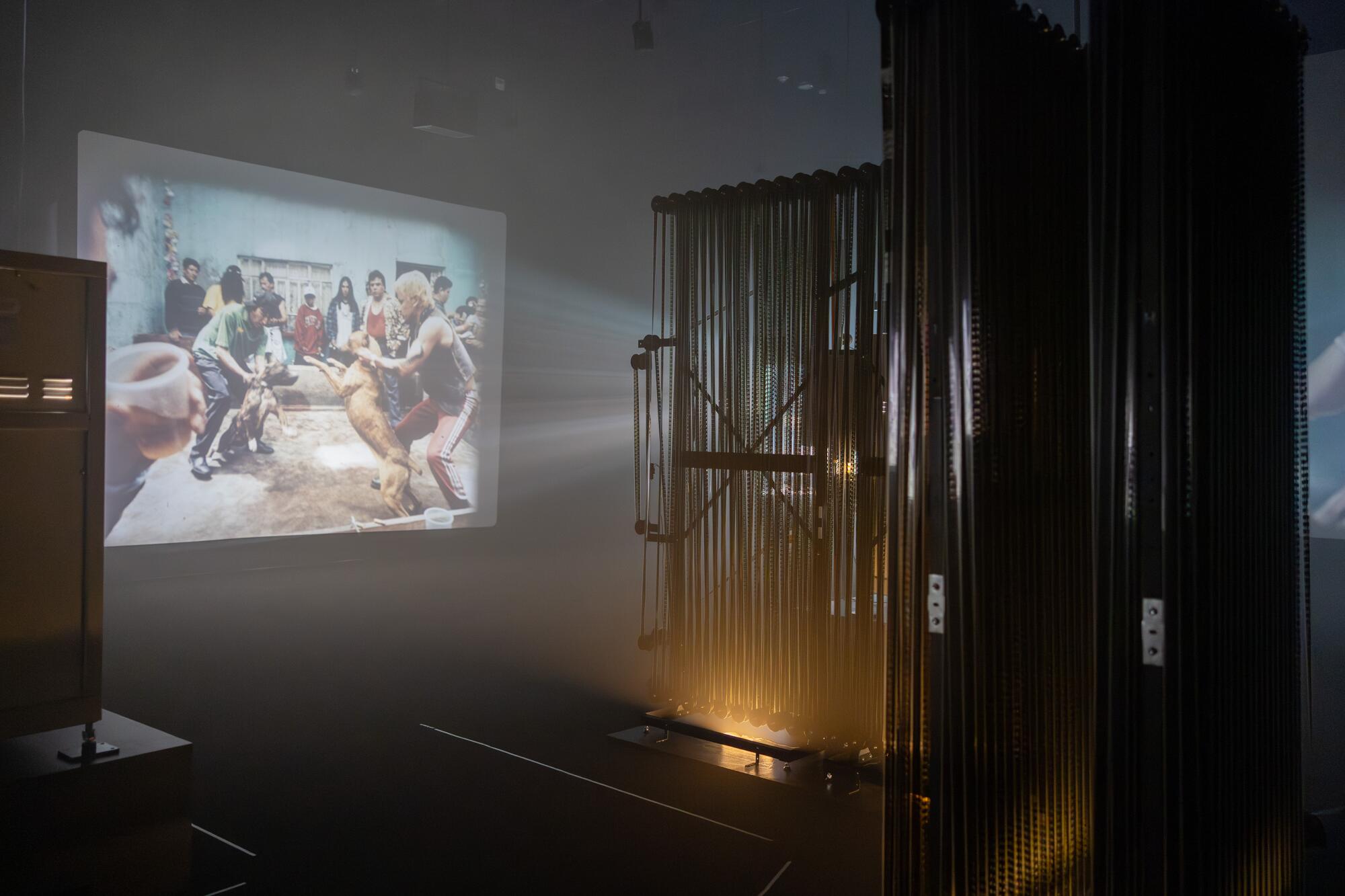
Inside the Los Angeles County Museum of Art, Iñárritu is giving me a tour of his new installation “Sueño Perro:” a sensorial celebration of his 2000 debut film, “Amores Perros,” in honor of its 25th anniversary. The only physical elements on display are six film projectors and the celluloid that contains frames of unreleased footage, which are shown on screens of different sizes around the room. Detached and unburdened by the need of a narrative, the images simply exist.
“I love doing installations,” Iñárritu says in Spanish. “It’s like playing a game with your friends. And it’s liberating for me, because I don’t have to think about selling tickets.”
Before arriving at LACMA, his “Sueño Perro” mesmerized audiences in Milan, Italy, and in his hometown of Mexico City. LACMA previously hosted Iñárritu’s intense and immersive project “Carne y Arena,” which allowed visitors to put themselves in the shoes of a person crossing the U.S.-Mexico border on foot.
In Milan and Mexico City, “Sueño Perro” occupied labyrinthine spaces with multiple rooms. Contained within a single room, the L.A. iteration is the “paranoic version,” Iñárritu says. Once inside, there’s no respite to the barrage of images and the soundscape that surround you. He aptly describes the projectors’ beams of luminosity as “light sculptures.”
Curiously, he notes, people have such reverence for these hypnotic streams of light that they duck to avoid disturbing them rather than crossing in front of them. Iñarritu wishes they would, in fact, disrupt the light, so their shadows can enter the frame and transform it.

Never-before-seen footage from “Amores Perros” projects from 35mm projectors across the walls at LACMA, Wednesday, Feb. 18, 2026.
(Sarahi Apaez / For De Los)
The projected footage is material that didn’t make it to the final cut of “Amores Perros”: a gritty, visceral drama following three different stories across different social classes in a chaotic Mexico City during the turn of the millennium. Back in 2018, Iñárritu learned that all his dailies (raw takes) from that shoot, which in most productions are thrown away, were preserved at Mexico’s National University (UNAM).
“It was like looking through an album you haven’t opened in 25 years, which smells of dust,” he says. “Because of the distance, the images actually evoked a beautiful nostalgia in me.”
And that album was substantial. Iñárritu recalls that he and cinematographer Rodrigo Prieto shot an immense amount of footage, nearly 1 million feet of film.

Gael García Bernal from a scene in “Amores Perros,” released in 2000.
“It’s like the placenta that’s thrown away when a baby is born. Suddenly, that discarded material, rich in DNA, which was already dead but was once part of a living being, has a life of its own,” Iñárritu explains vividly. “I didn’t know that these fragments, this dead material could be resurrected, but light has given new life to something that was forgotten.”
Critically acclaimed and Oscar-nominated for international feature film (foreign-language film back then), “Amores Perros” marked a watershed for the Mexican film industry, as an ambitious production that captivated both local and international audiences while unflinchingly portraying the country’s social ills from a humanistic standpoint.
“Look at Gael! He was 19 then. That’s a beautiful image of him,” Iñárritu says of “Amores Perros” lead García Bernal, whose shaved head is projected on one of the installation screens. The actor made his feature film debut in “Amores Perros” and has since had an extraordinary career.
At one point, three of the six projectors go dark — and the three remaining show the pivotal car crash that connects the film’s three narratives. Iñárritu and Prieto shot the imposing accident with nine different cameras. Seeing all nine different angles unspool in “Sueño Perro” provides a new understanding of the moment’s challenging orchestration.
Such a sequence evinces that “Amores Perros” was the work of an artist in his mid-30s willing to put it all on the line, uncertain whether he would get to make another film.
“I’ve changed a lot as a filmmaker, but I’m still the same idiot I’ve always been. That’s the bad news,” Iñárritu says laughing. “The other bad news is that I couldn’t make a film like that anymore, because of the number of shots and setups, and the energy behind each of those shots.”
The passage of time, in tandem with the film’s anniversary, allowed an opportunity for Iñárritu and screenwriter Guillermo Arriaga (who wrote “Amores Perros,” “21 Grams,” and “Babel”) to reconcile after a long-standing falling out. The two mended their bond in public last year during an event in Mexico City.
“It was very important for me to close this chapter,” Iñárritu explains. “There was something so special about our friendship as people — and our children were also very close. I truly missed him as a friend. As you get older, you realize that grudges and animosity are the worst investment; it’s like having a disease inside you and not wanting to let it go.”
While most exhibits celebrating a film’s legacy feature artifacts or costumes that appeared on screen, Iñárritu ultimately decided to opt out of that route. Initially, he admits, the director was tempted to find the scraps of the wrecked car that belonged to García Bernal’s character in the film, a black Ford, and place it at the center of the installation. But it was LACMA’s CEO Michael Govan who persuaded him to preserve the purer approach.
“Michael loved the idea of the projectors, of the light and memory. And he wisely told me, ‘Perhaps the material object will be distracting. This work is ethereal, and maybe something solid will create a knot.’ I thought it was a great reflection, and I said, ‘That’s true. I’m going to try for this exhibition to exist without physical matter, because it’s about the analogous, but also the immaterial, which is light and time.’”
The objects or “archaeological remains of a film,” as he calls them, cause Iñárritu great sadness. To him those relics are akin to looking at a collection of lifeless butterflies preserved in a box. “When I see the shoes that so-and-so wore or the dress that so-and-so wore, they seem to me like butterflies that once flew and now they’re dead,” Iñárritu says. “Objects that once appeared in film lack life afterwards. They’re like skeletons.”

(Sarahi Apaez / For De Los)
For young people who have mostly watched movies on their electronic devices, Iñárritu thinks witnessing “Sueno Perro” could spark great curiosity about the way cinema existed for most of its history: on film. It will allow them to think of cinema in a primal manner.
“We are organic beings, and our capacity for understanding and our development involves all our organs, and digital screens have forced us to perceive everything only on an intellectual level,” he says. Entering the installation, he hopes, will resemble the feeling of entering a womb or a cave. “The flickering light from the lamps in the projectors is reminiscent of the fire in caves when people gathered and shared stories,” he adds.
Sonically, “Sueño Perro” envelops attendees not in lines of dialogue or a musical score, but the sounds of life in Mexico City — from street vendors to a marching band — recorded over the years and brought to L.A. with the help of sound designer Martín Hernández, who’s worked on every single Iñárritu film since “Amores Perros.” And while some of those aural elements still exist today, “Amores Perros” also serves as a time capsule of a city that has evolved and mutated incessantly.
“I still recognize the city when I watch the film, but it makes me laugh so much to see the cars and the clothes of the time,” he says. “It now looks like the Paleolithic era. And I think, ‘I’m so old!” But yes, it was definitely a different city back then.”

(Sarahi Apaez / For De Los)
Like Iñárritu, I still lived in Mexico City, then known as Distrito Federal, when “Amores Perros” was released. In those days, international tourists often feared visiting the metropolis for fear of being kidnapped. To see Mexico City become a trendy, sought-after destination for “digital nomads” from the U.S. and elsewhere feels jarring.
“People from the U.S. have for so long been snobbish about Mexico, and now they go and say, ‘F—, this is a city with incredible cultural depth,’” Iñárritu says. “They realize that their snobbishness came from a misconception, based on propaganda they’ve been fed, which portrays us Mexicans only as “sombrerudos.’”
What’s so bewitching about Mexico City, and the country at large, Iñárritu thinks, is the people’s worldview and how they confront their realities.
“There’s no other country that has that kind of vitality, because despite all of its problems, and there are many — like how violence and corruption have become so normalized — the people have an energy, a joy, a vitality that’s very hard to find in any other city around the world,” he says.
On the subject of the ingrained issues that still plague his home country, Iñárritu recalls that those in power were not pleased with how “Amores Perros” addressed them on screen.
“The Mexican government was ashamed of the film,” he says. Whenever the film would win an award at an international festival, the Mexican ambassadors or diplomats in any given country would decline invitations to celebrate the accomplishment.
“They said it was a bad representation of Mexico, that what the film showed wasn’t Mexico,” Iñárritu recalls. “They said it showed too much violence. Give me a break, as if I were the secretary of Tourism.”
Aside from promoting this latest stop in the “Sueño Perro” installation’s journey, Iñárritu is in the post-production stage of his upcoming film “Digger,” starring Tom Cruise. Besides that, he’s also working on a project to honor Mexican American artist Judy Baca.
Baca is best known for the mural “The Great Wall of Los Angeles,” which extends for over half a mile along the Tujunga Wash and depicts the complex history of California. Iñárritu and cinematographer Emmanuel Lubezki shot a piece on this major work that will be screened at Walt Disney Concert Hall on March 7, alongside a special concert put together by Gustavo Dudamel and Gabriela Ortiz, and featuring several guest composers.
“I want to showcase the work of Judy, a Chicana who was 50 years ahead of her time and told the story of California through her eyes. I want it to be a landmark in Los Angeles. I want people to say, ‘You can’t go to L.A. and not see this mural.’”
As part of the ongoing celebration of “Amores Perros,” MACK has published a book featuring essays, behind-the-scenes photos, and storyboards. A double vinyl compilation including Gustavo Santaolalla’s score, plus tracks by generation-defining Mexican rock bands like Control Machete and Café Tacvba, has also been recently released.
Iñárritu hadn’t seen the film in a theater in many years. But when he saw it again at the Cannes Film Festival last year, he was pleased to realize it maintains its potency.
“I was struck by how well the film holds up. And it’s not just because I made it. It still has a rhythm and a muscle. It hasn’t aged badly at all. On the contrary, it’s like a young old soul,” he says with a laugh.
“Sueño Perro” will be open to the public from Feb. 26 until July 26.