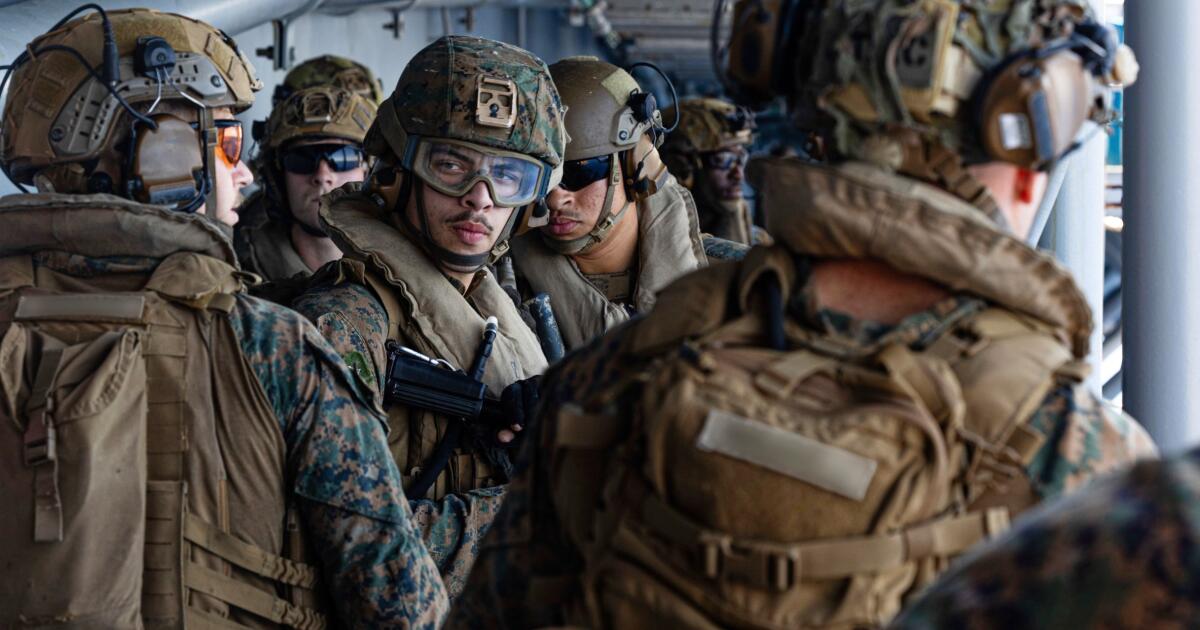
american troop

Trump says ‘serious’ talks are occurring, threatens strikes on Iran energy, water sites

President Trump threatened Monday to destroy vital Iranian energy and water infrastructure if a peace deal is not reached, as Tehran continued to deny negotiations were taking place and said it was preparing for a ground invasion following the arrival of thousands of American troops in the region.

If a ceasefire agreement is not reached quickly, the president said in a social media post, “We will conclude our lovely ‘stay’ in Iran by blowing up and completely obliterating all of their Electric Generating Plants, Oil Wells and Kharg Island (and possibly all desalinization plants!).”

The threats came within hours of the president insisting on Sunday night that diplomatic efforts would “probably” lead to a deal soon, and that Iran had allowed 20 more oil cargo ships to pass through the Strait of Hormuz as a “sign of respect.”

Trump said the United States is in “serious discussions with A NEW, AND MORE REASONABLE, REGIME in Iran” but offered no details.

Iran, however, continued to throw cold water on the negotiations Monday when Esmail Baghaei, the foreign ministry spokesperson, dismissed the Trump administration’s terms as “unrealistic, unreasonable and excessive.”

“I do not know how many people in the United States take American diplomacy claims seriously. Our mission is clear, unlike the other side, which constantly changes its position,” he said in comments carried by the semi-official Iranian agency Tasnim News.

Baghaei said that there have been no direct negotiations, but only messages through intermediaries stating that the U.S. wants to confer.

On Saturday, the USS Tripoli, a naval warship, arrived in the Middle East carrying about 3,500 sailors and Marines and a transport of fighter planes. Earlier this month, the San Diego-based USS Boxer and two warships from the 11th Marine Expeditionary Unit departed from Camp Pendleton to join the buildup of troops in the region.

The deployments have made Iranian diplomatic envoys even more dubious that American peace efforts are sincere.

“The enemy publicly sends messages of negotiation and dialogue while secretly planning a ground offensive. [They] are nothing more than a cover to hide preparations for a land invasion,” Iran’s top lawmaker, Mohammad Bagher Qalibaf, said in a statement Sunday.

He added that Iranian forces were waiting for the arrival of American troops on the ground to “set them on fire” and “punish their regional partners forever,” according to state media.

As officials in both Washington and Tehran strike increasingly hard lines, neighboring countries are desperate for a truce.

Egyptian President Abdel Fattah Sisi pleaded with Trump to stop the war during a speech at an Egyptian energy conference on Monday.

“I tell President Trump: Nobody can stop the war in our region in the gulf but you,” Sisi said.

“Please, Mr. President, please. Please help us stop the war. You are capable of doing so.”

Egypt, though not directly involved in the war, has contended with its repercussions on energy, fertilizer and food prices, not to mention disruptions to shipping income Cairo receives through the Suez Canal.

“Wealthy countries might be able to absorb this, but for middle-income and fragile economies, it could have a very, very severe impact on their stability,” ‌Sisi said, noting that predictions of oil reaching $200 per barrel were “not an exaggeration.”

Egypt and Israel signed a peace treaty in 1979, which saw Israel return territory it seized during the 1967 war. Though the agreement is deeply unpopular with most Egyptians, it has held despite escalating tensions during Israel’s campaign against Hamas.

In December, the two nations formally announced a $35-billion agreement expanding Israel gas exports to Egypt. But the war with Iran has disrupted supplies, tripling the cost of imports, according to Egyptian officials.

Last week, the government ordered energy-saving measures for a one-month period, including early closing times for most commercial establishments as well as reductions in street lighting and allocations for government vehicles.

Jordan, another U.S. regional ally that is also energy-starved, took similar steps, enacting bans on air conditioning in government offices and private use of government vehicles.

Despite talks of negotiations, the fighting showed little sign of abating.

Trump’s call for peace followed a fresh round of U.S. and Israeli airstrikes on Iran Monday. Tehran retaliated by hitting a major water and power facility in Kuwait, and Saudi Arabia and the United Arab Emirates said they intercepted incoming Iranian missiles.

Two U.N. peacekeepers were killed on Monday when an “explosion of unknown origin” hit their vehicle near the village of Bani Hayyan, in south Lebanon.

The deaths mark the second fatal incident in two days involving the United Nations Interim Force in Lebanon, known as UNIFIL, a peacekeeping force established in 1978 and which later monitored cessation of hostilities between the two nations.

UNIFIL also reported a peacekeeper was killed Sunday night when a projectile exploded in a UNIFIL position.

“We do not know the origin of the projectile. We have launched an investigation to determine all of the circumstances,” a UNIFIL statement on Monday said.

Meanwhile, Israel continued its bombardment of Lebanon, hitting areas near the capital and in the country’s south. One strike targeted a Lebanese army checkpoint, killing a soldier, the Lebanese military said. Lebanese authorities said on Monday that the death toll since hostilities broke out between Hezbollah and Israel earlier this month continues to rise.

The Israeli military said one of its soldiers was killed in a Hezbollah anti-tank missile attack in southern Lebanon, which also wounded four other soldiers. Six soldiers have been killed since Israel restarted its campaign in Lebanon.

Hezbollah rockets also killed two civilians, according to Israeli health authorities.

Israel’s fire and rescue service said a fuel tanker and a building at the oil refinery in the northern city of Haifa were hit by debris from an intercepted missile, according to a report from Israeli daily the Times of Israel.

It was unclear whether the missile was launched by Iran, the Lebanese Shiite group Hezbollah or Yemen’s Houthi rebels.

Deaths from the conflict continue to rise, with 1,900 people killed in Iran, over 1,200 in Lebanon, 19 in Israel and 13 U.S. military members. Millions of people have been displaced from their homes in Iran and Lebanon.

Ceballos and Quinton reported from Washington, Bulos from Beirut.
Source link

Trump says U.S. military operations in Iran likely to last at least a month

President Trump on Monday refused to box himself in on how long U.S. military operations will last in Iran, saying the conflict in the Middle East could stretch from a month to potentially “far longer” as he frames the mission as one that is necessary to eliminate a “colossal threat” to American interests.

“Whatever the time is, it’s OK. Whatever it takes,” Trump said at a White House event. “Right from the beginning, we projected four to five weeks, but we have the capability to go far longer than that. We’ll do it.”

Hours earlier, Defense Secretary Pete Hegseth said the duration of the military operation remains fluid, and that Trump has “all the latitude in the world” to determine how long the war in Iran will go on.

“Four weeks, two weeks, six weeks. It could move up. It could move back,” Hegseth told reporters at a Pentagon news conference.

The Trump administration’s shifting time frames and open-ended objectives in Iran have deepened uncertainty around an expanding conflict in the Middle East, particularly as American troops have already been killed in action and officials warn of more U.S. casualties.

Gen. Dan Caine, the chairman of the Joint Chiefs of Staff, said Monday that additional U.S. military forces are already moving into the region, and warned that the conflict will not be a “single, overnight operation” and that he expects “additional losses.”

A fourth U.S. fatality

The development came as military officials confirmed a fourth American service member had been killed by Iranian counterattacks and that three American jets were mistakenly shot down in Kuwait in an “apparent friendly fire incident” — and as airstrikes continued to fall across the Middle East, where missile defense systems were unable to intercept every attack and deaths mounted into the hundreds.

As the U.S. and Israel continued to hammer Tehran and other targets across Iran and in Lebanon, retaliatory strikes by Iran and its allies, including Hezbollah in Lebanon, were reported in Israel as well as at U.S. facilities and other targets inside Bahrain, Cyprus, Iraq, Kuwait, Oman, Qatar, Saudi Arabia, Syria and the United Arab Emirates, according to the Associated Press.

Meanwhile, to Iran’s east, Pakistan and Afghanistan were engaged in their own battles, further destabilizing the region.

In addition to hundreds of people dead, including Iranian schoolchildren, other civilians and migrant workers in the Gulf, the fighting has impacted the world’s production of oil and natural gas — disrupting tanker traffic through the Strait of Hormuz at the southern end of the Persian Gulf and causing oil prices to shoot up.

Saudi Arabia said it intercepted Iranian drones attacking an oil refinery near Dammam, with the refinery shutting down as a precaution, the AP reported. Iran denied targeting the facility.

Air travel disrupted

The war also disrupted air traffic globally, as major airports in the Gulf, including in Dubai, halted or radically scaled back flights. The travel interruptions rippled around the world, and airline stocks tumbled.

Israel had implemented nationwide restrictions on activities as it fended off attacks from Iran and residents hid in bomb shelters. Iran reported strikes at multiple schools in the country had left young students dead.

As the conflict unfolds in real time, Trump and Hegseth have refused to rule out sending American troops into Iran, and the president has signaled that the “big wave” of military attacks is yet to come.

“I don’t have the yips with respect to boots on the ground. Like every president says, ‘There will be no boots on the ground.’ I don’t say it,” Trump told the New York Post on Monday. ”I say, ‘probably don’t need them,’ [or] ‘if they were necessary.’”

When asked by a reporter whether U.S. troops were currently on the ground, Hegseth told reporters they were not, but then bristled at further questions about potential future deployments.

“Why in the world would we tell you, the enemy or anybody, what we will do or will not do in pursuit of an objective?” Hegseth said.

The Trump administration’s objectives in the war have been equally hard to pinpoint. Trump said Saturday that the operation is aimed at razing Iran’s military and nuclear capability and dismantling Iran’s theocratic regime, but on Monday said the goal is to eliminate the threats posed by the “sick and sinister regime” but not the government itself.

Hegseth said the attacks in Iran are not part of a “so-called regime change war, but the regime sure did change and the world is better off for it today.” The U.S. and Israel attack on Saturday killed Iranian Supreme Leader Ayatollah Ali Khamenei.

‘Second or third place is dead’

In an interview with ABC News on Sunday evening, Trump suggested his administration had considered some figures to replace Khamenei, but said those people are now dead.

“The attack was so successful it knocked out most of the candidates,” Trump said. “It’s not going to be anybody that we were thinking of because they are all dead. Second or third place is dead.”

The Trump administration’s messaging, meanwhile, was consistent in its vengeful rhetoric.

Hegseth and Trump both warned that any threat to Americans would be met with force.

“If you kill Americans, if you threaten Americans anywhere on Earth, we will hunt you down without apology and without hesitation, we will kill you,” Hegseth said.

Kevan Harris, an associate professor of sociology who teaches courses on Iran and Middle East politics at the UCLA International Institute, said a long misconception in “the way the U.S. reads Iran” is the belief that Khamenei ruled the country alone, and that taking him out would create a massive leadership vacuum or a sharp shift in the nation’s policies.

But while Khamenei was certainly an “intransigent” force in Iran, killing him won’t “lead to a major shift inside the country,” Harris said.

Benjamin Radd, a political scientist and senior fellow at the UCLA Burkle Center for International Relations, said whether the U.S. can get out of Iran on a relatively short timeline depends on whether those in power in Iran now are willing to negotiate terms that Khamenei and other leaders who have been killed rejected.

“If the remnants of the regime are ideologically committed to what they were under Khamenei,” Radd said he “can’t see Trump backing down” and would expect the war to rage on.

Other leaders in Iran are fundamentalist and aligned with Khamenei, but given the U.S. has shown a willingness and ability to capture and assassinate foreign leaders, they might back down out of self-preservation.

“In the short term, there should be a wait-and-see approach as to what this reconstituted regime looks like,” he said.

Source link