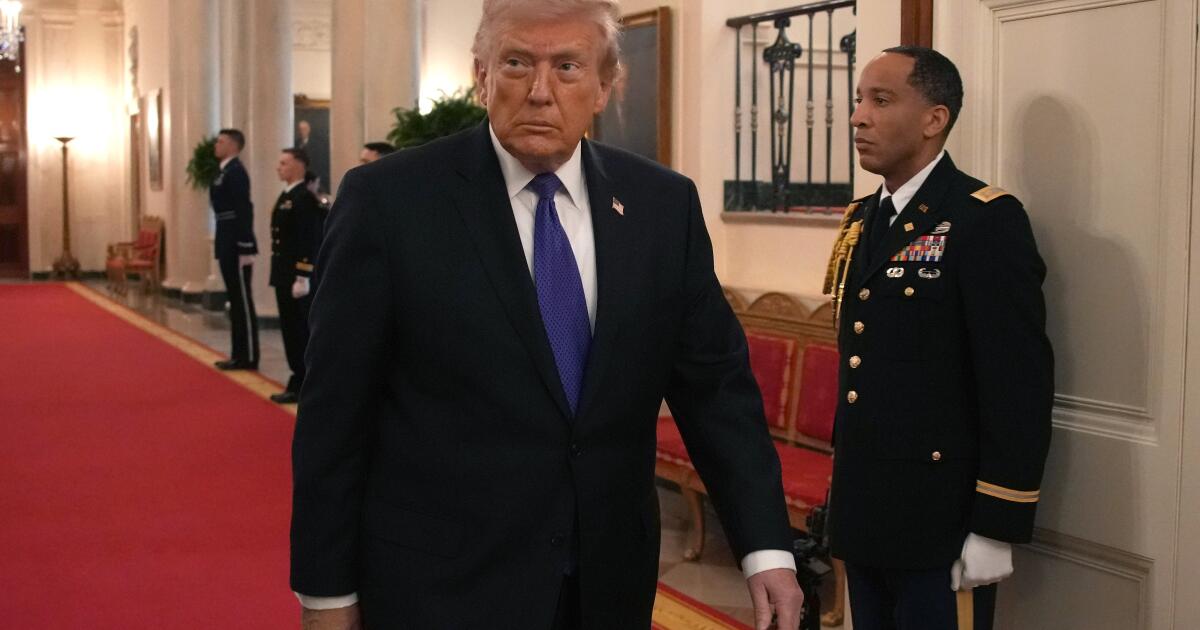
Trump says U.S. military operations in Iran likely to last at least a month
WASHINGTON — President Trump on Monday refused to box himself in on how long U.S. military operations will last in Iran, saying the conflict in the Middle East could stretch from a month to potentially “far longer” as he frames the mission as one that is necessary to eliminate a “colossal threat” to American interests.
“Whatever the time is, it’s OK. Whatever it takes,” Trump said at a White House event. “Right from the beginning, we projected four to five weeks, but we have the capability to go far longer than that. We’ll do it.”
Hours earlier, Defense Secretary Pete Hegseth said the duration of the military operation remains fluid, and that Trump has “all the latitude in the world” to determine how long the war in Iran will go on.
“Four weeks, two weeks, six weeks. It could move up. It could move back,” Hegseth told reporters at a Pentagon news conference.
The Trump administration’s shifting time frames and open-ended objectives in Iran have deepened uncertainty around an expanding conflict in the Middle East, particularly as American troops have already been killed in action and officials warn of more U.S. casualties.
Gen. Dan Caine, the chairman of the Joint Chiefs of Staff, said Monday that additional U.S. military forces are already moving into the region, and warned that the conflict will not be a “single, overnight operation” and that he expects “additional losses.”
A fourth U.S. fatality
The development came as military officials confirmed a fourth American service member had been killed by Iranian counterattacks and that three American jets were mistakenly shot down in Kuwait in an “apparent friendly fire incident” — and as airstrikes continued to fall across the Middle East, where missile defense systems were unable to intercept every attack and deaths mounted into the hundreds.
As the U.S. and Israel continued to hammer Tehran and other targets across Iran and in Lebanon, retaliatory strikes by Iran and its allies, including Hezbollah in Lebanon, were reported in Israel as well as at U.S. facilities and other targets inside Bahrain, Cyprus, Iraq, Kuwait, Oman, Qatar, Saudi Arabia, Syria and the United Arab Emirates, according to the Associated Press.
Meanwhile, to Iran’s east, Pakistan and Afghanistan were engaged in their own battles, further destabilizing the region.
In addition to hundreds of people dead, including Iranian schoolchildren, other civilians and migrant workers in the Gulf, the fighting has impacted the world’s production of oil and natural gas — disrupting tanker traffic through the Strait of Hormuz at the southern end of the Persian Gulf and causing oil prices to shoot up.
Saudi Arabia said it intercepted Iranian drones attacking an oil refinery near Dammam, with the refinery shutting down as a precaution, the AP reported. Iran denied targeting the facility.
Air travel disrupted
The war also disrupted air traffic globally, as major airports in the Gulf, including in Dubai, halted or radically scaled back flights. The travel interruptions rippled around the world, and airline stocks tumbled.
Israel had implemented nationwide restrictions on activities as it fended off attacks from Iran and residents hid in bomb shelters. Iran reported strikes at multiple schools in the country had left young students dead.
As the conflict unfolds in real time, Trump and Hegseth have refused to rule out sending American troops into Iran, and the president has signaled that the “big wave” of military attacks is yet to come.
“I don’t have the yips with respect to boots on the ground. Like every president says, ‘There will be no boots on the ground.’ I don’t say it,” Trump told the New York Post on Monday. ”I say, ‘probably don’t need them,’ [or] ‘if they were necessary.’”
When asked by a reporter whether U.S. troops were currently on the ground, Hegseth told reporters they were not, but then bristled at further questions about potential future deployments.
“Why in the world would we tell you, the enemy or anybody, what we will do or will not do in pursuit of an objective?” Hegseth said.
The Trump administration’s objectives in the war have been equally hard to pinpoint. Trump said Saturday that the operation is aimed at razing Iran’s military and nuclear capability and dismantling Iran’s theocratic regime, but on Monday said the goal is to eliminate the threats posed by the “sick and sinister regime” but not the government itself.
Hegseth said the attacks in Iran are not part of a “so-called regime change war, but the regime sure did change and the world is better off for it today.” The U.S. and Israel attack on Saturday killed Iranian Supreme Leader Ayatollah Ali Khamenei.
‘Second or third place is dead’
In an interview with ABC News on Sunday evening, Trump suggested his administration had considered some figures to replace Khamenei, but said those people are now dead.
“The attack was so successful it knocked out most of the candidates,” Trump said. “It’s not going to be anybody that we were thinking of because they are all dead. Second or third place is dead.”
The Trump administration’s messaging, meanwhile, was consistent in its vengeful rhetoric.
Hegseth and Trump both warned that any threat to Americans would be met with force.
“If you kill Americans, if you threaten Americans anywhere on Earth, we will hunt you down without apology and without hesitation, we will kill you,” Hegseth said.
Kevan Harris, an associate professor of sociology who teaches courses on Iran and Middle East politics at the UCLA International Institute, said a long misconception in “the way the U.S. reads Iran” is the belief that Khamenei ruled the country alone, and that taking him out would create a massive leadership vacuum or a sharp shift in the nation’s policies.
But while Khamenei was certainly an “intransigent” force in Iran, killing him won’t “lead to a major shift inside the country,” Harris said.
Benjamin Radd, a political scientist and senior fellow at the UCLA Burkle Center for International Relations, said whether the U.S. can get out of Iran on a relatively short timeline depends on whether those in power in Iran now are willing to negotiate terms that Khamenei and other leaders who have been killed rejected.
“If the remnants of the regime are ideologically committed to what they were under Khamenei,” Radd said he “can’t see Trump backing down” and would expect the war to rage on.
Other leaders in Iran are fundamentalist and aligned with Khamenei, but given the U.S. has shown a willingness and ability to capture and assassinate foreign leaders, they might back down out of self-preservation.
“In the short term, there should be a wait-and-see approach as to what this reconstituted regime looks like,” he said.