american people

Trump nominates Cameron Hamilton to lead FEMA, a year after he was fired from the role

President Trump nominated Cameron Hamilton on Monday to lead the Federal Emergency Management Agency, a surprising comeback for the former Navy SEAL who was fired from his role as FEMA’s temporary leader last year after he defended its existence.

His nomination comes as the Trump administration has increasingly signaled it is backing away from promises to dismantle FEMA, an agency that has faced withering criticism by the president. The nomination of Hamilton, who argued abolishing FEMA was not in the country’s best interests, is the latest indication of that change.

If confirmed, Hamilton would be the principal advisor to Trump and Homeland Security Secretary Markwayne Mullin on emergency management and FEMA’s first permanent administrator in Trump’s second term. The agency has gone through three temporary leaders, including Hamilton’s brief tenure from January to May 2025.

He would take over an embattled agency still reeling from Kristi Noem’s turbulent leadership of the Department of Homeland Security, of which FEMA is part. FEMA’s workforce has been worn down by mass staff departures, policies that hamstrung operations and a 75-day-long Homeland Security shutdown that ended April 30.

Hamilton will need to ensure the agency is prepared for summer disaster season, just weeks away, while answering to Trump, who is likely to expect major reforms after a council he appointed recommended sweeping changes on Friday.

“Now is the opportunity to stabilize FEMA,” said Michael Coen, the agency’s chief of staff in the Obama and Biden administrations.

Fired after defending FEMA

Hamilton, who had never been a state or local emergency management director and who had publicly criticized FEMA in the past, was a controversial choice when Trump named him temporary leader in January 2025, just days before the president floated the idea of “getting rid” of FEMA.

His rupture with Homeland Security officials began as he defended a federal role in supporting disaster-affected states, tribes and territories.

“Once the conversation shifted to, ‘Now we’re going to abolish,’ I immediately expressed concern,” he said in September on the “Disaster Tough” podcast with John Scardena, a former FEMA incident management team leader.

Homeland Security officials even subjected him to a polygraph test, accusing him and other officials of leaking details of a private meeting. He passed but said he knew his dismissal was inevitable.

At a May 7, 2025, appearance before a House Appropriations subcommittee, Rep. Rosa DeLauro, a Connecticut Democrat, asked Hamilton if he believed FEMA should be abolished.

“I do not believe it is in the best interest of the American people to eliminate the Federal Emergency Management Agency,” he replied. The next day, he was fired.

Hamilton will have to rebuild trust

Defending FEMA despite knowing it would probably cost him his job generated respect and trust among people whose job it is to lead communities through crisis, said Scardena, now president of the consultancy Doberman Emergency Management Group, which trains emergency managers.

“He won myself over and I think a lot of people by what he did,” Scardena said.

But multiple current FEMA employees who requested anonymity for fear of retribution for speaking publicly told the Associated Press they had concerns over some of the actions taken under Hamilton.

In 2024, Hamilton shared posts on X promoting misinformation about FEMA spending during Hurricane Helene.

During his temporary leadership, FEMA ceased door-to-door canvassing to reach survivors after disasters, and canceled a multibillion-dollar resilience grant program, since restored by a federal judge. The Department of Government Efficiency gained access to internal FEMA networks containing survivors’ private information. FEMA staff were fired for fulfilling a reimbursement payment to New York City for housing undocumented immigrants as part of FEMA’s Shelter and Services program.

Hamilton has said he believes FEMA needs major reform. He has said that he wants FEMA to move faster, that the agency is saddled with responsibilities he sees as outside its remit, and that some states have become too dependent on the agency. A Trump-appointed council last week urged sweeping changes to FEMA, which would require congressional action.

“I think he’s going to need to rebuild trust across the agency,” said Deanne Criswell, FEMA administrator under former President Biden, adding that she believes Hamilton cares about FEMA and she appreciated his outreach to emergency management directors and former officials during and after his tenure.

Senate confirmation process could raise questions of experience

Hamilton could face pushback in the Senate confirmation process over never having led an emergency management agency, a common stepping stone to becoming administrator of an agency with over 21,000 employees.

Federal law requires the FEMA administrator to have “a demonstrated ability in and knowledge of emergency management and homeland security” and at least five years of “executive leadership and management experience.”

Hamilton trained as a Navy hospital corpsman before spending a decade as a Navy SEAL on SEAL Team Eight. He then became a U.S. State Department emergency management specialist handling overseas crisis response, then directed emergency medical services at the Department of Homeland Security.

Angueira writes for the Associated Press.

Source link

Vance holds first meeting of a new anti-fraud task force targeting benefit programs

Vice President JD Vance on Friday held the inaugural meeting of a new anti-fraud task force he’s leading as the Trump administration seeks to show it’s cracking down on potential misuse of social programs.

Vance, speaking Friday before the task force held a closed-door meeting, said that the federal government for decades had not taken the issue of fraud seriously and that it needed to be tackled with “a whole-government approach.”

“This is not just the theft of the American people’s money,” Vance said. “It is also the theft of critical services that the American people rely on.”

President Trump, a Republican, has made a crackdown on fraud part of his chief domestic focus as voters have said they’re concerned about affordability ahead of November’s midterm elections. That effort comes after allegations of fraud involving day-care centers run by Somali residents in Minneapolis prompted a massive immigration crackdown in the Midwestern city, resulting in widespread protests.

Vance cited some of the Minnesota allegations on Friday. Last month, he held a news conference to announce a temporary halt of some Medicaid funding until the state took actions that federal officials said would address their concerns.

Minnesota Gov. Tim Walz, a Democrat who faced Vance as a vice presidential candidate in 2024, has called it a “campaign of retribution” and said the Trump administration was “weaponizing the entirety of the federal government to punish blue states like Minnesota.”

The task force is also the most visible assignment to date that Trump has given to Vance, who is seen as a potential 2028 presidential candidate.

Vance and the task force, which includes about half the president’s Cabinet, the leader of a new Justice Department division focused on prosecuting fraud and Federal Trade Commission Chair Andrew Ferguson, are set to meet regularly to look at rooting out potential fraud and waste in federal benefit programs.

Ferguson, who is vice chair of the task force, cast the issue of fraud as a dire crisis facing the country and said it “shreds the social trust on which these programs and our entire nation depend.”

“This fraud crisis is thus existential,” he said. “If we fail to address it, the fabric of our nation will swiftly unravel.”

Joining the task force was Colin McDonald, a top aide to the Justice Department’s second in command. He was recently confirmed as the assistant attorney general overseeing the new division at the department focused on prosecuting fraud.

The Justice Department has long prosecuted fraud nationally through its Criminal Division, but the Trump administration says the new division is needed to crack down on rampant fraud.

Price writes for the Associated Press.

Source link

Congress looks for Trump’s exit plan as the Iran war drags on

President Trump took the United States to war without a vote of support from Congress, but lawmakers are increasingly questioning when, how and at what cost the war with Iran will come to an end.

Three weeks into the conflict, the toll is becoming apparent. At least 13 U.S. military personnel have died and more than 230 have been wounded. A $200-billion request from the Pentagon for war funds is pending from the White House. Allies are under attack, oil prices are skyrocketing, and thousands more U.S. troops are deploying to the Middle East with no endgame in sight.

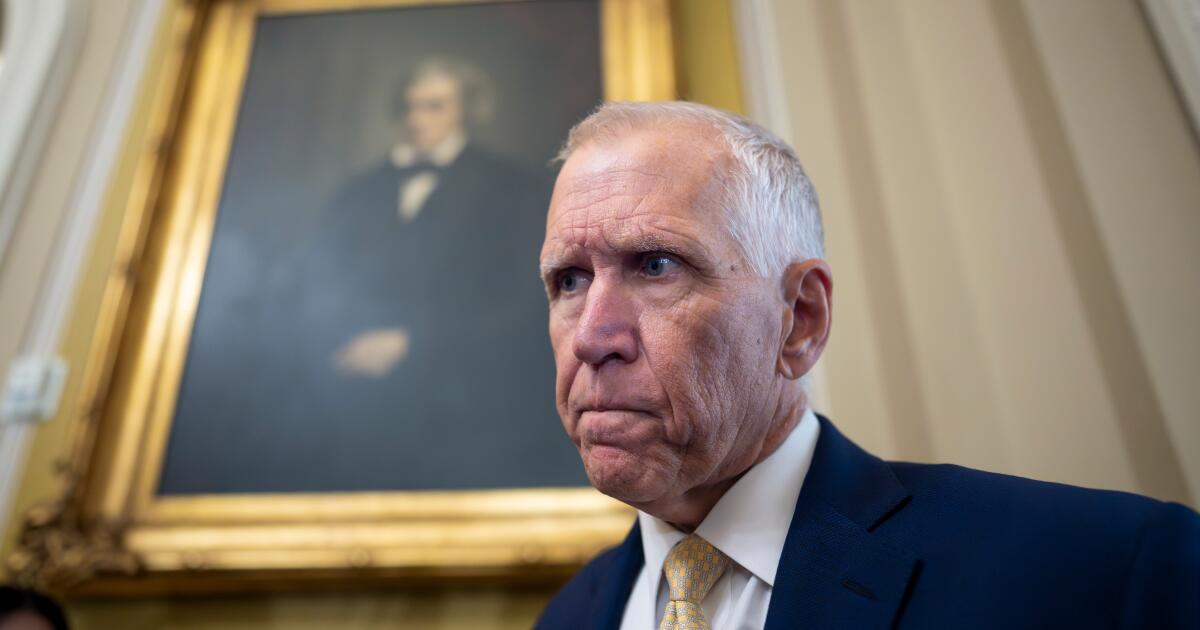
“The real question is: What ultimately are we trying to accomplish?” Sen. Thom Tillis (R-N.C.) told the Associated Press.

“I generally support anything that takes out the mullahs,” he said. “But at the end of the day, there has to be a kind of strategic articulation of the strategy, what our objectives are.”

Trump said late Friday that he was considering “winding down” the military operations even as he outlined new objectives and goals and despite the continued buildup of forces in the region.

Congress stands still

The president’s decision to launch the U.S.-Israeli war on Iran is testing the resolve of Congress, which is controlled by his party. Republicans have largely stood by the commander in chief, but will soon be faced with more consequential wartime choices.

Under the War Powers Act, the president can conduct military operations for 60 days without approval from Congress. So far, Republicans have easily voted down several resolutions from Democrats designed to halt the war.

But the administration will need to show a more comprehensive strategy ahead or risk blowback from Congress, lawmakers said, especially as they are being asked to approve billions in new spending.

Trump’s casual comment that the war will end “when I … feel it in my bones” has drawn alarm.

“When he feels it in his bones? That’s crazy,” said Virginia Sen. Mark R. Warner, the top Democrat on the Senate Intelligence Committee.

House speaker says mission is ‘all but done’

The president’s party appears unlikely to directly challenge him, even as the conflict drags on. House Speaker Mike Johnson (R-La.) has said the military operation will be over quickly.

“I do think the original mission is virtually accomplished now,” Johnson told the AP and others at the Capitol this week.

“We were trying to take out the ballistic missiles, and their means of production, and neuter the navy, and those objectives have been met,” he said.

Johnson acknowledged that Iran’s ability to threaten ships in the Strait of Hormuz is “dragging it out a little bit,” especially as U.S. allies have largely rebuffed the president’s request for help.

“As soon as we bring some calm to the situation, I think it’s all but done,” Johnson said.

But the administration’s stated goals — of ending Iran’s ability to obtain a nuclear weapon and degrading its ballistic missile supplies, among others — have perplexed lawmakers as shifting and elusive.

″Regime change? Not likely. Get rid of the enriched uranium? Not without boots on the ground,” Warner said.

“If I’m advising the president, I would have said: Before you take on a war of choice, make the case clear to the American people what our goals are,” he said.

The power of the purse

The Pentagon has told the White House that it is seeking an additional $200 billion for the war effort, an extraordinary amount that is unlikely to win support. Senate Democratic leader Chuck Schumer of New York called the amount “preposterous.”

The Defense Department’s approved appropriations from Congress this year are more than $800 billion, and Trump’s tax breaks bill gave the Pentagon an additional $150 billion over the next several years for various upgrades and projects.

Sen. Mazie Hirono (D-Hawaii) said the country has other priorities.

“How about not taking away funding for Medicaid, which will impact millions of people? How about making sure SNAP is funded?” she said, referring to the healthcare and food assistance programs that were cut as part of last year’s Republican tax reductions.

“These are things that we should be doing for the American people,” she said.

Many lawmakers have recalled the decision by President George W. Bush in the aftermath of the Sept. 11, 2001, attacks to come to Congress to seek an authorization for the use of military force — a vote to support his proposed military actions in Afghanistan and later Iraq.

Tillis said Trump has latitude under the War Powers Act to conduct the military campaign, but that will soon shift.

“When you get into the 45-day mark, you’ve got to start articulating one of two things — an authorization for the use of military force to sustain it beyond that or a very clear path on exit,” he said.

“Those are really the options the administration needs to be thinking about.”

Mascaro writes for the Associated Press.

Source link