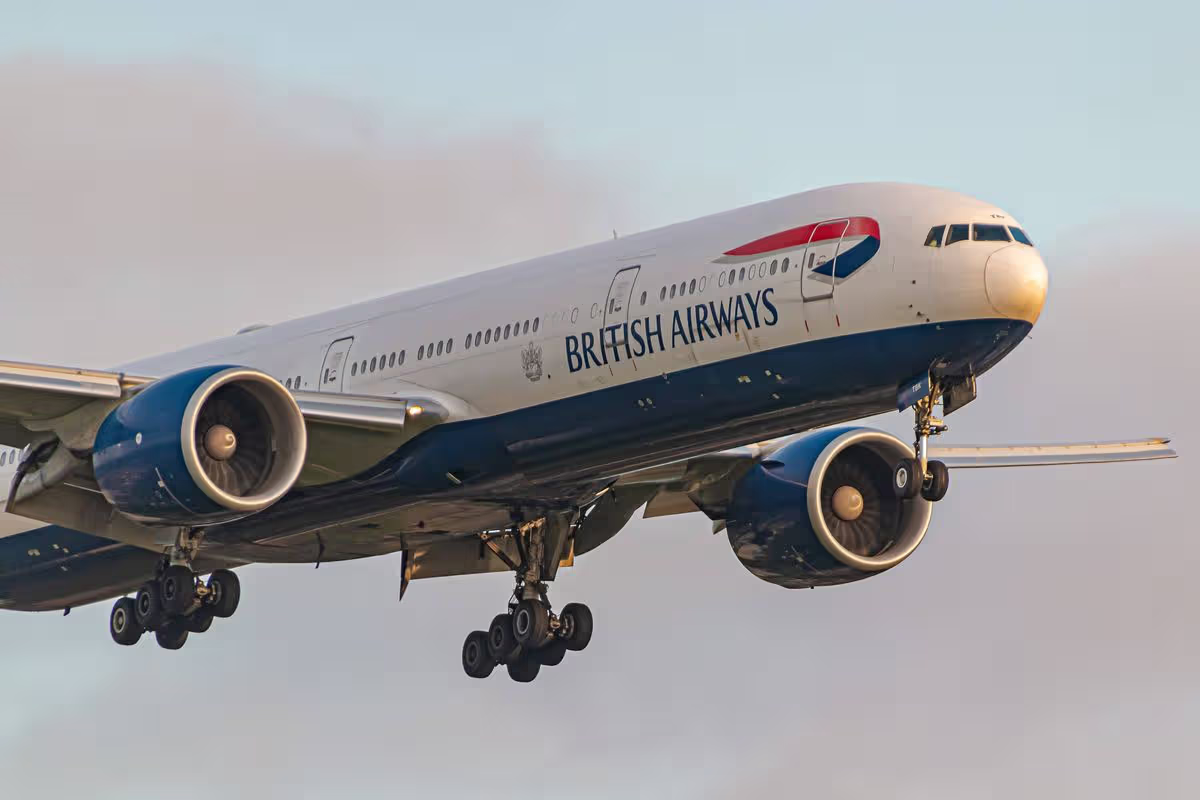
MOUNTING fears of jet fuel shortages have US travelers on edge ahead of summer vacations.
The holiday industry is bracing for a major fallout due to the Iran war’s impact on global travel.
Sign up for the Travel newsletter
Thank you!
Will US travelers end up stuck in an overseas airport over summer due to huge jet fuel shortages amid the Iran war?Credit: GettyExperts have warned travelers to be braced for chaos if flying to Asia or Europe over summerCredit: Getty
“Anxious” Americans are worrying about whether they can return home if they travel to Europe or Asia for their summer vacation, said one expert.
For example, will their their long haul-flight end up suddenly being chopped due to a lack of fuel while overseas?
Alternatively, “will my short-haul domestic flight to the international airport be canceled?” Patrick De Haan, GasBuddy’s head of petroleum analysis, told Forbes.
“It’s a level of anxiety that travelers have never really had to worry about, and absolutely it could worsen.”
People across the world are keen for the Strait of Hormuz to reopen to shipping, because of spiraling costs hitting everything from grocery shopping to global fertilizer supplies.
But, even if this vital, narrow corridor was to permanently reopen today, it’ll be too late to salvage this year’s summer holidays, experts have warned.
That’s because airlines have now got to stick to a hurriedly rejigged schedule with airports – which must be booked months in advance.
It comes as the global jet fuel shortage is ramping up fuel prices for US carriers, which in turn are axing cheap airfares and some flights to save money.
Some airlines are already passing on extra costs to travelers by increasing fees for baggage and other add-ons, via steeper ticket prices, and fuel surcharges.
It’s the largest energy crisis the world has ever facedCredit: Getty
And, unfortunately, it will take months for vital supplies of oil and jet fuel to return to normal, according to Kpler, an energy consulting firm.
“It’s going to take until at least July,” Matt Smith, head US analyst, warned CNN.
“And even that may be optimistic at this point.”
United, American, Delta and Southwest airlines spent about $100 million a day on average among them on fuel in 2025.
But jet fuel prices have roughly doubled since the war began, when the United States and Israel started bombing Iran on February 28.
Delta Air Lines — which frequently flies to destinations across Europe — said it was aware of the continent’s “potential jet fuel supply issue.”
The carrier has already slashed some flights this summer.
United Airlines announced in March that it was “tactically pruning flying that’s temporarily unprofitable in the face of high oil prices.”
It’s the “largest energy crisis we have ever faced,” IEA executive director Fatih Birol told Associated Press last Thursday.
“If we are not able to open the Strait of Hormuz… I can tell you soon we will hear the news that some of the flights from city A to city B might be canceled as a result of lack of jet fuel,” he warned.
It will take an estimated two years for the world to recover from energy shortages caused by the war in Iran, Birol added.
More than 110 oil-laden tankers and over 15 carriers loaded with liquefied natural gas are still waiting in the Persian Gulf.
In Europe, there are about six weeks of jet fuel leftCredit: Getty
America’s own jet fuel supplies aren’t currently a huge concern, as local carriers are insulated to a certain extent.
The US produces 13 million barrels of oil a day and imports some four million barrels a day from Canada, De Haan told Forbes on April 16.
However, it’s a different situation in Europe and Asia, both of which are facing a potential shortage because of the ongoing conflict.
In Europe, multiple countries are now relying on less than 20 days of coverage in their fuel supplies, warned the International Energy Agency (IEA).
Asia-Pacific countries are the most reliant on oil and jet fuel from the Middle East, followed by Europe.
“The strait accounts for around 40% of Europe’s jet fuel imports, but no jet fuel has passed the strait since the war broke out,” said Amaar Khan, head of European jet fuel pricing at Argus Media, last Friday.
America has this month come to Europe’s aid to help bolster jet fuel supplies due to the war, sending about 150,000 barrels per day in April.
This is about six times the normal level, according to Jacques Rousseau, managing director at financial firm Clearview Energy Partners.
Airlines chop flights and increase fees amid the Middle East crisis
Here are just some of the impacts on travelers due to the Iran war…
Air Canada:
From June 1 to October 25, 2026, Canada’s largest carrier will chop back flights to New York due to rocketing fuel prices.
Alaska Air:
Fees for the first checked bag have risen by $5 and by $10 for the second on its North American flights. A third checked bag has increased considerably, from $50 to $200.
American Airlines:
Baggage fees have risen by $10 for the first and second checked bags, and by $150 for the third checked bag on domestic and short-haul international flights.
Delta Air Lines:
The carrier is charging an increase of $10 on passengers’ first and second checked bags and a $50 increase on the third.
Frontier Airlines:
This carrier is reviewing its full-year forecast due to rising fuel prices.
Jetblue Airways:
Baggage prices will rise by either $4 or $9.
Spirit Airlines:
This budget US carrier has begged Donald Trump’s administration for hundreds of millions of dollars in emergency funding to offset rising fuel prices.
Southwest Airlines:
Checked baggage fees will rise by $10 for the first and second bags.
United Airlines:
The airline is slashing unprofitable flights.
Also, first and second checked bag fees will spike by $10 for customers travelling in the US, Mexico and Canada and Latin America.
Virgin Atlantic:
This carrier is reducing flights and raising fares.
Westjet:
The Canadian airline has chopped seat capacity for June.
A C$60 ($43) fuel surcharge will be slugged on some bookings.
A pilot has revealed his one method of balancing work and family life in the industry, despite the seriously long hours and time away from home that comes with the role
Christine Younan Deputy Editor Social Newsdesk
11:27, 29 Mar 2026
The pilot revealed how he balanced work and family (stock image)(Image: Getty Images/iStockphoto)
It’s widely recognised that pilots work lengthy shifts and spend considerable periods away from home. While on duty, they usually work between 10-14 hours daily, encompassing flight time, briefings and taxiing, although this can stretch to 16 hours when unexpected situations arise.
Throughout the week, the schedule can become more demanding, with pilots working up to 60 hours across 7 consecutive days, averaging around 20 hours weekly in the air. While travelling to different countries constantly and experiencing the world sounds thrilling, it can prove incredibly challenging for pilots with families.
One pilot has recently shared how he successfully balanced his career with family life. During a TikTok Q&A session, Captain Steve, employed by American Airlines, outlined his approach to making it work.
Following someone sharing their ambition to become an airline pilot, they ask: “What is your advice on a work-life balance in the industry?”
Content cannot be displayed without consent
Steve responds: “Well it’s like anything else if you travel, you have to balance being on the road and being home, the electronics help these days, you can FaceTime, communicate much more effectively and frequently than you did back then.”
When his children were young, the pilot succeeded in spending quality time at home while working as a reserve for the airline.
He added: “I did reserve on the airline and didn’t work as much on reserve, I’d get called a few times a month, maybe for a trip where when you’re regular line holder, you’re going to fly four or five times.
“Was it a big difference? Yeah, it was a huge difference because I got to spend more time with my kids and I still got paid as an airline pilot to be on call.”
While working as a reserve wasn’t straightforward for Steve but he “made the sacrifice”.
He went on: “There were some inconveniences with being on call as well but I made that sacrifice to be with my family so there is a way to work it up, where there’s a will, there’s a way.”
Numerous elements influence working hours. Short-haul pilots might complete 4-6 legs per day (consecutive flights). Long-haul pilots typically endure lengthier stints, such as 12-15 hours on a single extended flight.
Early starts, such as 5am, can cut into allowable duty hours owing to fatigue regulations. Between shifts, pilots must receive a minimum of 10 hours of rest, incorporating 8 hours of uninterrupted sleep.
American Airlines pilot Captain Steve Scheibner has shared crucial travel tips for passengers – warning them to avoid the seat back pocket he calls a “black hole of despair”
There is a hidden danger to using the back seat on planes, a pilot claims(Image: Captain Steeeve/YouTube)
An airline pilot has issued a stark warning to passengers never to stash their personal belongings in the rear pocket of plane seats for one straightforward reason.
Captain Steve Scheibner is an American Airlines pilot widely recognised by his huge YouTube following as Captain Steeeve. He revealed the advice in a recent video where he offered a string of travel tips for air travellers.
He regularly encounters people at the agent’s desk because of their use of the rear pocket during their journey, experiencing a “fingers crossed” situation where they face “diminishing” chances.
Captain Steve labelled the pocket the “black hole of despair” and cautioned people against placing anything valuable in it whilst they’re flying unless they “don’t ever want to see it again”.
He stated: “Stop putting personal items in the seat back pocket in front of you. If you want to lose it and never see it again, put it in that dark hole that is the seat back pocket in front of you.”
Captain Steve revealed he’d encountered numerous passengers who’d disembarked the aircraft but abandoned personal items in the seat pocket, and were subsequently unable to return to the flight to retrieve them.
He continued: “If the airplane is still at the gate, fingers crossed that somebody who cares can go out there and find the thing that you left in that seat back pocket.
“But the odds are diminishing with every minute that ticks by after you leave that seat and you leave it in that black hole of despair. So, my friends, do not put your personal items in that seat back pocket, unless of course, you don’t ever want to see it again.”
This comes as reports suggest budget airline passengers could soon experience a peculiar new way of flying – standing-only seats. The novel upright seats, allegedly designed for flights lasting under two hours, would allow passengers to lean rather than sit.
Initially unveiled by Italian company Aviointeriors back in 2018, the ‘Skyrider’ seats would enable airlines to “increase the passenger number by 20%”, resulting in “increased profits”, according to a company spokesperson.
They also maintained that the seats would provide an “increased upright passenger position” whilst ensuring “adequate comfort”. Nevertheless, one expert believes the seats could pose a challenge regarding “perception”.
Dr Akhil Bhardwaj, a former engineer and senior lecturer at the University of Bath’s School of Management, told the Express that such a development would demand “very strict oversight”.
Dr Bhardwaj stated: “The idea of a flying bus that packs passengers might seem appealing, but it might undermine the perception of how the industry thinks about safety. At the very least, such a move requires a very strict oversight and a very clear explanation to the flying public why this is safe.”