alZubaidi

Saudi-led coalition says STC’s al-Zubaidi fled to UAE via Somaliland | News

DEVELOPING STORY,

Secessionist leader took a boat to Berbera and then boarded a pane that flew to Abu Dhabi via Mogadishu, coalition says.

The Saudi Arabia-led coalition in Yemen has announced that the leader of the secessionist Southern Transitional Council (STC) has fled to the United Arab Emirates via Somaliland after skipping planned peace talks in Riyadh.

In a statement on Thursday, the coalition said Aidarous al-Zubaidi “escaped in the dead of night” on Wednesday aboard a vessel that departed Aden in Yemen for the port of Berbera in Somaliland.

Recommended Stories

list of 4 itemsend of list

Al-Zubaidi then boarded a plane along with UAE officers and flew to Somalia’s capital, Mogadishu. “The plane turned off its identification systems over the Gulf of Oman, then turned it back on ten minutes prior to arrival at Al reef military airport in Abu Dhabi,” the statement said.

There was no immediate comment from the STC or UAE.

If confirmed, the move could deepen the feud between Saudi Arabia and the UAE that came to light after the Abu Dhabi-backed STC launched an offensive against the Riyadh-backed Yemeni government troops in December.

The STC – which initially supported Yemen’s internationally recognised government against the Houthi rebels in northern Yemen – is seeking an independent state in southern Yemen. It seized the provinces of Hadramout and Mahra, which border Saudi Arabia, in a campaign that Riyadh described as a red line for its national security.

The Saudi-led coalition responded with air strikes on the Yemeni port of Mukalla on December 30, targeting what it called a UAE-linked weapons shipment, and backed a call by Yemen’s internationally recognised government for Emirati forces to withdraw from the country.

For its part, Abu Dhabi denied that the shipment contained weapons and expressed a commitment to ensure Riyadh’s security. On the same day, it announced an end to what it called its “counterterrorism mission” in Yemen.

Yemeni government troops, backed by Saudi Arabian air attacks, went on to reclaim Hadramout and Mahra, and the STC said on Saturday that it would attend peace talks hosted by Saudi Arabia.

But al-Zubaidi was not on board the Yemeni Air flight that took the STC delegation to Riyadh on Wednesday, the coalition said.

The head of the internationally recognised government’s Presidential Leadership Council, Rashad al-Alimi, has meanwhile announced that al-Zubaidi has been removed from the council for “committing high treason”.

Al-Alimi said he has asked the country’s Attorney General to launch an investigation against al-Zubaidi and take legal action.

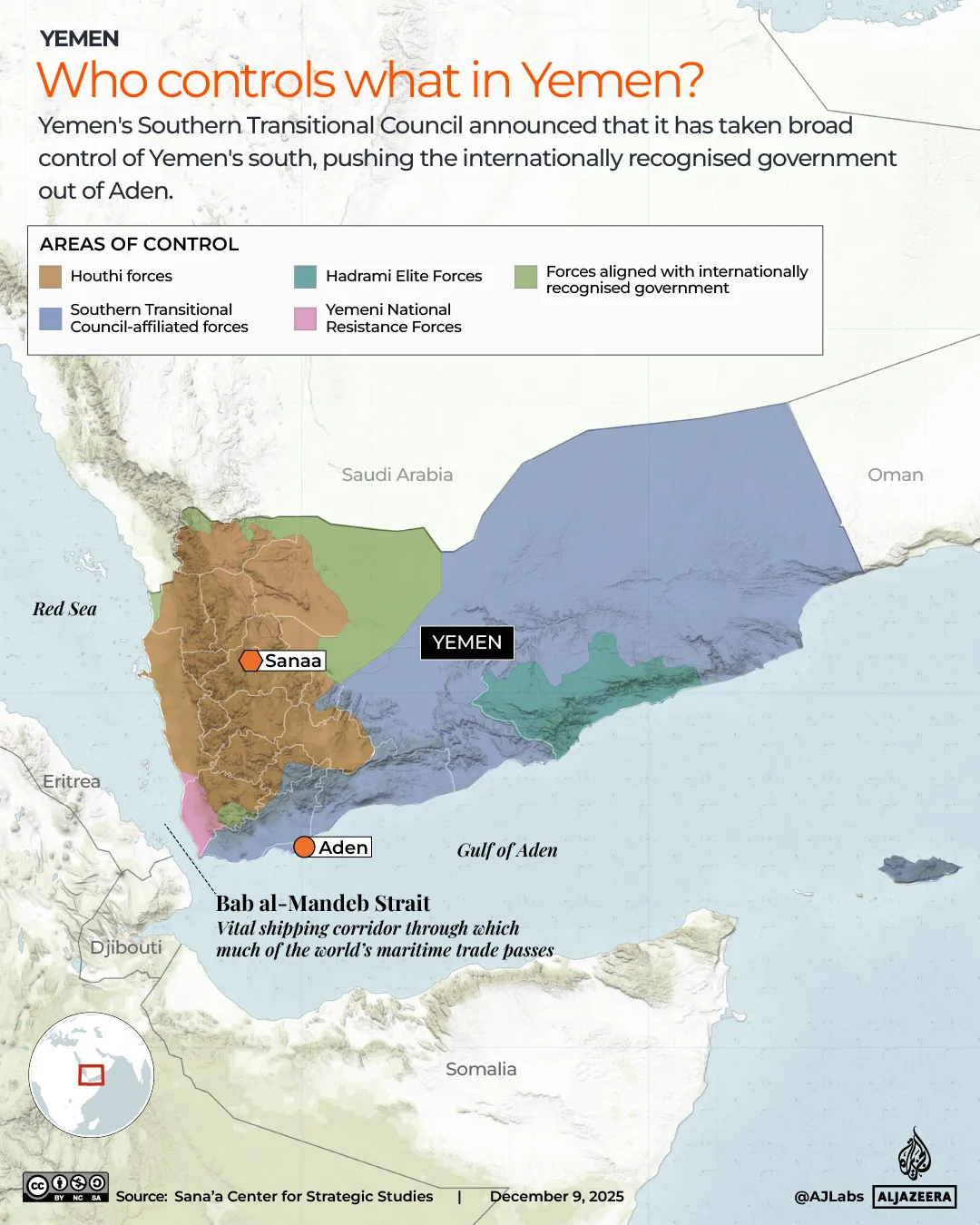
INTERACTIVE_YEMEN_CONTROL_MAP_DECEMBER 9_2025-1765288083

Source link

Who is Aidarous al-Zubaidi? Yemen’s ‘traitor’ chief | Features

For years, Aidarous al-Zubaidi has been the undisputed strongman of southern Yemen, a former air force officer who transitioned from a rebel leader to a statesman courted by Western diplomats.

But on Wednesday, his political trajectory took a drastic turn.

In a decree that has shaken the country’s fragile power-sharing arrangement, the chairman of the Presidential Leadership Council (PLC), Rashad al-Alimi, removed al-Zubaidi from his post as council member, stripping him of his immunity and referring him to the public prosecutor on charges of “high treason”.

The decree accuses al-Zubaidi of “forming armed gangs”, “harming the Republic’s political and military standing”, and leading a military rebellion.

Simultaneously, the Saudi-led coalition announced that al-Zubaidi had “fled to an unknown destination” after failing to answer a summons to Riyadh—a claim the Southern Transitional Council (STC) vehemently denies, insisting their leader remains in Aden.

So, who is the man at the centre of these rapid developments in Yemen?

INTERACTIVE_YEMEN_CONTROL_MAP_DECEMBER 9_2025-1765288083
(Al Jazeera)

The ‘rebel’ officer

Born in 1967 in the Zubayd village of the mountainous Al-Dale governorate, al-Zubaidi’s life has mirrored the turbulent history of southern Yemen.

He graduated from the air force academy in Aden as a second lieutenant in 1988. However, his military career was upended by the 1994 civil war, in which northern forces under then-President Ali Abdullah Saleh crushed the southern separatist movement.

Al-Zubaidi fought on the losing side and was forced into exile in Djibouti.

He returned to Yemen in 1996 to found Haq Taqreer al-Maseer (HTM), which means the Movement of Right to Self-Determination, an armed group that carried out assassinations against northern military officials. A military court sentenced him to death in absentia, a ruling that stood until Saleh pardoned him in 2000.

After years of a low-level rebellion, al-Zubaidi re-emerged during the Arab Spring in 2011, when his movement claimed responsibility for attacks on Yemeni army vehicles in Al-Dale.

From governor to secessionist chief

The Houthi takeover of Sanaa in 2014 and their subsequent push south in 2015 provided al-Zubaidi with his biggest opening.

Leading southern resistance fighters, he played a pivotal role in repelling Houthi forces from Al-Dale and Aden. In recognition of his influence on the ground, President Abd-Rabbu Mansour Hadi appointed him governor of Aden in December 2015.

However, the alliance was short-lived. Tensions between Hadi’s government and southern separatists boiled over, leading to al-Zubaidi’s dismissal in April 2017.

Less than a month later, al-Zubaidi formed the Southern Transitional Council (STC), declaring it the legitimate representative of the southern people. Backed by the United Arab Emirates, the STC built a formidable paramilitary force that frequently clashed with government troops, eventually seizing control of Aden.

In April 2022, in a bid to unify the anti-Houthi front, al-Zubaidi was appointed to the eight-member Presidential Leadership Council (PLC).

A vision of ‘South Arabia’

Despite joining the unity government, al-Zubaidi never abandoned his ultimate goal: the restoration of the pre-1990 southern state.

In interviews with international media, including United Arab Emirates state-run newspaper The National and Al Hurra, al-Zubaidi outlined a vision for a federal “State of South Arabia”. He argued that the “peace process is frozen” and that a two-state solution was the only viable path forward.

He also courted controversy by expressing openness to the Abraham Accords.

“If Palestine regains its rights … when we have our southern state, we will make our own decisions and I believe we will be part of these accords,” he told The National in September 2025.

Most recently, on January 2, 2026, al-Zubaidi issued a “constitutional declaration” announcing a two-year transition period leading to a referendum on independence – a move that appears to have triggered his dismissal.

The final rupture

The events of January 7 mark the collapse of the fragile alliance between the internationally recognised government and the STC.

Brigadier General Turki al-Maliki, spokesperson for the coalition, stated that al-Zubaidi had been distributing weapons in Aden to “cause chaos” and had fled the country after being given a 48-hour ultimatum to report to Riyadh.

Al-Maliki also confirmed “limited preemptive strikes” against STC forces mobilising near the Zind camp in Al-Dale.

The STC has rejected these accounts. In a statement issued on Wednesday morning, the council claimed al-Zubaidi is “continuing his duties from the capital, Aden”.

Instead, the STC raised the alarm about its own delegation in Riyadh, led by Secretary-General Abdulrahman Shaher al-Subaihi, claiming they have lost all contact with them.

“We demand the Saudi authorities … guarantee the safety of our delegation,” the statement read, condemning the air strikes on Al-Dale as “unjustified escalation”.

With “high treason” charges on the table and air strikes reported in the south, al-Zubaidi’s long game for independence appears to have pushed Yemen into a dangerous new phase of conflict.

Source link