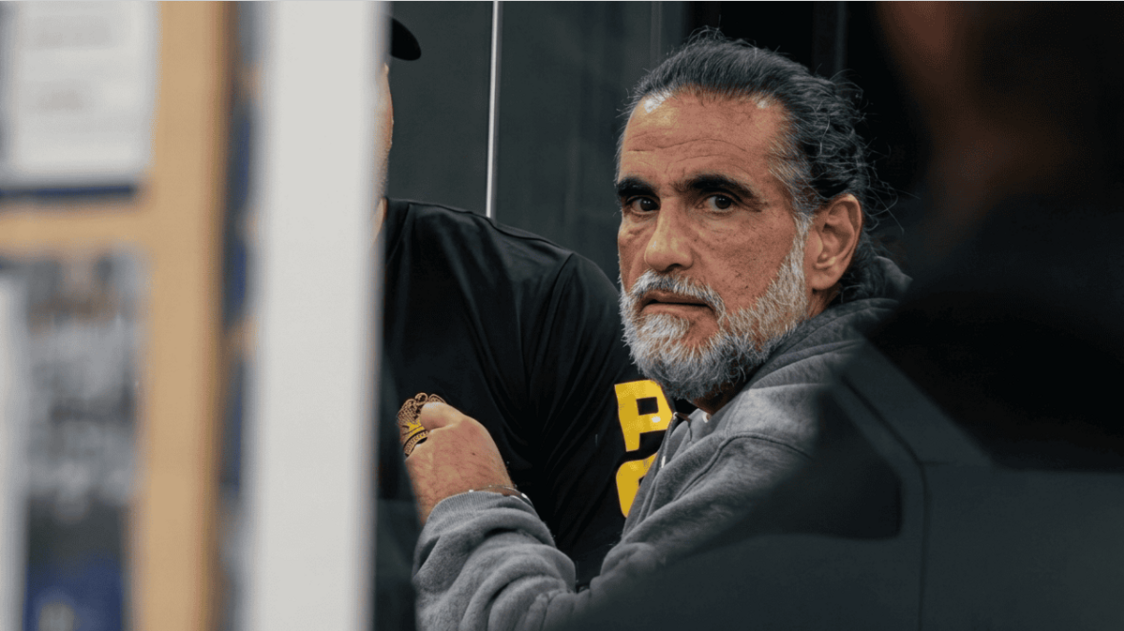
Alex Saab

Venezuela ‘Deports’ Former Minister, Diplomatic Envoy Alex Saab to US

Maduro alongside Saab following the latter’s release in December 2023. (AFP)

Caracas, May 17, 2026 (venezuelanalysis.com) – The Venezuelan government turned over former minister and diplomatic envoy Alex Saab to the US to face charges on Saturday.

The executive led by Acting President Delcy Rodríguez announced the “deportation of Colombian citizen Alex Saab Morán” through a statement issued by the Administrative Service for Identification, Migration, and Immigration (SAIME).

The statement said the measure was adopted “taking into consideration that [Saab] is implicated in various crimes in the United States of America, as is publicly known and widely reported.”

According to local media reports, Saab was transferred under custody from the El Helicoide detention center in Caracas to Simón Bolívar International Airport in Maiquetía, where a US government airplane was waiting for him. The operation reportedly involved agents from the FBI and the CIA, under the supervision of the US Justice and State Departments.

EFE confirmed Saab’s arrival at Opa-locka Airport in Miami-Dade County at 9:15 p.m. local time, escorted by Drug Enforcement Agency (DEA) personnel. Footage of his arrival showed him placing his fingerprints on a biometric scanner upon entering the airport terminal. 

US authorities have yet to issue a public statement on Saab’s detention. The charges against Saab reportedly include criminal conspiracy, money laundering, and bribery of Venezuelan officials. According to the indictment filed in the Southern District Court of Florida, he is accused of having falsified documents and used intermediaries to facilitate international transfers of public funds.

Rumors of Saab’s detention in Caracas, allegedly at Washington’s request, began to circulate in February, with Venezuelan authorities offering no confirmation or denial on his status and whereabouts.

Saab after arriving in Miami on Saturday night. (Archive)

A Colombian-born businessman who later received Venezuelan citizenship, Saab was previously detained on US charges in 2020, during a plane refueling stop in Cape Verde while on a trip to Tehran to negotiate food and fuel imports amid shortages in Venezuela. He was charged with conspiracy to commit money laundering.

Saab’s arrest and subsequent forced departure to US soil saw the Nicolás Maduro administration launch a significant effort to denounce the “kidnapping” of a government diplomatic envoy and demand his release. The “Free Alex Saab” campaign saw Venezuelan authorities and international solidarity movements organize multiple demonstrations and digital campaigns demanding the envoy’s liberation from US custody.

In 2021, Venezuelan National Assembly President and lead negotiator Jorge Rodríguez suspended a dialogue process with the Venezuelan opposition in Mexico following what he described as “the brutal aggression against Saab’s diplomatic status,” insisting at the time that Venezuela would exhaust “all available legal and diplomatic resources” to secure his release.

The Maduro government secured Saab’s return in December 2023, with US President Joe Biden granting him a presidential pardon, as part of a prisoner exchange. Venezuelan authorities released 10 US citizens, including two former Green Berets who had taken part in a failed mercenary incursion. The Venezuelan government hailed Saab’s release as a “victory of truth and dignity.”

He was appointed president of the International Center for Productive Investment (CIIP) in January 2024 and minister of industry in October 2024. Acting President Delcy Rodríguez replaced him in both posts in January, three weeks after the US military strikes and kidnapping of President Maduro and First Lady Cilia Flores.

Saab’s wife, Camilla Fabri, was likewise removed from her government responsibilities as communications vice-minister and head of the “Return to the Homeland” migrant return program.

During his prior detention, Saab’s legal team argued that the Barranquilla-born businessman had acquired Venezuelan nationality and was entitled to diplomatic immunity as a government special envoy. His Venezuelan citizenship allowed him not only to serve as minister, but also to vote in the 2024 presidential elections. Under Article 69 of Venezuela’s Constitution, Venezuelan citizens cannot be extradited.

However, the SAIME communiqué refers to Saab exclusively as a Colombian citizen, without explaining the legal procedure for his removal from the country. Likewise, the statement frames the move as a “deportation” rather than an extradition, although Saab was immediately flown to US territory. At the time of writing, there has been no judicial sentence publicly issued to approve the surrender of the former minister to US authorities.

Edited by Ricardo Vaz in Caracas.


Source link

Alex Saab and the Mutating Realities of Chavismo

Alex Saab was once presented by the Venezuelan state as a symbol of national sovereignty. Today, the same state refers to him simply as “the Colombian citizen Alex Naim Saab Morán.”

That contradiction is not a side detail in the Saab saga. It is the story.

For years, chavismo invested extraordinary political and symbolic capital into transforming Saab from a relatively obscure businessman into something much larger: diplomat, political prisoner, sanctions-era patriot, and eventually minister of commerce. When he was detained in Cape Verde in 2020 on U.S. money laundering charges, the Maduro government reacted as though a senior state official had been kidnapped by a hostile empire. State media launched nonstop campaigns demanding his release. Venezuelan diplomats lobbied internationally on his behalf. Officials presented copies of his Venezuelan passport in foreign courts. Delcy Rodríguez herself described him as an innocent Venezuelan diplomat persecuted by Washington.

The regime did not merely defend Saab. It fused his fate with the idea of Venezuelan sovereignty itself.

And yet today, after reports that Saab was quietly detained inside Venezuela for months before being surrendered to the United States, the same state apparatus appears eager to emphasize something entirely different: his Colombian nationality.

The legal logic is obvious enough. Venezuelan law generally prohibits the extradition of Venezuelan nationals. Saab’s status as a naturalized citizen may have provided the government with the legal flexibility needed to facilitate his transfer while preserving a veneer of constitutional procedure.

But politically, the reversal is extraordinary.

Until recently, Saab was not treated as a foreign intermediary operating on behalf of Venezuela. He was treated as Venezuela. Attacks on Saab were framed as attacks on the republic itself. His return from Cape Verde during the Biden-era prisoner exchange was celebrated as a geopolitical victory. In January, Delcy Rodríguez publicly thanked him for his “dedication and commitment to the homeland” while announcing he would assume “new responsibilities.”

Only months later, he became deportable.

The Saab affair exposes how late chavismo governed through mutable political realities rather than stable institutional principles.

What changed was not merely the regime’s opinion of Saab. The operative meaning of Saab himself changed according to political necessity. He was successively businessman, envoy, diplomat, patriot, minister, revolutionary symbol, and now effectively a legally manageable Colombian citizen. The categories surrounding him  (citizenship, sovereignty, legality, loyalty) were treated less as fixed institutional realities than as flexible political instruments.

This is what gives the entire saga its distinctly Orwellian quality.

The issue is not simply propaganda. All political systems engage in propaganda. The issue is the degree to which political reality itself became fluid. Yesterday’s indispensable patriot becomes today’s silent liability. Yesterday’s sovereign diplomat becomes today’s extraditable foreign national. The contradiction is not resolved so much as administratively absorbed.

For Venezuelans, this dynamic has become painfully familiar. Years of institutional improvisation, overlapping authorities, constitutional contortions, and contradictory official narratives have gradually normalized incoherence as a governing method. People learn not to ask whether political narratives are internally consistent, but whether they remain operationally useful.

The Saab saga condenses that evolution into a single character arc.

And yet this is not merely a story about narrative manipulation. It is also a story about how chavismo itself changed under the pressure of sanctions, isolation, and survival.

During the years of maximum international pressure, Saab’s networks reportedly became central to the regime’s economic adaptation. Food imports, opaque oil transactions, offshore procurement systems, sanctions workarounds, and parallel financial structures increasingly blurred the distinction between state policy and survival improvisation. Saab occupied a hybrid role inside that world: part businessman, part diplomat, part financial operator, part sovereign representative.

That ambiguity was not accidental. It reflected the logic of a state learning to survive siege conditions.

But survival systems often produce figures who become simultaneously indispensable and dangerous. The very people who help preserve a regime during periods of extreme pressure can later become liabilities once strategic priorities shift. As Venezuela moved from total isolation toward tentative normalization, figures associated with the sanctions-era architecture increasingly carried diplomatic, financial, and political costs.

The fall of Tareck El Aissami and the PDVSA crypto scandal had already hinted at this transition. Entire internal networks once tied to the regime’s survival mechanisms suddenly became objects of public investigation and selective purge. Saab’s extradition pushes that logic much further. Unlike the internal anti-corruption campaigns of previous years, this was not simply the revolution disciplining itself. It was the state externally relinquishing one of its own.

And perhaps that is why the Saab affair feels so psychologically significant inside chavismo itself.

For years, the movement functioned through implicit assumptions about loyalty and protection. Certain figures appeared untouchable because they embodied too much of the system’s operational history and symbolic legitimacy. Saab seemed to belong to that category. His sudden transformation from protected patriot to expendable liability suggests that the category itself may be disappearing.

That does not necessarily mean the regime is collapsing. Authoritarian systems can survive long after ideological coherence erodes. But it does suggest a deeper transformation underway: the gradual evolution of chavismo from revolutionary movement into survival-oriented governing apparatus.

Revolutionary systems rely on myths that are supposed to remain stable over time. Survival systems prioritize flexibility instead.

The Saab affair reveals what happens when that flexibility extends not only to policy, but to reality itself.

Source link