Alcatraz

Lawyer says guards beat and pepper-sprayed detainees at Florida’s ‘Alligator Alcatraz’

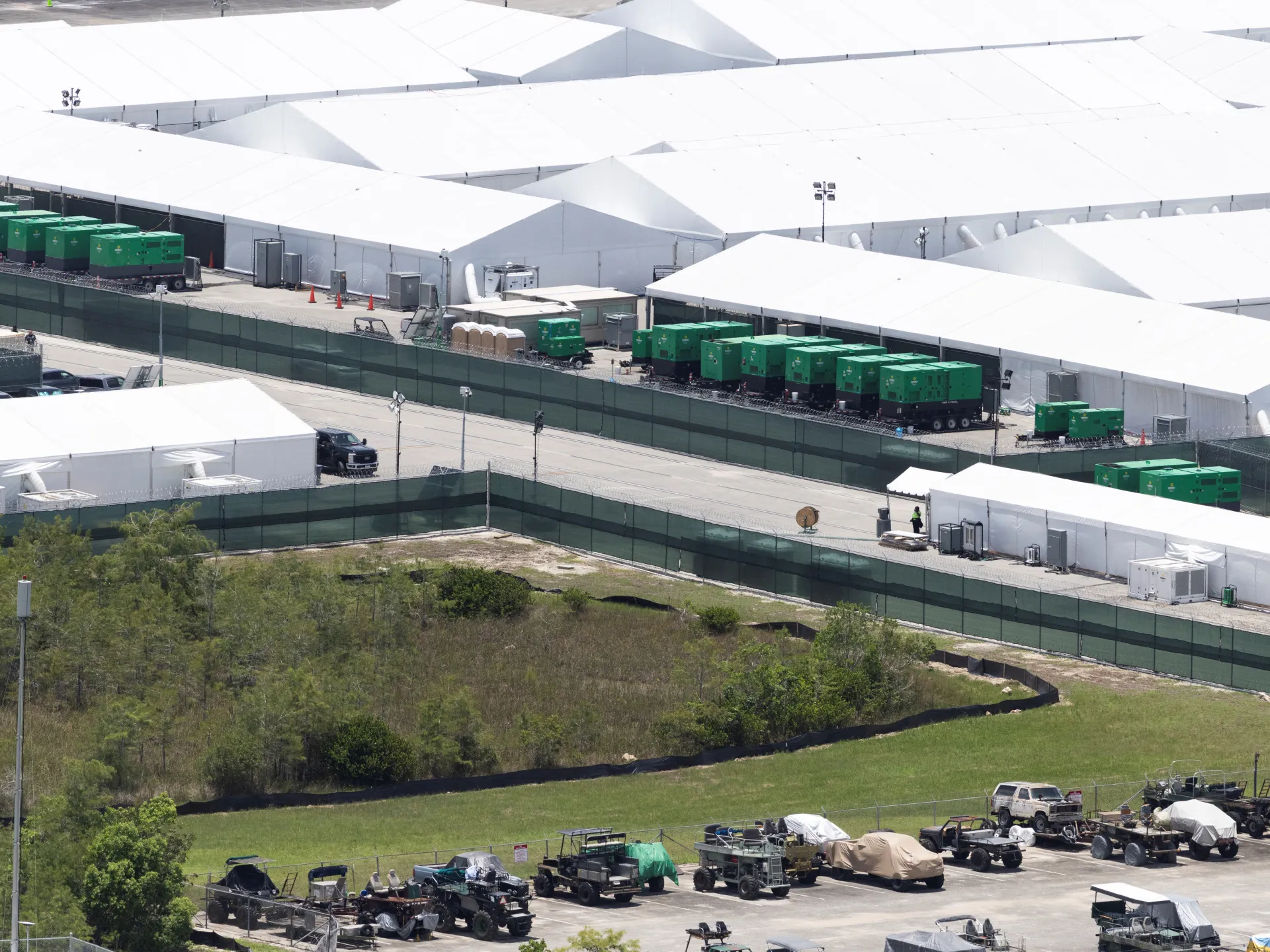
Guards severely beat and pepper-sprayed detainees at a state-run immigration detention center known as “Alligator Alcatraz” in the Florida Everglades this month, according to a lawyer for two detainees.

The guards targeted Katherine Blankenship’s clients and other detainees at the facility after they complained about not having phone access on April 2, Blankenship said in a court declaration.

The phones, which weren’t functioning, are the primary way for detainees to communicate with family and their attorneys while in the detention center. The guards began taunting the detainees, who were in a cell, then became “more aggressive and were yelling and threatening to enter the cage,” Blankenship wrote.

When one detainee approached a guard, he was punched in the face. The guards then started beating other detainees in the cell. One of Blankenship’s clients was punched in the right eye, thrown to the floor and beaten by several guards. He was kicked in the head and his shoulder and arm were injured. A guard put his knee on the detainee’s neck while restraining him, according to the attorney’s declaration, which included a photo made during a video call almost a week later showing the detainee with a bruised eye.

“The officers beat several people during this incident and broke another detained individual’s wrist,” Blankenship wrote. The detainee whose wrist was broken is not one of her clients.

Phone service was restored the next day without any explanation for why it was cut off.

The Florida Department of Emergency Management didn’t respond to questions emailed Wednesday about the incident.

Blankenship’s declaration was included in a court filing accusing state and federal officials of failing to comply with a federal judge’s preliminary injunction last month ordering detention center officials to provide access to timely, free, confidential, unmonitored and unrecorded outgoing legal calls. U.S. District Judge Sheri Polster Chappell in Fort Myers, Florida also said facility officials must provide at least one operable telephone for every 25 people held in the facility.

The judge’s order came in a response to a lawsuit that claimed detainees’ First Amendment rights were being violated.

State officials have denied restricting detainees’ access to their attorneys and cited security and staffing reasons for any challenges. Federal officials who also are defendants denied that detainees’ First Amendment rights were violated. State officials last week filed a notice that they plan to appeal the judge’s order.

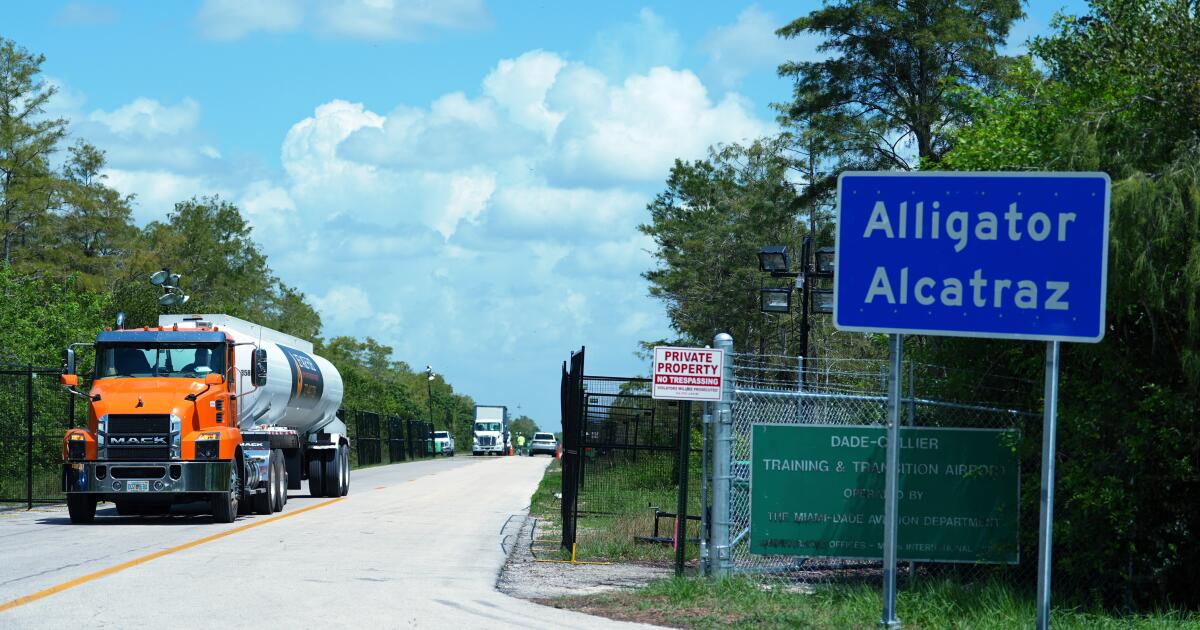
The Everglades facility was built last summer at a remote airstrip by Republican Gov. Ron DeSantis’ administration to support President Trump’s immigration policies. Florida also has built a second immigration detention center in north Florida.

During a visit last week to the detention center, U.S. Rep. Debbie Wasserman Schultz, a Florida Democrat, said she wasn’t given the chance to talk to detainees. She described conditions at the detention center as “inhumane.”

“The way the detainees are housed is cruel and unnecessary,” she said.

Schneider writes for the Associated Press. AP journalist Gisela Salomon in Miami contributed to this report.

Source link

Environmental groups urge appeals court panel to lift halt on closing Florida’s ‘Alligator Alcatraz’

Environmental groups on Tuesday asked a federal appellate court panel to drop its temporary halt of a lower court’s order instructing state officials to close an immigration detention center in the heart of the Florida Everglades known as “Alligator Alcatraz.”

The Everglades facility remains open, still holding detainees, because the appellate court in early September relied on arguments by Florida and the Trump administration that the state had not yet applied for federal reimbursement, and therefore wasn’t required to follow federal environmental law. State officials opened the detention center last summer to support President Trump’s immigration crackdown.

Questions by the three appellate judges during oral arguments in a Miami courtroom focused on how much control the federal government had over the state-built facility and under what circumstances an environmental review was required to be in compliance with federal law. The judges did not indicate when they would rule.

Jesse Panuccio, an attorney for the Florida Department of Emergency Management, told the judges federal funding and federal control of the facility were the two criteria for determining if the federal environmental law would apply and the federal agencies had no control over the state-run detention center.

Florida was notified in late September that FEMA had approved $608 million in federal funding to support the center’s construction and operation.

“You need both,” Panuccio said. “Even with funding, I don’t think that would follow because they don’t have federal control.”

An attorney for the environmental groups said the law requiring a review applied to the facility because the Department of Homeland Security had authorized the funding and immigration was a responsibility of the federal government, not the state.

“What is different about this property is that immigration is constitutionally a federal function,” said Paul Schwiep,” an attorney representing the Friends of the Everglades and the Center for Biological Diversity. “The state has no role.”

The federal district judge in Miami in mid-August ordered the facility to wind down operations over two months because officials had failed to do a review of the detention center’s environmental impact according to federal law. That judge concluded that a reimbursement decision already had been made. The appellate court halted the order on an appeal.

The environmental lawsuit was one of three federal court challenges to the Everglades facility since it opened. In the others, a detainee said Florida agencies and private contractors hired by the state had no authority to operate the center under federal law. The challenge ended after the immigrant detainee who filed the lawsuit agreed to be removed from the United States.

In the third lawsuit, a federal judge in Fort Myers, Fla., ruled the Everglades facility must provide detainees there with better access to their attorneys, as well as confidential, unmonitored, unrecorded outgoing legal calls.

Schneider writes for the Associated Press.

Source link

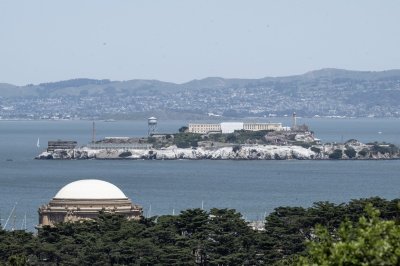
Trump requests $152M to reopen Alcatraz as a prison

April 3 (UPI) — The Trump Administration has requested $152 million in its fiscal year 2027 federal budget proposal to refurbish and reopen Alcatraz as a prison.

President Donald Trump first broached the idea of reopening the prison on Alcatraz Island in the San Francisco Bay in May 2025, but with the administration’s release of its budget proposal to Congress he is looking to put his plan in motion.

Alcatraz was closed in 1963 after 30 years as an active prison that has become famous for its former inmates and stories of attempted escapes, but has long been a popular tourist attraction that sees more than one million people per year visit the island, the San Francisco Chronicle reported.

In the budget proposal, the administration argued that restoring Alcatraz is an appropriate response to the federal Bureau of Prisons housing “violent criminals in crumbling detention centers.”

“The Budget affirms the President’s commitment to rebuild Alcatraz as a state-of-the-art secure prison facility, providing $152 million to cover the first year of project costs,” the budget proposal said.

The request is part of the administration’s $5 billion request for the BOP, and its larger intent is to improve working conditions and pay to stem shortages of correctional officers.

While the $152 million is projected to over the first year of refurbishing the prison, there are no details of the project or longer-term details included in the proposal.

In 2025, however, when Trump said he’d directed his administration to start looking into reopening Alcatraz as a prison, his administration suggested that the multi-year project to make it usable could cost around $2 billion.

The prison originally was closed because it was so expensive to run — every supply needed for the facility has to be brought there by boat because it is in the middle of the San Francisco Bay — and had at least 36 inmates attempt a total of 14 separate escapes in its 30 years as a prison.

“Alcatraz is a historic museum that belongs to the public, and San Franciscans will not stand for Washington turning one of our most iconic landmarks into a political prop,” U.S. Rep. Nancy Pelosi, D-Calif., told The Los Angeles Times.

President Donald Trump delivers a prime-time address to the nation from the Cross Hall in the White House on Wednesday. President Trump used the address to update the public on the month-long war in Iran. Pool photo by Alex Brandon/UPI | License Photo

Source link

Trump asks Congress for $152 million to start rebuilding Alcatraz prison

President Trump is requesting $152 million from Congress to begin “rebuilding” the prison on Alcatraz Island for operational use, though his administration appears to have taken few steps toward advancing the project.

The request, in the president’s proposed budget for fiscal year 2027, resurrects Trump’s attention-grabbing concept of converting the crumbling site — which has stood as a piece of history for more than 60 years — into a working federal prison.

But the Bureau of Prisons on Friday said it had no new information to share about the potential project and no updates about whether assessments that the agency had said it launched last year had been completed.

A spokesperson said the bureau was “moving forward, evaluating, and formulating the actions necessary” and pointed to to a May 2025 statement from bureau director William K. Marshall pledging to “vigorously pursue all avenues to support and implement the President’s agenda.”

The funding request was included in Trump’s budget proposal, which provides Congress with a look at the administration’s priorities ahead of the next fiscal year. Congress makes the ultimate funding decisions for the government.

Creating a working prison on the San Francisco Bay island would be extremely costly, the administration’s critics say, and would raise questions about its fate as a historic site that draws more than a million tourists a year.

Rep. Nancy Pelosi (D-San Francisco) said Friday she would attempt to block Trump’s proposal in Congress by any means possible, calling it “a stupid notion that would be nothing more than a waste of taxpayer dollars.”

“Alcatraz is a historic museum that belongs to the public, and San Franciscans will not stand for Washington turning one of our most iconic landmarks into a political prop,” she said in a statement.

The $152-million request is for only the first year of the project’s costs. How long the project could take or what the total cost could be are not clear. The budget proposal described the project as a “state-of-the-art secure prison facility.”

The White House did not respond to a request for comment Friday.

“It represents something very strong, very powerful, in terms of law and order,” Trump told reporters last year. “It housed the most violent criminals in the world. … It sort of represents something that’s both horrible and beautiful, strong, and miserable.”

He characterized the historic site as “rusting and rotting.”

Sen. Patty Murray (D-Washington), vice chair of the Senate appropriations committee, said Trump would waste taxpayer money on Alcatraz “while ignoring billions of dollars in repair-backlog needs for existing” federal prisons.

The government opened the federal penitentiary on Alcatraz in 1934, hoping to use the remote island to house particularly difficult prisoners, according to the National Park Service. Its cells held infamous criminals such as Al Capone, and several unsuccessful escape attempts captured public imagination.
The prison was closed in 1963 after becoming too costly to run. A group of Native American activists occupied the land during a period between 1969 and 1971, and in 1972, Alcatraz became a national recreation area under National Park Service management. It opened to the public as a national park attraction the following year and was later designated a National Historic Landmark.

Trump, who has pushed to round up criminals and pursued plans to open new detention centers in his second term, floated the Alcatraz idea last year, saying he wanted to send “America’s most ruthless and violent Offenders” there.

He directed the Bureau of Prisons to take up the task. In July, then-Atty. Gen. Pam Bondi and Interior Secretary Doug Burgum visited the island.

“Alcatraz could hold the worst of the worst, it could hold middle-class violent prisoners, it could hold illegal aliens,” Bondi told Fox News during the visit. “This is a terrific facility; it needs a lot of work, but no one has been known to escape from Alcatraz and survive.”

The Bureau of Prisons said at the time that no final decision had been made as to whether to use the site, but that the agency would determine whether “it makes sense operationally, legally, and financially.”

The bureau said then that was working on a cost estimate and feasibility report to present to Congress following a site assessment with the National Park Service and work by engineers and planners on potential budgets and models.

Sen. Adam Schiff (D-Calif.) said Friday opening Alcatraz would be “prohibitively expensive” for the federal government to undertake. He has previously characterized the concept as part of an attack by the Trump administration on national parks.

“Trump’s continued push to reopen it as a federal prison is a wasteful exercise in futility,” Schiff said. “He should focus on lowering the cost of living for the American people, not raising the cost of our prisons.”

Source link