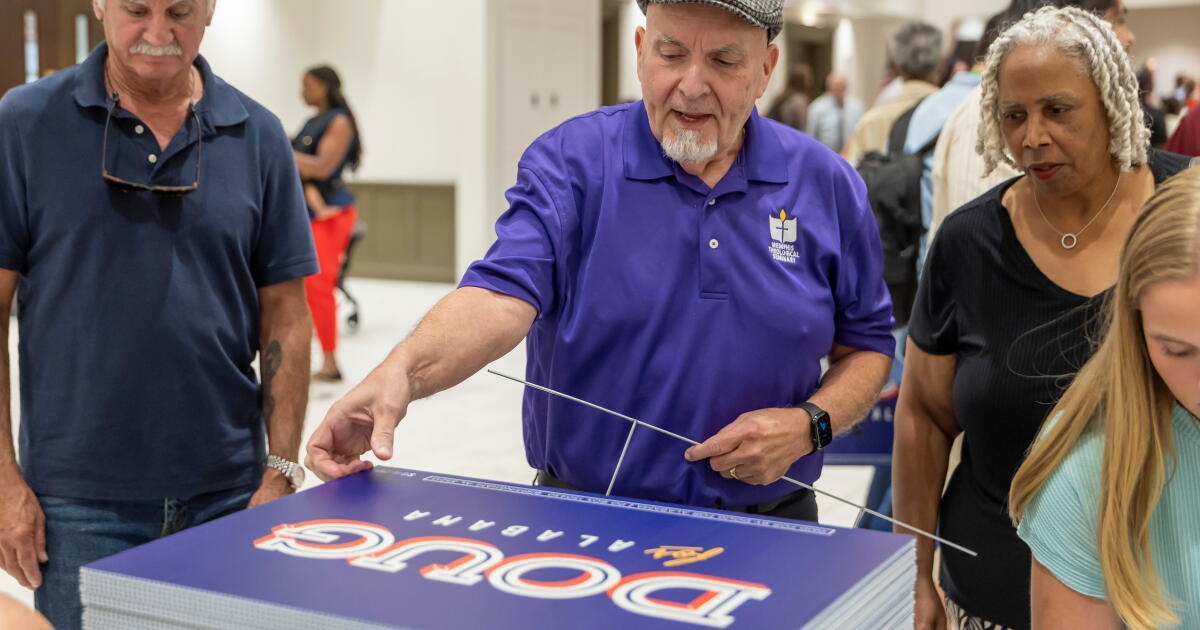
alabama

Supreme Court rules Alabama may redraw congressional maps to oust a Black Democrat

The Supreme Court ruled Tuesday night that Alabama Republican leaders may redraw their congressional voting districts to oust a Black Democrat and elect a white Republican.

The court’s conservatives, who ruled for Louisiana Republicans in a redistricting dispute, extended that decision to Alabama. The three liberals dissented.

The decision clears the way for the governor and state lawmakers to redraw their congressional voting map with six districts that favor Republicans and one that favors a Democrat.

“Weeks ago, I warned that vacating the District Court’s injunction in these cases would ‘unleash chaos and … confuse voters,’ ” Justice Sonia Sotomayor wrote in dissent. “Yet just as Alabama doubled down on racial discrimination, the Court today doubles down on chaos. Because I choose to defend the rule of law and the right of all Alabamians to participate equally in democracy, I respectfully dissent.”

The justices granted an emergency appeal that was backed by the Trump administration and set aside the decision of a three-judge panel in Alabama.

The court in a brief opinion said the three judges should not have blocked Alabama’s new map.

“While federal courts should not impose changes close to an election, states are free to decide for themselves whether last-minute changes to an election are in their best interests,” the court said.

Alabama’s emergency appeal went to Justice Clarence Thomas, who referred it to the full court.

Those three judges, two of them Trump appointees, ruled that Alabama’s state lawmakers discriminated against Black voters, who made up a near majority in the center of the state.

Three years ago, the Supreme Court agreed.

In a 5-4 decision written by Chief Justice John Roberts, the justices upheld the creation of a second district in the center of the state where Black voters had a near majority.

The result then was an Alabama state voting map that favored five Republicans and two Democrats for the House of Representatives.

But last month, in the wake of the Louisiana decision, Alabama’s lawmakers went back to court, arguing that the state may return to the voting map with only a single Black majority district.

In his appeal to the Supreme Court, Alabama’s Atty. Gen. Steven Marshall argued that the high court’s decision in favor of Louisiana “vindicates Alabama position on the lawfulness” of its earlier voting map. He said the state should not be penalized for “refusing to intentionally discriminate” to favor Black voters.

The court’s decision has cleared the way for Republican-led states in the South to flip congressional districts in Louisiana, Tennessee, Florida and now Alabama.

Source link

UCLA loses to Alabama in its Women’s College World Series opener

UCLA loses to Alabama

Megan Grant hit her 41st home run of the season to tie a UCLA career record Thursday night, but top-seeded Alabama rallied behind a five-run surge to beat the eighth-seeded Bruins 6-3 on opening day at the Women’s College World Series.

UCLA starter Taylor Tinsley took a 3-1 lead into the fifth inning but walked leadoff batter Jena Young then surrendered a 249-foot home run to Alexis Pupillo two batters later to tie the score.

In the sixth, Alabama’s Kristen White beat out a grounder to third and Young dropped a bloop single to left, setting the stage for Brooke Wells, who drove a pitch from Tinsley 239 feet to center field to give the Crimson Tide the lead.

The Bruins (52-9) will have to beat the winner of the game between Arkansas and Nebraska on Friday night to avoid elimination.

Continue reading here

Go beyond the scoreboard

Get the latest on L.A.’s teams in the daily Sports Report newsletter.

Angels rout the Tigers

Grayson Rodriguez pitched five strong innings as the Angels beat the Detroit Tigers 7-1 on Thursday for their fifth victory in six games.

The Angels won back-to-back series for the first time this season, sweeping Texas at home before winning two of three in Detroit.

Detroit has gone 4-18 since May 4, losing seven straight series.

Rodriguez (2-1) allowed one run on two hits and two walks in five innings. He struck out five.

Continue reading here

Angels box score

MLB standings

MLB team owners propose a salary cap

From Bill Shaikin: They had balloons, baseball caps and a splashy video. They even had Dusty Baker, because any day with Dusty Baker is a good day.

And, as a campaign called “The Sacramento Pitch” unveiled its plan to lure a Major League Baseball expansion team to the state capital, the mayor made his pitch a blunt one.

“This region has earned its place in the majors,” Sacramento Mayor Kevin McCarty said Thursday. “And, frankly, MLB could use Sacramento.”

We’ll see. But, as McCarty and other dignitaries rallied in Sacramento, a more important gathering was happening in New York, at which MLB owners formally proposed the salary cap players have vowed to resist.

Whether owners can get a cap — either by persuasion through the fall and winter, or more likely by canceling games next spring so players go unpaid — remains to be seen. For Sacramento and the other American and Canadian cities pursuing two expansion teams, the outcome of collective bargaining could determine the fee MLB would charge for each one.

Continue reading here

Mason Edwards leads USC to College Baseball World Series

From Joaquin Ruiz: Mason Edwards has first-round hype ahead of July’s 2026 MLB draft for a reason.

USC’s ace takes the mound like a boxer enters the ring, eager to land blow after blow. And as the Trojans (43-15) open the NCAA tournament in College Station, Texas, at 6 p.m. PDT Friday (ESPNU), the southpaw packs a serious punch. He carries a nation-leading 160 strikeouts and the second-best 1.43 ERA.

“They’re getting a competitor,” Edwards said of what people can expect when he pitches. “There have been a lot of situations where I’ve had to battle and fight adversity. So, I think you’ll see a good fight when I toe the rubber. I’m not going to shy away from any type of competition.”

If anything, the competition probably shies away from Edwards.

Named the Big Ten 2026 Pitcher of the Year after stacking a record 113 strikeouts in conference play, Edwards is integral to what has been USC’s best team since the early 2000s.

Continue reading here

Can UCLA win the College Baseball World Series?

From Joaquin Ruiz: No. 1 UCLA’s quest for the second baseall national title in school history starts Friday.

The Bruins (51-6, 28-2 Big Ten) enter the NCAA tournament as the top overall seed and host against Saint Mary’s (34-25, 15-12 West Coast) to begin the Los Angeles Regional at Jackie Robinson Stadium.

After winning its first Big Ten tournament championship in program history on Sunday, UCLA is focused on continuing its dominance and embracing the target on its back as a College World Series favorite.

“We’ll see what happens, but I think just staying with us and not trying to do too much and just stay present,” UCLA junior outfielder Payton Brennan said. “That’s the main thing — and staying with each other.”

Their record and conference dominance aside, the Bruins sit atop several statistical categories and are intimidating across the diamond.

But UCLA coach John Savage said UCLA isn’t looking past its regional foes — Saint Mary’s, Cal Poly San Luis Obispo and Virginia Tech.

Continue reading here

This day in sports history

1946 — Two-year-old fillies Chakoora and Uleta become the first thoroughbreds to complete a transcontinental flight. They’re flown from New York to Inglewood by the American Air Express Corp., a 2,446-mile trip that lasts 20 hours due to bad weather.

1968 — European Cup Final, Wembley Stadium, London: Bobby Charlton scores twice as Manchester United beats Benfica, 4-1; first English club to win the trophy.

1971 — Al Unser wins his second straight Indianapolis 500 with a record mark of 157.735 mph and finishes 22 seconds ahead of Peter Revson. The pace car, ridden by Eldon Palmer, crashes into the portable bleachers and injures 20 people.

1977 — A.J. Foyt becomes the first driver to win four Indianapolis 500s and Janet Guthrie becomes the first woman in the race. Guthrie is forced to drop out after 27 laps with mechanical problems.

1977 — Australian Sue Prell first female golfer to hit consecutive holes-in one; 13th and 14th holes at Chatswood Golf Club, Sydney.

1980 — Larry Bird beats out Magic Johnson for NBA rookie of year.

1983 — After three second-place finishes, Tom Sneva wins the Indianapolis 500 by 11 seconds over three-time champion Al Unser.

1985 — 29th European Cup: Juventus beats Liverpool 1-0 at Brussels.

1988 — Rick Mears overcomes an early one-lap deficit, then overpowers the rest of the field on the way to his third Indianapolis 500 victory. Mears gives team-owner Roger Penske an unprecedented seventh victory and fourth in five years.

1990 — Stefan Edberg and Boris Becker, the top two seeds, are bounced in the first round of the French Open by two European teenagers, the first time the top two men’s seeds are eliminated in the first round of a Grand Slam tournament. Edberg is swept easily in straight sets by 19-year-old Sergi Bruguera of Spain, and Becker loses to 18-year-old Yugoslav Goran Ivanisevic.

1991 — 35th European Cup: Red Star Belgrade beats Marseille (0-0, 5-3 on penalties) at Bari.

1993 — Wayne Gretzky’s overtime goal gives the Kings a 5-4 win over the Toronto Maple Leafs in the Western Conference finals. The Kings become the first NHL team to play the full 21 games in the first three rounds.

1998 — Eighteen-year-old Marat Safin, ranked 116th in the world and playing in his first Grand Slam tournament, beats defending champion Gustavo Kuerten, 3-6, 7-6 (7-5), 3-6, 6-1, 6-4 in the second round of the French Open.

2005 — Dan Wheldon wins the Indianapolis 500 when Danica Patrick’s electrifying run falls short. Patrick is the first woman to lead at Indy, getting out front three separate times for a total of 19 laps. But Wheldon passes her with seven of the 200 laps to go and easily holds on.

2006 — Rafael Nadal passes Guillermo Vilas as the King of the clay courts and begins his pursuit of a second successive French Open trophy. Nadal earns his 54th consecutive win on clay, breaking the Open era record he shared with Vilas by beating Robin Soderling in straight sets in the first round at Roland Garros.

2011 — JR Hildebrand, one turn from winning the Indianapolis 500, skids high into the wall on the final turn and Dan Wheldon drives past to claim an improbable second Indy 500 win in his first race of the year.

2011 — Roger Federer sets another record by reaching the French Open quarterfinals, and Novak Djokovic closes in on a pair of his own. Federer extends his quarterfinal streak at major tournaments to 28 with a 6-3, 6-2, 7-5 victory over Stanislas Wawrinka. Djokovic maintains his perfect season to 41-0 and stretches his overall winning streak to 43 matches by beating Richard Gasquet of France 6-4, 6-4, 6-2.

2012 — Serena Williams loses in the first round of a major tournament for the first time, falling to Virginie Razzano of France 4-6, 7-6 (5), 6-3 at the French Open. Williams enters the day with a 46-0 record in first-round matches at Grand Slam tournaments.

2016 — Alexander Rossi wins the 100th running of the Indianapolis 500.

2017 — Tiger Woods is arrested and charged with driving under the influence in Jupiter, Fla.

2021 — UEFA Champions League Final, Porto: Kai Havertz scores just before halftime to give Chelsea a 1-0 win over Manchester City in an all-English final; Blues’ second CL title.

Compiled by the Associated Press

This day in baseball history

1916 — Christy Mathewson defeated the Boston Braves 3-0 for the New York Giants’ 17th consecutive road win.

1922 — The U.S. Supreme Court ruled organized baseball was primarily a sport and not a business, and therefore not subject to antitrust laws and interstate commerce regulations. The suit had been brought by the Federal League’s Baltimore franchise.

1928 — Bill Terry hit for the cycle to lead the New York Giants to a 12-5 win over Brooklyn at Ebbets Field. Terry became the first player in major league history to include a grand slam as part of the cycle.

1942 — New York’s Lefty Gomez, self-described as the worst-hitting pitcher in baseball, banged out four hits while pitching a 16-1 four-hitter against Washington.

1956 — Dale Long went hitless for the Pirates, ending his major league record streak of home runs in eight consecutive games. The Brooklyn Dodgers beat Pittsburgh, 10-1.

1965 — Philadelphia’s Richie Allen hit a 529-foot home run over the roof of Connie Mack Stadium off Chicago’s Larry Jackson in the Phillies’ 4-2 victory.

1976 — Houston’s Joe Niekro was the winning pitcher and hit a home run off his brother, Phil Niekro. The Astros beat the Atlanta Braves 4-1. It was the only home run hit by Joe in his 22-year major league career.

1990 — Oakland’s Rickey Henderson broke Ty Cobb’s 62-year-old American League stolen base record, but the Toronto Blue Jays still beat the Athletics 2-1. Henderson’s 893rd steal came in the sixth inning.

2000 — Oakland second baseman Randy Velarde turned the 10th unassisted triple play in regular-season history during a 4-1 loss to the New York Yankees. With runners on first and second in motion, Shane Spencer hit a line drive to Velarde who caught the ball, tagged out Jorge Posada (running from first) and stepped on second to beat Tino Martinez.

2002 — Roger Clemens recorded the 100th double-digit strikeout game of his career, fanning 11 in seven innings against Chicago. Nolan Ryan (215) and Randy Johnson (175) were the others to have 100 double-digit strikeout games.

2002 — In an article in Sports Illustrated former NL MVP Ken Caminiti stated that about 50% of current major league players used some form of steroids.

2003 — Colorado, behind Todd Helton’s three home runs and Ron Belliard’s five hits beat the visiting Dodgers 12-5. Helton added a single and drove in six runs.

2010 — Philadelphia’s Roy Halladay threw the 20th perfect game in major league history, beating the Florida Marlins 1-0. It was the first time in the modern era that there were a pair of perfect games in the same season. Halladay faced three Marlins pinch-hitters in the ninth. Mike Lamb led off with a long fly ball, Wes Helms struck out, and Ronny Paulino to hit a grounder to third for the 27th out. Halladay struck out 11 and went to either 3-1 or 3-2 counts seven times, twice in the game’s first three batters.

2013 — Chris Davis went 4 for 4 with two home runs, and the Baltimore Orioles overcame three homers by Ryan Zimmerman to beat the Washington Nationals 9-6.

2013 — Dioner Navarro had the first three-homer game of his career, connecting from both sides of the plate at Wrigley Field to lead the Chicago Cubs to a 9-3 win over the Chicago White Sox. Navarro drove in a career-high six runs and scored four times.

2014 — Diamondbacks pitcher Josh Collmenter faces the minimum 27 batters in spite of giving up three hits in a complete game shutout defeat of the Cincinnati Reds. The three Reds baserunners were erased on double plays.

2015 — Lewis-Clark State wins their 17th NAIA baseball title.

2021 — The Twins’ Josh Donaldson scored the two-millionth run in major league history.

2025 — Chris Sale becomes the fastest pitcher to reach 2,500 strikeouts, doing so in 2,026 innings, fewer than the 39 men who have preceded him to the mark.

Compiled by the Associated Press

Until next time…

That concludes today’s newsletter. If you have any feedback, ideas for improvement or things you’d like to see, email me at houston.mitchell@latimes.com. To get this newsletter in your inbox, click here.

Source link

Alabama asks Supreme Court to allow use of congressional map helping GOP, despite racial bias ruling

Alabama on Wednesday asked the Supreme Court to allow it to use a congressional map favoring Republicans in this year’s elections, despite a lower court’s ruling that the redistricting plan intentionally discriminates against Black people.

The state’s Republican leadership filed an emergency appeal with the justices a day after a three-judge court refused to let the state use a map it adopted three years ago that has a majority Black population in just one of its seven congressional districts.

The judges instead required Alabama to continue using a court-ordered map that was put in place for the 2024 elections that includes two districts where Black residents comprise a majority or close to it.

Atty. Gen. Steve Marshall told the court that the state did not intentionally discriminate against Black residents and should be allowed to hold elections this year under a map chosen by lawmakers, not judges.

The appeal is the latest development in the fallout from last month’s Supreme Court ruling that struck down a Black-majority district in Louisiana and weakened the federal Voting Rights Act. That ruling has led Republicans in several Southern states, including Alabama, to take steps to reshape voting districts with large minority populations that have elected Democrats.

The redistricting frenzy is part of a broader push by President Trump to try to hold on to Republicans’ slim House majority in the November elections.

The Alabama cases stretches back several years. The three-judge panel in 2023 ruled that a map drawn by Republican state lawmakers intentionally diluted the voting power of Black citizens. The court said the state, which is about 27% Black, should have two districts where Black voters are the majority or close to it. The court-selected map was used in 2024.

After the Supreme Court’s recent ruling in the Louisiana case, Alabama officials moved to implement the 2023 state-drawn map. The Supreme Court’s conservative majority agreed to lift the injunction that had blocked the map’s use and sent the case back to the three-judge panel for reconsideration in light of the Louisiana ruling.

In the meantime, voters cast ballots in Alabama’s May 19 primaries, and Republican Gov. Kay Ivey set new special primaries for Aug. 11 in four congressional districts affected by the map switch.

Upon further review, the judicial panel said it was standing behind its initial finding that there was “undisputed evidence” of intentional racial discrimination, a holding that was independent of and unaffected by the Supreme Court ruling on the Voting Rights Act.

It said the special congressional primaries should instead proceed under the previous court-approved districts.

The use of the court-ordered map led to the 2024 election of U.S. Rep. Shomari Figures, a Black Democrat. State Republicans are seeking to use a map that would give the GOP an opportunity to reclaim the south Alabama seat.

The state is asking for Supreme Court action by Monday as it makes preparations for the special vote in August.

Sherman writes for the Associated Press.

Source link

Federal court blocks Alabama plan for new congressional districts that could help Republicans

Federal judges on Tuesday blocked Alabama’s plan to use a congressional map that could give Republicans an advantage in a key U.S. House race in the midterm elections.

A three-judge panel in the state’s long-running redistricting case issued a preliminary injunction that prevents the state from switching maps, ruling that the Republican-backed plan “intentionally discriminated based on race” by including only one Black-majority district. The judges instead required Alabama to continue using a court-ordered map in place for the 2024 elections that includes two districts where Black residents comprise a majority or close to it.

“Ultimately, we cannot see our way clear to requiring Alabamians to cast their votes in the 2026 elections under a districting plan tainted by intentional race-based discrimination,” the judges wrote.

The ruling is a setback for Republicans, who want to use a map for the November midterms that would give the GOP a chance to reclaim the seat now held by Democratic U.S. Rep. Shomari Figures. However, the state could appeal the ruling to the U.S. Supreme Court.

Figures said he is pleased with the ruling but expects an appeal. “This is a significant step in the right direction, but there is still a long way to go before this fight is settled,” Figures said.

The court order is the latest development in the twisting legal and political saga following a U.S. Supreme Court ruling that struck down a Black-majority district in Louisiana and weakened the federal Voting Rights Act. That ruling has led Republicans in several Southern states, including Alabama, to take steps to reshape voting districts with large minority populations that have elected Democrats.

The redistricting frenzy is part of a broader push by President Trump to try to hold on to Republicans’ slim House majority in the November elections.

Alabama court fight stretches back several years

The three-judge panel in 2023 ruled that a map drawn by Republican state lawmakers intentionally diluted the voting power of Black citizens. The court said the state, which is about 27% Black, should have two districts where Black voters are the majority or close to it. The court-selected map was used in 2024.

After the Supreme Court’s recent ruling in the Louisiana case, Alabama officials moved to implement the 2023 state-drawn map. The Supreme Court’s conservative majority agreed to lift the injunction that had blocked the map’s use and sent the case back to the three-judge panel for reconsideration in light of the Louisiana ruling.

In the meantime, Alabama Gov. Kay Ivey set Aug. 11 special primaries using the new map.

Upon further review, the panel said there was “undisputed evidence” of intentional racial discrimination. It said the special congressional primaries should instead proceed under the previous court-approved districts.

The decision to temporarily block the map switch came after a seven-hour court hearing Friday in which judges sharply questioned state lawyers about the timeline and the impact of the Louisiana ruling.

Using the same districts that had been in place for the previous election would prevent “an expensive, aggressive, and perhaps logistically impossible voter reassignment effort,” the judges wrote.

“Candidate and voter confusion is troublesome and warrants significant consideration, but we do not see that a preliminary injunction will worsen it. To the contrary, we expect a preliminary injunction to lessen it,” the judges said.

Deuel Ross, director of litigation for the NAACP Legal Defense Fund, said the court ruling “again vindicated the constitutional rights of voters in the Black Belt, and our clients look forward to voting under a fair map this fall.”

Redistricting changes affect primaries in several states

Other states also have considered adjustments to their primary elections to allow time for congressional redistricting after the U.S. Supreme Court’s decision affecting the Voting Rights Act. Louisiana’s congressional primaries, scheduled for May 16, were postponed until later this summer by Republican Gov. Jeff Landry so that state lawmakers could consider a new U.S. House map that would eliminate a majority-Black district.

In South Carolina, the Republican-led legislature is considering a plan that could throw out the votes from its June 9 congressional primary and instead hold a new primary in August under revised districts that could improve Republicans’ chances of winning an additional seat.

Tennessee also moved quickly to enact new U.S. House districts after the Supreme Court’s ruling, carving up a Black-majority district based in Memphis that had elected the state’s only Democratic representative. The new map gives Republicans a chance to sweep all nine of the state’s seats. As part of the plan, Tennessee temporarily reopened the candidate qualifying period for its August congressional primaries, allowing new candidates to enter the race and existing ones to either switch districts or drop out.

Since Trump first urged Texas to redraw its U.S. House districts last summer, about a half-dozen Republican-led states have enacted new voting districts, though some still face legal challenges. Democrats countered with new districts in California and also expect to gain a seat from new court-imposed districts in Utah.

Chandler and Lieb write for the Associated Press.

Source link

Supreme Court voting rights ruling fuels a new push to defend Black representation

Same fight. New generation.

That’s the mantra of a multiracial group of civil rights leaders and activists organizing opposition to a mostly white conservative alliance dismantling the Voting Rights Act and political districts that allowed Black and other nonwhite voters to choose more of their elected leaders for the last half-century.

“We have to respond as quickly as possible,” NAACP President Derrick Johnson said in an interview. “The real question,” Johnson told the Associated Press, “is how do we as a country really address the effort to shrink us backwards into a 1950s reality?”

Johnson’s 117-year-old association, which was at the forefront of legal and legislative fights for Black political rights in the 20th century, is among scores of groups coming together Saturday in Alabama for a rally and tribute to the Civil Rights Movement that helped bring about the 1965 Voting Rights Act. They plan events in Selma, where voting rights advocates were attacked by white law enforcement officers on Bloody Sunday, and Montgomery, where a rescheduled march concluded two weeks later.

Unlike 61 years ago, the Alabama events are not the pinnacle of a protracted movement. Instead, civil rights activists hope they serve as a catalyst for a renewed crusade after the U.S. Supreme Court, two weeks ago, further weakened the VRA by no longer allowing race to be considered in how congressional and other districts are drawn.

They acknowledge difficulty in countering a white-dominated conservative network entrenched in the White House, Capitol Hill, federal courts and many state legislatures of the Old Confederacy, where a majority of Black Americans still live.

The VRA “was the foundational nucleus of the Civil Rights Movement,” said Jared Evans of the Louisiana-based Power Coalition for Equity and Justice. “They’ve taken that from us,” he said, with the recent Louisiana v. Callais decision on congressional districts and the earlier Shelby v. Holder decision in 2013 that rolled back federal oversight of election procedures in states and localities with a history of discrimination.

Georgia Sen. Raphael Warnock, who is senior pastor of Atlanta’s Ebenezer Baptist Church, where the Rev. Martin Luther King Jr. once preached, said from his pulpit that the result is “Jim Crow in new clothes.”

Warnock pointed to King and the last voting rights movement. “We need political power. We need economic power. We need personal power,” he said, assuring parishioners that “your adversaries know that your voice matters” because they’re “bending over backwards” to diminish it.

Evans reached further back into history to say what must happen next.

“Our response must be and will be a second Reconstruction period,” Evans said.

Some Democrats want an answer from Congress

The ultimate goal, organizers said, is to win more elections, sway policy fights and protect diverse political representation at all levels.

U.S. Rep. Terri Sewell, a Black lawmaker who represents Selma, Alabama, said an immediate priority is to “reform and reintroduce” Democrats’ flagship voting bill, the John R. Lewis Voting Rights Act.

Sewell, whose seat ultimately could be threatened under redistricting, said Democrats want to “completely” eliminate partisan gerrymandering.

She also said the legislation would “bring back pre-clearance,” the requirement for certain federal approvals that the court struck down in Shelby.

“We need to come up with a modern-day formula for showing just how egregious the behavior of these state actors is,” Sewell said.

The Supreme Court ruled in Callais that states do not have to draw majority nonwhite districts under the Voting Rights Act and, in fact, should not consider race at all when drawing boundaries. By arguing that the law’s remedies to combat discrimination had themselves become racist, the decision allows states to redraw heavily Black districts that have historically elected Democrats while arguing that the designs are based on party interests, not race.

President Trump praised the decision as “a BIG WIN for Equal Protection under the Law, as it returns the Voting Rights Act to its Original Intent, which was to protect against intentional Racial Discrimination.”

Groups mobilized for redistricting sessions

Many of the same groups who’ll be in Alabama on Saturday have already gone to Southern statehouses, where white Republican lawmakers moved swiftly to redraw congressional districts after Callais.

Alabama and Louisiana lawmakers reverted to a single majority-Black district, each scrapping a second district that had been ordered by lower federal courts under now-reversed VRA interpretations. Tennessee lawmakers gutted a majority Black district by splitting greater Memphis into three different sprawling districts — itself an obvious racial gerrymander the court had previously forbidden, Evans said.

Anticipating the Callais outcome, Florida and Texas proceeded with redistricting before it came down. Georgia Gov. Brian Kemp, a term-limited Republican, has called a June session to redraw congressional lines for the 2028 cycle. Mississippi and South Carolina have delayed the matter for now.

South Carolina state Senate Majority Leader Shane Massey was among the few white Republicans who pushed back against GOP redistricting plans. He said that not even pressure from Trump could sell him on disenfranchising Black South Carolinians instead of doing what’s best for his state.

Other white conservatives are still talking openly about ousting Reps. Jim Clyburn and Bennie Thompson, the only Black U.S. House members from South Carolina and Mississippi, respectively.

Evans, the Louisiana activist, predicted the fight ahead won’t just be about congressional representation.

“Look for them to go after state house and state senate seats — and then it will be the local level,” he said, adding that “it’s going to be an entire erasure of Black representation.”

The issue is more than a partisan Washington fight

Heavily minority districts drawn under the VRA before Callais nearly always elect Democrats. Black Americans have overwhelmingly aligned with the party since President Lyndon B. Johnson signed the Civil Rights Act and Voting Rights Act, sparking a decades-long migration of most white Southern politicians to the Republicans. Latino and Hispanic voters still lean Democratic in most places as well.

The immediate fight shapes the midterm campaign scramble for control of the U.S. House during the final years of Trump’s presidency. Trump initially pushed Republican-run states to redistrict to protect the party’s fragile House majority.

But Johnson, the NAACP leader, said all voters should see more than partisan warfare or a regional battle over race.

Beyond party allegiance, Johnson argued, white conservatives want to curtail a range of rights “depending on how you pray, depending on who you love,” while also pushing economic policies that punish workers across racial and ethnic lines. From legislation to the confirmation of federal judges who decide constitutional questions, those policy outcomes start with election results.

“It’s not a Black problem,” Johnson said. “That’s an American problem.”

There is no singular movement or leader yet

Evans, Johnson and others acknowledged the complexity in harnessing disparate organizations and galvanizing voters on issues like redistricting and gerrymandering. But they insist the brazen nature of Republicans’ course has spurred engagement.

Johnson said he was on an organizing call in Mississippi this week that had 8,000 participants. Evans pointed to packed hallways in the state Capitols in Baton Rouge and Nashville, respectively.

The NAACP and allies have challenged new maps in multiple states, despite Callais. Many groups want to spur midterm turnout among Black voters, and others are disenchanted with white conservatives’ maneuvers in racially diverse places.

Johnson stressed the need for perseverance.

The 1954 Brown v. Board of Education decision was seismic, with a unanimous court declaring segregated public schools unconstitutional and reversing 19th-century precedents denying Black Americans’ fundamental rights.

But it took 17 years — and many more court battles — for it to be implemented in most Southern school districts. Fights over mandated student busing continued beyond the South. It was a decade after Brown before Congress and Johnson enacted the movement’s seminal laws.

There’s no clear leader of a modern movement.

Johnson said it’s worth remembering that even with King at the helm before his assassination, “there was tension around strategy” in the 1950s and 1960s.

But even “through that tension, through many episodes, we were able to get directly in the right place.”

Barrow and Brown write for the Associated Press.

Source link

Louisiana advances plan to eliminate majority-Black U.S. House district after court ruling

Republican senators in Louisiana advanced a plan Wednesday to eliminate one of two majority-Black, Democratic-held congressional seats following a U.S. Supreme Court ruling that struck down the state’s U.S. House map as an illegal racial gerrymander.

The early morning Senate committee vote came after hours of impassioned testimony from Black residents and Democrats opposed to the move. Republicans opted not to pursue a more aggressive approach, which could have targeted both Democratic seats for elimination.

The Supreme Court’s recent ruling weakening federal Voting Rights Act protections for minorities has prompted Republicans in several Southern states to try to eliminate House districts with large minority populations that have elected Democrats. Tennessee and Alabama already have acted to implement different House maps that could help Republicans win an additional seat. But a similar effort fizzled Tuesday in the South Carolina Senate.

The redistricting efforts to undo minority districts are the latest variation in a 10-month-long national redistricting battle that already has involved about one-third of the states. It gained steam when President Trump urged Texas Republicans last year to redraw House districts in an attempt to win more seats in the midterm elections. Democrats in California responded with their own new districts. Numerous Republican states have redistricted since then.

Republicans think they could gain as many as 15 seats so far from new House maps in Texas, Missouri, North Carolina, Ohio, Florida, Tennessee and Alabama. Democrats, meanwhile, think they could gain six seats from new maps in California and Utah. The Virginia Supreme Court last week struck down a redistricting effort that could have yielded four more winnable seats for Democrats.

Brook and Lieb write for the Associated Press. Lieb reported from Jefferson City, Mo.

Source link

Voter confusion and headaches for election officials follow hasty GOP push to redraw U.S. House seats

Thousands of Louisiana voters have already cast early ballots for congressional candidates in what soon could be the wrong districts. Alabama’s primaries are a week away, but the state could force a do-over for voting on U.S. House races. A new congressional map in Tennessee upended races that had been underway for months.

Republicans’ rush to gerrymander congressional districts across several Southern states after a U.S. Supreme Court ruling hollowed out the Voting Rights Act is confusing voters and creating logistical headaches for local election officials. The changes are hitting while primary season is in progress.

The chaotic upheaval to an election season that could determine which party controls the U.S. House is the latest fallout from an intensely partisan gerrymandering battle initiated by President Trump last year to protect Republicans’ slim majority.

The Supreme Court’s decision last month severely weakening the Voting Rights Act required Louisiana to reconsider a map drawn in 2024 with two majority minority congressional districts that elected Black representatives. The GOP-controlled Legislature could eliminate one or both in a state where roughly 30% of the population is Black.

The ruling also encouraged Republicans in Alabama, Mississippi, South Carolina and Tennessee to consider eliminating four Democratic districts among them, three represented by Black lawmakers. Florida has a new map meant to cost Democrats four of their eight seats, out of 28.

In Louisiana, 66-year-old New Orleans resident Sallie Davis voted early last week. Her ballot allowed her to vote for Democratic U.S. Rep. Troy Carter, but a sign at her polling booth showed his race crossed off with a ballpoint pen. She was confused and frustrated — especially when a poll worker told her to go with what the sign seemed to convey. She’s now worried that her entire ballot will not be counted.

“I was supposed to believe a piece of paper with an X on it marking out the person I wanted to vote for,” she said, her voice breaking as she recounted her experience later. “I think I have been disenfranchised. I think my vote, that I just voted on, it’s not going to count or something. I think it’s illegal.”

Primaries postponed, deadlines compressed

Louisiana’s primary is on Saturday, and a week of early voting there began May 2, two days after the Republican governor declared an emergency and suspended congressional primaries to give lawmakers a chance to draw a new map.

Republican Secretary of State Nancy Landry’s office said nearly 179,000 primary ballots had been cast as of Friday, including about 53,000 absentee ballots returned by mail. She said the ballots included U.S. House races, but votes in those contests won’t be counted.

In Alabama, South Carolina and Tennessee, Republicans justified pursuing new maps by saying that electing more Republicans would better reflect their states’ conservative values. Alabama lawmakers passed legislation Friday allowing a do-over of congressional primaries.

Alabama’s primary is May 19, and voting in congressional races will occur then as planned, but with the old districts. Those votes would end up not counting if a court allows the switch to different districts.

Mississippi held its primaries in March, but a federal court has ordered it to redraw its state Supreme Court districts, and Trump is pushing Republicans to redraw the state’s four congressional districts.

A special session of its Legislature is set for May 20. Renovations of the House chamber will force members to meet at the Old State Capitol, where, decades ago, Mississippi lawmakers passed Jim Crow laws suppressing Black voting.

“Modern-day voter suppression relies on election administration errors and chaos, and that’s what we’re going to see play out in all of these states,” said Amir Badat, a Jackson, Mississippi, voting rights attorney and activist.

Tennessee continues yearlong fight

Tennessee was the first state to enact a new map since the U.S. Supreme Court decision, but Trump’s push for redistricting started in Texas last year. Democrats countered in California and tried but ran afoul of the courts in Virginia.

Before Tennessee’s GOP-controlled Legislature passed a new map last week, the state’s elections coordinator told county officials in a memo what that would mean: reprogramming election systems, retraining poll workers and possibly adjusting precinct boundaries, meaning some voters’ polling places could change.

Tennessee’s congressional primaries still will be held Aug. 6 as planned, and candidates have until Friday to qualify for the ballot. Those who qualified previously will get a pass if they can run in a new district with the same number.

In South Carolina, lawmakers could move all the state’s June 9 primaries to August, or just the congressional races. While mail balloting is limited because the state requires an excuse to do it, more than 6,800 mail ballots already had been sent to voters — with 260 returned — as of Friday, according to the state Elections Commission.

Holding a separate election for congressional primaries would cost $3 million and the time for preparations would be compressed, Conway Belangia, the commission’s executive director, told lawmakers Friday.

“It will be difficult, but it will be possible,” he said.

Activists see problems ahead for voters

Michael McClanahan, president of the NAACP’s Louisiana State Conference, is hearing “total confusion” as voters call him and ask, “Is there an election?”

“People say, ’I ain’t going to vote because the governor’s suspended the election,’” he said. “But he didn’t, he only suspended one aspect of it.”

In Alabama, Senate Democratic leader Bobby Singleton said he has been fielding calls from public officials who also are confused.

“These are the people who are the head of elections,” he said. “They don’t know what to do.“

Voting rights activists see problems that arose in Nashville, Tennessee, in 2022, when Republican legislators divided the state’s capital city into three congressional districts to take a seat from Democrats, as a harbinger of what Memphis voters could face this year. A state report said more than 3,000 Nashville-area voters were assigned to incorrect districts and more than 430 cast ballots in the wrong races in the November 2022 election.

“It’s going to be really hard for the election commissions to be able to keep up with this short timeline,” Matia Powell, executive director of the voting rights nonprofit Civic TN, said during a conference call Friday with other voting rights activists in the South.

Some fear confusion will lead to distrust and apathy

Anneshia Hardy, executive director of Alabama Values, which provides support to voting and civil rights groups, said people will lose trust in elections if they believe the rules can change every two years.

“Once people stop believing that the process is stable and fair, disengagement is going to increase, and that’s one of the biggest dangers here,” she said. “Democracy doesn’t just depend on voting systems existing but really on people believing that their participation matters.”

At least a few Democratic voters who went to the Louisiana Capitol on Friday to protest the gerrymandering expressed doubt about whether they still have a political voice.

Davis came to the State Capitol in Baton Rouge and had a bullhorn with her for a protest in which she yelled, “Whose vote? Our vote!”

David Victorian, a 79-year-old Vietnam veteran from Baton Rouge, said: “I’m concerned for the survival of the democracy that we’re supposed to be living in.”

Hanna and Brook write for the Associated Press. Hanna reported from Topeka, Kan. AP writers Jeffrey Collins in Columbia, S.C., and Kim Chandler, in Montgomery, Ala., contributed to this report.

Source link

Alabama lawmakers pass plan for new U.S. House primary, if courts allow different districts

A national redistricting battle over U.S. House seats swung toward Republicans on Friday, as a Virginia court invalidated a Democratic gerrymandering effort and Republicans in Alabama approved plans for new primary elections if courts allow GOP-drawn House districts to be used in the November midterm elections.

The Alabama legislation, which was signed quickly into law by Republican Gov. Kay Ivey, is part of an effort by Republicans in Southern states to capitalize quickly on a recent U.S. Supreme Court ruling that significantly weakened Voting Rights Act protections for minorities.

Tensions ran high in the Alabama Statehouse. And Republican lawmakers in Louisiana and South Carolina also faced staunch opposition from civil rights activists and Democrats as they presented plans Friday to redraw their congressional districts.

The action came just a day after Tennessee enacted new congressional districts that carve up a Democratic-held, Black-majority district in Memphis. The state Democratic Party sued on Friday, seeking to prevent the districts from being used until after this year’s elections because of the tight time frame

Even before last week’s Supreme Court ruling in a Louisiana case, Republicans and Democrats already were engaged in a fierce redistricting battle, each seeking an edge in the midterm elections that will determine control of the closely divided House. That battle tilted further toward Republicans when the Virginia Supreme Court ruled Friday that Democratic lawmakers had violated constitutional requirements when placing a redistricting amendment on the ballot.

Since President Trump prodded Texas to redraw its congressional districts last summer, Republicans think they could gain as many as 14 seats from new districts in several states while Democrats think they could gain up to six seats. But the parties may not get everything they sought, because the gerrymandering could backfire in some highly competitive districts.

Alabama primaries could be in flux

Demonstrators outside the Alabama Statehouse on Friday shouted “fight for democracy” and “down with white supremacy.”

“I was out there in 1965 marching for the right to vote, and now we are back here in 2026 doing the same thing,” Betty White Boynton said.

During debate inside the statehouse, Black lawmakers sharply criticized the Republican legislation, saying it harks back to the state’s shameful Jim Crow history. The new law would ignore the May 19 primary results for some congressional seats and direct the governor to schedule a new primary under revised districts, if a court allows it. Lawmakers also approved a similar bill related to state Senate districts.

“What happened here today is that we were set back as a people to the days of Reconstruction,” Democratic state Sen. Rodger Smitherman said after the vote.

Senate Democrats shouted “hell no” and “stop the steal” as the vote occurred in the Alabama Senate.

The special primary would happen only if the courts agree to lift an injunction that put a court-selected map in place until after the 2030 census. That order required a second district where Black voters are the majority or close to it, resulting in the 2024 election of Democratic Rep. Shomari Figures, who is Black. If a court lifts the injunction, Republican officials want to put in place a map lawmakers drew in 2023 — which was rejected by a federal court — that could allow them to reclaim Figures’ district.

“With this special session successfully behind us, Alabama now stands ready to quickly act, should the courts issue favorable rulings in our ongoing redistricting cases,” Ivey said in a statement.

Virginia ruling centered on timing of election

Democrats had hoped to gain as many as four additional U.S. House seats under new districts narrowly approved by voters in April. But the state Supreme Court invalidated the measure because it said the Democratic-led legislature violated procedural requirements.

To place a constitutional amendment before voters, the Virginia Constitution requires lawmakers to approve it in two separate legislative sessions, with a state election sandwiched in between. The legislature’s initial approval of the redistricting amendment occurred last October — while early voting was underway but before it concluded on the day of the general election. The legislature’s second vote on the amendment occurred after a new legislative session began in January.

The Supreme Court said the initial legislative approval came too late, noting that more than 1.3 million ballots already had been cast in the general election, about 40% of the total votes ultimately cast.

Louisiana lawmakers look at map options

A Louisiana Senate committee considered several redistricting options Friday from Republican state Sen. John “Jay” Morris that would eliminate either both or one of the current Black-majority U.S. House districts.

“Every one of these maps reduces Black voting power in every one of the districts. And I think that’s a problem,” Democratic state Sen. Sam Jenkins told Morris.

Morris denied that the proposed redistricting maps were racially discriminatory. He said his goal was to be “respectful of the traditional boundaries” of the state’s six congressional districts.

“I don’t think we should care that much about race,” Morris said.

The only four Black congressmen who have represented Louisiana since the end of the Reconstruction era appealed to state senators to keep two majority-Black districts in a state where one-third of voters are Black.

Leona Tate, who as a 6-year-old girl was escorted by federal marshals through a racist white mob trying to prevent her from desegregating a New Orleans elementary school, told lawmakers she felt they were taking a step backward in time by reducing Black political power.

“You have a choice in front of you: You can draw a map that reflects what Louisiana actually is — a state where Black voices belong in the halls of Congress,” said Tate, 71. “Or you can draw a map that tells my grandchildren that their votes don’t count, that their faces don’t matter and that the progress I helped build with my own two feet as a 6-year-old can be erased at will.”

South Carolina considers a House map

A small group of South Carolina lawmakers held a rare Friday meeting to discuss a proposed new congressional map intended to allow Republicans a clean sweep of the state’s seven U.S. House seats.

The hearing was the first step in redistricting. But its future remains murky. The state Senate has yet to agree to consider new districts later this month, an action that would require a two-thirds vote.

The new map has some Republicans nervous. Breaking up the 6th District, represented by Rep. James E. Clyburn (D-S.C.), makes the other six districts less Republican.

At Friday’s subcommittee meeting, lawmakers heard hours of testimony, almost all against the new map. The hearing included a consultant who reviewed the map, saying it appeared to be legal under the Supreme Court’s decision in the Louisiana case.

“I agree if the law allows us to do it, then we can do it,” Democratic state Rep. Justin Bamberg said. “But I can slap somebody’s mama and it’s not the right thing to do.”

Some absentee ballots already have been returned for the state’s June 9 primary elections. The legislative subcommittee advanced a plan to delay the congressional primaries to August and reopen a candidate filing period, if a new map is approved.

Chandler, Brook, Collins and Lieb write for the Associated Press. Collins reported from Columbia, S.C.; Brook from Baton Rouge, La.; and Lieb from Jefferson City, Mo.

Source link

South Carolina joins Southern redistricting push after U.S. Supreme Court ruling on minority districts

An election-year redistricting movement has spread to South Carolina as Republicans attempt to redraw majority-Black congressional districts that have suddenly become susceptible because of a U.S. Supreme Court ruling upending protections for minority voters.

Urged on by President Trump, South Carolina Republicans are attempting to redraw a district long held by a Black Democratic lawmaker in their quest for a clean sweep of the state’s seven congressional seats.

Lawmakers already are meeting in special sessions in Alabama and Tennessee in a bid to change their U.S. House districts. And Louisiana lawmakers are making plans for new congressional districts after the Supreme Court last week struck down the state’s current map.

The stakes are high for minority voters who stand to lose their preferred representatives and for any Republican lawmakers reluctant to follow Trump’s wishes. In Republican primary elections Tuesday, Trump-endorsed challengers defeated at least five of the seven Indiana state lawmakers targeted by Trump’s allies for refusing to support a congressional redistricting effort last year.

The Supreme Court’s recent ruling said Louisiana relied too heavily on race when creating a second Black-majority House district as it attempted to comply with the Voting Rights Act. The ruling significantly altered a decades-old understanding of the law, giving Republicans grounds to try to eliminate majority-Black districts that have elected Democrats.

The ruling revved up an already intense national redistricting battle ahead of a November midterm election that will determine control of the closely divided House.

Since Trump prodded Texas to redraw its U.S. House districts last year, a total of eight states have adopted new congressional districts. From that, Republicans think they could gain as many as 13 seats while Democrats think they could gain up to 10 seats. But some of the new districts could be competitive in November, meaning the parties may not get all they sought.

South Carolina to test its will for redistricting

Democratic U.S. Rep. Jim Clyburn has represented South Carolina’s 6th Congressional District since it was redrawn to favor minority voters in 1992. He’s running for an 18th term. But it could get harder for him to win reelection if Republicans redraw his district.

Leaders in the state House and Senate said a redistricting effort needs to start with a two-thirds vote in each chamber. The issue could come up as soon as Wednesday. But if only a few Republicans aren’t on board, it can’t succeed.

Senate Majority Leader Shane Massey has warned that redistricting could backfire because of thin political margins, resulting in a second Democrat in the U.S. House. Massey told reporters Tuesday that he had a cordial conversation with Trump about redistricting, each laying out their concerns.

The state’s primaries are June 9 and early voting starts in three weeks.

Alabama looks at setting a new primary

The state House on Wednesday could debate legislation that would allow Alabama to hold a special congressional primary, if the Supreme Court clears the way for the state to change its U.S. House districts.

In light of the court’s ruling on Louisiana’s districts, Alabama officials have asked courts to set aside a judicial order to use a U.S. House map that includes two districts with a substantial number of Black voters. Republicans instead want to use a map passed in 2023 by the Legislature that could help the GOP win at least one of those two seats currently held by Democrats.

Alabama’s primaries are scheduled for May 19. If the Supreme Court grants the state’s request after or too close to the primary, the legislation under consideration would ignore the results of that primary and direct the governor to schedule a new primary under the revised districts.

Democrats denounced the legislation as a Republican power grab that harkens back to the state’s shameful history of denying Black residents equal rights and representation.

Republicans are “working to secure an electoral victory by taking Alabama back to the Jim Crow era, and we won’t go back,” Democratic U.S. Rep. Terri Sewell told a crowd gathered outside the Alabama Statehouse.

Tennessee plan targets Memphis district

Republican Gov. Bill Lee called Tennessee lawmakers into a special session to consider a plan urged by Trump that could break up the state’s lone Democratic-held U.S. House district, centered on the majority-Black city of Memphis. Republicans didn’t say much about the plan Tuesday.

But as the state Senate began work Tuesday, shouts of “shame, shame, shame” could be heard inside the chamber from protesters gathered in the hallways. On the chamber floor, state Sen. Raumesh Akbari, a Black Democrat from Memphis, called the redistricting “an act of hate.”

Martin Luther King III sent a letter to Tennessee legislative leaders expressing “grave concern” about the plan to divide Memphis, saying the move could undermine the work for voting rights carried out by his father, Martin Luther King Jr.

The candidate qualifying period in Tennessee ended in March, and the primary election is scheduled for Aug. 6.

Thousands had already voted in Louisiana

After last week’s Supreme Court decision, Republican Gov. Mike Landry postponed the state’s May 16 congressional primary to allow time for lawmakers to approve new U.S. House districts. State Sen. Caleb Kleinpeter, a Republican, said a redistricting committee he leads plans to hold a public hearing Friday.

Louisiana voters had already sent in more than 41,000 absentee ballots by last Thursday, when Landry suspended the House primaries, according to the Secretary of State’s Office. That’s about a third of all the absentee ballots sent out to voters. Around 19,000 were from registered Democrats, 17,000 from registered Republicans and the remainder belonged to neither party.

Democrats and civil rights groups have filed several lawsuits challenging the suspension of Louisiana’s congressional primary.

Collins, Loller, Chandler and Lieb write for the Associated Press. Chandler reported from Montgomery, Ala., Loller from Nashville and Lieb from Jefferson City, Mo. AP writer Jack Brook contributed to this report from New Orleans.

Source link

Alabama lawmakers adjourn after protests over redistricting | Elections

NewsFeed

Alabama lawmakers adjourned their special session after protesters entered the State House during demonstrations over redistricting. The unrest follows a US Supreme Court ruling that weakened protections of the Voting Rights Act, fuelling a battle over electoral maps as Republicans push to redraw districts ahead of upcoming midterm elections.

Source link

Rams’ draft pick Ty Simpson aims to mirror Matthew Stafford’s career

Quarterback Ty Simpson arrived in Los Angeles on Friday — and the Rams’ first-round draft pick sounded as if he couldn’t wait to start learning from coach Sean McVay and Matthew Stafford.

“The best head coach in the league, the best quarterback in the league, the best … franchise in the league — it’s a perfect situation,” Simpson said during a news conference at the Rams’ draft headquarters in Inglewood.

How the situation plays out — short and long term — remains to be seen.

Stafford, 38, will enter his 18th NFL season as the reigning NFL most valuable player.

With free agent Jimmy Garoppolo mulling retirement, McVay said Thursday night that Simpson would compete with Stetson Bennett to be Stafford’s backup.

The Rams used the 13th pick to select Simpson, 23, who started 15 games for Alabama.

McVay said that he had informed Stafford that the Rams would select Simpson.

“He was great,” McVay said of Stafford’s reaction. “He’s a stud. He’s always first class in every sense of the word.”

But McVay and general manager Les Snead were not their typically ebullient selves when discussing Simpson during their Thursday night news conference. Some observers perceived that as a break in what is regarded as one of the NFL’s best coach-general manager partnerships.

On Friday, Snead said in an interview with ESPN radio that he and McVay work “in lockstep.”

So their muted reactions Thursday might have been out of sensitivity, warranted or not, to not upset Stafford after drafting his heir apparent in the first round. McVay took pains to remind that the Rams are Stafford’s team, seemingly to not offend the Rams’ most important player.

After last year’s draft-day trade with the Atlanta Falcons, the Rams went into the offseason with two first-round picks — their own at No. 29 and the one acquired from the Falcons at 13.

Ty Simpson poses for a photo with his family during a news conference in Inglewood on Friday.

Ty Simpson poses for a photo with his family during a news conference in Inglewood on Friday.

(Caroline Brehman / Associated Press)

In March, the Rams used the 29th pick in a trade with the Kansas City Chiefs for All-Pro cornerback Trent McDuffie, so perhaps the 13th pick was regarded as a luxury.

They spent it on a player who was at Alabama for four seasons, but started only one.

Snead acknowledged that as Simpson pondered whether to remain at Alabama or make himself available for the draft, Snead spoke with Simpson’s father, Jason, who like Snead played college football in the Southeastern Conference and is now the coach at Tennessee Martin. Snead said it was in the role similar to the NFL’s College Advisory Committee, which evaluates prospects and lets them know in what round, if any, that they might be selected. Snead reportedly told Jason Simpson his son was first-round caliber.

“You try to get across it’s not about where you get drafted,” Snead said Thursday night. “It’s more about where you go and what situation you go and what you do with that opportunity after.”

A few months later, the Rams drafted Simpson, who was upbeat as he met with reporters, while his parents and his brother and sister sat nearby.

  • Share via

The Rams drafted Alabama quarterback Ty Simpson with the 13th overall pick in the 2026 NFL draft in Pittsburgh.

Simpson, who passed for 28 touchdowns, with five interceptions last season, was in Southern California last January when Alabama lost to Indiana in the Rose Bowl. The Crimson Tide did a walkthrough at SoFi Stadium.

Now he will begin his NFL career there.

“I’m, I guess, like a redneck in Southern California,” he joked. “So we’ll see how that goes. But I’m super excited to be here. This is a great place, with great people and I can’t wait to get started.”

Simpson said that Rams safety Quentin Lake had texted him. He also received a social media message from Stafford’s wife, Kelly, inviting him and his family to reach out if they need anything.

“Can’t wait to talk to Matthew,” said Simpson, who characterized the veteran as “an assassin” on the field. “I’m super excited because I just want to pick his brain about everything.”

Simpson met with McVay on Friday.

“He’s got the juice, man,” Simpson said, “like that dude … he’s a fireball.”

Simpson said he benefited from the years he spent at Alabama before he got his opportunity to play last season.

“The years that I sat were … probably more important,” he said, “because I had to learn how to practice. I had to learn how to study when I wasn’t playing because I didn’t know when that time was going to come.

“And so whenever that time did come — it was this year — I made the most of it.”

Now he is ready for the next phase of his career.

He said his faith was his foundation, and that he aspires to be “not only be the best football player I can be,” but also a better teammate and person.

“I want people to come into the locker room and smile, knowing that ‘Hey, Ty’s here,’” he said. “I want to lead, influence people and I think at the quarterback position that’s what you need to do.”

His immediate goal is modest.

“My plan is just to get better each and every day,” he said, “so, eventually, I have a long career like Matthew.”

Source link

Former Alabama lineman accused of impersonating NFL players for loans

A member of Alabama’s 2009 national championship team has been accused of impersonating NFL players as part of a scheme to fraudulently obtain nearly $20 million in loans to purchase real estate, vehicles and jewelry.

Luther Davis, a Crimson Tide defensive lineman from 2007-10, faces felony counts of conspiracy to commit wire fraud and aggravated identity theft, according to court documents filed last month by the U.S. attorney in the the Northern District of Georgia. An alleged co-conspirator, CJ Evins, also faces the same counts.

The documents mention the initials of three players — X.M, D.N. and M.P. — that were impersonated during the alleged scheme. The Guardian is reporting that those players are Green Bay Packers safety Xavier McKinney, Cleveland Browns tight end David Njoku and Atlanta Falcons quarterback Michael Penix Jr.

Prosecutors in the court filings said the NFL players were not involved in the alleged scheme.

The documents describe an elaborate hoax in which the defendants allegedly created fake companies and fraudulent email accounts and driver’s licenses to help fool lenders into loaning them huge sums of money.

Davis attended virtual loan-closing meetings wearing wigs, makeup and/or a head covering to disguise himself as players seeking loans, according to court documents.

Both men entered pleas of not guilty at their arraignments but have indicated to the court they will enter guilty pleas at hearings set for April 27, according to court records.

In 45 games over four seasons with Alabama, Davis registered 21 solo tackles, 26 assists and eight tackles for loss. A 2013 Yahoo report alleged that Davis broke NCAA rules by paying five prospective draft picks from the Southeastern Conference as an intermediary for sports agents and financial advisers.

Source link