airports

Four Spanish airports to launch special queues for Brits amid fears of travel chaos this summer

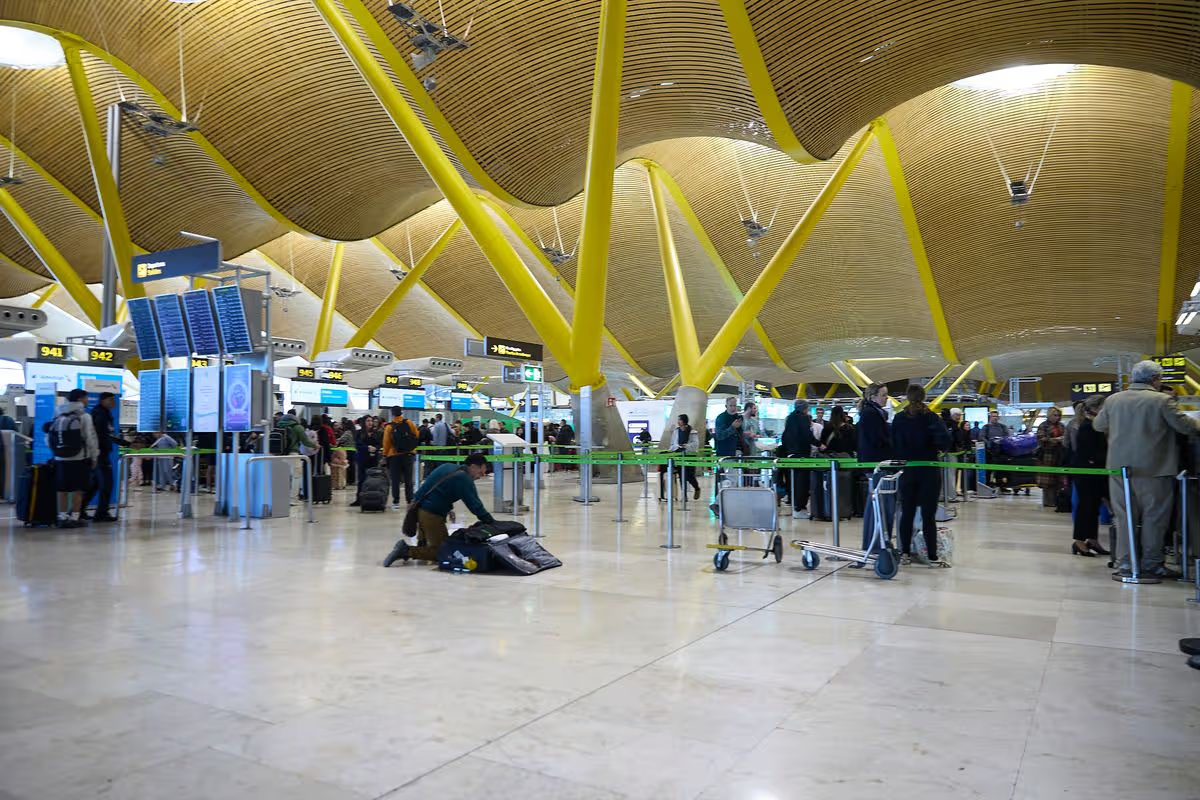
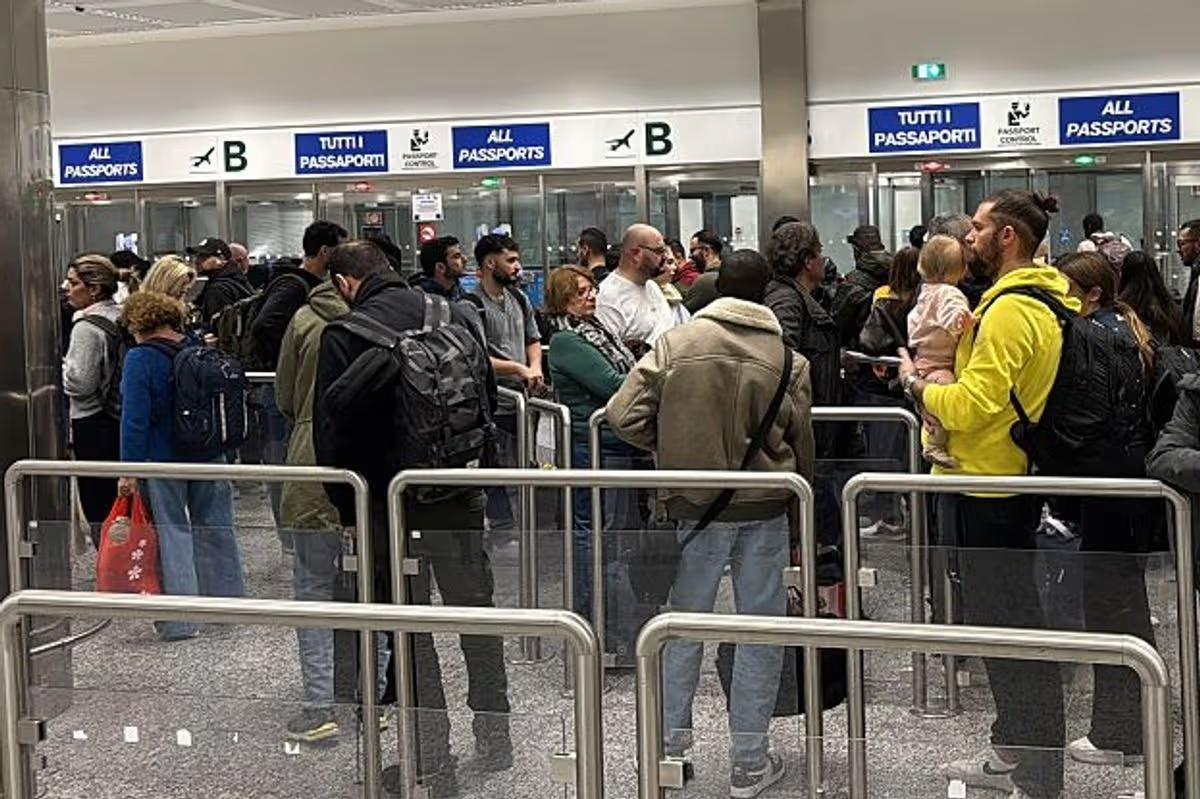
MAJOR airports in Spain are introducing Brit-only border control to avoid travel chaos this summer.

New EES requirements have resulted in large queues at airports for British holidaymakers.

Spanish airports are set to add areas for Brits-only and non-EU residents at border controlCredit: Getty
Aena has revealed that four airports will adapt their security and border control for BritsCredit: Alamy

According to local media, the Spanish operator Aena has revealed that four airports will adapt their security and border control for Brits.

These airports are in Ibiza, Menorca, Malaga and Palma, Majorca.

It’s set to be put in place to ease the queues caused by new EES rules.

These will have a single access point to non-Schengen boarding zones to be used only by UK and non-EU passengers.

DREAMY DEALS

Our pick of the best long haul holidays for short haul prices


WINTER WARMER

Best winter sun hols with NO jet lag & hot temps, picked by The Sun’s experts

There’s concern that the new EES requirement is causing delays in airports and will only grow during peak travel times, like the summer holidays.

Officials have expressed their worry that queues could be up to four hours or more.

The changes form part of Aena’s huge investment plan to its airports set to take place between 2027-2031.

These airports will use the investment ‘redesign control areas to improve passenger flow’.

They will allocate 29 per cent more space for passengers to ‘ensure smoother processing and better service quality’.

Malaga Airport could receive €1.5billion (£1.3billion) which could see it double the size of the terminal and increase capacity to handle 36million passengers each year.

Palma Airport (called Son Sant Joan) could receive €621.6million (just over £544million) for upgrades.

The investment is set to go towards the airport’s platforms, runway and taxiway pavements, taxiways, and renovation of boarding bridges.

In the case of Ibiza, the investment is set to be €229.7million (£201million), and in Menorca, the investment will reach €170.7million (£149million).

It will also include the adaptation to border control regulations to improve its efficiency.

At all four of the upgrade plans at these airports include allocated areas for Brits and non-EU passengers.

In order to fund the investment, Aena has proposed an average annual increasing its fees for airlines.

This hasn’t been well-received by the likes of Ryanair which has planned to axe over a million seats to certain Spanish routes, with some being cut down or cancelled completely.

Here’s more on the Spanish city which is getting MORE Ryanair flights after budget airline scrapped millions of seats.

And here are the cheapest destinations to fly to from six major UK airports including Spanish resorts to Greek islands.

Brits and non-EU residents could get their own queue at certain Spanish airportsCredit: Alamy

Source link

The two UK airports that are about to be much easier and cheaper to travel to

TWO UK airports will be much easier to travel to in less than two weeks and could save you from a hefty fine.

Contactless payment will make it easier to travel to London Stansted and London Southend Airports from March 8.

Greater Anglia trains has expanded the pay-as-you-go contactless option to 20 stationsCredit: Greater Anglia

The update applies to some Greater Anglia routes and means that passengers travelling from London Liverpool Street Station to either airport, can tap-in and tap-out on their journey.

In total, across Essex, 20 stations will be added to the contactless network.

Before, passengers were travelling to Stansted Airport using their contactless cards at the start of their journey not realising that you could not use contactless at the end of their journey, at the airport, reports London TravelWatch.

This meant that passengers would need to purchase a ticket instead, to avoid a £100 penalty.

Read more on travel inspo

GO ON

All the little-known websites for cheap or FREE tickets to gigs, theatre & festivals


CHEAP BREAKS

UK’s best 100 cheap stays – our pick of the top hotels, holiday parks and pubs

If they did try to tap-out, they would get an automatic £100 fine, plus the price of a standard single ticket – though the fine would be reduced to £50 if paid within 21 days.

Data released back in 2019 revealed that the number of people fined had risen by over 16,000 in just two years.

At the time, London TravelWatch’s boss Michael Roberts told the Daily Mail: “It’s plainly wrong that passengers continue to be unfairly penalised for not knowing that contactless payment isn’t accepted at London Stansted Airport.

“With ‘London’ in its name, people quite reasonably assume they’ll be able to tap out using a contactless card, especially when they were allowed to tap in using one at the start of their journey.”

Despite the update, passengers will still NOT be able to use their Oyster cards in the stations.

Contactless can sometimes be cheaper than purchasing a ticket.

Your fare will either be based on a peak or off-peak single for each journey you make.

And daily and weekly caps will be applied to journeys into and within London.

The Stansted Express links London Liverpool Street Station with Stansted Airport, taking about 48 minutes.

The trains are usually every 15 minutes, with fares starting from £9.90 per person.

This means it will be easier for passengers to travel to and from London Stansted and London Southend AirportsCredit: Alamy

In comparison, the journey from London Liverpool Street to Southend Airport takes about 50 minutes.

Commuters will benefit from the update too, as stops such as Southend Victoria, Witham, Chelmsford, Harlow Town and Bishop’s Stortford have all been added to the contactless payment option.

Greater Anglia’s managing director, Martin Beable, said: “We are pleased to be able to confirm that pay-as-you-go contactless ticketing will be introduced at a further 20 stations from March 8, making travel across our network simpler and more flexible for customers.

“This extension is another important step in modernising ticketing on the railway, allowing passengers to tap in and out and pay for the journeys they make, while improving the overall experience for those travelling into and out of London.”

The update comes as part of a wider programme to simplify fares and ticketing across the rail industry, which both the Department for Transport and Transport for London are working on.

New stations with the pay-as-you-go contactless option

  • Billericay
  • Beaulieu Park
  • Bishop’s Stortford
  • Chelmsford
  • Harlow Mill
  • Harlow Town
  • Hatfield Peverel
  • Hockley
  • Ingatestone
  • Prittlewell
  • Rayleigh
  • Rochford
  • Roydon
  • Sawbridgeworth
  • Stansted Airport
  • Southend Victoria
  • Stansted Mountfitchet
  • Wickford
  • Witham
  • Southend Airport

In other rail news, thousands more Brits will get a £126 discount on rail travel as certain rules have been relaxed.

Plus, a miniature railway has unveiled a new electric steam train and it’s right by the best place to live in the UK.

Previously, travellers had been fined £100 for trying to tap out at London StanstedCredit: Alamy

Source link

Storm Hernando: Travel chaos as flights cancelled at major UK airports

Hundreds of flights departing and arriving in the UK have been cancelled across several airports due to dangerous weather conditions with passengers advised to contact their airlines

Flights departing and arriving at several UK airports have been cancelled due to dangerous weather conditions.

Storm Hernando is causing chaos in the USA and, as a result, hundreds of flights have been cancelled on Monday, February 23.

The weather conditions on the east coast of the USA have already caused thousands of flights to and from the region to be cancelled.

Ensure our latest headlines always appear at the top of your Google Search by making us a Preferred Source. Click here to activate or add us as your Preferred Source in your Google search settings.

Flights from London Heathrow, London Gatwick, Manchester Airport, Edinburgh Airport and Dublin Airport have all been impacted by the storm.

The National Weather Service has warned: “A major winter storm is expected to bring heavy snow, strong winds, and coastal flooding across the Mid-Atlantic and north-east that may cause impossible travel conditions and power outages.”

Flights to JFK airport in New York, Newark airport in New Jersey and Boston airport are affected.

A huge 32 flights leaving from London Heathrow to JFK on Monday, February 23 have been cancelled. As well as departing flights, arrivals from the US destination have also been cancelled.

Three direct flights from Manchester have also been impacted. In Scotland, 35 flights that depart from Edinburgh have the second leg of their flight cancelled.

Posting on X, Dublin Airport said: “Due to adverse weather (Storm Hernando) on the east coast of the US, airlines have cancelled a number of flights due to operate to/from Dublin Airport on Monday.”

Dublin Airport said airlines had cancelled seven outbound and six inbound flights so far as a result of the storm.

Passengers have been advised to contact their airlines for the latest updates.

Source link

Fury as two MORE airports hike their drop-off parking fees to £7 in ‘national disgrace’

TWO more UK airports have raised the price of their drop-off charges, in what is becoming an increasingly common trend for drivers.

Glasgow and Aberdeen airports have announced they are increasing their fees to £7 for up to 15 minutes, with Glasgow rising by £1 and Aberdeen up from £5.50.

Aerial view of cars and other vehicles outside Terminal 3 in London Heathrow  Airport
Glasgow and Aberdeen airports are increasing terminal drop-off fees to £7 for up to 15 minutes, citing rising costs and pointing drivers towards free long-stay alternativesCredit: Getty
Sign to the Pickup spot, and short and main stay car parks.
Airport ‘kiss-and-fly’ charges continue to climb across the UK, with several major hubs now charging £7 or more for short staysCredit: Getty

AGS Airports, which operates both sites, said the increases reflect higher running costs and that the extra income will help the airports remain competitive and attract new routes.

It acknowledged the decision would not be popular, while some critics have described the wider rise in airport drop-off fees as “price gouging” and “a national disgrace”, as reported by Travel Tomorrow.

AGS has stressed that drivers have a free alternative at both airports, with up to one hour’s free parking in long-stay car parks and an on-demand shuttle service to and from the terminal.

They said: “It is important to keep in mind that there is always a free alternative where customers can park for up to one hour.

TAKING ITS TOLL

Another UK city weighs up daily congestion charge in blow for drivers


LENGTH OFFENCE

Seven car models are BANNED from car parks for being too long

“This is located in our long-stay car park, and passengers can use a free, on-demand shuttle service to and from the terminal.

“The pick-up and drop-off area is intended for short visits of up to 15 minutes only.

“We would encourage anyone who thinks they may be longer to use the free alternative or our short-stay car park.

“Valid Blue Badge holders continue to receive 30 minutes free in our Short-Stay Car Park.”

The increases also reflect a recent pattern across the UK, with airports such as Edinburgh having raised prices previously as well as other hubs charging comparable or higher rates.

These include Leeds, Luton, Heathrow and Stansted at £7, London City charging £8, Bristol at £8.50 and Gatwick increasing to £10 for 10 minutes.

London City introduced its charge for the first time at the start of the year, while Gatwick, Heathrow and Bristol also increased their fees.

Opponents, including Clive Wratten of the Business Travel Association, have argued that outside London, public transport is often not a practical substitute, meaning higher kerbside fees can simply shift costs onto passengers, workers, businesses and the taxi trade rather than changing behaviour.

There have also been calls for clearer, more transparent pricing, as well as proposals such as a cap – for example, £3 per drop-off – as well as a single daily charge to avoid people being hit by charges twice.

UK pricing has also been compared to several large European airports, including the Paris Charles de Gaulle and Frankfurt airports, where short drop-offs can be free for limited periods.

Source link

Cuban airports face jet fuel, landing systems crises

An operational notice from the international NOTAM system Sunday confirmed that Havana’s José Martí international airport will not have Jet A-1 fuel, the standard for commercial aviation, for one month between Tuesday and March 11. File Photo by Ernesto Mastrascusa/EPA

Feb. 9 (UPI) — The fuel shortage in Cuba began to simultaneously impact air transportation and tourism after an international aviation alert reported that Havana’s José Martí airport will not have fuel for one month.

The government also began to close hotels and relocate tourists as part of an emergency plan in the face of one of the worst energy crises in the island’s history, worsened by the end of oil shipments from Venezuela and pressure from the government of Donald Trump on crude oil supplies.

An operational notice from the international NOTAM system Sunday confirmed that Havana’s José Martí international airport will not have Jet A-1 fuel, the standard for commercial aviation, for one month between Tuesday and March 11, digital outlet CiberCuba reported.

The notification not only warns of the fuel shortage, but also of temporary limitations in landing aid systems, in addition to the inoperability of the runway visual range system, which is used to measure visibility when weather conditions are unfavorable.

The restriction is not limited to the capital. Similar notifications indicate fuel shortages at the country’s nine other airports.

Aviation authorities warned airlines that reserves could run out within a short period if supplies are not restored.

The measure compromises commercial, charter, cargo and executive aviation flights, and forces companies to arrive with extra fuel, make refueling stopovers in other countries or reschedule operations, reported Cuba Noticias 360.

This situation contrasts with recent statements by Transport Minister Eduardo Rodríguez Dávila, who had said operations at ports and airports remain guaranteed.

So far, international airlines have not communicated how they will deal with the contingency.

The impact is projected directly on tourism, the island’s main source of foreign currency.

Cancellations, delays and reduced air connectivity threaten the arrival of visitors from key markets such as Canada, Russia and Europe, in a context in which traveler confidence already shows signs of deterioration.

According to official figures, the arrival of international tourists to Cuba fell to 1.8 million in 2025, 17.8% less than in 2024. The result fell well short of the government target of 2.6 million visitors and marked one of the lowest records in more than two decades.

The energy crisis has as its backdrop the interruption of oil supplies from Venezuela, the island’s main supplier, following the capture of Nicolas Maduro.

This was compounded by the recent decision of the United States to declare a national emergency regarding Cuba and warn that it could impose tariffs on countries that supply oil to the Caribbean nation, in an escalation of pressure that has further complicated Havana’s access to fuel.

In parallel with the airport problem, the government has begun to close hotels in key tourist destinations and relocating foreign guests. The measure is part of an emergency plan to reduce energy consumption and reorganize facilities.

At least eight hotels closed in Cuba’s main tourist destinations and their clients are being relocated to other resorts amid the worsening national crisis and the shortage of fuel and supplies, Diario de Cuba confirmed from the island.

The hotel closures are occurring in the middle of the high season but amid travel advisories over the deterioration of internal conditions. The reduction of flights, energy uncertainty and hotel reorganization add pressure to an industry that is strategic for the Cuban economy.

Vice Prime Minister and Minister of Foreign Trade and Foreign Investment Oscar Pérez-Oliva Fraga said on state television that the executive branch “has designed a plan in tourism to reduce energy consumption, compact tourist facilities and take advantage of the high season,” digital outlet Cuba LLama reported.

Sources from the sector indicated that destinations such as Varadero and the northern cays concentrate much of these measures, where international chains operate.

Authorities are maintaining an emergency plan that includes broader energy restrictions, a reduction of state activities and measures to manage available fuel.

Cuban President Miguel Díaz-Canel said Thursday he was willing to initiate a negotiation process “without pressure” with the United States to help economic difficulties facing the island.

He acknowledged that the lack of Venezuelan oil has placed the country in a “complex” energy situation, affecting not only electricity generation, but also the population’s basic economic activities.

While the United States has sent more than $5.95 million in humanitarian aid managed by the Catholic Church, a measure criticized by Havana because of its “grossly opportunistic political purposes,” it has insisted on the blockade regarding hydrocarbons.

Meanwhile, countries have sent assistance. China was behind a financial package of about $81 million and a food shipment of 60,000 tons of rice in January. Mexico, sent two Navy vessels Sunday loaded with 800 tons of humanitarian aid.

Source link

New 100ml rules at UK airports after 2 key changes

Regulations surrounding the carriage of liquids on aircrafts have changed and there are two main alterations to the 100ml rule at UK airports.

Regulations surrounding carrying liquids at airports have been changing recently and it’s important to know where you stand because different airports have different rules.

Multiple British airports have relaxed the stringent 100ml liquid restriction, with Britain’s busiest airport, London Heathrow, the latest to confirm the significant update on January 23, 2026. The modification has been made possible through newly installed computed tomography (CT) scanners which give security personnel detailed 3D imagery of luggage, enabling passengers to keep liquids of up to two litres in their bags during security checks.

This recent development at Heathrow represents the final stage of its £1 billion security transformation that’s been underway over recent years. Furthermore, travellers no longer need to take out laptops, tablets, and liquids from their hand luggage at Heathrow, where the advanced scanners are now in operation.

A statement released by Heathrow on the same day said: “Passengers travelling through all terminals at Heathrow no longer need to remove liquids or electronics from their hand luggage, or juggle plastic bags at security. The UK’s hub has become the largest airport in the world to fully roll out next-generation CT (computed tomography) security scanners – a move that promises faster queues, less stress and a smoother start to journeys for millions of travellers.”

These new rules for carrying liquids at UK airports began to take effect on July 17, 2025. The two main changes mean:

  • Travellers can now carry up to two litres in their hand luggage
  • Passengers no longer need to separate them into a clear plastic bag when passing through security.

All UK airports, including Heathrow, were mandated to install new CT scanners by summer 2025, enabling passengers to carry up to two litres of liquids in their cabin bags and keep all electronic devices in their hand luggage. However, not all airports have made the changes in that timeframe.

In fact, 2019 saw Boris Johnson vow that the liquid rules at major UK airports would ease by 2022, which would allow passengers to carry larger quantities. Rishi Sunak’s government then extended that deadline to June 1, 2024.

From summer 2025 onwards, individual airports that pass Department for Transport (DfT) inspections have been permitted to ease the 100ml restriction.

UK airports that have ditched the 100ml rule

  • Belfast International
  • Belfast City
  • Birmingham
  • Bristol
  • Edinburgh
  • London Gatwick
  • London Heathrow

The switch hasn’t been rolled out at every UK airport, with some still enforcing the 100ml limit or less. Certain airports also require liquids to be taken out and placed in a clear plastic bag during security checks.

UK airports that still require you to remove liquids over 100ml

  • Aberdeen
  • Bournemouth
  • Cardiff
  • East Midlands
  • Glasgow International
  • Glasgow Prestwick
  • Inverness
  • Isle of Man
  • Leeds Bradford
  • Liverpool
  • Luton
  • London City Airport
  • Manchester
  • Newcastle
  • Newquay
  • Norwich
  • Southampton
  • Southend
  • Stansted
  • Teesside

Exemptions apply for essential medicines, baby food or milk, and special dietary requirements.

It’s crucial to verify your airport’s requirements before travelling, especially ahead of the February half-term, to prevent delays or having liquid items seized at security.

A spokesperson for the Department for Transport said: “Airports are responsible for the installation and operation of security equipment. Passengers should continue to check security requirements with airports before they travel and come prepared with liquids in containers no larger than 100ml in hand baggage unless advised otherwise.”

Why did the 100ml liquid ban come into force?

The 100ml liquid ban and other rules surrounding liquids in airports were introduced worldwide almost overnight, in August 2006. The aviation sector and travellers woke up to the news that airport authorities had foiled an attempted terrorist conspiracy to destroy transatlantic flights travelling from Heathrow to North America.

The suspects allegedly planned to smuggle the components for homemade explosive devices onto multiple aircrafts, which would be concealed in soft drink bottles. While a massive tragedy was stopped from occurring in 2006, it also meant that the aviation industry was changed forever.

Full list of items you can’t take through UK security

  • Bleach
  • Catapults
  • Compressed gas
  • Corrosives
  • Creosote, quicklime, oiled paper
  • Crossbows
  • Darts
  • Diving equipment – check with your airline
  • Explosives ammunition, detonators and related equipment
  • Firearms (including replicas)
  • Fireworks and pyrotechnics
  • Flammables (fire lighter, lighter fuel, paints, thinners)
  • Golf clubs
  • Harpoon or spear guns
  • Heavy bats and sticks (including baseball, softball and cricket bats)
  • Ignitable gas devices
  • Incapacitating sprays
  • Infectious substances (e.g. live virus materials)
  • Instruments containing magnets
  • Liquids and gels – with certain restrictions
  • Magnetrons. Instruments containing mercury
  • Martial arts equipment (including knuckledusters, clubs, coshes, rice flails and nunchuks)
  • Non-safety matches
  • Oxidisers
  • Poisons, arsenic, cyanide, weedkiller
  • Radioactive materials, acids, corrosives, alkalis, caustic soda
  • Sharp items (including scissors with blades over six inches)
  • Smoke canisters and smoke cartridges
  • Toxic
  • Vehicle fuel system components which have contained fuel
  • Walking / hiking poles
  • Wet-cell car batteries

Source link

UK airports that have scrapped 100ml liquid rule ahead of half-term

UK airports that have scrapped 100ml liquid rule ahead of half-term – The Mirror


reach logo

At Reach and across our entities we and our partners use information collected through cookies and other identifiers from your device to improve experience on our site, analyse how it is used and to show personalised advertising. You can opt out of the sale or sharing of your data, at any time clicking the “Do Not Sell or Share my Data” button at the bottom of the webpage. Please note that your preferences are browser specific. Use of our website and any of our services represents your acceptance of the use of cookies and consent to the practices described in our Privacy Notice and Terms and Conditions.

Source link