
AirLaunched

Russia’s Stealthy S-71K Air-Launched Missile Seen In New Detail

Ukraine has released more details of Russia’s S-71K Kovyor — translated as Carpet — an air-launched missile that Kyiv says has been used in combat since late last year. The continued development of weapons in this class highlights the fact that Russia is looking for alternatives to its more established — and more costly — legacy air-launched cruise missiles, with current production levels struggling to meet wartime needs.

The Ukrainian Ministry of Defense’s Main Directorate of Intelligence (GUR) today publicly released new information on the S-71K, including an interactive 3D model. The GUR had previously released details of companies involved in the manufacture of Russia’s Su-57 Felon fighter, and notes that the new missile was specifically developed for this platform.

GUR

“The new missile was first deployed by the enemy late last year and appears to represent the United Aircraft Corporation’s (UAC) initial venture into missile manufacturing,” the GUR says.

The GUR adds that the warhead of the S-71K utilizes a 551-pound OFAB-250-270 high-explosive fragmentation bomb. This bomb, which was developed in the Cold War as a free-fall air-launched weapon, is integrated into the structure of the S-71K, which otherwise features a low-observable airframe.

OFAB-250-270 high-explosive fragmentation bomb repurposed as the missile warhead. GUR

The S-71K’s airframe is made from “a multi-layer fiberglass material with additional reinforcement,” with other internal elements made of aluminum alloys. The airframe has a low-observable shape, with a trapezoidal cross section, chined nose, pop-out swept wings, and an inverted V-tail. Available imagery of the wreckage reveals details of the top-mounted conformal engine intake, feeding a pentagon-shaped intake duct. There are, however, no signs of any low-observable coatings, such as radar-absorbent material, likely to keep costs down.

The S-71K engine air intake. GUR

The GUR also provides information on various electronic components, of which it says “the vast majority” are of foreign origin, including items manufactured in China, Germany, Ireland, Japan, Switzerland, Taiwan, and the United States. As the GUR says, “Continued access to foreign technologies and components allows the aggressor state to develop new weapons and scale their use in the war against Ukraine.”

This makes it one of many Russian weapons relying on foreign parts. For instance, a Russian Shahed-136 strike drone obtained by the GUR contained numerous components from the U.S. as well as parts from Iran, Taiwan, and other nations. Previously, we noted that the GUR found multiple foreign components in a Russian S-70 Okhotnik-B (Hunter-B) flying-wing uncrewed combat air vehicle (UCAV) downed in a case of friendly fire.

The S-71K is powered by a compact R500 turbojet engine, also produced by UAC, and features what the GUR describes as “an inertial navigation system based on simple sensors.”

The R500 turbojet engine. GUR

With three separate internal fuel tanks, Ukraine assesses that the S-71K has an operational range of up to 186 miles. Earlier reports suggest that the missile flies at a speed of Mach 0.6 and at altitudes of up to 27,000 feet.

One of the bladder-type fuel tanks inside the missile. GUR

In 2024, it was reported that Sukhoi had received approval from the Russian Defense Ministry to begin producing the S-71, after it underwent “significant design changes” based on lessons from the Ukraine conflict.

Two views of the S-71 as seen in the original patent, with wings folded and deployed. via X

These changes apparently included increasing the range and reducing the radar cross-section to improve survivability against air defenses.

S-71
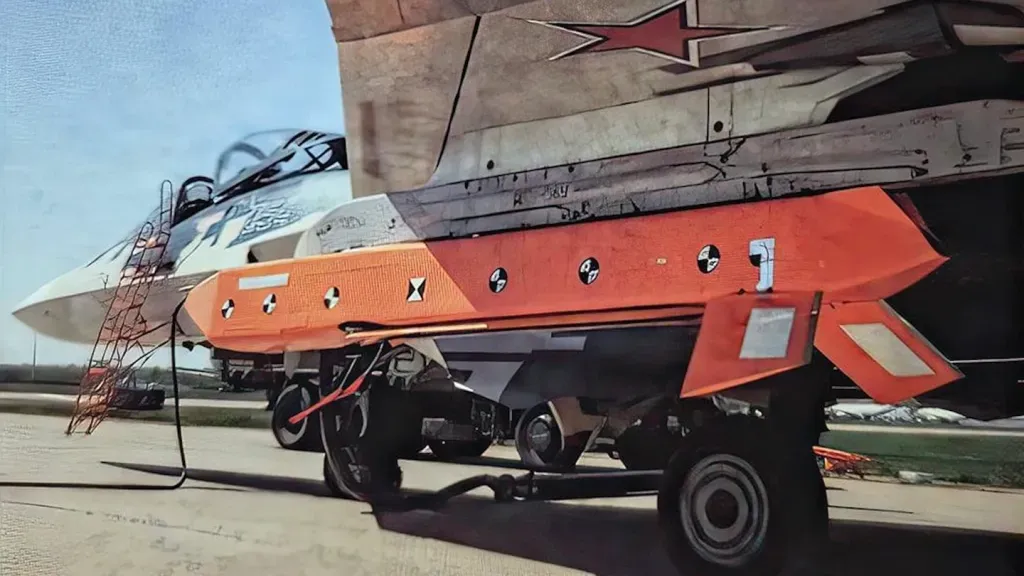
A rear view of the S-71K under the wing of a Su-57. via X

The GUR has not said what platform or platforms are understood to have employed the S-71K in the war in Ukraine. As mentioned, the S-71K is known to have been developed with the Su-57 in mind and has at least been tested on this aircraft, with captive-carry trials in April 2024 at the Russian flight research center in Zhukovsky. There is no reason that it couldn’t also be carried by other Russian tactical jets; this would be necessary for large-volume employment, if significant production numbers are actually realized.

It is also expected that Russia will explore the integration of the S-71K with its S-70 Okhotnik UCAV.

S-70 Okhotnik-B (Hunter-B) flying wing uncrewed combat air vehicle (UCAV). Russian Ministry of Defense screenshot/via X

Interestingly, there have also been reports that the S-71K may be complemented by a more advanced weapon, known as the S-71M Monokhrom. While described as a kamikaze drone, this is essentially an air-to-ground missile expected to have a “human-in-the-loop” capability, to allow dynamic targeting, including against moving targets, via a controller on the ground. In this way, it differs from the S-71K, which apparently features a fairly basic inertial guidance system, likely backed up by satellite navigation. The S-71M is also said to feature electro-optical sensors for day and night operations, and multiple warhead options, including high-explosive and shaped charges.

While the S-71K is externally carried by launch aircraft, the S-71M can reportedly also be accommodated in the weapons bay of a Su-57 or S-70 UCAV. So far, we have not seen S-71s with folding tailfins, which would be required for internal carriage.

A graphic showing the external carriage of two S-71Ks under the wing of a Su-57. via X

Earlier this year, unconfirmed reports from Russia suggested that the S-71M Monokhrom may have been used in an attack on a Ukrainian HIMARS launcher in the Chernihiv region, although the Russian military stressed that the target was destroyed by a Geran loitering munition. Images released of S-71M test rounds indicate a missile design that is notably less stealthy than the latest S-71K, but the M-version may also have been refined in the meantime.

An S-71M test article under the wing of a Su-57. via X

In March of this year, the GUR revealed details of another new Russian air-launched cruise missile, the Izdeliye 30, which you can read more about here.

The Defence Intelligence of Ukraine has published an interactive 3D model, the main assemblies, and components of the enemy’s new cruise missile “izdeliye-30,” as well as data on 20 enterprises involved in its production cooperation chain.

🔗: https://t.co/shMagPCZHE pic.twitter.com/6XgEsxVatf

— Defence Intelligence of Ukraine (@DI_Ukraine) March 2, 2026

This missile also has folding wings, but offers a much longer range of at least 930 miles. It is similarly powered by a compact turbojet engine but does not have a stealthy airframe.

Various components in the Izdeliye 30 appear to have been reused from existing weapons, reducing cost and complexity and speeding development.

Based on its range, the Izdeliye is likely intended as a cheaper, simpler alternative to the air-launched cruise missiles otherwise used by Tu-95MS and Tu-160 bombers, namely the Kh-101 and Kh-555 (the Kh-55 carries a nuclear warhead).

Meanwhile, the S-71K appears to be tailored for tactical crewed and uncrewed aircraft, while its more limited range is partly compensated for by the fact that it has low-observable features (and is intended for launch from low-observable platforms).

The S-71K should also offer a cheaper alternative to the Kh-69, a weapon widely associated with the Su-57, although it can also be launched by ‘legacy’ Russian tactical aircraft. You can read about this air-to-surface missile here.

1/ TASS reports that KTRV will display (a mock-up of) its Kh-69 air-launched cruise missile (ALCM) at the upcoming “Army-2022” forum.

Specifications:
– Max range (km): 290
– Cruise speed (km/h): 700 – 1,000
– Warhead (kg): 300 – 310 (depending on configuration) pic.twitter.com/UD38MsNNpG

— Guy Plopsky (@GuyPlopsky) August 11, 2022

While it remains to be seen exactly how the S-71 series will be used in an operational context, it’s clear that Russia has a need for cheaper, easier-to-produce air-launched missiles for its combat aircraft fleet. 

Just as the U.S. military is facing the challenge of limited munitions stocks as it prepares for a potential future conflict with China, Russia has a requirement today for strike weapons that can be manufactured cost-effectively and in large numbers.

A Su-57 undergoes trials with a pair of S-71K missiles. via X

At minimum, the deployment of the S-71 poses an additional challenge for Ukraine’s already strained air defense forces, especially given the continued scarcity of Western-supplied ground-based air defense systems.

Contact the author: thomas@thewarzone.com
Thomas is a defense writer and editor with over 20 years of experience covering military aerospace topics and conflicts. He’s written a number of books, edited many more, and has contributed to many of the world’s leading aviation publications. Before joining The War Zone in 2020, he was the editor of AirForces Monthly.


Source link

Air-Launched Drones Key To Keeping New Army Surveillance Jets Out Of Harms Way

Army officials have shared new details about plans to launch extremely long-range drones from the service’s forthcoming ME-11B High Accuracy Detection and Exploitation System (HADES) surveillance and reconnaissance planes. With ranges of around 620 miles (1,000 kilometers) or more, the uncrewed aerial systems will help keep the Bombardier Global 6500 bizjet-based ME-11Bs as far away from enemy air defenses as possible. In this way, the Army expects to gain a penetrating aerial intelligence-gathering capability without the need for a very stealthy or otherwise highly exquisite and costly aircraft.

“There will be nothing in the world that we can’t touch with a combined range of HADES and what we can launch off of this thing,” Andrew Evans, Director of Strategy and Transformation with the Office of the Deputy Chief of Staff of the Army, or G-2, told TWZ and other outlets today. “I don’t think anybody’s safe in the future from a sensing perspective.”

New DVIDS video showcasing systems integration on the future HADES platform which will serve as the fixed-wing portion of the @USArmy’s Multi-Domain Sensing System initiative.

The collective data from ARTEMIS I/II, ARES, and ATHENA will help forge this new capability. pic.twitter.com/v00XnPaOIc

— Air Superior (@airsuperiorx) April 16, 2026

Evans comments came at a roundtable with several Army officials about HADES on the sidelines of the Army Aviation Association of America’s (AAAA) 2026 Warfighting Summit.

To take a step back quickly, the Army selected the Bombardier Global 6500-based bid from the Sierra Nevada Corporation (SNC) as the winner of the HADES competition in 2024. Flight testing of the first ME-11B prototype is now slated to kick off this summer. The service is expecting to take formal delivery of that aircraft from SNC before the end of the year. Two other prototypes are currently in various stages of conversion.

Each HADES aircraft will have a built-in suite of sensors, as well as a robust array of communications systems to pass the data it collects along to other nodes in near-real-time. The Army says it is following an incremental approach to integrating systems with the initial trio of prototypes. The service is also using a modular open-systems approach to make it easier to add new and improved capabilities down the line.

Details about what sensors the baseline HADES configuration will have are limited, but we do know it will include a version of the Advanced Synthetic Aperture Radar System-2B (ASARS-2B), something TWZ was first to report back in 2024. ASARS-2B was originally developed for the U.S. Air Force’s U-2 Dragon Lady spy planes, and it features synthetic aperture radar (SAR) imaging and ground moving target indicator (GMTI) modes, as you can read more about here.

For more than a year now, the Army has also been talking about launching very long-range so-called “launched effects” from the HADES aircraft. This term is a catch-all used to describe drones configured designed to perform a wide variety of missions that can be deployed from aircraft (fixed wing and rotary; crewed and uncrewed) in flight, as well as platforms on the ground or at sea. The process of converting Global 6500s into ME-11Bs includes integrating four underwing pylons, which the aircraft will be able to use to launch drones and carry podded sensor systems.

A rendering of an ME-11B High Accuracy Detection and Exploitation System (HADES) aircraft showing the pylons under the left wing.US Army

At the roundtable today, Evans, the Director of Strategy and Transformation, offered a detailed explanation of how the Army arrived at this plan and what it expects to gain from the blend of capabilities in response to a question from our Jamie Hunter.

“So, someone’s going to eventually ask about survivability. It’s going to tie it all together in here,” Evan said. “We did the research. I’ll save you time on doing the research.”

“In 70 or 80 years, there would be 0.1% of the time when you wouldn’t be able to fly ISR [intelligence, surveillance, and reconnaissance missions] because you would be afraid of the threat, potentially, or the threat would be too high to fly,” he added. “That means that 99.9% of the time of a life of the system, it is a useful system for deterrence, for building pattern of life, target development, and so on and so forth. So we’re building a system that can be used for 99.9% of the useful life of the system.”

“So we’re, I think, wise in the approach, saying, all right, if there’s still that 0.1% of the time where you need to be resilient enough to survive in a situation, how do you do that? Well, how do you combine the best of both? Because there’s no one perfect solution, right?” he continued. “What’s really, really good for conflict is not very good for the 99% of the time you need it for campaigning [routine operations], and vice versa. So what we’ve determined strategically is that there’s a way to combine both of these things.”

A head-on view of the first Global 6500 delivered for conversion into an ME-11B HADES aircraft. Bombardier

This is where Evans says the air-launched drone capability comes in.

“We can have a useful asset for campaigning 99.9% of the time, but we can pair with it launch effects [for] when we aren’t going to put that capital system in harm’s way,” he said. “We’ve already engineered hard points into HADES to be able to receive these launch effects in the future. So once we mature the capabilities and determine which way forward we want – what type of launch effects, what type of performance we need out of these things – and we marry those two things up, now we have the best of both. We have something that’s supremely capable in campaigning and probably the best joint asset in the world at being able to do penetrative launch effects. And now you have a bit of a utopia.”

Furthermore, “we believe that in the role of HADES, there’s also an opportunity to be a bit of a quarterback of an ecosystem of sorts. So you can imagine how that might look,” Evans also noted. “That isn’t going to quarterback everybody’s assets, but the ones that have the most strategic importance and match that type of mission profile. There’s certainly a space for it to do that.”

In terms of the range of drones launched from HADES, the Army has put forward the 620-mile (1,000-kilometer) figure in the past. Speaking today, Evans alluded to even greater potential reach.

There are questions about the scale and scope of coverage that a single ME-11B will be able to achieve using “launched effects” type drones designed to be lower cost, and that will likely have a limited sensor payload. The concepts of operations the Army is putting forward for HADES point to a need for expendable designs, as well. These are drones that, in turn, are most effective when employed in large networked swarms to cover broad areas cooperatively. The ME-11B, at least as it is being presented now with its four underwing pylons, does not seem set to carry very large numbers of uncrewed aerial systems.

Another rendering of a fully-configured HADES jet. US Army

“This is important breakthrough technology. so I’m not going to reveal too much about what we’re discovering in this space,” Evans said. “But know that it’s going to change the game. It takes us from a sensing platform to a sensing and platform, and the ‘and,’ I’ll just let you use your imagination.”

Evans’ deliberately vague comments here might point to a broader airborne drone controller role in HADES future. ME-11B crews could potentially oversee larger and more capable drones, including Collaborative Combat Aircraft (CCA) types now in development. CCAs or other heavier types would be able to carry bigger sensor suites and otherwise bring additional capabilities to the table, including the ability to provide close-in defense for HADES itself during missions.

Survivability has certainly been a hot topic of discussion around HADES since the Army first announced its intention to acquire a new fleet of business jet-based ISR aircraft. The service had highlighted growing concerns about the vulnerability of its now-retired fleets of turboprop ISR planes, which had provided key intelligence-gathering capacity globally for decades, tracing back to the Cold War. TWZ and others have repeatedly noted that these concerns are very real, especially in the context of a future high-end fight in the Pacific against China, but also apply to non-stealthy jets like the Global 6500.

The RO-6A Airborne Reconnaissance Low-Enhanced (ARL-E) aircraft seen here is an example of turboprop ISR aircraft that the US Army previously operated. US Army

For routine operations, the ME-11B does a major leap in capability over the turboprop ISR aircraft the Army previously operated, both in terms of its mission systems and its general performance. HADES can fly higher, faster, and farther, and do so while carrying a bigger sensor payload. Higher altitudes also offer greater fields of view for the aircraft’s sensors. The improved performance also translates to being able to get to and from operating areas more rapidly and the ability to remain on station longer. The underwing pylons will offer additional flexibility beyond the drone launch capability.

“The deployability of this platform, being able to fly 6,000 miles at 0.87 Mach, and go globally without the world will require the ability to rapidly change sensors,” Army Col. Joe Minor, the Capability Program Executive for Aviation within the office of the Program Acquisition Executive for Maneuver Air, also said at today’s roundtable at the AAAA conference. “With those hard points and cleared envelopes for pods, it gives us that ability to rapidly configure and update even more quickly than we could internally or within the canoe [fairing under the fuselage]. So those hard points being built in from the beginning is part of that [sic] building the right platform and air vehicle from the start, with the ability to integrate and evolve very quickly as you move forward.”

Using the Global 6500 as the underlying aircraft offers maintenance and other logistical benefits. This is an in-production aircraft with a significant global user base. This includes the U.S. Air Force, which operates a fleet of E-11A Battlefield Airborne Communications Node (BACN) aircraft based on this platform.

One of the US Air Force’s Global 6500-based E-11A BACN aircraft. USAF

The Army says it has already been seeing an important boost in ISR capability with contractor-owned and operated ISR-configured business jets, including Global 6500-based types. The service has been utilizing those aircraft for eight years now as a transitional ‘bridge’ force to lead into the fielding of HADES.

Many of “our previous platforms were centered around the COIN [counterinsurgency] fight,” Army Col. Matt McGraw, head of the 116th Military Intelligence Brigade, the Army’s main aerial ISR unit, who was also at the roundtable today, said. “If you’re flying a platform operating full motion video [cameras], you’re tracking maybe one or two targets at most. A platform today, on these bridge aircraft with MTI and SAR, you’re tracking a couple 100 targets at the same time.”

A generic example of GMTI tracks overlaid on top of a SAR image. Public Domain

There do continue to be significant questions about the true extent of what the Army’s ME-11Bs will be able to offer, in any context, given the expected size of the fleet. The Army currently plans to buy just six production HADES jets on top of the three prototypes. The service previously operated dozens of turboprop ISR aircraft.

“We work for the United States Army, on behalf of the United States Army. And so if the Army’s given direction to cap a fleet size based on budget pressure, and of the other things that we have to balance as an army – like, if the Army only built ISR [aircraft], we build 1,000 of these things,” Evans said at the roundtable today. “But we don’t. We build a lot of things. And ISR is an enabler to [the] ground lethality that we deliver.”

“The Army’s got a tremendous amount of budget pressure. The Army has a top line that’s not keeping pace with inflation,” he added. “And so until our top line increases to support the world’s premier land force, then we’re going to be capped inside programs like HADES.”

As it stands now, the Army certainly looks to be hoping that even the small fleet of HADES will be able to punch well above its weight, thanks in no small part to the ability to launch very long-range drones from relative safety deep in hostile territory.

Jamie Hunter contributed to this story.

Contact the author: joe@twz.com

Joseph has been a member of The War Zone team since early 2017. Prior to that, he was an Associate Editor at War Is Boring, and his byline has appeared in other publications, including Small Arms Review, Small Arms Defense Journal, Reuters, We Are the Mighty, and Task & Purpose.


Source link