Airbus SA

Ryanair, EasyJet, TUI and Jet2 ‘left side’ rule for booking seats

People picking this side of the plane could get a lot less – and for some that could actually be a good thing

When aircraft manufacturers like Boeing and Airbus build planes, they design the windows to line up perfectly with standard, comfortable legroom (usually a 31-to-32-inch seat pitch). But most budget airlines make a change to their seating set-up that some passengers might actually prefer.

Because aircraft seats are mounted on floor tracks, airlines can move them freely. Budget airlines like Ryanair, Jet2, TUI and Easyjet will often deliberately push the seat rows much closer together (down to a tight 28-to-29-inch pitch) to fit extra rows onto the plane.

Although the seats move, the window cut-outs in the metal body of the plane stay. It’s this shrinking legroom that instantly forces the seats and windows out of sync.

Most window seats that passengers pick will have a view out of the plane, but some are known to have restricted views. In some cases, there are seats that have no window at all.

While this might sound like a complaint waiting to happen, some people may actually see this as a perk. Unlike the ‘extra legroom’ trick, this flat surface offers the best spot for those wanting to take a nap during their flight – or those nervous fliers who would rather not know what being 30,000ft in the air looks like.

Certain people claim that the window-free wall space offers a great place to rest a pillow. These misaligned seats often run down the left-hand side of the plane.

For people wanting to benefit from less of a view, check your plane’s seating chart before confirming your choice. You can often see how the window situation will work.

Content cannot be displayed without consent
  • Ryanair (Boeing 737-800): The misalignment runs heavily down the left side of the aircraft. It is so pronounced that Seat 11A and 11F often has no window at all.
  • EasyJet (Airbus A319/A320): Highly noticeable misalignment on the left-hand side. The final rows (Row 31 on A320s and Row 26 on A319s) are completely windowless as well as certain overwing exit rows which may also have slightly altered alignment.
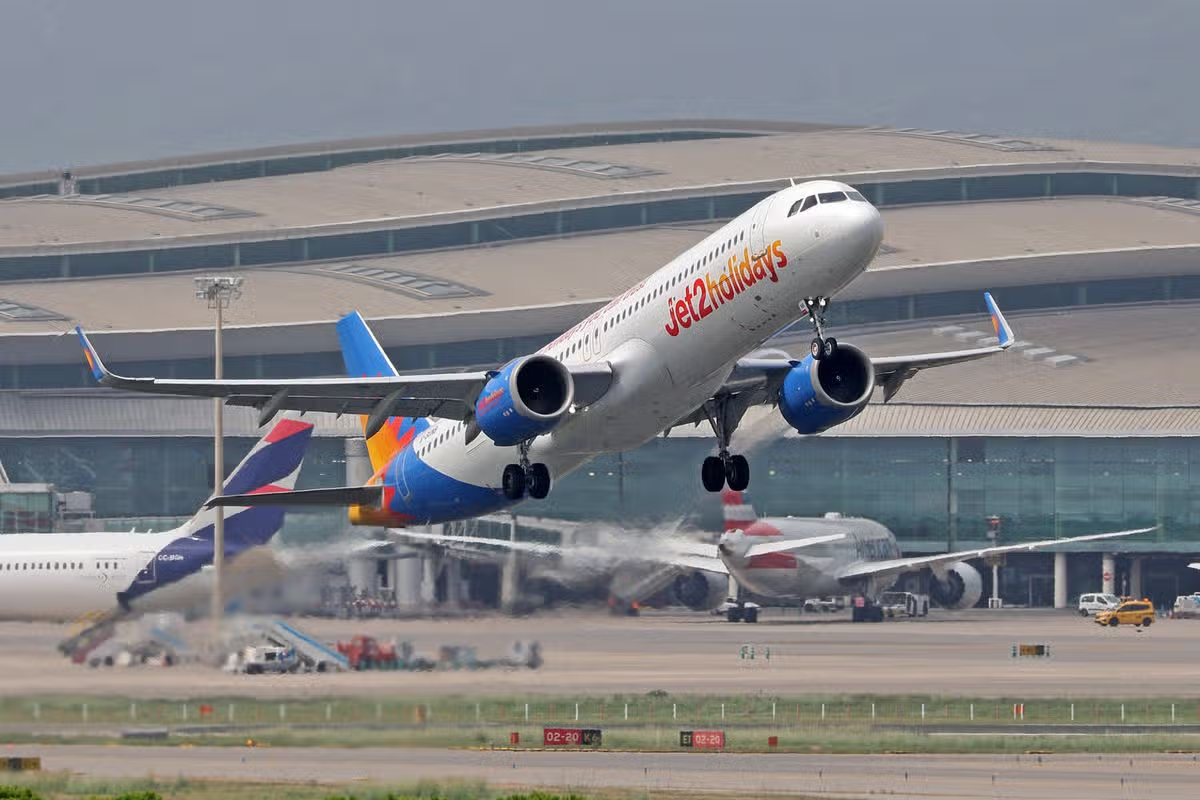
  • Jet2 (Boeing 737-800 or Airbus A321neo): On their Boeing 737s, you will find the Jet2 windows out of alignment past the front bulkhead. If you book an “A” seat on the left, you will frequently find yourself staring directly at the plastic pillar between two windows rather than out of the glass.
  • TUI (Boeing 737 MAX or 787 Dreamliner): On TUI’s short-haul Boeing 737s, the misalignment works exactly like Ryanair and Jet2 models. However, if you are flying on TUI’s long-haul Boeing 787 Dreamliner, the rule does not apply as long-haul aircrafts usually maintain standard legroom pitches, meaning the seats and windows stay properly aligned.

If your goal is to sleep on your next flight, sitting on the left side (Seats A) of a short-haul flight on these airlines gives you a higher statistical chance of getting a solid wall or a heavily forward-shifted window to rest your head against.

If you actually want to enjoy the view, you are better off sitting on the right side (Seats F). Booking these seats may also offer a little ‘extra’ legroom at a fraction of the cost.
Source link

Simon Calder gives BA and easyJet update after flight cancellations

Travel expert Simon Calder has explained the rights of British Airways and easyJet passengers after numerous flights were cancelled

Travel expert Simon Calder has issued a stark warning to British Airways (BA) and easyJet passengers, telling them they ‘will not be getting any cash’ after thousands found their flights axed over the weekend. Hundreds of services were thrown into chaos following a bout of thunderstorms, with Heathrow and Gatwick bearing the brunt of the disruption.

On Saturday alone, more than 900 inbound and outbound flights were delayed — some by as much as 11 hours — with dozens cancelled outright. South-East England and North-West Europe were among the worst-hit regions.

Travel expert Mr Calder said the chaos had left approximately 40,000 passengers ‘stranded’. He broke down exactly what passengers are entitled to when flights are delayed or cancelled, and precisely what obligations airlines have towards them, reports the Express.

Content cannot be displayed without consent

What are your rights?

Mr Calder said: “It has been a miserable Saturday for 30,000 or more passengers on British Airways to and from London Heathrow and EasyJet in and out of Gatwick. The reason? Thunderstorms in the London area have caused air traffic control restrictions, and as those airports are operating at full stretch, especially on Saturdays in summer, unfortunately there’s no slack in the system, and the biggest airlines at those airports have no option but to cancel flights.”

“BA’s cancelled around 100, including an Airbus superjumbo going to and from Los Angeles. EasyJet has cancelled 82, including some really long ones to Hurghada in Egypt and also Antalya in Turkey.

“Under air passenger rights rules, the airline must get you to your destination as soon as possible, including booking a flight on another airline if necessary. Meanwhile, they have to provide you with hotel accommodation and meals as necessary until they can get you where you need to be. You will not, though, be getting any cash compensation. Good luck, everybody.”

What happened?

Mr Calder continued: “200+ flights cancelled today on British Airways to/from Heathrow and on easyJet to/from Gatwick, with 35,000 passengers stranded.

“Under air passengers’ rights rules, they are entitled to be flown to their destination as soon as possible on any airline, plus meals/hotels as appropriate.

“Dozens more flights cancelled on Sunday to and from Heathrow and Gatwick airports by British Airways and easyJet due to poor weather”.

“(It) follows more than 200 grounded flights on Saturday (and) brings the number of passengers whose flights have been cancelled this weekend to around 40,000.”

In an updated statement on Saturday afternoon, NATS said: “Severe thunderstorms across the south east of England and Europe continue to impact flights, and this is expected to continue for the remainder of today and overnight.

“To ensure the safety of the travelling public, aircraft need to avoid affected areas and be spaced further apart, which limits the number of flights that can operate safely.

“We understand disruption is frustrating, but we’re working closely with airlines and airports to reduce disruption as much as possible.

“Passengers should continue to contact their airline for the latest information on their flight.”

Source link

Inside the world’s first 22 hour nonstop flight ‘that hasn’t been done before’

The plane is being specially modified so it can fly the impressive route

A new flight is set to become the longest non-stop journey in the world from next year. The title of the longest nonstop flight is currently held by Singapore Airlines and takes 19 hours to travel from Singapore to New York.

However, it won’t hold the record for long, as Qantas is set to launch a new non-stop route in 2027. It is planning a nonstop flight from Sydney, Australia, to London.

Thanks to a 20,000-litre fuel tank, the plane wouldn’t need to stop to refuel. It will travel 10,573 miles and has been labelled “the final frontier of long-haul travel” by Qantas.

Travel expert Simon Calder has revealed more details of the flight after visiting the home of Airbus, which is making the plane.

He said of the plane: “This is a specially modified Airbus A350 Twin Jet that is being built for Qantas so they can, in October 2027, fly you nonstop from London Heathrow 10, 573 miles to Sydney.

“It is going to take a long time, over 20 hours in the air. But, achieving something no airline has done before.”

Typically, passengers flying to Australia have a stopover in the Middle East, yet there is demand for a long-haul direct flight.

Simon said Qantas believes there is a “premium customer base” that is prepared to pay a 20% surcharge on the one-stop flight to get to Sydney directly.

He added: “On top of that, there’s lots of passengers that do not want the faff of changing planes in Singapore, Hong Kong, Dubai or Abu Dhabi along the way. They just want to get there, and Qantas believes they will be able to sell those seats.”

Simon explained on his Travel Expert podcast that he asked Qantas if the rise in fuel prices would affect the flight.

But the airline says it has seen increased demand for direct flights to Australia, so it doesn’t need to stop in the Middle East along the way.

Due to the flight’s length, Qantas is making changes to the plane to make it more comfortable for passengers.

There will be a reduced passenger count to 238, which Simon said is almost 100 fewer than British Airways and Virgin Atlantic have on identical flights.

The first record-breaking flight almost took a different route, as it was scheduled to depart from New York rather than London. New York will get its own direct flight, and the route will take slightly less time to fly.

Source link