aides

Former Trump attorneys, aides plead not guilty to Wisconsin fake elector felony charges

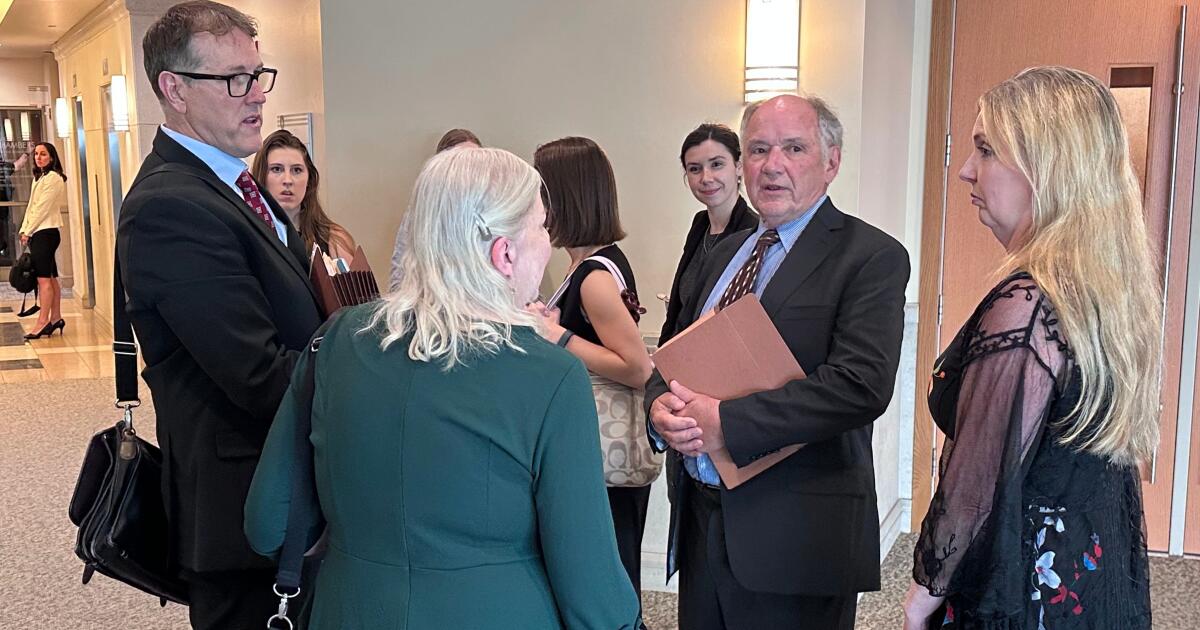
President Trump’s attorney for the 2020 campaign in Wisconsin and two former aides all pleaded not guilty Tuesday to felony forgery charges for their roles in a fake elector scheme designed to overturn Trump’s loss in the swing state.

Jim Troupis, a former judge who was Trump’s Wisconsin campaign attorney; Mike Roman, Trump’s director of election day operations in 2020; and Ken Chesebro, a former Trump legal advisor, all entered the pleas in Dane County Circuit Court.

Troupis, who lives in the Madison area, appeared in person. Roman and Chesebro appeared via Zoom.

The Wisconsin fake electors case is moving forward even as others in the battleground states of Michigan and Georgia have faltered. A special prosecutor last year dropped a federal case alleging Trump conspired to overturn the 2020 election. Another case in Nevada is still alive.

The fake elector scheme, under which Republican electors in battleground states submitted documentation to Congress attesting that Trump had won their states even though he lost to President Biden, originated in Wisconsin.

Troupis, Chesebro and Roman argue that they committed no crime and were just trying to keep their options alive in case a court ruled that Trump had actually won the state.

But prosecutors allege that the three defendants defrauded the 10 Wisconsin Republican electors who cast their ballots for Trump in 2020.

Prosecutors contend that Troupis, Chesebro and Roman lied to the electors about how the certificate they signed would be used as part of a plan to submit paperwork to then-Vice President Mike Pence, falsely claiming that Trump had won the battleground state that year.

A majority of the electors told investigators that they did not believe their signatures on the elector certificate would be submitted to Congress without a court ruling, the complaint said. Also, a majority said they did not consent to having their signatures presented as if Trump had won without such a court ruling, the complaint said.

The arraignment on Tuesday came two years and two weeks after the first charges were brought against the three by Wisconsin Democratic Atty. Gen. Josh Kaul. Troupis, Chesebro and Roman face 11 felony forgery charges that are each punishable by up to six years in prison and a $10,000 fine.

Troupis and Roman both filed motions seeking to relocate the trial from Dane County, which includes Madison, to neighboring Jefferson County, saying negative publicity had tainted the potential jury pool.

Trump carried Jefferson County by 15 percentage points in 2020. He lost Dane County by nearly 53 points.

“This case is headed to trial,” wrote Troupis’ attorney, Joe Bugni, in Troupis’ motion. “No question. Neither side is going to blink. And when we get to trial, Troupis has the right to a fair and impartial jury.”

Troupis and Roman also argued that one of the 11 felony counts against them should be dropped because Trump issued a pardon for any federal crimes related to their work on the fake elector scheme. They argued that the state can’t prosecute them over the casting of electoral votes, which is a federal process, and therefore Trump’s pardon applies.

Trump also pardoned Chesebro.

The judge said Tuesday he would set a schedule to hear arguments on those motions.

The state charges against the Trump attorneys and aide are the only ones in Wisconsin. None of the electors have been charged. The 10 Wisconsin electors, Chesebro and Troupis all settled a lawsuit that was brought against them by Democrats seeking damages.

Bauer writes for the Associated Press.
Source link

Key Zelenskyy aides under corruption cloud: What are they accused of? | Corruption News

Andriy Yermak, Ukrainian President Volodymyr Zelenskyy’s former chief of staff and close aide, is now at the centre of the country’s biggest corruption investigation since Russia’s full-scale invasion in 2022.

Anticorruption authorities named him an official suspect on Monday in an alleged multimillion-dollar money laundering scheme linked to a luxury housing project outside the capital, Kyiv.

Recommended Stories

list of 3 itemsend of list

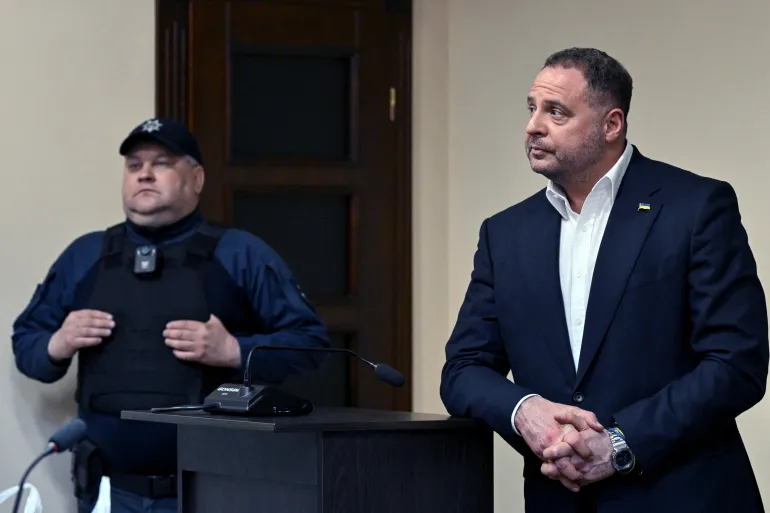
Yermak appeared at a Kyiv court on Tuesday for a hearing related to the charges, which are part of a widening probe drawing in other senior figures associated with the president, including his national security chief.

While Zelenskyy is not accused of any wrongdoing, the scandal could potentially threaten Ukraine’s aspirations for European Union membership as it seeks to convince the bloc that its anticorruption drive is on track.

So, what are the charges against Yermak? Are other allies of Zelenskyy also under a cloud of suspicion? And what does this mean for Ukraine’s standing with its Western allies?

What are the charges against Yermak?

Ukraine’s National Anti-Corruption Bureau (NABU) and the Specialized Anti-Corruption Prosecutor’s Office (SAPO) say Yermak is suspected of involvement in an organised criminal group that allegedly laundered about 460 million hryvnias ($10.5m) through a luxury real estate project near Kyiv.

Prosecutors are seeking to impose bail of about $5.4m on the 54-year-old while they continue their investigation.

Yermak, who resigned in November, has firmly rejected the claims. In a post on Telegram after a court hearing on Tuesday, he described the accusations as “unfounded”.

“As a lawyer with more than 30 years’ experience, I have always been guided by the law. And now, in the same way, I will defend my rights, my name and my reputation,” he said.

Ukraine's former Presidential Office Chief of staff Andriy Yermak (R), stands in court before a hearing in a money laundering case, to determine a preventive measure, in Kyiv on May 12, 2026, amid the Russian invasion of Ukraine.
Ukraine’s former Presidential Office Chief of Staff Andriy Yermak stands in court before a hearing in a money laundering case in Kyiv on May 12, 2026 [AFP]

At one point during the hearing, Yermak told reporters that he “owns only one apartment and one car”.

His lawyer, Ihor Fomin, labelled the allegations against his client “groundless” and denied any role by Yermak in laundering funds through the high-end development. Fomin told Ukraine’s public broadcaster Suspilne that “this entire situation has been provoked by public pressure.”

NABU director Semen Kryvonos defended the proceedings, stating that authorities move to issue formal notices only when they believe they possess enough evidence to sustain charges in court. He clarified that Zelenskyy was not subject to any investigation.

But the case has dragged the shadow of corruption closer to the Ukrainian president than ever before. That’s because it isn’t just Yermak who has been caught up in the accusations of fraud.

Have other Zelenskyy allies been implicated, too?

Timur Mindich, a wealthy businessman who was Zelenskyy’s former partner from the entertainment world – the Ukrainian president is a former comedian – has emerged as another leading figure in the scandal. He left for Israel after corruption allegations surfaced last year.

The probe has also brought Rustem Umerov, the head of Ukraine’s National Security and Defence Council, into the crosshairs of the authorities. Umerov, who until last year was Ukraine’s defence minister, is Zelenskyy’s main representative in United States-backed diplomatic efforts to end Russia’s war on Ukraine.

Prosecutors say Umerov has been interviewed as a witness in the luxury real estate development case.

The case is part of a broader anticorruption operation, dubbed “Midas” and led by NABU and SAPO. The operation was first made public in November, when prosecutors accused Mindich of engineering a $100m kickback scheme at Energoatom, charges the businessman has refuted.

Zelenskyy has yet to publicly respond to the allegations involving Yermak. On Monday, a communications aide said it was premature to comment on the case.

Ukraine’s government in July passed a law in an effort to strip the independence of NABU and SAPO, which were established in 2014 after a pro-democracy uprising against the then-government of President Viktor Yanukovych.

Within days, protests broke out against the move, forcing Zelenskyy to reverse course and sign a new law to restore the anticorruption institutions’ independence.

Why does this matter?

The scandal has emerged at a particularly sensitive moment for Ukraine, as Kyiv continues to make the case for military and financial support from its allies in Western Europe and North America.

Last July, US senators Jeanne Shaheen and Lindsey Graham released a strongly worded statement denouncing the attempt by the government to, at the time, curb the anticorruption work of NABU and SAPO.

“One of the most widely used talking points for ending support for Ukraine is that it was awash with corruption,” they said. “We acknowledge that Ukraine continues to make progress on this front and we urge the government to refrain from any actions that undermine that progress.”

Moreover, Ukraine’s bid to join the EU has increased pressure on Zelenskyy’s administration to demonstrate institutional independence and accountability.

German Chancellor Friedrich Merz last month cautioned against a quick accession of Ukraine to the EU, saying Ukraine cannot join the bloc due to several key concerns, including ending the war and fighting corruption.

Ukrainian opposition politician Oleksiy Goncharenko said the allegations had now reached a point that Zelenskyy “personally cannot ignore”.

However, Olena Halushka, a board member at the Anti-Corruption Action Centre in Kyiv, said the case against Yermak and others was a “clear example that the checks and balances system really works”.

Speaking to Al Jazeera, Halushka said it proved that in Ukraine there are “law enforcement institutions functioning independently and professionally, exercising their powers in defence of democracy”.

“These institutions were protected by the Ukrainian society and European partners from the political attack last summer, and now we see the tangible results of their activities,” she added.

In a survey conducted on May 6 by the Kyiv International Institute of Sociology, 54 percent of Ukrainians said corruption was a bigger threat to the country than the war with Russia.

Source link