aide

Aide involved in affair with Gavin Newsom in 2005 speaks out

An aide involved in an affair with Gavin Newsom more than 20 years ago, when he was mayor of San Francisco, detailed their relationship and her journey to sobriety in an essay published by Vanity Fair on Tuesday.

Although Ruby Rippey, 54, has spoken previously about her relationship with the now-governor, her first-person essay offers the most intimate description yet of the affair. It comes at a time when Newsom is wrapping up his final year as California governor and considering a presidential run in 2028.

Rippey, who had worked as Newsom’s appointments secretary, was married to Alex Tourk, the then-mayor’s close friend, campaign manager and prior deputy chief of staff, when the affair became public in 2007. Tourk resigned after Rippey told him that she had been sleeping with their boss, she writes.

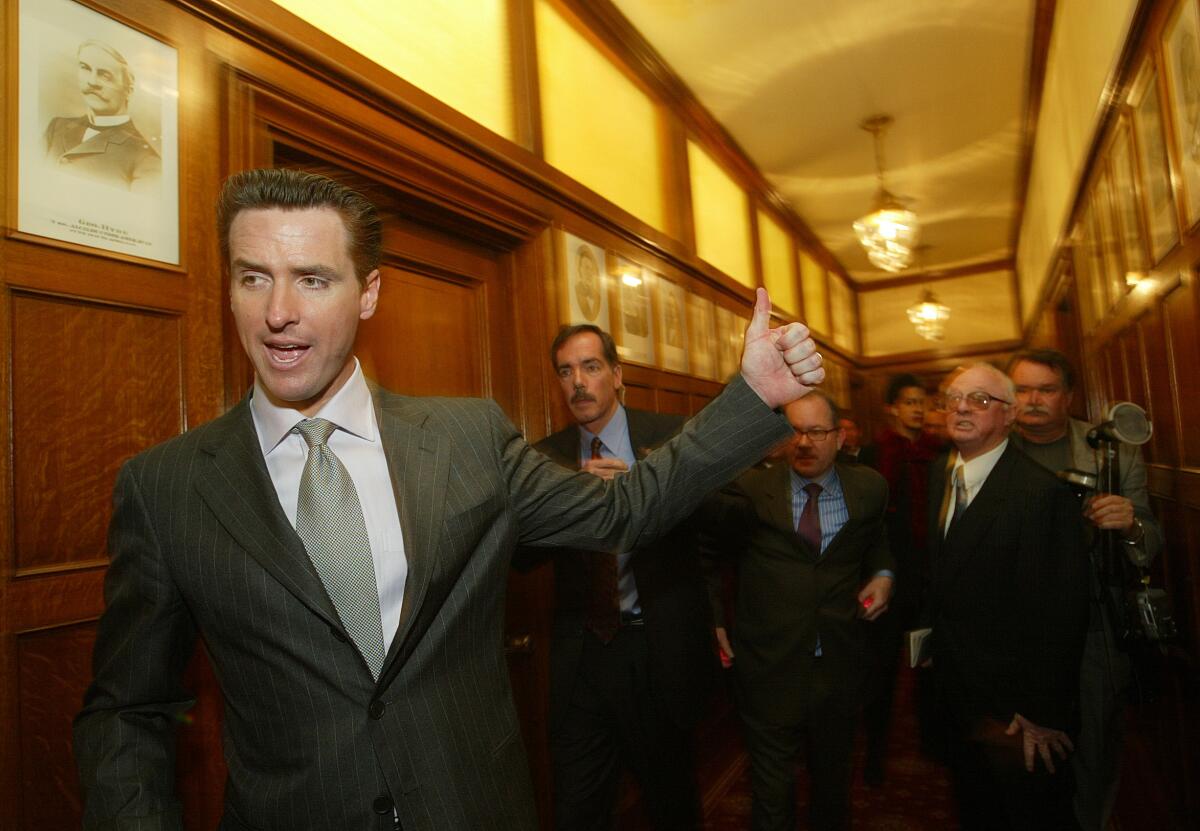
At the time, Newsom was newly divorced from Kimberly Guilfoyle and he apologized in front of a gaggle of reporters who packed his office for a news conference, admitting “everything you’ve heard and read is true.” Later, he said he was seeking treatment for alcohol abuse.

In the essay, Rippey details that the affair with Newsom happened when she was a new mother and when her drinking, which had been a problem before the relationship, spiraled out of control.

Rippey writes that their relationship began in July 2005 after a wedding at a Napa Valley estate and spanned months, with intermittent sexual encounters until she entered rehab in May 2006.

They met at his penthouse in San Francisco’s Russian Hill neighborhood, at a private back room in a bar in North Beach and at the W Hotel in Los Angeles, she writes.

“We meet and we drink. There is sex, but it isn’t the point. The point is proximity — to power, to being chosen, to feeling newly visible — no longer muted by pregnancy, by new motherhood, by the strain of white-knuckling long stretches of sobriety,” she writes. “It isn’t love. It isn’t romance. It’s intoxication.”

Izzy Gardon, a spokesperson for the governor’s office, said on Tuesday that Newsom acknowledged his role and publicly apologized for the affair nearly two decades ago.

“In the time since, he met his wife, started a family and has focused on serving Californians. He addressed this chapter of his life, including in his memoir, and out of respect for everyone involved, does not have anything further to add,” Gardon said.

 Gavin Newsom when mayor of San Francisco.

The affair occurred while Gavin Newsom was mayor of San Francisco.

(San Francisco Chronicle / Hearst Newspapers)

Newsom faced renewed criticism for the affair during the 2018 governor’s race amid a larger reckoning over sexual misconduct in politics, corporate America and Hollywood. But Rippey has said she doesn’t see herself as a victim of a powerful man.

“Yes, I was a subordinate, but I was also a free-thinking, 33-yr old adult married woman & mother. (I also happened to have an unfortunate inclination towards drinking-to-excess & self-destruction.),” she wrote on Facebook at the time.

She still doesn’t place blame on the governor for what happened, but noted in her essay that in the post-#MeToo era she came to realize that her then-boss had a responsibility to “hold the line.”

“That didn’t happen. But I didn’t stumble into the space left open — I saw a possibility and went for it,” she writes. “Both things are true: I am responsible for what I did. Power does not distribute consequences evenly.”

For Newsom, she writes, the affair is merely a “footnote in a longer arc of ascent. For me, it is the fracture that split my life into before and after.”

In his memoir, “Young Man in a Hurry: A Memoir of Discovery,” published this year, Newsom acknowledges the liaison with Rippey, describing it as “the briefest of affairs.”

He also writes that he admitted the betrayal to Tourk, a detail that Rippey takes issue with in her essay. She says she was the one who first broke the devastating news to her husband via email while she was at her parent’s house in Napa and he was home in San Francisco with their young son.

“But resentment is a luxury I can’t afford,” she writes. “Instead, I return to gratitude, not for the affair, not for the pain I caused Alex, but for the totality of what followed. I required something catastrophic to change direction. Something that made the cost of going back — of drinking again — unthinkable.”

After the affair, Rippey and Tourk divorced but continued to co-parent their son, who is now an adult. She’s been sober for 20 years, she writes, remarried and now has a son with her second husband.

“The damage was mine,” she writes at the conclusion of her essay. “But so is the life rebuilt in its wake.”

Times staff writer Taryn Luna contributed to this report.
Source link

After Lindsey Graham’s death, questions linger about aging politicians and health transparency

The sudden death of Sen. Lindsey Graham, a top ally of President Trump and one of Washington’s best-known politicians, is renewing focus on the country’s aging lawmakers.

Graham, a South Carolina Republican who had turned 71 just two days before dying on Saturday, was far younger than many of his Senate colleagues and appeared to have been in good health. He suffered a tear in his aorta, according to a preliminary report from the medical examiner.

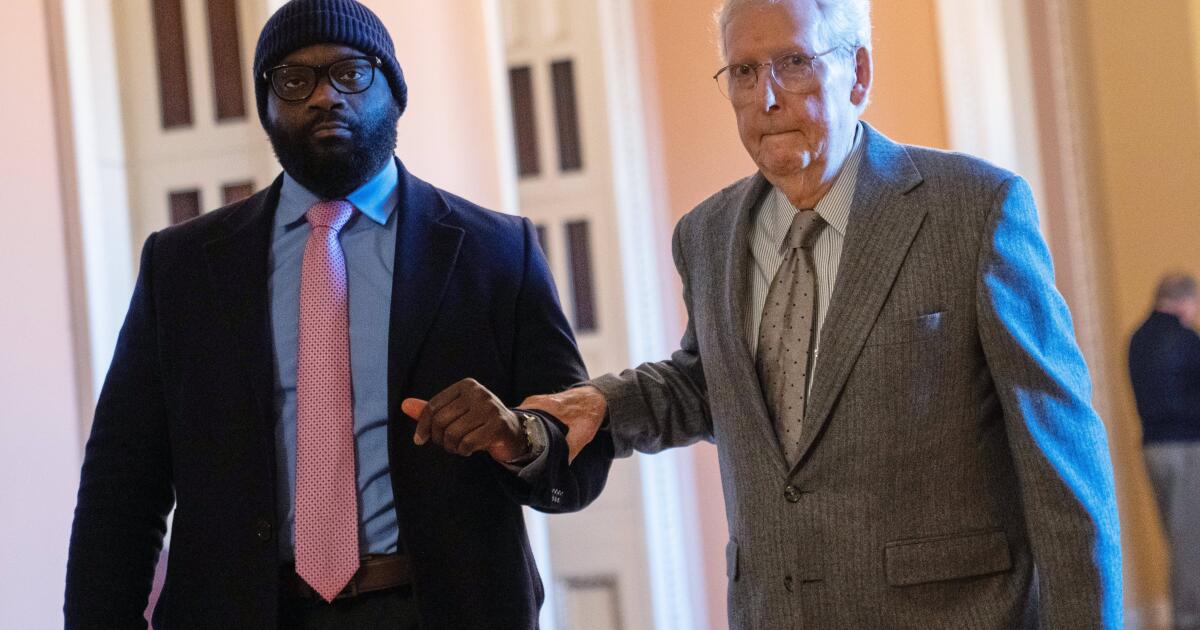
It was the second time in less than a month that emergency personnel were dispatched to the home of a U.S. senator. In early June, Mitch McConnell of Kentucky, the former Republican Senate leader, was hospitalized for undisclosed reasons.

After weeks of increasingly dire speculation about his health, he finally revealed on Sunday that he had fallen and suffered from mild pneumonia. He released a photo, complete with a copy of the day’s newspaper.

Graham’s death and McConnell’s hospitalization have come amid an ongoing reckoning about the nation’s aging leaders, two years after the disastrous presidential debate that sparked widespread panic among Democrats about then-81-year-old President Biden’s capacities and accusations of a cover-up.

Some politicians have continued to obscure details about their health challenges, asking for privacy despite their public positions, and fueling conspiracy theories.

“I think we need some transparency,” Sen. John Cornyn (R-Texas) said Monday. “I wish Sen. McConnell and his team would have done that earlier. I think it would have resolved a lot of questions.”

McConnell is admitted to a hospital

McConnell, who at 84 is only the third-oldest member of the Senate, was admitted to the hospital on June 14 with barely any explanation. Aides said he was “receiving excellent care” but offered no details about his condition.

The dearth of information fueled a wave of speculation about his prognosis, with Laura Loomer, a Trump ally and conspiracy theorist, claiming on social media that a “high level source close to the White House” had told her he was “officially brain dead.”

But McConnell, who will retire from Congress at the end of January after serving as the longest-ever Senate leader, said in a statement that he is on the mend. He said a fall had led to his hospitalization and that he was “briefly unconscious” and treated for mild pneumonia.

“You all know how folks of my generation often hesitate to share the vulnerability that comes with growing older,” he said. “Even in the public eye, I feel that same instinct — I can’t help it.”

That wasn’t enough to put speculation to rest. On social media, many refused to believe the veracity of a photo his office released that included the front page of the sports section of the Washington Post.

Conspiracy theories about McConnell’s health are “a symptom of our times,” said Sen. Rand Paul, a Republican who is also from McConnell’s home state of Kentucky. Paul said people should “give him a break.”

“People think they have a right to know everyone’s medical problems,” he said, “but I don’t know, where does it begin and where does it end?”

Trump’s medical reports offer limited details

The oldest person ever elected president, at age 78, has long offered only the rosiest picture of his health.

“Everything checked out PERFECTLY,” he boasted after his last physical in May, adding that he took yet another cognitive test aimed at detecting early dementia and has “aced them all.”

His past medical reports have been criticized for offering limited detail and including statistics that some health professionals have viewed with skepticism.

When he first ran for president in 2016, Trump declined to release his health records, breaking with longtime precedent. He instead offered a four-paragraph note from his doctor declaring that he would be “the healthiest individual ever elected to the presidency.” Rep. Ronny Jackson (R-Texas), White House doctor during Trump’s first term, later drew headlines when he extolled the president’s “incredibly good genes.”

When he was infected with COVID-19 in the midst of his 2020 reelection campaign, Trump’s doctors and aides withheld key details of his treatment and tried to downplay the severity of his illness.

And after an attempted assassination at a Pennsylvania rally, Trump aides kept the public in the dark for days, declining to discuss the extent of his injuries or release medical records after assuring he was “fine.”

Kean Jr. goes absent for months

The obfuscation extends beyond the septuagenarian and octogenarian set. New Jersey Republican Rep. Tom Kean Jr. spent four months missing without explanation before he finally disclosed late last month that he had been in treatment for depression.

He said in a brief floor speech after his return that he had remained silent about his condition because he is a “private person by nature.”

He won an uncontested primary during his absence, despite missing more than 100 votes in the House, and is running for reelection.

The approach stood in contrast to Sen. John Fetterman, a Pennsylvania Democrat, who disclosed his hospitalization for clinical depression the day after he was admitted to Walter Reed National Military Medical Center for treatment. He also suffered a stroke while running for office.

Biden’s stumbles doom his reelection effort

Biden’s halting gait, frail appearance and frequent verbal stumbles eventually doomed his 2024 reelection campaign. After a debate in which he frequently lost his train of thought, he chose to withdraw from the race, sparking an unprecedented swap at the top of the Democratic ticket that ultimately paved the way for Trump’s return to office.

Many others have refused to retire. California Sen. Dianne Feinstein, a Democrat, died in office in 2023 at the age of 90, after years of declining health, including a bout of shingles. Though she returned to the Senate after her illness, she appeared frail and confused at times. It was later revealed that her office had failed to disclose in real time that she had contracted encephalitis while recovering.

Longtime Republican Rep. Kay Granger of Texas spent the final months of her more than two decades in Congress, when she was in her early 80s, suffering from what her office called “unforeseen health challenges” that made travel to Washington difficult.

Eleanor Holmes Norton, 89, the longtime House delegate for the District of Columbia, announced earlier this year that she would not run for reelection amid questions about her competency.

Colvin writes for the Associated Press. AP writers Mary Clare Jalonick and Lisa Mascaro in Washington contributed to this report.

Source link

Former Trump attorneys, aides plead not guilty to Wisconsin fake elector felony charges

President Trump’s attorney for the 2020 campaign in Wisconsin and two former aides all pleaded not guilty Tuesday to felony forgery charges for their roles in a fake elector scheme designed to overturn Trump’s loss in the swing state.

Jim Troupis, a former judge who was Trump’s Wisconsin campaign attorney; Mike Roman, Trump’s director of election day operations in 2020; and Ken Chesebro, a former Trump legal advisor, all entered the pleas in Dane County Circuit Court.

Troupis, who lives in the Madison area, appeared in person. Roman and Chesebro appeared via Zoom.

The Wisconsin fake electors case is moving forward even as others in the battleground states of Michigan and Georgia have faltered. A special prosecutor last year dropped a federal case alleging Trump conspired to overturn the 2020 election. Another case in Nevada is still alive.

The fake elector scheme, under which Republican electors in battleground states submitted documentation to Congress attesting that Trump had won their states even though he lost to President Biden, originated in Wisconsin.

Troupis, Chesebro and Roman argue that they committed no crime and were just trying to keep their options alive in case a court ruled that Trump had actually won the state.

But prosecutors allege that the three defendants defrauded the 10 Wisconsin Republican electors who cast their ballots for Trump in 2020.

Prosecutors contend that Troupis, Chesebro and Roman lied to the electors about how the certificate they signed would be used as part of a plan to submit paperwork to then-Vice President Mike Pence, falsely claiming that Trump had won the battleground state that year.

A majority of the electors told investigators that they did not believe their signatures on the elector certificate would be submitted to Congress without a court ruling, the complaint said. Also, a majority said they did not consent to having their signatures presented as if Trump had won without such a court ruling, the complaint said.

The arraignment on Tuesday came two years and two weeks after the first charges were brought against the three by Wisconsin Democratic Atty. Gen. Josh Kaul. Troupis, Chesebro and Roman face 11 felony forgery charges that are each punishable by up to six years in prison and a $10,000 fine.

Troupis and Roman both filed motions seeking to relocate the trial from Dane County, which includes Madison, to neighboring Jefferson County, saying negative publicity had tainted the potential jury pool.

Trump carried Jefferson County by 15 percentage points in 2020. He lost Dane County by nearly 53 points.

“This case is headed to trial,” wrote Troupis’ attorney, Joe Bugni, in Troupis’ motion. “No question. Neither side is going to blink. And when we get to trial, Troupis has the right to a fair and impartial jury.”

Troupis and Roman also argued that one of the 11 felony counts against them should be dropped because Trump issued a pardon for any federal crimes related to their work on the fake elector scheme. They argued that the state can’t prosecute them over the casting of electoral votes, which is a federal process, and therefore Trump’s pardon applies.

Trump also pardoned Chesebro.

The judge said Tuesday he would set a schedule to hear arguments on those motions.

The state charges against the Trump attorneys and aide are the only ones in Wisconsin. None of the electors have been charged. The 10 Wisconsin electors, Chesebro and Troupis all settled a lawsuit that was brought against them by Democrats seeking damages.

Bauer writes for the Associated Press.

Source link

Rep. Frank Admits Employing Male Prostitute as Aide : Says He Fired Him After Learning Sex Was Being Sold Out of His Capitol Apartment

Rep. Barney Frank (D-Mass.), one of two acknowledged homosexuals in the House of Representatives, admitted Friday that he had employed a male prostitute as a personal aide, but he said that he fired him after learning that the congressman’s Capitol Hill apartment was being used as a house of prostitution.

Frank said he met the man, whom he identified as Steve Gobie, through an ad in a Washington gay newspaper in 1985 and paid to have sex with him. The Massachusetts congressman, who at the time had not made his public acknowledgement that he was gay, said he later hired Gobie as a chauffeur and housekeeper with the hope of reforming a troubled young man with a history of petty crime and prostitution.

‘I Was Victimized’

“I hired him out of a charitable impulse. I thought I was going to be a liberal who got involved directly with an individual who needed help,” Frank told reporters in Boston on Friday. “ . . . I was victimized. I misjudged his character.”

Frank was responding to a front page story Friday in the Washington Times headlined, “Sex Sold Out of Congressman’s House,” that included the young man’s description of his former relationship with Frank.

Frank said he paid Gobie about $20,000 a year in his own funds. According to the newspaper, the congressman wrote letters on Gobie’s behalf to Virginia probation authorities. Gobie was on probation after being convicted in 1982 of four felonies, including cocaine possession and production of obscene items involving juveniles.

In August, 1987, Frank said he fired Gobie and ended their relationship after his landlady alerted him to the prostitution business being run out of his basement apartment several blocks from the Capitol.

House Democratic leaders were quick to come to Frank’s defense.

Foley Offers Backing

“There is no more able, articulate and effective member of the House of Representatives than Barney Frank,” House Speaker Thomas S. Foley (D-Wash.) said in a statement. “He has provided outstanding service to his constituency and the nation, and I’m absolutely confident he will continue to do so long after this matter has been forgotten.”

Despite Foley’s statement of support, several politicians raised the possibility that the House Ethics Committee may choose to investigate Frank’s conduct as unbecoming of a House member.

Just last month, Frank was one of three House members to ask the Ethics Committee to investigate sexual misconduct allegations against Rep. Gus Savage (D-Ill.). A Peace Corps worker has accused Savage of making sexual advances during an official trip to Zaire.

Frank said he intends to run for reelection next year and does not believe the Gobie incident would undermine his campaign. “I don’t believe it shows me as unethical,” he said. “I believe it shows me as gullible.”

Frank, who publicly acknowledged his homosexuality in 1987, has faced only token opposition in recent elections. Since 1980, he has represented a Massachusetts district that extends west from Boston’s Back Bay through the generally liberal, affluent suburbs of Brookline and Newton and then veers south to the blue collar, old textile towns such as Fall River.

In 1983, another Massachusetts Democratic congressman, Gerry E. Studds, admitted having sex with a male page employed by the House. His Cape Cod constituents also have continued to elect him overwhelmingly.

Dorothy Reichard, an aide to Frank in Boston, said the several dozen calls to his office have been overwhelmingly supportive. “I think people feel he’s an excellent congressman who’s done his job, even though he may have used poor judgment in this instance,” Reichard said.

Source link

A former Becerra aide pleaded guilty in a fraud case. I still have questions

Dana Williamson, one of the political heavyweights at the center of a financial scandal involving gubernatorial candidate Xavier Becerra, looked shell-shocked Thursday morning in a federal courtroom in downtown Sacramento, as most folks do when bad choices collide with the hard realities of the justice system.

A thousand-yard stare in her eyes, Williamson responded “guilty” three times in a voice that required a microphone to be heard as the judge walked her through a plea deal reached days before with the U.S. Department of Justice. She likely won’t be sentenced until fall (possibly close to the general election) but will — again, just a likely here — at best face home confinement and at worst upward of three years in prison.

It’s a colossal fall for a woman who wasn’t so much a consultant as a political operative to Becerra, Gov. Gavin Newsom, former Gov. Jerry Brown and a slew of companies including Meta and PG&E. She was known at the Capitol as a woman who got things done, sometimes with finesse, sometimes not.

It was her savvy and ability to deliver whatever was needed through her deep connections and knowledge of the complicated structures — official and cultural — that govern the California halls of power that make her predicament all the more confounding. Especially because, far from stealing money for self-enrichment, she actually paid money to be part of this scheme.

That alone, to me, raises questions.

Though Williamson’s guilty plea may seem like an ending to the saga, it shouldn’t be, because there’s still a lot lurking in the dark corners of this deal.

If Becerra makes it past the primary, which seems (I’ll use that word again) likely, voters have a right to know.

Here’s the simple backstory, according to court documents. Becerra’s close aide, Sean McCluskie, took a pay cut to remain with his boss when he moved to Washington to become President Biden’s secretary of Health and Human Services.

Strapped for cash, McCluskie asked Williamson to receive money from Becerra’s dormant campaign account — which Becerra was legally not allowed to manage while holding federal office — and pass it through a bunch of other accounts before giving it to McCluskie’s wife as payment for a nonexistent job.

Williamson’s attorney, McGregor Scott, said Thursday that Williamson received $7,500 each month from the Becerra account and added $2,500 from her own funds before sending it on to ultimately reach McCluskie — for a total of $10,000 a month.

McCluskie was “living on a government salary,” Scott said Thursday after court. “Wife is home with the kids. They didn’t have enough money, and that’s where this all originated. [Williamson] was simply trying to help a friend in a pinch as best she could.”

Scott, a former Bush and Trump United States attorney, managed to get Williamson’s original 23-count indictment knocked down to the Becerra account issue, along with lying to the FBI and filing a false tax return.

McCluskie entered his own guilty plea in the case last November and is scheduled to be sentenced, along with the third lobbyist, in June.

Becerra, who is a slim-margin front-runner for governor, was the victim in this case — or more precisely, his state campaign bank account was, according to court documents.

There has never been any indication that Becerra was investigated as a participant, and he has forcefully denied wrongdoing, calling it a “gut punch” that his advisers allegedly betrayed him.

That, of course, hasn’t stopped the other candidates from using the case against him.

“My opponents have spent millions spreading lies to purposefully mislead voters,” he wrote Thursday on social media. “Today confirms what I have said from day one: I did nothing wrong. Case closed.”

Meanwhile, Scott, the attorney, also said Thursday that Williamson assumed, based on her conversations with McCluskie, that McCluskie had spoken to Becerra about the concept of the money transfer. Text messages in court records show a brief and ambiguous exchange between McCluskie and Williamson that backs that up.

Scott said that Williamson never spoke directly with Becerra about the scheme.

That leaves the distinct possibility that Williamson believed Becerra knew what was happening — but never asked him. Dumb? Maybe. But Williamson isn’t usually dumb.

“The understanding that McCluskie conveyed to my client was it was OK to proceed,” Scott said.

Becerra has repeatedly said he believed the $10,000 a month was a legitimate fee being paid to manage the funds in the dormant account while he could not — though that is an amount above what is usual for such work, as my colleague Dakota Smith has reported.

Becerra has also repeatedly used some variation of the “case closed” line, seemingly hoping to move past this scandal without further answers.

But at the very least, it deserves some kind of mea culpa from Becerra or lessons learned, a more robust conversation than the brush-off it’s been getting. Because either McCluskie is one heck of a con man who rolled both Becerra and Williamson, making both believe what was happening was kosher with entirely different tales, or someone isn’t being entirely honest.

Did Becerra never question why an account with almost no activity was costing so much to manage? Did he never wonder what Williamson was doing to earn all that money? Should he, with his decades of legal and political experience, have seen red flags, even with a trusted adviser? Or is Williamson, facing sentencing, just trying to paint herself in a sympathetic light?

“I’m not trying to paint my client as a victim,” McGregor said. “She’s accepted responsibility today for what she did by pleading guilty. She’s now a felon. So you know, we’re not trying to do anything to dance away from that.”

Williamson may be done dancing, but the music’s still playing, and the fancy footwork of politics continues.

Source link