ahead

Iran’s soccer team arrives in Mexico for training ahead of World Cup matches in L.A.

Iran’s soccer team arrived in Mexico on Sunday morning for training ahead of the World Cup, before its first two group matches at SoFi Stadium in Inglewood later this month.

Ehsan Hajsafi was the first player to exit the plane with markings for German charter airline USC, which arrived at about 5:05 a.m. He led the team, dressed in blue blazers over white T-shirts, through a brief security check with Mexican officials and dogs before boarding a bus.

The bus stopped briefly at the entrance to the Tijuana airport, where around 20 or so Iran fans waved flags.

The team’s participation in the World Cup, jointly hosted by the United States, Mexico and Canada, has been complicated by the Iran war. Problems with processing visas earlier led Iran to move its training base from Tucson to Tijuana.

The team has been training in the Turkish city of Antalya. It flew directly to Mexico on a private jet from the Mediterranean city’s airport.

Some members of their entourage were reportedly still without U.S. visas, according to Iranian state television Saturday. Those include the Iranian Football Federation’s secretary-general, Hedayat Mombeini, and its vice president, Mehdi Mohammad Nabi.

Iran plays its first two games at SoFi Stadium in Inglewood against New Zealand on June 15 and Belgium on June 21, then heads to Seattle to face Egypt on June 26. Iran and the U.S. could meet in the Round of 32 on July 3 in Arlington, Texas, if both teams finish second in their groups.

In March, President Trump discouraged Iran from participating in the tournament, saying he didn’t think it was “appropriate” and raising concerns over players’ “life and safety.” A day later, Iran’s national team countered, saying “no one can exclude” it from playing.

Iran finalized its team on Monday, including 17 home-based players whose clubs haven’t played since February because of the war. Star forward Sardar Azmoun was dropped in March, reportedly because of a social media post that angered Iranian authorities during the war.

Iran’s sports minister said in March that it would “not be possible” for the team to participate in the World Cup, but the Islamic Republic’s soccer federation said in May that it was moving ahead with a team. The federation had insisted that all players and staff be granted visas, including those who had military service in the Islamic Revolutionary Guard Corps.

Source link

‘This is where you’ll see the truth about Lee’ says Katie Price ahead of The Sun’s explosive sit-down interview TONIGHT

IT’S the story the whole nation is talking about – and The Sun’s Clemmie Moodie has the inside scoop after joining Katie Price in Dubai to find out the truth about husband Lee Andrews. 

Conman Lee, 43, is serving time in the notorious Al Awir prison in the United Arab Emirates city, where he is being held for fraud. (Not “spying” as he has apparently suggested).

Katie Price and Michelle Heaton sitting together.
The Sun’s Clemmie has the answers to the story everyone is talking about Credit: Louis Wood News Group Newspapers Ltd
Katie Price posing with Max McNeil in front of a white wall with "Mistr Aesthetics Max McNeil" printed repeatedly.
Tonight Katie will reveal the damning truth she discovered about her husband Credit: Instagram

Clemmie and Katie, 48, have embarked upon an extraordinary international trek looking for “the world’s most hated man” – and tonight, she bares her soul to The Sun in her only sit-down interview since the firestorm started. 

And Katie confesses that if she doesn’t get the answers she wants from her husband, she is prepared to turn the tables in explosive fashion.

In the hour-long interview, Katie shares her sensational side of the story after initially being led to believe that Lee had been kidnapped before – following three weeks of zero contact – learning of his incarceration. 

She’s someone who has lived every possible high and low, both personally and professionally, in the glare of the public eye. 

PROUD MUM

Katie Price gushes with pride as Junior takes to the stage to perform in Monaco


‘SO STRESSED’

Katie Price says ‘I look like Skeletor’ as her weight drops over Lee battle

But even she warns readers of her latest tell-all: “You don’t want to miss it. 

“This is where you’ll see the truth.” 

Katie flew out to Dubai last Monday and has visited Al Awir Central Prison several times, though her only contact with her Lee has been via the phone.

She opens up to Clemmie about Lee’s infamous flight ban – after he humiliated her by forcing her to do a live TV interview without him – and about the concerns from loved-ones and fans alike over her marriage.

And, in a shock turn of events, Katie will tell all after being confronted with some damning news about the man she loves.

You can read and watch Clemmie’s interview with Katie tonight at 7pm right here on The Sun.

Source link

Times columnists on what’s ahead in California governor’s race

The votes are still being tallied but the result of Tuesday’s top-two primary election in California seems pretty clear.

Despite an uptick in his performance, hopes for third-place finisher Tom Steyer are fading along with the number of uncounted ballots, suggesting Democrat Xavier Becerra and Republican Steve Hilton will face off in November.

Given the overwhelming Democratic advantage — both attitudinally and in registration — the outcome of the governor’s race might seem preordained. But it’s voters who decide elections, not know-it-all columnists.

Two of that breed, Mark Z. Barabak and Anita Chabria, can’t see into the future. But they can try to make sense of what just passed, starting with a primary season that was a strange mix of ennui and white knuckles.

Barabak: So Anita, now that the election is over how are you feeling? Relieved? Giddy? Depressed?

Chabria: Tired, with five months to go. And while it’s true neither of us can see into the future, it’s not too much of a long shot to predict that in a state where registered Democrats vastly outnumber Republicans, the next governor will likely be blue.

So while the primary was bruising and confusing, the general election will be much more predictable — it’s Becerra’s to lose, and he’d have to try really hard to do that.

But here’s what I’ll be looking for in the lead up to November: How far will Hilton go to capitalize on this moment for personal gain? There are plenty of real issues to be discussed where the Republican-Democrat divide could offer worthy debate. What should we do about gas prices? What is the right balance between environmental regulation and building housing?

But my fear is, with little chance of winning, Hilton will instead focus on boosting his MAGA credentials.

In the past week, we’ve seen him dive headfirst into voter-fraud conspiracies, following the lead of President Trump. Hilton’s campaign is providing Trump with the biggest platform for this false propaganda of rigged elections that California has ever endured.

That is bad for our state and bad for democracy, and it’s troubling that we will likely be subjected to these lies — and that California could be used to further erode voting rights nationally — for the entire summer leading up to the midterms.

What will you be keeping an eye on?

Barabak: How Becerra spends the next five months.

One presumes he’s smart enough not to take anything for granted. Meaning he won’t spend the time between now and Nov. 3 at some swank beach resort, sipping one of those colorful cocktails with a little paper parasol while musing over his inaugural address.

So it will be interesting to see how Becerra campaigns and whether he uses the next several months to build a mandate and also to prepare California voters for the rough road ahead.

Becerra is smart enough, one would think, not to run as Mr. Sky Is Falling and tell voters, “Boy, oh, boy things are really gonna suck going forward.” But the next governor is going to face some really tough challenges, including a structural budget deficit that’s probably going to require both painful cuts and unpopular tax hikes.

On top of that, there are the inevitable disasters, be they earthquake, fire or flood, the latter quite possibly exacerbated this winter by what may be an epic El Niño. There’s also the continued challenge of dealing with a president who treats California the way a dog regards a fire hydrant.

Finally, there’s the unknowable but certain catastrophes the next governor will face.

All of it makes you wonder why anyone would want the job — though Steyer panted after it enough to burn through more than $215 million of his fortune in a bonfire of vanity.

Chabria: Steyer was bashed for being a self-funded billionaire, but what his support showed is that there is a significant contingent of voters who are tired of the status quo and want a governor with bold ideas.

California definitely faces many problems, but we are also historically a state that pushes forward on hard issues.

Universal healthcare and standing our climate ground in the face of federal rollbacks were two of Steyer’s big talking points, along with standing up to corporate influence. Becerra now inherits those thorny problems if he wants to form a more cohesive Democratic base.

Becerra hasn’t yet offered up his vision of the Golden State, as you point out. As much as it may benefit Hilton to focus on Trump in coming months, the same could be true for Becerra.

Why get into messy policy when you can run on opposing MAGA in a very blue state? I fear the next few months will be more about Trump than California.

Barabak: That’s a charitable way to look at $teyer’s campaign.

Sure, he had plenty of ideas, though I think the promise of delivering universal healthcare — a political nonstarter — was cheap pandering, not visionary leadership.

There’s no shortage of people with good ideas. The only reason anyone paid attention to Steyer, who’s never served in any elected office, was the obscene amount of money he spent on his luxury-class ego trip. So it pleases me voters didn’t reward his arrogance or buy his billionaire-turned-populist, “Amazing Grace” spiel. (“I once was blind, but now I see.”)

And I’m be gladder still that voters showed — once again — the governor’s office is not for sale.

I do agree, however, that Becerra should to more than just cry MAGA! MAGA! MAGA! for the next five months, as if that incantation is magic and will solve all our problems. That applies, by the way, to Democratic candidates everywhere.

All of that said, we should note the governor’s race has yet to be officially decided and Steyer still has at least a theoretical possibility of slipping into the top two.

What do you think about California’s prolonged, much-derided long ballot count? Is the criticism warranted?

Chabria: First, we’ll have to agree to disagree. California is on a healthcare cliff and even middle-class Americans (not just Californians) can’t afford either insurance or care.

Single-payer may be a dream, but it’s my dream — for my kids, for my community and for my state, because healthcare shouldn’t be just for the rich and that is increasingly the direction we are going. So any politician, Steyer included, who fights for inclusion rather than accepting exclusion will get my consideration.

And let’s be real — self-funded or corporate-funded — our elections are, to their detriment, too much about money. My outrage is for the 2010 Citizens United Supreme Court decision, which unleashed the current no-limits mess and created a system in which it requires hundreds of millions from somewhere, anywhere to run for our highest offices.

But back to ballots: Slow is not fraud. Slow is not bad if it’s accurate. Slow allows for greater voter participation by allowing mail-in ballots, and carefully checking all ballots for problems. Slow takes into account the federal mangling of the post office that has, yes, slowed down our mail.

And, slow happens because most of our county elections offices are understaffed and budget-starved. If you want fast, you’ve got to pay for it.

So keep your britches on people and don’t buy Trump’s (or Hilton’s) manufactured hype. Every system can be improved, but there’s far worse problems than slow.

What’s your take on the ballot controversy?

Barabak: Here’s one where we agree.

California goes out of its way to make it easy to vote, which, I believe, is a very good thing. Kim Alexander of the non-partisan California Voter Foundation, who’s spent decades on the matter, has suggested ways we can have both wide access and a faster count, starting with better funding of the state’s over-extended county election offices.

This prolonged count is something Gov. Gavin Newsom and the Democratic-run Legislature could have anticipated. Shame on them for not doing more to address it.

Chabria: Any final thoughts?

Barabak: Just this. I’ve read the many plaintive pieces written about this boring, wholly-unworthy-of-the-Great-Golden-State field of gubernatorial candidates.

I, too, yearn for that perfect candidate who is firm but flexible, old but youthful in his or her thinking, masculine but also feminine, brilliant but not too smart and larger than life but also totally relatable.

Maybe in 2030.

Source link

SoFi Stadium workers vote to authorize strike ahead of World Cup

Nearly 2,000 food and beverage workers at SoFi Stadium voted overwhelmingly Friday to authorize a strike just a week before the venue will stage the first World Cup game on U.S. soil in more than three decades.

Negotiations on a labor contract between Unite Here Local 11, the union representing the cooks, dishwashers, concession workers and bartenders at SoFi and, Legends Global, the stadium’s food-service operator, are expected to continue Monday despite the vote. But Kurt Petersen, the union’s co-president, said if an agreement isn’t reached workers will walk off the job and the 70,000 fans arriving for the June 12 match between the U.S. and Paraguay will be greeted by hundreds of picketers.

Union members have been working without a contract for a year and Petersen said Unite Here is demanding salary increases, protection against subcontracting and job loss through automation, and are protesting the collection of sensitive private information such as nationality and home addresses that FIFA, organizer of the World Cup, said it needs to accreditate workers.

Workers are also demanding the right to walk off the job if federal immigration enforcement enters the stadium and creates a reasonable fear for their safety. Ninety-six percent of the vote was in favor of strike authorization.

Legends Global, the stadium’s food-service operator, responded to the vote with a statement.

“Legends Global has presented progressive wage proposals to Unite Here Local 11 throughout our negotiations and remains confident an agreement is within reach,” it read. “While we expect a contract will be finalized in time, a contingency staffing plan is in place to ensure seamless operations and no disruption to fans. We remain committed to delivering an outstanding hospitality experience at the FIFA World Cup matches.”

That contingency plan would involve hiring replacement workers who would have to undergo the same detailed accreditation procedures demanded by FIFA, plus job training. SoFi Stadium is scheduled to play host to eight World Cup matches, including two of the U.S. team’s three group-stage games. The first of those is on June 12 when the U.S. faces Paraguay in its World Cup opener.

Petersen said the union is looking for “substantial increases” in hourly pay, to more than $30 an hour. Legends’ most recent proposal calls for wage freezes for some workers and a 25-cent hourly increase for cooks and dishwashers, the union said.

But perhaps the biggest sticking point is FIFA’s demand for workers’ sensitive personal information, including Social Security numbers and fingerprints, to process background checks. Under California privacy laws, workers have the right to know exactly what personal information their employer collects, how it will be used, and who it will be shared with. Local 11 said its members fears such information, if collected, could be made available to the Department of Homeland Security and ICE.

According to Petersen, when workers were originally hired by Legends they submitted the documentation necessary for employment, and under the current collective bargaining agreement the company does not have the right to request it again for FIFA.

FIFA has refused to comment on the contract talks, saying they are “between Legends Global and Unite Here Local 11.” But its insistence on collecting personal information is something Legends cannot address during contract talks, which makes a resolution impossible.

FIFA said it was partnering with the governments of the U.S., Canada and Mexico, the three countries in which the 39-day tournament will be played, “to enhance safety and security of all workers, staff, team members, vendors, journalists, volunteers, and spectators by mitigating potential insider threats. … Such name checks do not constitute pre-employment checks.”

All data collected during the name-check process, FIFA said, will be processed “in accordance with applicable data protection and privacy laws, and will be deleted by FIFA as soon as it is no longer needed for purposes of adjudicating requests for credentialed access to FIFA-controlled spaces.

Source link

Ronaldo joins Portugal training ahead of sixth World Cup appearance | World Cup 2026

NewsFeed

Portuguese star Cristiano Ronaldo hit the training pitch as he readies for his sixth World Cup appearance. Portugal will play Chile in a friendly, before heading to the US for their first World Cup match on June 18. Punters say Portugal is a dark-horse contender to take the title.

Source link

Elon Musk’s SpaceX eyes $1.77tn valuation ahead of historic IPO | Technology News

Elon Musk’s rocket company SpaceX is targeting a valuation of nearly $1.77 trillion in its blockbuster initial public offering (IPO), paving the way for the largest stock market debut in history.

In a filing with the US Securities and Exchange Commission on Wednesday, SpaceX said that it plans to sell 555.6 million shares at $135 apiece, raising approximately $75bn.

Recommended Stories

list of 4 itemsend of list

The eye-popping valuation would make SpaceX the world’s seventh-largest company by market capitalisation, ahead of Musk’s electric vehicle maker Tesla and social media giant Meta, and just behind Taiwanese chipmaker TSMC.

It would also eclipse energy giant Saudi Aramco’s 2019 debut, which raised $26bn at a valuation of $1.7 trillion.

Musk, who holds a roughly 42 percent stake in SpaceX, is poised to become the world’s first trillionaire upon the company’s debut on the New York-based Nasdaq stock exchange on June 12.

Despite the public listing, Musk will retain effective control of SpaceX with more than 82 percent of voting rights, the result of a dual-class stock structure that grants certain shares 10 votes instead of one.

The Texas-based firm’s decision to set a specific share price ahead of its IPO marks a break from usual practice.

Companies preparing for a public listing usually announce a preliminary price range that can be adjusted based on investor interest.

“The genuine surprise is that SpaceX fixed a price before the investor roadshow began,” Fabien Yip, a market analyst at online trading and investment company IG Group, told Al Jazeera.

“To me, this reflects Musk’s control over the deal terms and his confidence that the book will fill.”

Musk
Elon Musk departs after a welcome ceremony with USPresident Donald Trump and China’s President Xi Jinping at the Great Hall of the People, in Beijing, China, on May 14, 2026 [File: Mark Schiefelbein/AP]

Founded by Musk in 2002, SpaceX is best known for designing and launching rockets, spacecraft and reusable launch vehicles on behalf of NASA and private companies.

The company also provides internet services and artificial intelligence models through its Starlink and xAI divisions.

Musk has outlined lofty ambitions for SpaceX, including to establish a “self-sustaining” city on Mars, “make life multiplanetary,” and “extend the light of consciousness to the stars”.

SpaceX’s listing will be a test of investors’ confidence in Musk’s vision, which has yet to translate into profits at the company.

SpaceX reported a net loss of $4.9bn on revenue of 18.7bn in 2025, followed by a $4.3bn loss in the first quarter of this year.

Jay R Ritter, an emeritus professor at the University of Florida who specialises in IPOs, said the SpaceX IPO differs from Saudi Aramco’s blockbuster listing as the state-owned oil company had a track record of generating large revenues and profits.

“SpaceX, in contrast, has trailing annual revenue of less than $20bn, and is not profitable,” Ritter told Al Jazeera.

“So, one company’s valuation was – and is – based on its demonstrated profitability, while the other company’s valuation is based on potential.”

“With SpaceX, there is a risk that cash flows will be used to send hundreds of thousands of people to Mars, at a loss,” Ritter added.

Despite SpaceX’s lack of profitability, market sentiment is strong, said IG’s Yip, noting that buyers of investment products linked to the listing are pricing the company’s end-of-first-day market capitalisation at $2.2 trillion.

“The Tesla parallel is perhaps worth drawing: It debuted in 2010 as a loss-making company and largely tracked the S&P 500 for years, only breaking away decisively once it turned profitable for the first time in Q1 2013,” Yip said, referring to the benchmark stock index on Wall Street.

“SpaceX investors are making a similar bet on future growth, with the added complexity that SpaceX’s addressable market – rockets, satellite internet, AI – is considerably broader than Tesla’s was at listing.”

Source link

Meliá exits 15 Cuba hotels ahead of U.S. deadline

Tourism in Cuba has all but disappeared, as hotels close and airlines cancel routes because of fuel shortages. Photo by Ernesto Mastrascusa/EPA

June 3 (UPI) — Spanish hotel operator Meliá Hotels International said Wednesday it will stop managing 15 hotels linked to Cuba’s military-run conglomerate GAESA, expanding the withdrawal of foreign operators from the island just days before new U.S. sanctions take effect.

The decision makes Meliá the fourth international hotel company to reduce or end operations in Cuba in less than a week, following the departures announced by Blue Diamond, Iberostar and Archipelago International under its Aston brand.

Meliá informed Spain’s National Securities Market Commission that its Portuguese subsidiary, Ilha Bela, will immediately terminate management, marketing and brand-use services at hotels associated with entities controlled by GAESA, according to Forbes España.

The company said the economic impact will be limited because many of the affected properties already were closed or only partially open.

In February, the Spanish hotel chain confirmed the temporary closure of several properties due to fuel shortages, transportation problems affecting workers and a sustained decline in tourism demand, CiberCuba reported.

At that time, the company operated 35 hotels on the island and said it was not considering leaving the Cuban market.

The latest move comes two days before the deadline set by President Donald Trump‘s administration for foreign companies to sever commercial ties with Cuba’s military conglomerate or face potential economic sanctions.

GAESA controls a significant portion of the Cuban economy and dominates large segments of the tourism sector through companies such as Gaviota Tourism Group.

On Tuesday, Archipelago International withdrew from several hotels operated under the Aston brand for Gaviota, including properties in Havana, Varadero and Cuba’s northern cays.

Days earlier, Canada’s Blue Diamond announced the end of its operations on the island, while Spain’s Iberostar stopped managing 12 hotels linked to GAESA assets.

None of the companies officially attributed their departure to the U.S. measures.

The withdrawals coincide with a deep crisis in Cuba’s tourism sector. According to data cited by IndexBox, Cuba received 328,608 international visitors between January and April 2026, a 55.8% decline from the same period a year earlier.

The deterioration is also affecting air transportation, as at least 11 airlines have suspended or reduced flights to Cuba this year.

The withdrawal of Meliá and Iberostar has also raised concerns in Spain.

Jaume Bauzà, tourism, culture and sports minister for the Balearic Islands regional government, said Wednesday that authorities are closely monitoring the situation facing the two Mallorca-based companies and offered institutional support.

“We will look after them. This is a commercial matter, but if we can help in any way, we will do so,” Bauzà said, according to Forbes España.

He said he hopes the situation can be resolved “as quickly as possible” for the companies and the Cuban population.

Source link

LAUSD school board incumbents ahead in early returns in races devoid of pro-charter money

Los Angeles Unified School District incumbents — Rocio Rivas, Kelly Gonez and Nick Melvoin — surged strongly ahead in early returns Tuesday night for three seats on the Board of Education.

The first reported results were trending toward one-sided outcomes because the major political forces of recent years declined to do battle against each other: The teachers union supported Rivas, who represents a largely Eastside district; a charter-friendly retired businessman supported Melvoin, whose district is centered on the Westside. And the largest union representing nonteaching employees all but avoided the fray.

The third incumbent, Gonez, was the only candidate on the ballot in District 6, and faced one write-in challenger, Jose Sagredo. Thus, Gonez is poised to continue to represent a district centered in the east San Fernando Valley for a third and final term.

With no challengers boosted by high special-interest funding, the three incumbents had a virtually unobstructed campaign path.

If the early returns hold as expected, the Los Angeles Board of Education will continue to lean against charter schools and would stand in general agreement on most policies — including assertive support for immigrants and a continued holding pattern on the future of Supt. Alberto Carvalho, who remains on administrative leave as a federal investigation proceeds.

District 4, Westside

Well ahead in District 4 was two-term incumbent Melvoin. His challenger was Ankur Patel.

The funding advantage in Melvoin’s campaign was sizable through just before election day: Melvoin, $378,803; Patel: $22,662.

In addition, Melvoin benefited from an independent expenditure of $367,093 on his behalf by retired businessman Bill Bloomfield, who has been a major funder in recent campaigns, typically for candidates who also are acceptable to charter-school advocates.

Charters are privately operated public schools, most of which are nonunion. About 1 in 5 L.A. public-school students is enrolled in an independent charter operating within L.A. Unified.

District 2, downtown and Eastside

Also with a huge funding advantage was Rocio Rivas, who was headed toward a second term in District 2.

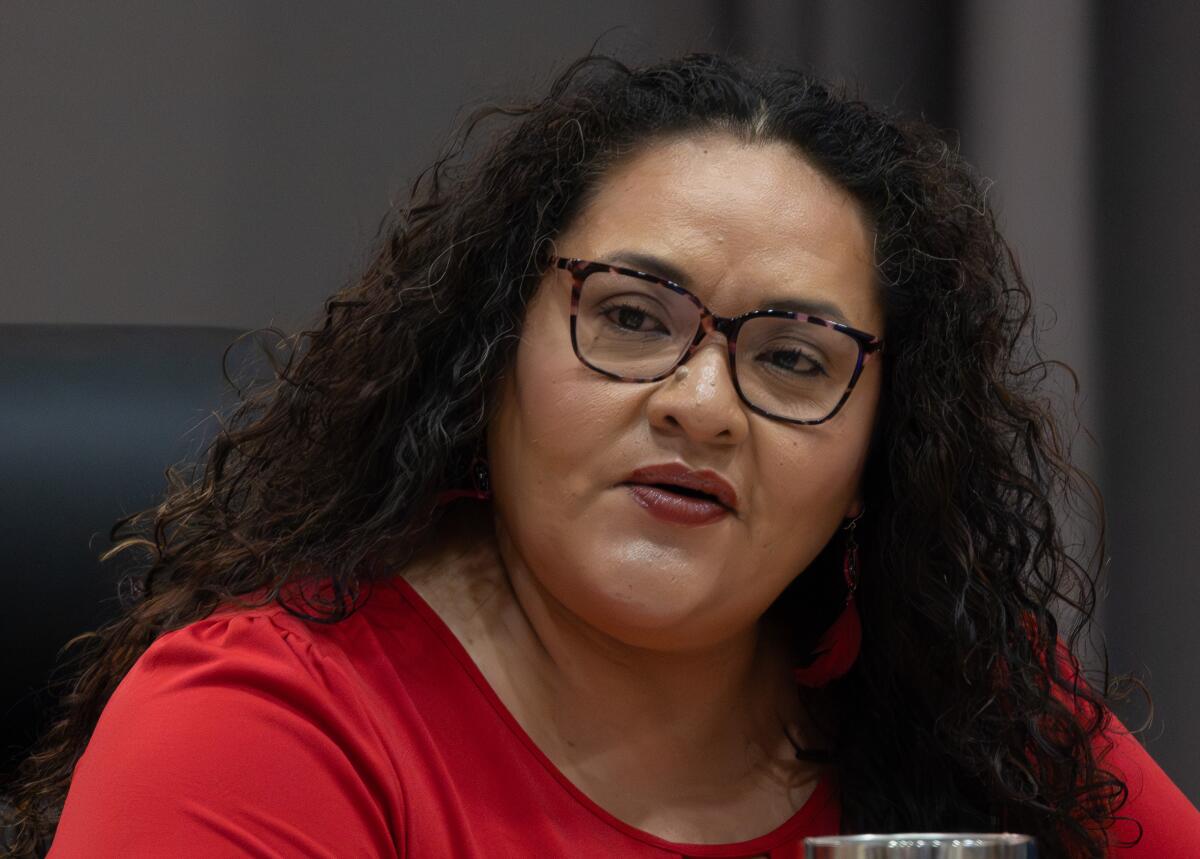
A woman in a red top wearing glasses.
LAUSD Board Vice President Rocio Rivas was headed toward a second term in District 2. Her major funding source was $889,469 in an independent-expenditure campaign on her behalf, nearly all of it from the United Teachers Los Angeles union.

(Myung J. Chun / Los Angeles Times)

Rivas’ own campaign raised $66,218. But the major funding source was $889,469 in an independent-expenditure campaign on her behalf, nearly all of it from the United Teachers Los Angeles union. The union also spent more than $4,000 in communications to its members about the election.

These figures compare with $2,525 raised by challenger Raquel Zamora, who reported spending $5,089.

In Rivas’ successful 2022 run, her main funding opponent was Local 99 of the Service Employees International Union, which backed Maria Brenes for an open seat. Historically, Local 99 has not been inclined to oppose an incumbent, which Rivas has become. And, true to history, Local 99 has endorsed Rivas, but without spending money on her behalf.

An end to charter school wars

More broadly, this election cycle marks the end to a generation of bitterly contested Los Angeles school board races that became the most expensive in the country, with the L.A. teachers union and charter school advocates slugging it out to advance their vision for public education.

Charter school supporters — who had poured tens of million of dollars into races to elect board members sympathetic to their cause — largely stepped aside, a reflection of their diminished resources and evolving strategy.

The bottom line is that, if current vote-count trends hold, the board will be unchanged for the next two years.

This situation is less than ideal for charter schools. Charters with a mixed record face a tough review when they come up for renewal — about once every five years. Charter opponents want the board majority to move more aggressively to shut down charters when possible and to force them off district campuses — where, under state law, they have a legal right to operate.

Big board decisions looming

Big decisions before the board include how to manage a projected structural deficient — with union leaders calling the dire predictions an accounting mirage.

Meanwhile, Supt. Alberto Carvalho remains in limbo after a February FBI raid of his home and office. The investigation relates at least in part to a failed district chatbot project.

Carvalho maintains his innocence and would like to return to work. The board, however, has turned the reins over temporarily to acting Supt. Andres Chait.

Words on a wall say "Los Angeles Unified School District, Administrative Offices."
This election cycle marks the end to a generation of bitterly contested Los Angeles school board races that became the most expensive in the country, with the L.A. teachers union and charter school advocates slugging it out to advance their vision for public education. Above, LAUSD headquarters in downtown Los Angeles.

(Ronaldo Bolaños / Los Angeles Times)

Source link

Mexican protesters clash with police ahead of the 2026 World Cup | Protests

NewsFeed

Teachers marched in Mexico City demanding better pay and pensions, warning of further protests ahead of the 2026 FIFA World Cup. Al Jazeera’s Julia Galiano reports police fired tear gas after some demonstrators pushed through barricades near a FIFA fan zone.

Source link

Olivia Attwood shows off daring bum snap as she undergoes treatment ahead of bikini season

OLIVIA Attwood undergoes treatment whilst showing off risqué bum snap as she prepares for bikini season.

The stunning TV star, 35, is topping up her curves with a bum enhancing regimen amid her high-profile romance with Pete Wicks.

Olivia Attwood undergoes treatment whilst showing off risqué bum snap as she prepares for bikini season Credit: Instagram
The stunning TV star is topping up her curves with a bum enhancing regimen Credit: Instagram
Taking to her Instagram stories Olivia shared a body pic of herself hooked up to a machine at a clinic Credit: Instagram

Taking to her Instagram Stories Olivia shared a body pic of herself hooked up to a machine at a clinic. 

The reality beauty was snapped face down as the daring bum pic revealed her covered in wires undergoing a treatment known as Truflex.

The non-invasive procedure acts as a muscle stimulant which aims to strengthen, tone, and firm the glutes.

Olivia added the caption: “We are not f****** around this season.”

READ MORE ON OLIVIA ATTWOOD

CRYPTIC LIV

Olivia Attwood hints at trouble in paradise with Pete Wicks in cryptic post


YACHT THE HELL

Olivia Attwood and Pete Wicks snubbed from KISS Ibiza trip

In additional text alongside the risque snap, she penned: “Truflex at @sadaf_jaffari I have had better results with this than emsculpt personally depends on your goal x”

In another one of her recent social media posts Olivia had appeared to have undergone an eye treatment with a mirror selfie showing noticeable swelling around her eyes. 

The photo dump which also showed Olivia appearing downcast in several snaps which had sparked worry with fans that there could be trouble in her relationship.

Looking downcast in one photo, Olivia pouted and didn’t look very impressed.

The images that followed were of her dogs, with a snap being of her taking a selfie in an elevator.

It also included a pic of Olivia beaming whilst getting her hair and makeup done. 

Olivia is preparing for bikini season amid her high profile relationship with Pete Wicks Credit: Instagram/Olivia_attwood
In another one of her recent social media posts Olivia had appeared to have undergone an eye treatment Credit: Instagram

The photos had left people alarmed by the lack of Pete appearing in the post, despite the pair dating for a while now.

But it seemed all was to be good in paradise as eagle-eyed fans spotted a sign that all might be well between the pair.

One person seemed to spot Pete’s dog in one of the snaps.

“Yay to Rodney. Was hoping to spot some subtle Pete hints and also wondered if the dogs are mates with eachother! (So invested),” one person penned.

While another added: “Yes Rodney!!!!!!!”

And a third penned: “Hard launching Rodney!”

“Stitch, Lola & Rodney,” penned another, spelling out how Olivia’s pups Stitch and Lola, were now pally with Pete’s dog Rodney.

Source link

Armenia Faces Rising Russian Pressure Ahead of Key June Election

Russia has sharply criticized Armenia for its closer ties with the European Union, arguing that Armenia is not maintaining a balanced relationship with Moscow and is working with countries that wish Russia harm. This criticism comes ahead of Armenia’s parliamentary vote on June 7, where the ruling Civil Contract party, led by Prime Minister Nikol Pashinyan, is seeking a third term and has shown interest in strengthening ties with the West against various pro-Russian opposition groups. Recent polls suggest that Pashinyan’s party holds about 30% support.

Moscow’s discontent with Armenia’s warming relationship with the West was expressed by Russian Foreign Ministry spokeswoman Maria Zakharova, who emphasized that while Russia sees Armenia as a partner, it questions Armenia’s partnerships with the EU, especially given claims from Western nations about a “hybrid war” against Russia.

In response to these developments, Russia’s agricultural safety agency announced new temporary bans on Armenian produce, including tomatoes and strawberries, set to take effect on Saturday. Russia has warned Armenia that it may halt supplies of cheap oil, gas, and diamonds if Armenia continues pursuing EU membership. Armenia, with a population of around 3 million, depends heavily on Russian energy and military support.

With information from Reuters

Source link