agrees

DOD agrees to continue supporting Scouting America after ‘key reforms’

Feb. 27 (UPI) — The Department of Defense reached an agreement with Scouting America to continue to support the organization after it committed to end its diversity, equity and inclusion initiatives.

Secretary of Defense Pete Hegseth said he had been considering an end to supporting the organization because of “significant cultural changes” it made in the early 2010s.

The 116-year-old organization changed its name from Boy Scouts of America to Scouting America, allowing girls to join and introducing programs that included various DEI themes.

“The Boy Scouts lost their way, and a once-great organization became gravely wounded,” Hegseth said in a statement.

“[DEI] crept in, the name was changed to ‘Scouting America,’ girls were accepted [and] the focus of God as the ruler of the universe was watered down to include openness to humanism and Earth-centered pagan religions,” he said in the statement.

Hegseth tied the move to an executive order President Donald Trump signed on his first day in office seeking to end “illegal discrimination and restoring merit-based opportunity,” including with the end of DEI programs among government agencies.

Scouting America said in a statement that it is making changes to align with DOD policies and goals as it has engaged in negotiations with the department for several months about its support for the organization.

The group said in a statement that it plans to waive registration fees for military families, launch a new merit badge focused on military service and veterans and reinforce its commitment to “scouting’s foundational ideas: leadership, character, duty to God, duty to country and service.”

As it has engaged the DOD about potential changes to its program, Scouting America said in the statement that it has “preserved our service to the more than 200,000 girls who participate in our programs.”

Noting that girls have participated in scouting since the 1960s, Scouting America said that its commitment to girls being part of the organization is “unwavering.”

Since 1910, more than 130 million people have participated in scouting programs and it is a well-known pipeline to the U.S. military based on its history showing that “scouts are significantly more likely to serve in uniform than the general population.”

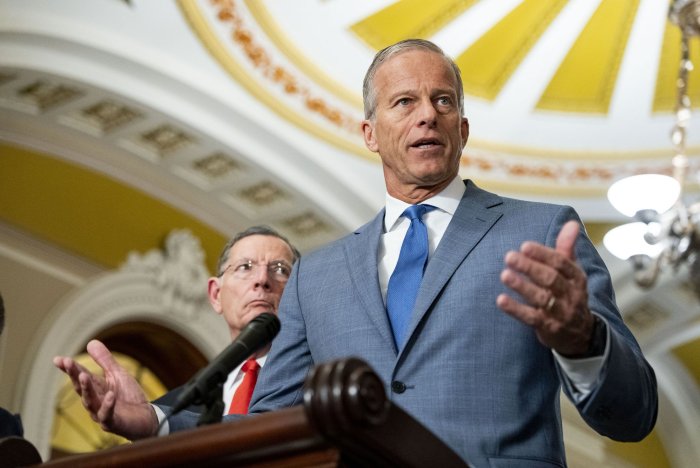
Senate Majority Leader John Thune, R-S.D., speaks during a press conference after the weekly Republican Senate caucus luncheon at the U.S. Capitol on Wednesday. Photo by Bonnie Cash/UPI | License Photo

Source link

Peace ‘within reach’ as Iran agrees no nuclear material stockpile: Oman FM | Military News

Oman’s Foreign Minister says most recent indirect talks between US, Iran ‘really advanced, substantially’ and diplomacy must be allowed do its work.

Iran agreed during indirect talks with the United States never to stockpile enriched uranium, said Oman’s top diplomat, who described the development as a major breakthrough.

Oman’s Foreign Minister Badr bin Hamad Al Busaidi also said on Friday that he believed all issues in a deal between Iran and the US could be resolved “amicably and comprehensively” within a few months.

Recommended Stories

list of 4 itemsend of list

“A peace deal is within our reach … if we just allow diplomacy the space it needs to get there,” Al Busaidi said in an interview with CBS News in Washington, DC, after Oman brokered the third round of indirect talks between the US and Iran in Geneva on Thursday.

“If the ultimate objective is to ensure forever that Iran cannot have a nuclear bomb, I think we have cracked that problem through these negotiations by agreeing [on] a very important breakthrough that has never been achieved any time before,” Al Busaidi said.

“The single most important achievement, I believe, is the agreement that Iran will never ever have nuclear material that will create a bomb,” he said.

“Now we are talking about zero stockpiling, and that is very, very important because if you cannot stockpile material that is enriched, then there is no way that you can actually create a bomb,” he added.

There would also be “full and comprehensive verification by the IAEA [International Atomic Energy Agency]”, he said, referring to the UN’s nuclear watchdog.

Oman’s top diplomat also said Iran would degrade its current stockpiles of nuclear material to “the lowest level possible” so that it is “converted into fuel, and that fuel will be irreversible”.

“This is something completely new. It really makes the enrichment argument less relevant, because now we are talking about zero stockpiling,” Al Busaidi said.

Regarding recent US demands regarding Iran’s missile programme, Al Busaidi said: “I believe Iran is open to discuss everything”.

Asked if he thought enough ground was covered in the most recent talks in Geneva to hold off a US attack on Iran, the minister said, “I hope so.”

“We have really advanced substantially, and I think, obviously, there remains various details to be ironed out, and this is why we need a little bit more time to really try and accomplish the ultimate goal of having a comprehensive package of the deal,” he said.

“But the big picture is that a deal is in our hands,” he added.

The foreign minister’s comment followed after he met earlier on Friday with US Vice President JD Vance and as US President Donald Trump continued to sabre-rattle while at the same time declaring he favoured a diplomatic solution with Tehran.

Trump said on Friday that he was not happy with the recent talks that concluded in Geneva.

“We’re not exactly happy with the way they’re negotiating,” Trump told reporters in Washington, adding that Iran “should make a deal”.

“They’d be smart if they made a deal,” he said.

Trump later said that he would prefer it if the US did not have to use military force, “but sometimes you have to do it”.

The US and Iranian sides are expected to meet again on Monday in Vienna, Austria, for more indirect negotiations.

Source link

Exclusive: EU agrees procedure to choose host country for future European Customs Authority

Published on Updated

EU lawmakers have drafted a procedure to select the future host of the European Custom Authority, a new decentralised agency tasked with supporting and coordinating national customs administrations across the bloc.


ADVERTISEMENT


ADVERTISEMENT

The agency is expected to be set up in 2026 and operational in 2028. Many EU countries have put themselves forward as potential hosts for the new body, including Belgium, Spain, France, Croatia, Italy, The Netherlands, Poland, Portugal and Romania.

In a committee meeting in January, all the nine countries presented their candidacy, with Spain, France, Poland and The Netherlands receiving the majority of questions from EU lawmakers.

The need to establish a dedicated selection procedure arises from the fact that no predefined method exists for choosing the host country. As the location of an EU agency often becomes a politically sensitive contest among member states, the institutions have sought to design a detailed procedure aimed at ensuring the decision is as impartial and balanced as possible.

And with the business of customs management and trade surging in importance since US President Donald Trump imposed tariffs on countries worldwide, the debate over which country will host the future European Customs Authority has become particularly tense.

According to a draft procedure seen by Euronews, the European Parliament and the Council of the European Union will each independently select two preferred candidates. The two institutions will then meet in a joint session to reveal their selections. If at least one candidate appears on both shortlists, that overlapping candidate will be automatically declared the winner.

If there is no overlap, two or four candidates will move to three rounds of votes, all with different rules.

In the first round, a candidate who obtains a majority in both institutions will be elected immediately. But if no candidate achieves a majority in either body, additional scenarios will apply to determine who advances to the second round.

Specifically, if two candidates are tied with neither securing a majority, both will move forward to the second round. In a scenario with four candidates, the two receiving the fewest votes will be eliminated. However, if there is a very close result between the second- and third-placed candidates, three candidates may advance to the second round instead.

In the second round, a joint vote of the two institutions will take place. A candidate must obtain a three-quarters majority to be elected; if no candidate reaches this threshold, the process will move to the third round.

If three candidates remain, the one receiving the fewest votes will be eliminated. However, in the event of a very close result between the second- and third-placed candidates, all three may proceed to the third round.

In the third and final round, the same joint voting procedure will apply, but the required threshold is lowered to a two-thirds majority. This vote may be repeated up to three times. And if no candidate secures the required majority after these attempts, the threshold will be reduced to a simple majority.

Source link

Bayer agrees to $7.25B Roundup class-action settlement

Feb. 17 (UPI) — Officials for Germany-based Bayer have agreed to pay $7.25 billion to settle a class action filed by those who say its Roundup weedkiller caused them or their loved ones to develop cancer.

The proposed settlement would create a fund to pay for existing and future claims filed by those who say the weed killer caused non-Hodgkin lymphoma, which is blood cancer that forms in the body’s lymphatic system – most often in the lymph nodes — and spreads to other organs.

Bayer filed the proposed settlement in the city of St. Louis Circuit Court on Tuesday that also would include a separate Durnell case that is before the Supreme Court.

“The proposed class settlement agreement, together with the Supreme Court case, provides an essential path out of the litigation uncertainty and enables us to devote our full attention to furthering the innovations that lie at the core of our mission: Health for all, Hunger for none,” said Bayer Chief Executive Officer Bill Anderson.

“This litigation and the resulting cost underscore the need for guidance from the Supreme Court on clear regulation in American agriculture.”

“The class settlement and Supreme Court case are both necessary to help bring the strongest, most certain and most timely containment to this litigation.”

Bayer subsidiary Monsanto produces the popularly used Roundup weedkiller and will make annual payments into the settlement fund over the next 21 years.

Monsanto officials do not admit to any wrongdoing and said they agreed to the settlement to end the tens of thousands of lawsuits filed against it and stop more from being filed.

The settlement applies to those who say they were exposed to Roundup before Tuesday and who have a medical diagnosis of non-Hodgkin lymphoma or are diagnosed with it within 16 years of the proposed settlement gaining final approval.

Source link

US border chief says Trump agrees to end deportation surge in Minnesota | Donald Trump News

US border chief announces the conclusion of a federal operation with 700 immigration agents set to leave Minnesota.

Tom Homan, the US border security chief, says that the immigration crackdown in Minnesota that led to mass detentions, protests and two deaths is coming to an end.

“As a result of our efforts here, Minnesota is now less of a sanctuary state for criminals,” Homan said at a news conference on Thursday.

Recommended Stories

list of 3 itemsend of list

“I have proposed, and President Trump has concurred, that this surge operation conclude,” he continued.

US Immigration and Customs Enforcement (ICE) launched Operation Metro Surge on December 1. Homan added that ICE operations would continue as they did before the operation began.

“Through targeted enforcement operations based on reasonable suspicion, and prioritising safety and security, ICE will continue to identify, arrest, and remove illegal aliens who pose a risk to public safety, as we’ve done for years,” he said.

Federal authorities say the sweeps focused on the Minneapolis-St Paul metro area have led to the arrest of more than 4,000 people. While the Trump administration has called those arrested “dangerous criminal illegal aliens,” many people with no criminal records, including children and US citizens, have also been detained.

Democratic Governor Tim Walz said Tuesday that he expected Operation Metro Surge to end in “days, not weeks and months,” based on his conversations with senior Trump administration officials. He told reporters he spoke this week with both Homan and White House chief of staff Susie Wiles.

Minneapolis Mayor Jacob Frey also said he had a “positive meeting” with Homan on Monday and discussed the potential for a further drawdown of federal officers.

Homan took over the Minnesota operation in late January after the second fatal shooting by federal immigration agents and amid growing political backlash and questions about how the operation was being run.

“We’re very much in a trust but verify mode,” Walz said, adding that he expected to hear more from the administration “in the next day or so” about the future of what he said has been an “occupation” and a “retribution campaign” against the state.

Officials with the Department of Homeland Security did not reply to a request for comment on the governor’s remarks.

Walz said he had no reason not to believe Homan’s statement last week that 700 federal officers would leave Minnesota immediately, but the governor added that that still left 2,300 on Minnesota’s streets.

Homan at the time cited an “increase in unprecedented collaboration” resulting in the need for fewer federal officers in Minnesota, including help from jails that hold deportable inmates.

Source link