Andy Hernández: ‘We Must Defend Our Institutions even if We Do Not Agree with the Gov’t‘
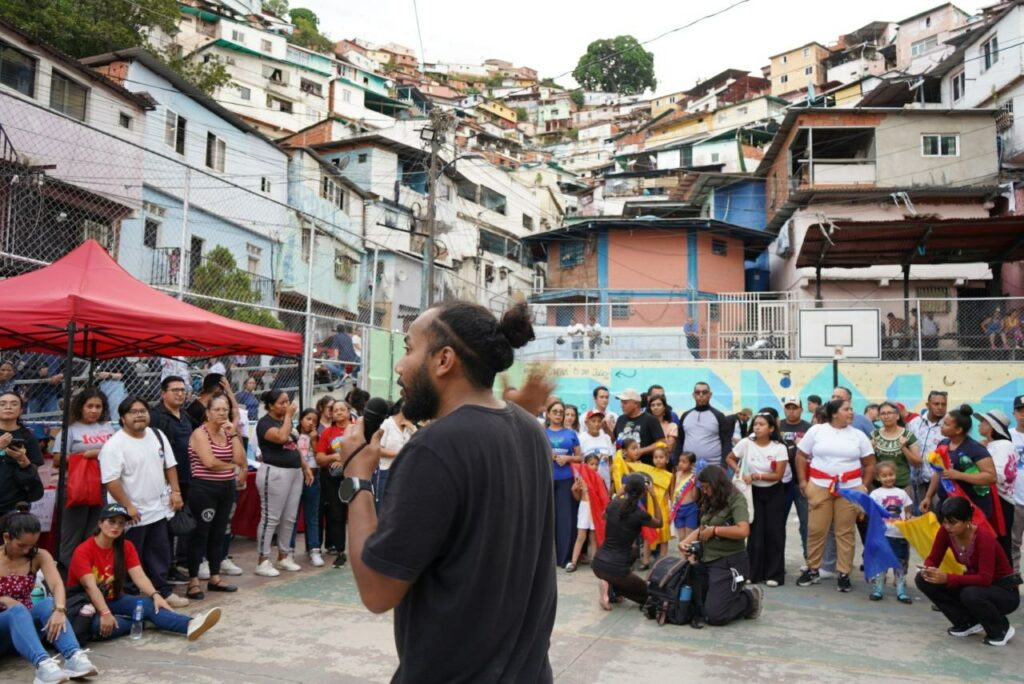
Andy Hernández. (Venezuelanalysis)
Andy Hernández is a Venezuelan economist and grassroots activist. He currently serves in the parliament of the 5 de Marzo Comandante Eterno Commune in El Valle, Caracas, and has played an active role in the Communard Union, a national alliance of communes. In this exclusive interview, Hernández offers his perspective on local, state-backed projects within the current context of undermined sovereignty.
The 5 de Marzo Comandante Eterno Commune immediately mobilized in response to the double earthquake on June 24. Tell us a little about this and other recent initiatives by the commune.
After the twin earthquakes on June 24, community organizations sprang into action immediately. Collection centers were set up even before the government announced them. In our case, we set up a collection center on the premises of our communal social enterprise (EPSDC) Somos Karive.
At the same time, we noticed that around Somos Karive, many elderly people began leaving their homes, frightened, and taking to the streets. We brought them coffee, talked with them, and before we knew it, we had 300 people inside Somos Karive. There, with the support of the Ministry of Communes and the Caracas Mayor’s Office, we set up a shelter for a few days, until the panic subsided and people felt calm enough to return to their homes.
Somos Karive is one of the community’s main projects. How is it currently operating?
This initiative originally arose from a need to have a space to store food and expand our collaboration with the Pueblo a Pueblo Plan, a rural collective that organizes with urban counterparts to deliver produce at fair prices. The project then grew and now has several branches. The main operation, which generates the most cash flow, partly because it’s coordinated with the Ministry of Commerce, is the meat-processing plant. There, various cuts of meat are cleaned and portioned, vacuum-sealed, and then sold retail and wholesale to about 30 grocery stores in El Valle.
The second most important activity is our supermarket, which sells groceries and other products. There’s also the café, a space at the entrance that serves coffee, breakfast, and lunch. In fact, we also prepare large-scale lunches on demand. Another project here is a water treatment plant. And finally, a Family Production Unit (UPF) operates here, selling screws and other tools. This UPF contributes to the community through the social reinvestment fund. For now, that fund is used to support community activities. But according to the Law of Communes, the fund must be managed by the communal bank, which we are currently reactivating.
In short, Somos Karive has had its successes and failures, but it is a key initiative. I believe the most complex issue is establishing a management model. While all economic activity must generate a surplus, social property companies propose a different framework for labor relations. There is no boss; rather, there is administrative coordination that answers to the commune. No taxes are paid; instead, contributions are made to the social reinvestment fund. There are no social security contributions, but there must be a fund to support producers and a fund for necessary reinvestments. So we’ve been facing these challenges, in addition to the difficulty of operating EPS in the city, where retail activity makes sense but there is a lot of competition.

The Venezuelan government announced a new popular consultation [for communities to select state-funded projects] for October. What has been the outcome of previous consultations in the commune?
The consultations have led to progress and also provided valuable lessons in our territory. Before the first consultation in 2024, we drew up a wish list without asking ourselves whether those items were feasible or not. Now, after several votes, and with some tools provided by the Venezuelan government for systematic planning, such as the Concrete Action Agenda or the Map of Solutions, we’ve been able to ground the projects in reality. Today we can say that we manage the proposed initiatives and the resources obtained much more effectively. Sometimes we even prepare two reports: one institutional and one community-based.
The most recent one was an extremely complex water project. Our community has gone 30 years without a regular water supply. There are no formal water supply connections, just hoses everywhere. First, the project was formulated: to fix the problem for 291 families without service, and it really did have a significant impact.
Other initiatives proved more difficult. For example, with a project to purchase water tanks, the funds raised were enough for only 10 tanks, yet hundreds of families needed them. The same thing happened with the project from the last consultation, which was to replace gas cylinders. We’ve managed to replace about 500, but there are 2,700 in total that need replacing. And the biggest challenge was with the rooftops. We needed 16,000 zinc sheets, but the project funds only allowed us to purchase about 850. So in situations like these it is difficult to manage everyone’s needs. In the end, we identified the most vulnerable homes, but we were only able to assist 65. No matter how well we manage the resources, they simply aren’t enough.
So we’ve had our share of setbacks, along with a lot of lessons. People now understand that we have to identify the scope of the problems that can actually be solved through these consultations. Rather than having a wish list, we’re learning to formulate real, concrete, and feasible projects.
What do you think of Acting President Delcy Rodríguez’s proposal to extend consultations to condominium boards and neighborhood associations?
To be honest, I find it interesting. The initial reaction, which I’ve seen in discussions with comrades, is to view it with suspicion, thinking of middle-class condominiums that have never believed in popular power.
The central issue is that a condominium board merely manages infrastructure, whereas the commune must implement policies on health, education, recreation, etc. It must act as the government in the territory, even if we aren’t fully exercising that role. So it might seem that by extending the consultation to condominiums, our presence is being undermined. However, our legislation doesn’t prevent condominium boards from participating in these processes.
Ultimately, the commune is the structure that defines the methodology for these consultations. Perhaps if, at some point, the consultations begin to prioritize the perspective of condominium boards, this concern would be justified. To me, that would indeed be a colossal mistake because it would violate the principle that the citizens’ assembly is the body that decides and has the final say on local projects.

Turning to the national scene, some analysts describe the situation in Venezuela as “tutelage,” while others call it a “protectorate,” where the country’s fate is essentially decided in Washington. In this context, what role should grassroots organizations play? Is it justified to maintain unconditional support for the government?
Here I will speak in a personal capacity, not on behalf of my commune or the Communard Union, because this is a complex and highly contentious debate taking place within social movements, with many different perspectives.
There are several positions: some speak of tutelage, others of a protectorate, and others of a new form of neocolonialism. I believe we must ask ourselves what defines sovereignty. For me, there are two models of sovereignty currently clashing worldwide: one defined by corporations and the other by organized peoples. Now, in more concrete terms, I defend the Venezuelan revolutionary process, our history, and our struggle. I do not agree with some of the government’s decisions, but it remains my government nonetheless.
However, this is a very complex context in the wake of a foreign military intervention. How can a government be evaluated while under military coercion? That is a difficult question to answer. Regardless of whether or not one supports the government, January 3 [US military strikes and kidnapping of Maduro] is a turning point in our process. For me, the central issue is not whether to defend the government or not, but rather to defend our institutions. For example, I do not agree with reestablishing relations with Israel, nor do I agree with the terms of our relationship with the United States. But this is still my government.
I know this may sound illogical or contradictory, but as a popular movement we must understand that sovereignty is being contested on a global scale. Our goal is to build a new form of state, one that has the commune as its foundation. We must strive to ensure that these 5,400 communal circuits form a network for the defense of the territory, fighting for a new hegemony, and with a leadership that allows us to advance and influence national politics. However, this begins with exercising power from the territories in a coordinated manner, managing resources, and sustaining new social relations.
The communes are not even at 10% of our potential. Public consultations, for example, are a glimpse of what we can do, but they account for less than 1% of the national budget. This means that social organizations are not managing oil revenues, which are our primary source of wealth. We must develop political awareness not only to identify imperialist interests in our resources but also to create economic models that can scale up so we can challenge the status quo on different terms. For example, we could envision a communal corridor to exploit minerals in an alternative way. This would turn us into a real threat to those who seek to impose corporate sovereignty.
But returning to the more practical question: should we support the government or not? I believe we must support it because it is the government that establishes our institutional framework, even if it takes the form of a bourgeois state that we want to transcend. Now, should we support every decision? Of course not. But defending sovereignty means defending our institutions against foreign powers that seek to impose themselves upon them. For example, the assassination of Niño Guerrero struck me as a very dangerous precedent.
Finally, I believe it is important to have these discussions, both individually and within our organizations. In the case of the Communard Union, we are preparing a congress where we will need to collectively establish positions regarding this reality and, from there, define the actions we will take to try and revert the situation we are currently facing.
In recent months, we have seen a series of measures and reforms clearly geared toward the interests of transnational capital, such as the reform of the Hydrocarbons Law. What stance should communards take on these issues of national interest?
The reform of the Hydrocarbons Law is an example of this advance of the corporate sovereignty model. And in our context, the coercion and plundering began immediately after January 3. The attacks against Venezuela to seize its resources did not begin a few months ago, but before there was some care about appearances. Now the United States has moved on to directly stealing the country’s export revenues. This is like going back to the 19th century.
It is a complex time for the world. We are sometimes a bit chauvinistic; we believe that Venezuela determines what happens everywhere else. Although we certainly have an impact. We have the world’s largest energy reserves, minerals, fresh water, and other resources. Naturally, without independence there is no commune, and defending the process means defending national independence in order to envision a different world.
Now, what steps should we take to defend ourselves against this plundering? We have our Constitution, but this scheme falls outside even the international legal framework. Some might say the solution is to sabotage our own oil industry, but others would ask whether that would help shift the correlation of forces. Because we’re not just interested in being right. We want to change reality. We could issue a statement from the Communard Union right now, outlining everything we disagree with, and perhaps we should do so, but we must collectively decide what our coherent course of action will be, in terms of politics, communication, and so on, to defend our national project.

Venezuelan communes have also been characterized by their internationalism. How do you assess recent events, ranging from “joint” military operations with the US to the reestablishment of ties with Israel?
We believe that the commune is a civilizational project that we are implementing in a specific territory: Venezuela. Elsewhere, people may call it something else or pursue it with a different strategy, but we believe it is a civilizational project that is being debated around the world. So, based on that, the commune is obviously anti-Zionist and anti-imperialist. However, we are being subjugated and subdued. Not just the communes, but the country as a whole.
I believe that in the aftermath of January 3, elements such as the rapprochement with Israel were imposed on us. January 3 and the subsequent coercion were decisive in shifting the balance of institutional power, both within the Venezuelan state and in its foreign relations. The United States violated the Constitution, subdued our armed forces, and killed more than 200 people, including those extrajudicially murdered at sea, not to mention the piracy of hijacking our oil tankers. Thus, these disastrous changes are an imposition based on the logic of the military victor getting the spoils. In fact, US officials have openly stated this.
But the concept of the commune is and always will be anti-imperialist, anti-Zionist, and in support of the self-determination of peoples, with a vision of how resources and community life should be organized, the full exercise of our sovereignty, and so on. In this context, the communes must resist by demonstrating their existence, their socially owned enterprises, their assemblies, and their impact on the territory. Demonstrating that another way of life is possible is a way to fight back both locally and internationally.