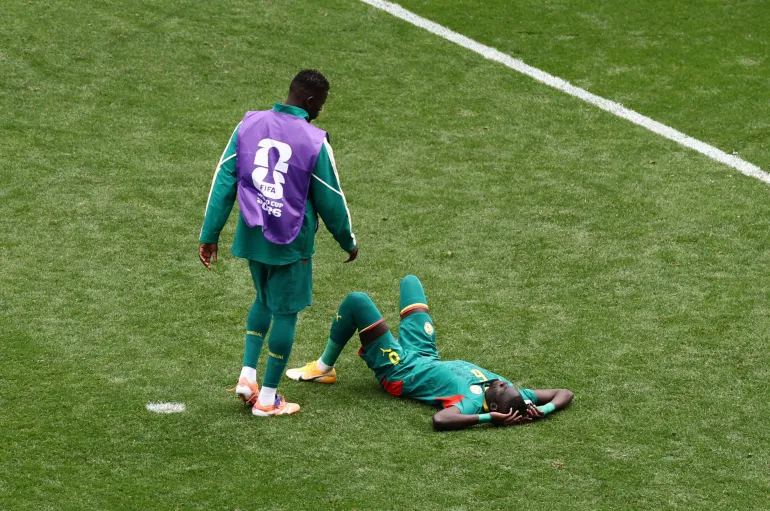
agony

Senegal’s World Cup agony: Nation left rueing last-gasp collapse | World Cup 2026 News

Dakar, Senegal – The silence came before kickoff. Not from fear but anticipation, a nation holding its breath.

Across Dakar, radios crackled from open windows. Men gathered shoulder to shoulder in cafes, their eyes fixed on flickering television screens. Families crowded into living rooms. Friends leaned over phones, tea growing cold as conversation gave way to concentration.

Recommended Stories

list of 3 itemsend of list

The city’s usual rhythm horns, its markets, its arguments, its laughter – did not disappear. It simply yielded to something larger.

Senegal were in the first knockout round of the World Cup, playing against Belgium.

On the 25th-minute mark of the game, the boy from the suburbs of Dakar, Habib Diarra, delivered the nation from its anxiety, sweeping a loose ball beyond the Belgian goalkeeper: 1-0 to Senegal.

Eight thousand kilometres away from the game in Seattle, the United States, Dakar became the stadium. The celebrations only grew after Senegal scored a second goal early in the second half. Confidence turned into complacency. Five minutes from full-time, car horns blared and firecrackers echoed through the night. Victory was near.

But the celebrations came too early.

Belgium scored once. Then again. All in the space of five minutes, completing an astonishing comeback. And then, in the final minutes of extra-time, Senegal gave away a penalty: 3-2 to Belgium.

Problem is preparation

A day later, the silence remains.

Not quite mourning, but more disbelief.

“It’s incomprehensible,” says former Senegal international footballer Ferdinand Coly. “When you control a match with such quality until the 85th minute, you have to finish it. But psychologically, everything changed.”

Coly believes the turning point was not Belgium’s resurgence, but the Senegal coaching team’s decisions.

“The substitutions completely changed the midfield. There was no reason to make them. Once Belgium scored, they gained the psychological advantage. Senegal became fragile. They retreated, played with fear, and never recovered.”

Coly was part of Senegal’s 2002 World Cup squad, the team that famously stunned France in the tournament’s opening match.

“It’s never over… until the final whistle,” he said, reflecting on Belgium’s dramatic comeback.

Since retiring, Coly has swapped his football boots for farming. He has also worked with the Senegalese Football Federation, and believes the national team has lost sight of the basics.

For him, the problem is not talent but preparation.

He criticises what he sees as an over-reliance on data, statistics, and performance apps, instead of building a coherent team identity and developing a clear tactical strategy.

As Belgium searched for an equaliser, their coach was still scribbling notes on a sheet of paper, adjusting and reacting until the very last minute.

“What a contrast!” Coly said. “We’re relying on technology when football is still about reading the game, adapting and thinking.”

Soccer Football - FIFA World Cup 2026 - Round of 32 - Belgium v Senegal - Seattle Stadium, Seattle, Washington, U.S. - July 1, 2026 Senegal's Pathe Ciss looks dejected after the match as Senegal are eliminated from the World Cup REUTERS/Lee Smith
Senegal’s Pathe Ciss looks dejected after the match as the team are eliminated from the World Cup [Lee Smith /Reuters]

Same old struggle

Coly’s analysis echoes that of supporters still trying to process a defeat that slipped away in the closing minutes.

Ibrahima Diop is a die-hard fan of the Lions of Teranga. He travelled to the 2022 FIFA World Cup in Qatar. He was even jailed in Morocco after trouble during the Africa Cup of Nations Final earlier this year.

In that controversial final – played against the hosts, Morocco – Senegal’s coach controversially called his players off the pitch after a disputed penalty decision. Senegal went on to win the match, but later lost the title over the incident.

For Diop, the lesson was the same as against Belgium.

“It comes down to concentration,” he says. “For 85 minutes the team was organised and united. Then it disappeared. European teams are prepared psychologically to fight until the very end. We still struggle in those final minutes.”

Diop also believes Senegal were missing something impossible to measure.

“The team played without its supporters. Visa restrictions and the economic crisis meant many fans could not travel. The players know what that atmosphere gives them. Mentally, it made a difference.”

US President Donald Trump signed a proclamation in December declaring that no visas would be given for business or tourism to nationals of Senegal, and several other countries. This meant that fans with only Senegalese nationality were unable to travel to the tournament.

Diop sees a pattern in this World Cup. Ivory Coast, DR Congo, and now Senegal led until the closing minutes, only to watch victory slip away in stadiums empty of their fans.

Senegal supporters react after their team lost the 2026 World Cup round of 32 football match against Belgium as they watch the game at the FIFA Fan Zone at the Place de l'Obelisque in Dakar on July 1, 2026.
Senegal supporters watch as their national football team snatches defeat from the jaws of victory in the World Cup round-of-32 game against Belgium [AFP]

Cruel for country

Football is rarely just football. This World Cup – meant to unite – has revealed the deep inequalities beyond the stands. A nation may be united in victory. But when the referee blows the final whistle, another game begins: the blame game.

Football is opium for the masses, says Coly.  It has become one of the few moments when political loyalties disappear. For 90 minutes, everyone wears the same colours.

“The national team is a bridge,” Coly said. “When Senegal plays, there is no political affiliation. It’s simply Senegal. Sport has this unique ability to unite people beyond their differences.”

The unity makes defeat feel disproportionately heavy.

Social media quickly filled with frozen moments from the match: missed chances, defensive mistakes, and coaching decisions replayed endlessly.

Under pressure, football often reveals more than just sporting weaknesses.

Babacar Fall, a Senegalese journalist who has closely followed the national team, argues that the problems began long before kickoff.

According to him, uncertainty over the coach’s future, disagreements inside the federation, and unresolved contractual issues created instability during the tournament.

“There were already problems before the Norway match,” he says. “The coach’s contract wasn’t settled. There were disagreements over player selection. Then, 10 minutes from the end against Belgium, one substitution broke the defensive structure completely.”

He draws an even broader comparison.

“The country is paralysed. There was so much hope after the Africa Cup of Nations, just as there was so much hope politically. Today, there is disappointment. In many ways, the team’s collapse reflects the country’s mood.”

Those views capture a feeling repeated by many supporters in Dakar this week. There is frustration, not simply because Senegal lost, but because of how it lost.

The talent was there. The opportunity was there. For much of the match, Senegal looked like the stronger side. That is perhaps why the silence lingers.

This generation has raised expectations. Winning continental titles transformed how Senegal sees itself. Reaching the knockout stages is no longer enough; supporters believe this team should compete with the world’s best.

Ultimately, it is only football. But in Senegal, football has become something larger than sport. It is a source of national pride, a rare moment of collective unity, and a reflection of possibility.

That is why this defeat feels so cruel. Not because a match was lost. But because, for one evening, it felt as though an entire country’s potential had slipped away in the space of just five minutes.

Source link

100 miles of agony and hope: A cancer survivor’s ultramarathon journey

In the pre-dawn chill of the Sierra Nevada, Christina Klayko bounced on the balls of her feet, trying to keep warm and calm before one of the planet’s most punishing competitions.

Surrounding her at the starting line for the Western States Endurance Run — a lung-busting 100-mile race over towering mountain ridges and through deep, sun-scorched canyons — were some of the most elite athletes in the world, including former champions, record holders and an Olympic marathon medalist.

  • Share via

Klayko, a 48-year-old mother of three, had no illusions about winning — she was just relieved to be there. She is a two-time cancer survivor, and a year earlier, she was lying on an operating table enduring a full hysterectomy, followed by months of radiation treatment. She was terrified she might die.

Spectators hike to the summit of the Sierra Crest at Palisades Tahoe Ski Resort.

Spectators trekked to Emigrant Pass before dawn to cheer at the first significant milestone the Western States Endurance Run.

“I was in a very dark place,” she said. “I would have given anything just to be able to walk my dog around the block.”

But Klayko, a former software engineer from Los Altos, has never been a quitter. In her twenties, following a breast cancer diagnosis and a full mastectomy, she finished an Ironman triathlon. Last Saturday, she was hoping to complete an even more miraculous comeback.

To do so, she would have to run almost half the width of California, from the shores of Lake Tahoe to Auburn, a former mining town in the foothills above Sacramento, along remote, rock-strewn paths that rise and fall like a roller coaster.

In all, she would have to propel herself up more than 18,000 vertical feet, or three times the elevation hikers climb to the summit of Mt. Whitney, the tallest peak in the contiguous U.S. And she’d have to endure relentless jack-hammering from nearly 23,000 feet of descent.

Hard things are nothing new to her, Klayko said. And unlike cancer, running is a choice. You can walk away when you’ve had enough.

There’s no prize money for doing well in the Western States 100, but finishers get a commemorative belt buckle and, more importantly, membership in one of the most exclusive clubs in all of sports. More than 11,000 runners entered a lottery for fewer than 400 spots this year. Many had waited for more than a decade for their chance.

But there’s a cruel twist — not everyone who crosses the finish line wins the bragging rights.

There’s a strict 30-hour time limit. Which means, most years, dozens of competitors struggle over snow-capped mountains, push themselves to the brink of heat stroke in the sweltering canyons and endure a long, dark night in the wilderness, only to show up at the finish line a few minutes late.

Eric Strand, 65, of Wildwood, MO, center, runs the Western States Endurance Run.

Eric Strand, 65, of Wildwood, MO, center, runs in front of the Granite Chief Wilderness at the start of the Western States Endurance Run.

They’re not acknowledged as finishers. As far as the official record is concerned, they didn’t make it.

So as Klayko waited for the ceremonial shotgun blast that signals the start, she wasn’t worrying about cancer, or mortality, or even the hours of torture that lay ahead — she was dreading the cutoff.

“I knew I could just push and push as long as I had to,” Klayko said. But she couldn’t escape the looming fear of “running out of time.”

The first major obstacle was Emigrant Pass, a high ridge that is four miles, almost straight uphill, from the start at the Palisades Tahoe ski resort.

Half an hour after the start, the sun peeked over distant summits, turning the horizon orange, and the first runners approached the top.

In the lead pack was Jim Walmsley, a four-time Western States champion and holder of the course record — an astonishing 14 hours, 9 minutes and 28 seconds. Spaniard Kilian Jornet, arguably the greatest ultra runner of all time, was right there with him. That was no surprise. In addition to having won Western States and almost every other notable ultramarathon, Jornet famously summited Mt. Everest twice in one week — without supplemental oxygen.

Among the women was Molly Seidel, perhaps the most recognizable name after Jornet. Seidel had been a 27-year-old barista and babysitter before the COVID-delayed Olympics in 2021, when she shocked the running world by winning the bronze medal in the marathon. It was only the third marathon she had ever run.

These battle-hardened pros barely flinched when they crested the ridge and ran headfirst into bitter, gale-force winds gusting to 65 mph. Their bare, muscled legs kept pumping steadily and carried them down the other side, where the gusts quickly subsided.

The rest of the pack didn’t make it look so easy.

Spectators watch the sunrise before the start of the Western States Endurance Run.

Spectators watch the sunrise before the start of the Western States Endurance Run.

Many were hunched and gasping as they struggled toward the crest. One woman bent over and started retching violently. Locking eyes with a reporter, she shouted, “I’M OK!” — apparently unaware that she was screaming over the wind and whatever was playing in her headphones. “I JUST SWALLOWED TOO MUCH SPIT!”

Then she straightened and staggered into the howling gale: only 96 more miles to go.

Seven hours later, at mile 56, the lead runners climbed out of the course’s deepest and hottest canyon, onto a dusty promontory called Michigan Bluff.

The first few looked almost as fresh and fast as they had at the ridge. But the punishment was starting to show on everyone else.

Jornet, who had been nursing a knee injury before the race, was concerned about the canyons. He didn’t make it through them, dropping out at mile 38.

Walmsley, who had been among the leaders for the first 30 miles, was fading by Michigan Bluff. Persistent hip pain would force him from the race at the next aid station. At this point, most of the other runners, including Klayko, were hours behind.

Justin Grunewald, a 40-year-old Colorado doctor, who some picked as a dark horse contender to finish in the top ten, looked exasperated as he emerged from the canyon. He went straight to his support team, who started dumping water down the back of his shirt and tying an ice bag around his neck.

“I’m totally fine,” he told them, “but my knee is killing me because I keep eating s—.” That’s runner shorthand for falling.

His knee was bleeding, but the real problem was his vision. He pulled off his sunglasses, and his eyes were a scary shade of red. He leaned his head back while a friend squeezed drops into them and reminded him to keep wearing his glasses. Obvious advice — but what else do you say to someone hellbent on running another 44 miles?

“Ultra runners are a strange breed,” said Amanda Basham, Grunewald’s wife. She was on his support team this year, but she has twice finished the race in fourth place.

Jacob Banta, of Mill Valley, pushes up the trail near Michigan Bluff during the Western States Endurance Run.

Jacob Banta, of Mill Valley, pushes up the trail near Michigan Bluff during the Western States Endurance Run.

As Grunewald composed himself and trotted off into the distance, it seemed like a good time to ask the obvious: why does anyone put themselves through such an ordeal?

Basham laughed and said most people would probably brush the question aside with something safe and trite, like, “I just love running!” But the truth, she said, is that “almost everyone here has an intense story.”

Grunewald’s first wife and running partner, Gabe, died after fighting a rare cancer for 10 years, Basham said. Other competitors have lost a child, struggled with mental health or battled addiction. Running long distances on secluded trails can be a coping mechanism. For some, showing up at big races to commune with their tribe is like group therapy.

“We all come together for this common thing, and it doesn’t really matter if you went to rehab 10 times,” Basham said. “You’re here trying to get better, and it’s cool.”

Minutes later, Seidel hobbled out of the canyon clutching her thighs. When her crew offered her a chair, she tried to settle but started panting in pain, apologizing that she was in too much agony to sit.

This was her first attempt at 100 miles. She would explain later that she hadn’t eaten enough during the race and had developed excruciating skin lesions from chafing. It looked like her day was done, but she refused to quit.

The women’s winner, Jennifer Lichter, might have the most intense story of them all. Born in Bogota, Colombia, she was a nine-year old orphaned by cartel violence when a couple from Wisconsin adopted her.

In her first 100-mile race, she shaved a minute off the women’s course record, finishing in 15 hours, 28 minutes and five seconds.

The men’s winner, Vincent Bouillard, smashed the overall course record by more than 20 minutes, sprinting across the line in 13 hours, 46 minutes and 15 seconds.

Klayko, who never imagined herself involved in the chase for records, emerged from the canyon eight hours behind the leaders.

For most of the race, she hovered between hiking fast and running slow. She subsisted mostly on energy chews and gels, indulging in a baked potato sprinkled with salt at one point, and luxuriating in a cup of broth with rice at another.

Was attempting the race wise, given her health? Had she told her doctors she was planning to do this?

“That’s, um, a good question,” she said with a chuckle. “They know I’m a serious runner but … I don’t think I actually told them I was running the Western States.”

Probably for the best.

Like a lot of the runners, Klayko said she got a jolt of much needed energy at mile 78, on the bank of the American River, where the run suddenly turns into an obstacle course.

Racers grab a thin nylon rope and gingerly wade into the freezing water. Volunteers offer life vests and stay close to prevent drownings, but offer no assistance.

A racer crosses the American River during the Western States Endurance Run.

A racer crosses the American River during the Western States Endurance Run.

Near the middle of the crossing, the water got so deep that many runners submerged completely, pulling on the rope to haul themselves to the far bank.

“It definitely woke me up,” Klayko said of her crossing in the dark at 3 a.m. “It was a lot colder than I expected.”

On the other side — soaked to the bone, with wet clothes and shoes — she crawled back onto the dusty trail and started running again. Soon after, the trouble set in.

It began with a burning sensation on the bottom of her left foot. As the pain intensified, she started hobbling, leaning on the trekking pole in her right hand to take pressure off the blister that was growing bigger than a golf ball.

With just miles to go, her husband, Chris, who ran beside her — after the halfway point, competitors are allowed to have a companion for safety — kept checking the time. They were falling behind.

What do you say to someone you love in such a situation? You don’t want them to suffer, but you don’t want them to fail.

“We need to hustle,” he told her.

In the last few hundred yards, the race enters the football stadium at Placer High School. Seidel had finished hours earlier, at 5:29 a.m., when the stadium was relatively empty.

But the last 60 minutes before the notorious cutoff — known as Golden Hour — attracts a huge crowd.

Cameras film from every angle as one battered body after another circles the track. Some jog, some hobble, some openly sob. Whatever they do, it’s fully public and likely to go viral on social media.

Christina Klayko pushes for the finish in the Western States Endurance Run in Auburn. Her total elapsed time was 29:42:30.

Christina Klayko pushes for the finish at Placer High School with just minutes to spare in the Western States Endurance Run..

Klayko said she was coached to visualize her finish during training. In her head, it looked nothing like this.

When she came around the final bend with the clock ticking down, gasps arose from the media gaggle behind the finish line.

Desperate to compensate for the enormous blisters on both feet now, she leaned forward and to the right at almost 90 degrees — wobbling and weaving on her heels, relying on trekking poles to stay upright and claw forward.

It was hard to watch but impossible to look away.

When she was finally in stumbling distance of the line, Chris bounced up and down and thrust his arms in the air. The crowd roared.

She finished with 18 minutes to spare.

Christina Klayko completes the Western States Endurance Run in Auburn

Christina Klayko nearly collapsed after crossing the finish with minutes to spare in Western States Endurance Run.

Source link

Newspaper headlines: ‘Agony for Arsenal’ and ‘5 cops axed’ at Kensington Palace

The headline on the front page of the Sunday Telegraph reads: “Benefits checks watered down”.

Similarly, the Sunday Telegraph is dominated by an image of an emotional Gabriel, and reads: “Arsenal’s Champions League dream dies”. It leads with a story accusing UK Prime Minister Sir Keir Starmer of “watering down” checks on welfare benefits claimants, as new rules come into effect this week which will allow people to receive a Personal Independence Payment (PIP) for four years after their initial assessment, and then a further six years after a review. The paper says claimants face reviews as often as every nine months under the current system. It writes that officials are warning that urgent changes to the welfare assessment system are needed, with the record number of people claiming PIPs costing the British taxpayer £26bn a year.

Source link

NEWS ANALYSIS : Agony at the Top: Bosnia May Be a Clinton Vietnam

If agony in high places is any measure, the war in Bosnia is already President Clinton’s Vietnam.

The President says that it is the issue he cannot stop worrying about at the end of the day; he takes the problem home at night and hashes it over with his wife, Hillary Rodham Clinton. The tragedy in the Balkans is “not only heartbreaking,” he said this week, “it’s infuriating.”

And Secretary of State Warren Christopher, a notably unemotional man, throws up his hands at the subject. “This is a problem from hell,” he declared. On Wednesday, Christopher met privately with author and Holocaust survivor Elie Wiesel to discuss the issue’s moral implications.

Clinton’s advisers have huddled for hours over the last three weeks to thresh out options for diplomatic and military action–and still have not reached a decision.

Like Lyndon B. Johnson, whose presidency was wrecked by the American military intervention in Vietnam, Bill Clinton faces an agonizing conflict between his international ideals and the potential cost of achieving them.

Beginning in last year’s presidential campaign, Clinton declared that the United States had a responsibility to stop the onslaught of Bosnia’s Serbs against the republic’s other ethnic groups, the Croats and Muslims. “We have an interest in standing up against the principle of ‘ethnic cleansing’ . . ,” he said earlier this month. “If you look at the other places where this could play itself out in other parts of the world, this is not just about Bosnia.”

Yet the President’s attempt to stop the Serbs through diplomatic pressure has failed. So Clinton, only three months into his presidency, faces an unpalatable choice between escalation and retreat–that, and a swelling national debate over the limits of American responsibility.

Since the fall of Saigon in 1975, Americans have argued over every potential military intervention in terms of Vietnam, whether the battlefield was Lebanon, Central America, the Balkans and even Desert Storm in its early days. Is Bosnia another quagmire, a war America should not enter because its price in blood will inevitably run too high? Or is it, as Christopher has asked, another Holocaust–a tragedy America must stop because the cost in innocent lives–and to America’s moral conscience–is too great to ignore?

All historical analogies are inexact, of course. But Vietnam and the Holocaust are the twin phantoms that haunt the Clinton Administration’s debate over what to do in the Bosnian highlands.

Last week, at the opening of Washington’s new Holocaust Memorial Museum, Clinton found himself confronted directly with one of history’s unwelcome ghosts, when Wiesel appealed to him to stop the war in Bosnia: “Something, anything must be done,” Wiesel pleaded.

At the same time, members of Congress and senior military officers are increasingly warning of the other pitfall. “All of us want to stop the tragedy in Bosnia,” said Sen. John McCain (R-Ariz.), a former pilot who spent five years as a prisoner of war in North Vietnam. “But . . . I’m not willing to risk another Vietnam.”

Clinton has tried to defuse such fears by promising that he is only considering the use of air power in Bosnia, not the introduction of ground troops. Responds McCain, “The fact is, militarily, if you want to affect the situation, you have to inject massive (numbers of) ground troops.”

The President and his advisers do not like the Vietnam analogy but they cannot escape it. Their own careers, their ways of thinking, were forged in the crucible of the nation’s longest war.

White House National Security Adviser Anthony Lake resigned his first White House job–under Richard M. Nixon, in 1970–to protest the relentless escalation of the war. Defense Secretary Les Aspin served as a young Army lieutenant on the Pentagon staff that planned the conflict. Secretary of State Warren Christopher, then a Justice Department official, was assigned to quell the sometimes-violent protests that followed.

And Clinton spent his college years struggling with the issue of the war–whether to volunteer, to resist the draft or, as he finally chose, to maneuver his way out of military service.

On the ground, diplomats and military experts say, Bosnia is not much like Vietnam at all–except, perhaps, for its mountains. In Vietnam, the United States faced a well-armed guerrilla army hardened by years of war against the colonial French. In Bosnia, the Serb militias are said to be ill-trained and ill-disciplined, and their weapons, while effective against their lightly armed Muslim foes, would have little effect against U.S. air power.

In Vietnam, the Communists had an important strategic ally in the Soviet Union. “That had a restraining influence on Johnson, who didn’t want to risk a nuclear confrontation with Moscow,” noted Patrick Glynn of the American Enterprise Institute. “The Serbs don’t have a big brother with nuclear weapons.”

Where the Vietnam analogy is most telling, officials said, is not in the hills of Bosnia but in the corridors of official Washington. Once again, an Administration is thinking about intervention in a tangled civil war–and hoping to find a low-cost way to do it.

“Are we looking at a pattern of decision-making that looks like Vietnam?” asked Glynn, who has advocated military intervention in Bosnia. “I worry that the Administration is falling into an old pattern–a gradualist approach that commits us to action but takes only small steps that don’t solve the problem.”

“The idea of taking only intermediate steps is very dangerous,” agreed John Steinbruner of the Brookings Institution.

“I really do sympathize with Clinton’s dilemma,” he added. “This could blow him out of the water. But I don’t think he can stay out and get away with it. And I don’t think he can do it the easy way. I’m afraid he’s going to have to organize an international coalition and intervene in a big way.”

So far, no one in the Administration has publicly called for that kind of massive intervention, which would presumably include the use of U.S. and allied ground troops. Instead, Clinton and his Cabinet appear closely divided over more limited options–principally, lifting a U.N. embargo to allow the Bosnian Muslims to import weapons and launching air strikes against the Serbs to stop their offensive and force them back to peace talks.

Clinton himself initially tried to stay away from the issue, aides said, hoping he could avoid being diverted from his ambitious domestic agenda. But in recent weeks, he has reluctantly concluded that he cannot escape. “I think it is a challenge to all of us . . . to take further initiatives in Bosnia,” he declared at the Holocaust museum last week. “I accept it.”

And Clinton has accepted the argument that a small, symbolic military action would be worse than none at all. “That shouldn’t be done just to say that people . . . will feel better that we did something,” he said in an interview with the Boston Globe earlier this week.

But he has not worked out how to enforce those high principles in practice. “The essence of the matter isn’t just punishing the Serbs. It’s establishing a principle that this is a breakdown in the world’s civil order and the world has to respond,” said Steinbruner.

Clinton, Christopher and others like to note that the dilemma in Bosnia is one that they inherited from the previous Administration of President George Bush.

But that is becoming cold comfort, as the problem rapidly becomes theirs as well.

“If Bush were in power, he’d be facing the same problems,” Steinbruner noted. “But Bush ignored the problem. The Democrats are reacting the way they do because they have a harder time writing these things off. They’re less ruthless about it. They worry more about the moral questions in foreign policy . . . and so they fall into the natural trap of trying to do something, but not too much.”

Source link