When Dodgers rookie Josue De Paula debuted a little over two weeks ago, he was the youngest player in the lineup by four years. And when veteran infielder Miguel Rojas pinch-hit for Alex Freeland in the eighth inning, the 21-year-old De Paula and 29-year-old Kyle Tucker were the only Dodgers under 30 remaining in the batting order.
“You’ve got to have both,” veteran shortstop Mookie Betts, who turns 34 next month, said in a recent conversation with the Times. “You need experience, but you also do need youth. I don’t know what the balance is, to be honest.”
The age of the Dodgers’ stars is the most persistent knock on a group that just finished a 100-win regular season and has the second-best odds to win the World Series (16.7%), according to Baseball Prospectus.
It’s the threat looming beyond every new accomplishment. Yes, the Dodgers are in the midst of a historic run. Only one other organization has strung together so many consecutive postseason berths, and that Braves team of the 1990s and early 2000s won only one World Series.
The Dodgers are aiming to become the first National League team to claim three straight championships.
But how long can this last?
The Dodgers’ lineup is the oldest in the majors, according to Baseball Reference, with an average age of 30.9 years old when weighted by at-bats and games played. Their star corner infielders, Freddie Freeman and Max Muncy, are the oldest of the everyday starters, at 37 and 36, respectively. Even two-way phenom Shohei Ohtani turned 32 in July.
“That’s a fact, we’re an older team,” manager Dave Roberts said. “With age, there’s experience. I know we’re not going to fall off a cliff, our team.”
Plenty of young players in the Dodgers’ system have been blocked by older stars over the years. But in addition to a sky-high payroll, the Dodgers are known for their player development.
Even after the trade deadline — when the Dodgers sent two MLB Top-100 prospects, outfielder Zyhir Hope (No. 25) and right-hander River Ryan (No. 68), to the Tigers as part of the trade package for left-hander Tarik Skubal — the organization’s farm system ranked No. 1 on MLB Pipeline’s rankings.
Serving as a reminder of that strength, when the Dodgers called up De Paula straight from double A, he immediately showed his bat belonged in the big-leagues.
At the same time, injuries stoked the flames of the age discussion. De Paula got his shot because Ohtani finally went on the injured list, after managing problems with his left knee and right biceps for much of the season.
Freeman pushed through knee tendinitis in September. Teoscar Hernández (left hamstring strain) and Betts (right oblique strain) both had monthlong IL stints earlier in the season but have helped carry the offense lately.
“As I’ve gotten older, I’m definitely taking a lot more care of my body,” Betts said. “I know I had an oblique [injury] earlier, but as far as just showing up every day and whatnot, I feel like we do a good job in taking care of our bodies and staying healthy for the most part.
“But I mean, people are talking like we’re the only ones in the league that’s getting hurt. You look everywhere around the league, somebody’s hurt.”
That’s true. And it also isn’t just the guys in their mid-to-late 30’s sustaining soft-tissue injuries. Dodgers catcher Dalton Rushing, 25, served back-to-back IL stints for a flexor strain in his forearm down the stretch.
The Dodgers’ roster has proven deep enough to withstand injuries, as the team posted the second-best regular-season record in the majors this year.
“We’re not going to win games the same way that Milwaukee or Tampa Bay or these younger teams are winning games,” said Rojas, 37. “We’re going to win games a different way. We’re going to win games with a lot of talent, with experience, and winning moments.”
Over the years, the Dodgers have brought in players with postseason experience. But roster continuity also has meant that 17 players on this year’s projected postseason roster also contributed to both of the Dodgers’ last two World Series-winning seasons.
So, after playing more games than any other team the past couple years, the Dodgers may be a little hobbled going into their first-round bye. Regardless, they just completed their first 100-win season since 2023.
“The experience, how smart these guys are on the field, I think those things help win moments and win battles on the edges in October,” president of baseball operations Andrew Friedman said when the Dodgers clinched the NL West title earlier this month. “It’s not as easy to navigate through a 162-game season with an older roster. But I do think that experience in those moments will definitely help and we’ll see it shine through at different points in October.”
It’s stunning to comprehend how much has changed since Russia began its invasion of Ukraine. The conflict quickly turned into one dominated by artillery, with both sides scrambling to source shells wherever possible. Drones have since replaced tubed artillery as the ‘king of battle’ along the front, but cannons still have an important place on the battlefield. The commander of a new combined drone-artillery brigade offered some fresh insights into how his guns are now being deployed to achieve effects that drones still can’t provide.
As we have frequently documented, the ubiquity of drones has changed the nature of combat, especially when it comes to artillery. Not only can drones hold artillery positions at risk, many are cheaper than shells and easier to produce at scale. Most types are also precision guided munitions capable of hitting moving targets with pinpoint accuracy and can also provide battlefield surveillance. However, they are not a panacea, especially amid the cat-and-mouse game of electronic warfare countermeasures and improving kinetic and passive defenses.
In a recent interview with the Ukrainian Oboronka news outlet, Lt. Col. Vitalii Korniienko, commander of the 7th Artillery Brigade, talked about the changing nature of artillery warfare. Korniienko, whose unit is part of the Ukrainian National Guard, explained what is being done to keep his array of domestically produced Bogdana 155mm systems, donated weapons like M777 howitzers, remaining Soviet-era 2S7 Pion 203mm self-propelled howitzers and other guns, relevant. Here are some takeaways from that discussion.
How The Game Changed
“Guns used to be massed at positions to create an ‘artillery wall’ and a barrage of fire,” the lieutenant colonel said. “That practice is gone now. So, how effective is artillery today? We can create an artillery barrage, but what is the point of mindlessly churning up the earth? I’d rather send 20 FPV drones to destroy the target. The cost of that mission is $20,000.”
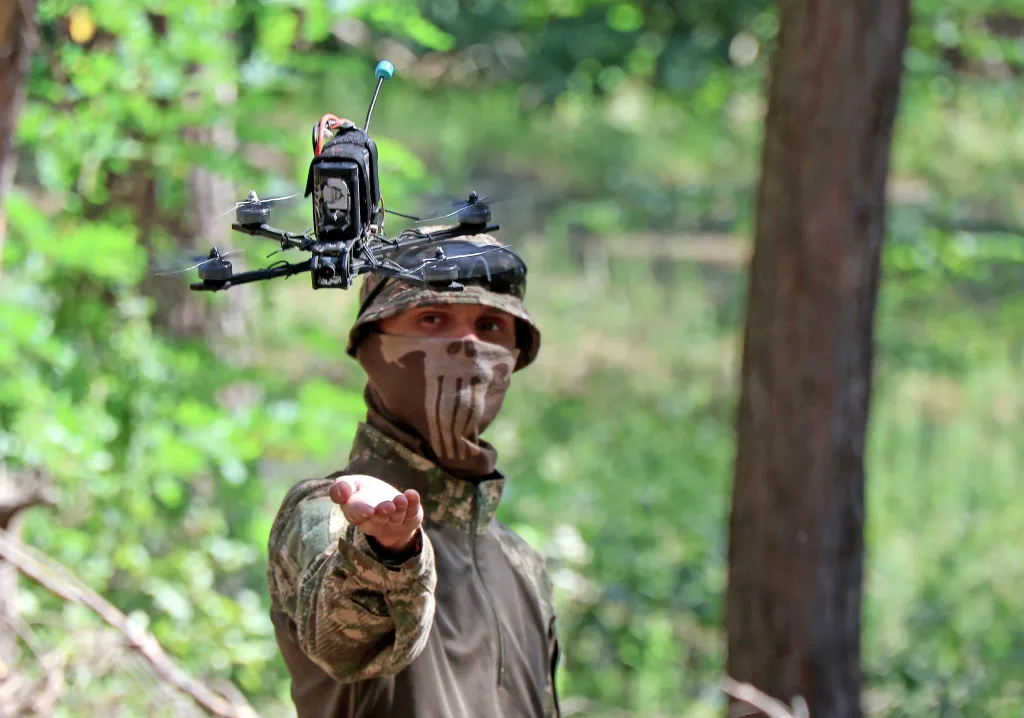
A soldier from the 13th Khartiia Brigade of Ukraine’s National Guard hones his FPV drone piloting skills during a training flight in the Kharkiv region, Ukraine. (Photo by Viacheslav Madiievskyi/Ukrinform/Future Publishing via Getty Images) Future Publishing
“Alternatively, I could fire 200 shells, but the cost would be astronomical,” he pointed out. “Plus, if we fired 100 shells from a gun in a single day, it likely wouldn’t survive until evening. The sky is full of drones; every shot gives away the position, leading to detection and an attempt to dismantle it using every available means. Nowadays, a typical mission involves a series of up to 10 shots. First, 3–5 shells for ranging, followed by fire on the target. That’s a minimum of five shells, with each costing at least $2,000.”
What Does The Drone-Artillery Brigade Do Differently?
“It is a concept of ours that was approved: combining artillery and drones within a single brigade,” Korniienko said. “Drones take out enemy artillery and logistics, while our guns provide cover for the infantry, destroy targets, and pin the enemy down in their dugouts. This way, we mitigate the limitations of both systems and boost overall effectiveness.”
Ukrainian troops firing a domestically produced 2S22 “Bogdana” self-propelled howitzer against Russian forces near the front line in the Zaporizhia direction. (Photo by Maksym Kishka/Frontliner/Getty Images) Frontliner#VIDEO
“Our primary operations are focused within the corps’ area of responsibility—targeting positions 10 kilometers deep or farther behind enemy lines. Of course, we will also engage closer targets if requested by the brigade holding the defense. In addition, we are shifting logistics tasks from pickup trucks to ground-based robotic systems. They are already transporting ammunition to drone and artillery positions, as well as food and fuel for generators.”
What Artillery Can Do That Drones Can’t
“Let’s be honest: 95% of strikes right now are carried out by drones,” Korniienko explained. “Yet, we cannot simply abandon artillery. The focus of our operations has shifted from merely striking the enemy to destroying, suppressing, and halting the actions of assault groups and armored columns—and the need for that remains as critical as ever. There are tasks that only artillery can handle.”
“For instance, we currently have several enemy targets in the Kupyansk sector that drones cannot reach due to electronic warfare (EW) interference, while slow fiber-optic drones are simply shot down,” the officer noted. “What do we do? We call in artillery. Nothing affects its shells. Fog, strong winds, snow, or headwinds—it makes no difference to artillery; it will operate regardless.”
Preparing Artillery For The Modern Battlefield
“At the beginning, both we and the Russians might have had two or three guns at a single position,” Korniienko proffered. “The enemy was doing this as late as 2023. Then it tapered off, because if you deployed six guns, an hour later they’d be gone. No one drives out into an open field anymore. Today, a gun wouldn’t even make it to the position without being spotted.”
Ukrainian National Guard troops prepare a ‘Bogdana-BG’ artillery installation from a dugout position. (Photo by Sofiia Bobok/Anadolu via Getty Images) Anadolu
As a result, the artillery crew’s deployment “is prepared in advance,” the officer stated. “First, anti-aircraft drone teams ‘clear’ the sky above the site of enemy reconnaissance assets. The position itself is a fully underground-dugout caponier with well-camouflaged access routes. We put a lot of effort into ensuring the artillery doesn’t get destroyed. Losing a gun is a huge blow to us.”
Short Range Versus Long Range Shells
“There is currently an ongoing debate about phasing out ‘short’ shells and switching entirely to long-range variants,” the officer stated. “This is intended to protect artillery from drone strikes.”
“What exactly is a ‘short’ shell, and should we stop using it?” he asked rhetorically. “The M107 155mm round is what is known as a ‘short’ shell. It is inexpensive and mass-produced; all our allies—and even our own country—manufacture it. We have sufficient stocks of them for combat operations. While accurate, its range is limited to 14–18 km, depending on the propellant used.”
Army
Long-range options “include the M795 and its foreign equivalents,” Korniienko explained. “These are longer, heavier, and significantly more expensive. With high-quality propellant, they can reach 30 km, or even further if equipped with a base-bleed unit. However, both these shells and the necessary propellants are in short supply.”
Army
“I do not believe abandoning the M107 is the right move,” the officer suggested. “Long-range shells cause faster barrel wear and compromise position concealment; firing a long-range charge produces a massive burst of flame from the muzzle—visible for kilometers at dusk or dawn.” “Besides,” he added, “18 km is a respectable range. If the gun is positioned 15 km back, it still has a 3-km margin to spare. That is sufficient for engaging frontline infantry. In my view, the ideal mix for most brigades would be 60% long-range shells and 40% standard M107 rounds.”
Big Versus Small Guns
“I operated 105mm guns in the Serebryanka area, on the Kharkiv axis,” Korniienko noted. “Based on intercepted communications, the enemy thought it was a mortar and searched for it within a five-to-six-kilometer range. But the howitzer was positioned eight or nine kilometers away and fired out to 10–12 kilometers.”
“There is almost no muzzle flash, just a bit of dust,” he added. “The shell arrives, and the enemy doesn’t even hear the sound of the shot. It’s compact and lightweight—you can transport it on a pickup truck. So yes, it would be useful.”
An L119 lightweight towed howitzer. (Via X)
“I’d also like to see the development of 203mm artillery; why move away from that caliber?” the officer wondered aloud. “Our ‘Pion’ systems fire a massive 100-kilogram shell capable of punching through at least two floors of a building or a bunker. And it’s reasonably accurate, too. You wouldn’t want to be on the receiving end when guns like that are firing at you. Overall, I believe we need competition. Right now, the ‘Bogdana’ is evolving under wartime conditions, which is good. But in a few years, momentum could stall. They might just keep producing the same system without significant upgrades because there’s no incentive to innovate. Yet, the nature of war doesn’t stand still.”
Wary Of Asian Shells
“We have a wide range of shells from different countries, and the ones coming from the West are fine,” Korniienko said. “However, their counterparts produced in certain Asian countries… the quality is frankly poor.”
“What is wrong with them?” queried Korniienko, who did not name the country in question. “On paper, the shell weight is listed as 46 kilograms, but when we weigh them, we find 46.9 or 45.4 kg. And that half-kilogram difference—give or take—has a huge impact on where the shell lands.”
As a result, “we no longer trust the standard firing tables provided with the shells; instead, we compile our own for each manufacturer. We weigh every batch and sort them by weight so that the difference between the ‘piles’ is minimal, ensuring a reasonably tight grouping. I can’t afford to make a mistake that causes a shell to land 2 kilometers off-target—right where our infantry guys are positioned. I should add that our artillerymen are actually wary of shells from one specific country. There have been instances where they tore off the muzzle brake or even caused the barrel to burst. A barrel burst is a disaster.”
Homegrown Is The Best
Korniienko said his unit was one of the first to test the Bogdana system, adding that he prefers it to other guns.
“We tested them and provided feedback to the manufacturer, which was then used to refine the design,” he explained. “It is a solid gun now, and it is my preferred choice. It might not be the absolute best, but I am very satisfied with the support and service.”
“If there’s a breakdown, the gun is back in position within a day or two,” he pointed out. “For instance, a gun broke down today, and we needed a repair team from the manufacturer. I know I’ll have it fixed by the day after tomorrow. They arrive in the morning, and by midday, the gun is ready. Then it takes another day or two to get it back to the position. That is very fast.”
That’s a very different experience than what he sees with donated weapons like the U.S.-made M777.
Ukrainian soldiers prepare to fire an M777 howitzer at Russian forces. (Photo by Diego Herrera Carcedo/Anadolu Agency via Getty Images) Anadolu
“As for the Western partners helping us—we are deeply grateful,” the officer avowed. “However, by the time you actually receive a part—say, a sensor—the gun might have been sitting idle for six months. And you can’t try to fix it yourself, because that would void the warranty.”
While artillery may no longer be the reigning weapon of war, as far as Ukraine is concerned, it has not been relegated to the dustbin of history yet either.
Presley Gerber, the son of supermodel Cindy Crawford and her husband, businessman Rande Gerber, died Sunday at a rehab facility at age 27, according to the Los Angeles County medical examiner.
Few details were available late Sunday.
Gerber worked as a model, including in 2018, at age 18, as the face of Calvin Klein Jeans’ global advertising campaign, along with his sister, Kaia Gerber.
A year later, he was arrested and charged with driving under the influence, according to USA Today. He was sentenced to three years’ probation and ordered to complete a DUI program, TMZ reported.
Kaia, left, and Presley Gerber in Paris in 2017.
(Kamil Zihnioglu / Associated Press)
The death was confirmed to the Associated Press by Allie Jenkins, a representative for Crawford and Rande Gerber, who were married in 1998.
“The family is asking for privacy during this very difficult and painful time,” Jenkins said.
In an Aug. 11 interview with Vogue, sister Kaia, a model and actor, spoke of her older brother struggling with drug addiction, which he described in a since-deleted Instagram video in December.
She told the magazine that she was proud of him.
“My parents … were very, very private,” she said. “Now we have this absolute teacher, my brother, who said, ‘I’m gonna be very human for everyone.’”
Myleene Klass showed off her incredible figure during a photo shootCredit: SkechersMyleene shared behind the scenes photos from a shoot she died for SkechersCredit: Skechers
Myleene posed poolside in the red bikini and unbuttoned denim shorts as she rocked a baseball cap with large headphones over the top.
Other photos in her Instagram post included posing outside Skechers’ head office in black shorts and matching hoodie, pretending to play a large outdoor guitar statue, and hanging out with the Skechers photoshoot crew.
Sign up for the Showbiz newsletter
Thank you!
Myleene also showed off her business class seat on the flight as she wore a glass effect skin mask.
The I’m A Celeb star looked chic in a skintight black mini-dress which she wore to pose by a different pool while wearing a Skechers branded baseball cap.
Myleene opted for tiny shorts for most of her tripCredit: SkechersAnd made sure to keep her skin hydrated while on the long haul flightCredit: Skechers
Myleene’s fans loved the glimpse into what it takes to create a campaign shoot and shared their thoughts in the comments.
“Vibes you look absolutely incredible love your style have a positive weekend ahead,” wrote one person.
Another added: “Stunning.”
And a third wrote: “Gorgeous Myleene.”
Last month, Myleene looked incredible at The Dog Stars premierealongside her two lookalike daughters.
They cuddled up to their famous mum on the carpet and were seen smiling for the cameras.
Are the brakes finally being slammed on the artificial intelligence race? Or are we simply witnessing a wake-up call that has come too late?
Developers are coming forward in numbers these days to say that the speed and direction of travel of AI, machine learning and the tech reaching the human level of intelligence is threatening human existence.
Jacob Coxon, the researcher who quit Anthropic last week, feared that those developing AI systems are “genuinely frightened” for the future of humanity. His words echo a growing anxiety in the field, as well as in government, about the challenges and dangers posed by AI. At this late stage, could there still be room for a U-turn that keeps the machine at the service of humanity, instead of human existence becoming a victim of the machines that have already been built?
Ask anyone on the street and — though they would be all for the progress and the positives the tech is offering in many fields touching human life — they would be quick to roll their eyes in despair when they reflect on AI, the uncertainties it brings and their future job security. Scratch the surface further and their anxiety surges about the impact unregulated tech companies are having on their children, potentially exposing them to unmoderated, manipulated content and often-damaging influence.
People are quick to despair when they reflect on AI, the uncertainties it brings and their future job security
Mohamed Chebaro
Their worries take a turn when they reflect that, even if they safely navigate their children’s youth, the job market may be permanently changing, hurting their prospects in the digitally automated and largely autonomous world of tomorrow.
It was troubling when I read recently that Microsoft co-founder Bill Gates had called, in a 6,000-word essay, for society to intentionally keep certain roles off-limits to the machine. His proposal of setting aside 40 percent of occupations as “human-reserved” is bizarre to say the least, as he better than anyone should be aware that markets, economies and competition do not work this way.
The words of Gates and the AI developers and researchers point to a grave lapse. It seems we have rushed into a race to make the machine supreme, giving artificial general intelligence agency over humans, who could ultimately be replaced by AI and advanced robots. The developers seem to have fallen into the trap of the machine becoming an end in itself and not a tool to serve and ensure the well-being of individuals.
It is not usual for companies and entire industries to plead with the world to make them work less and advance at a slower pace. And who and which institutions should heed their calls when we live in a highly fractured and geopolitically splintered world, in which superpowers and medium powers are vying for supremacy, with AI and its tools becoming their most potent vehicles?
The tech industry has clearly become too big to fail and too big to slow down. An AI slowdown — if there were suggestions its progress could be reversed or even stalled — would significantly affect the long-term direction and costs of the infrastructure boom.
It was surprising and unusual to hear key world leaders defend the sector. In the race for the vast supremacy and advantages it offers, their posture is understandable. The political imperative to press ahead was made clear by both Washington and Beijing. That appears to show that, whatever the private sector does, governments will want to drive this capability precisely because of, not despite, the risks that are now being flagged.
Governments want to drive this capability precisely because of, not despite, the risks that are now being flagged
Mohamed Chebaro
In this competitive world, there is no place for existential worries or fears for humanity and its survival. One country’s slowdown is another’s chance to catch up.
Calls for guardrails, rules and regulations are being constantly ignored or watered down. In a world where multilateralism is waning, technological restrictions like arms controls are useless unless solid conventions enforce them internationally.
The prospect of a multilateral agreement on hard-and-fast rules limiting the capacity of AI seems far-fetched. US President Donald Trump made that clear, saying on social media that “There is a SICK conspiracy going on against AI and Data Centers, and the only one that is happy about it is China.” The reply from Beijing came through an editorial in China’s state-backed Global Times, which claimed that AI warnings were a “Cold War playbook” targeting Beijing.
A call by Anthropic CEO Dario Amodei to slow the pace of AI development won rare backing from SpaceXAI’s Elon Musk and OpenAI’s Sam Altman, with all evoking AI “doomerism.” This should surely not be ignored.
The solution should be simple: more cooperation in order to regulate.
According to these tech supremos, reports that swarms of AI agents have been increasingly found to be collaborating with others and hacking outside systems, or that their power was being used to develop harmful biological agents, are just the beginning. The same AI tools might have the potential to take down the internet and everything that relies on it, such as power grids, transport infrastructure, water supplies and banking systems. All of which could be the first call for an act of aggression by any group or state.
AI has become a crucial tool of economic and military prowess. Calls for protocols and conventions to restrain the tech realm have long irked most companies. Yet, if we are to believe some in the tech community, the world has in its hands a calamity in the making that surpasses even the existential nuclear threat, which was ultimately constrained through global moratoriums and conventions. AI is a different beast and, since its onset, humans have been the victims in the name of reducing labor costs.
Over the past decade, labor has become a mere number on a cost sheet. The fear is that humanizing work once again would be a far more complex task — one that the tech giants, the financiers and the state are not ready to undertake, even if it could save humanity from eventual extinction. The world has long since departed from the mindset that the machine should serve humans and not the other way round.
Mohamed Chebaro is a British-Lebanese journalist with more than 25 years of experience covering war, terrorism, defense, current affairs, and diplomacy.
Mohamed Chebaro is a British-Lebanese journalist with more than 25 years’ experience covering war, terrorism, defense, current affairs and diplomacy. He is also a media consultant and trainer.