Meyby Ugueto-Ponce: ‘Afro-Venezuelan Ancestral Knowledge Embodies Memory and Resistance’
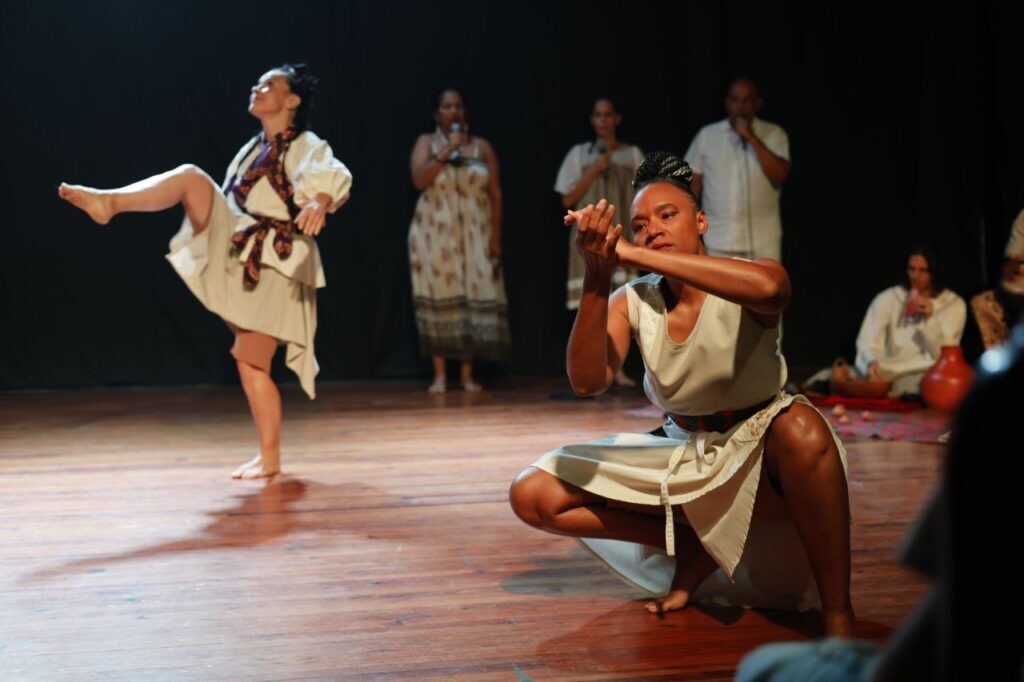
Meyby Ugueto-Ponce. (Venezuelanalysis)
Meyby Ugueto-Ponce is an Afro-Venezuelan activist, dancer, and researcher. She holds a Ph.D. in Anthropology and currently works at the Venezuelan Institute for Scientific Research (IVIC). In this interview, she addresses some of the main themes of her research, including structural racism in Venezuelan society, restorative justice, and the impact of the Bolivarian Revolution.
Many Venezuelans deny that there is systemic racism by reducing it to isolated incidents. How would you explain the ways in which racism operates in everyday life? What is the difference between everyday micro-racism and structural racism?
To address this topic in depth, we must examine the historical and political project that underpins it. The dominant, mainstream narrative on racism in Venezuela denies its existence. It claims that the colonial contradictions between “races”, which provided the cultural and historical foundation for who we are today, were overcome following the nineteenth-century independence struggle.
In our collective imagination, there is often this entrenched idea that the biological and cultural mixing that occurred among “Indigenous peoples,” “Africans,” and “Spaniards” during the colonial period generated a kind of “harmony” that erased the violence and the racial and economic hierarchies characteristic of more than 300 years of slavery and a caste-based society.
Another idea prevalent in Venezuela is that, having achieved the long-cherished republican dream and with Bolívar decreeing “equality among men,” it was believed that deepening this mixing would guarantee the harmony the future republic needed, giving rise to a “new man” superior to the three component parts.
The white political, intellectual, and economic elite has insisted that the fact that we established ourselves as a republic made us equal as citizens, without questioning that this same elite perpetuated social and economic hierarchies based on criteria of race, gender, and caste.
Furthermore, we Venezuelans have many times been told that we should thank the Europeans who arrived in the early decades of the twentieth century for the country’s modernization, following the selective immigration policies such as the “February Program” of 1928. These policies were grounded in scientific positivism, which ascribed the essence of civilization, progress, and culture to the “white race.”
Faced with this “truth effect” constructed over centuries, what is the logical next step that can guarantee citizenship, inclusion, and acceptance of the population? Logically, it is to mix culturally and biologically in order to become part of the nation and a modern citizen.
And if the “seed” of citizenship lay with the “white race,” as claimed by Venezuelan intellectual Arturo Uslar Pietri, then what was the implied direction of that mixing? One that privileges whiteness, of course. That is, a veiled logic toward “whitening,” which simultaneously implies a rejection of African and Indigenous identities.

How did this construct evolve over the rest of the 20th century?
This dissociative narrative gained strength throughout most of the twentieth century, marked by an intense marginalization and denial of Indigenous and African identities, and at the same time a veiled glorification of whiteness. Just imagine: we were building the country, internalizing the values of European and later Anglo-Saxon whiteness in a disguised way, while silencing the other two components, which were understood as synonymous with backwardness.
Every institution, every administrative procedure, every university curriculum, every cultural policy, every public policy, every beauty standard, every food habit, every religious sentiment, every idea about care, about health, and so on, had to be modernized. In other words, it had to be “whitened” at the expense of the diverse and unique aspects inherited from the misnamed “primitive” African and Indigenous traditions.
Systemic racism was thus gradually established; it seeped into the collective imagination, into people’s emotions, and into the everyday and institutional relationships of Venezuelans. This results in racism flowing in a “naturalized” way through the veins of the country’s entities, coagulating in administrative procedures, in state bureaucracy, in the creation of belief practices, in the ways the deceased are laid to rest, in the conceptions of sport and beauty, in what is considered art, in what is deemed worthy of ridicule, and so on.
Racism is systemic because it circulates through the arteries of the state. And mestizaje is the mechanism created to “harmoniously” instill whiteness into society, not just in Venezuela but throughout the entire Latin American region.
What a contradiction, isn’t it? The psychological effects of this are very powerful, given that it involves a dissociation and denial of both the individual and society. That is why, when a person of African descent, for example, for whatever reason or due to culinary tradition, decides to bring their lunch to the office or school, and that lunch consists of foods typical of their region of origin, prepared using local methods rather than processed products, an uncomfortable situation can arise, one that may go unnoticed as micro-racism.
Something as simple as lunch can be questioned or made to seem exotic by others through the most common mechanism: the joke, which is considered harmless. The person in question may feel out of place, uncomfortable. They may wonder if no one else eats that way, if their way of eating is weird. Possible consequence: they stop bringing their lunch and instead go to fast-food chains or restaurants, or eat alone.
This is the mechanism of “whitening” at work. Although it may not appear to be violence, we are dealing with a form of micro-racism. It is a way of denying practices, aesthetics, care, and local knowledge surrounding food and, at the same time, with an unconscious encouragement to conform to behaviors and practices considered more modern.
This affects positive self-perception, leads to the devaluation of family wisdom, and causes local food practices to be forgotten. In other words, it fosters endoracism, the erosion of small-scale local economies based on Afro-family logic, and, at the same time, the strengthening of the logic of the globalized food system. It is deeply racist.
How can we present these issues to new generations?
It’s not easy, but the only way to teach it is to put it into practice in the situations that arise, since each one is different and unique; or to think about it structurally within the classroom, together with teachers, specialists, students, decision-makers, mothers, and others.
For example, when I worked with preschool and elementary school children through dance, I focused on conveying the importance of the country’s cultural diversity. I created a workbook featuring various traditional dances to help them learn the alphabet and understand the cultural practices associated with each of these forms of movement.
I also implemented an exercise in which participants must match magazine clippings featuring images of people with different skin tones, hair textures, eye colors, professions, and clothing with other magazine clippings depicting various objects, elements, and themes such as money, pots, airplanes, cars, landscapes, professions, tools, technologies, and so on.
The task is to associate the people with these objects. The goal is to uncover the associations participants make and the reasons behind them. I believe this brings to light the mental constructs surrounding gender, race, and class that lift the veil of racial mixing and make structural racism visible along with its everyday micro-racist manifestations.

“Restorative justice” has become an important element in the discourse and thinking of Afro-descendant peoples. Can you explain this concept?
To answer this question, the first thing we must consider is the meaning of “to restore.” Restoring, or repairing, is synonymous with fixing, amending, remedying harm, correcting an error, and making amends to the offended party. There are at least three premises from this definition:
- There is another person or entity who has caused harm, an injustice, or an offense to someone;
- In the face of harm, there are laws that classify it as a crime and determine who committed it; and
- The word “restore” is a verb that calls for actions that address the aggrieved party’s condition. In other words, those who cause harm commit an offense or crime that requires compensatory actions to improve the affected person’s circumstances.
In 2001, at the World Conference Against Racism held in Durban, South Africa, slavery and the transatlantic slave trade were declared crimes against humanity.
Furthermore, very recently, in March 2026, the UN General Assembly adopted a historic resolution, proposed by Ghana and earlier by the African Union, declaring that the transatlantic slave trade and the enslavement of Africans have been the most serious crime against humanity in history.
Faced with this historical truth, what must be done? We are talking about at least four centuries of a system and a logic of inhuman exploitation; about the systemic nature of the devaluation of individuals who were considered inferior, lacking in intellect, spirituality, and existence, and treated as property.
The normalization of these practices following the invention of “race” served to establish a hierarchy across all levels of society, leaving structural consequences for future generations in the form of accumulated dispossession and inequality.
Knowing this, what is the most urgent form of reparations demanded by the Afro-descendant people? I would say that we should overhaul the entire system, precisely because of what we discussed earlier regarding systemic racism. Racism is a global order of economic and subjective power.
However, we can make a list. After all, we have to start somewhere. First, of the 54 countries that abstained from voting this past March 2026 at the UN, the Western bloc and the countries directly involved in enslavement and the transatlantic slave trade (the United Kingdom, Spain, Portugal, France, the Netherlands, etc.) must issue a public apology, as Pope Leo XIV recently did on May 24, for the leading role the Catholic Church played in the crimes of colonization, the slave trade, and slavery.
Furthermore, these countries must develop joint policies and plans for material and symbolic reparations among nations, aimed at ending the perpetuation of the inequality that was institutionalized during 400 years of slavery and modernized over the following 200 years.
And in the case of Venezuela, what form would this restorative justice take?
In particular, Venezuela has a restorative agenda developed by social movements, intellectuals, institutions, Afro-Venezuelan communities, individuals, and others. It highlights several aspects, such as:
- Territory;
- Afro-Venezuelan epistemology, thought, and spirituality;
- The deracialization of the justice system; and
- Recognition as citizens in all dimensions, from legal rights, through culture, to public safety.
As an Afro-Venezuelan movement, we have highlighted two specific projects. One that directly addresses territorial reparations: the return of land to the people of Turiamo, Aragua State, who were displaced in 1957. On the other hand, a demand for reparations regarding symbolic memory linked to the right to justice and the recognition of Afro-Venezuelan thought and culture: clarifying the circumstances surrounding the death of the Madera Experimental Folkloric Group in 1980.
By all this, I mean that reparations must be understood as multidimensional and multilateral, involving specific actions by nation-states and concrete policies tailored to each territory, aimed at moral and economic compensation. This includes formal recognition of the affected individuals, as well as territorial, cultural, and political restitution, and the removal of economic and legal barriers that prevent the active participation of the Afro-descendant population.
At the same time, this must include a review of technologies that can improve education, health, security, and justice, while recognizing Afro-diasporic knowledge in the wake of the deliberate actions of the powers that perpetrated crimes against humanity.
For its part, Venezuela supports a reparations plan introduced by CARICOM (Caribbean Community) in 2014. At the same time, it is pursuing lines of research that, using specific and local data, can showcase the affected areas and the extent of the impact.
Recently, the Ministry of Science and Technology has funded research so that the Afro-Venezuelan people themselves can lead the process, which demonstrates greater awareness in understanding Afro-Venezuelan identity and the social debt owed to them, ensuring they are treated as citizens with full rights. Much remains to be done. An immediate step would be the inclusion of Afro-Venezuelans in the Constitution of the Bolivarian Republic of Venezuela.

Building on the example you mentioned earlier, and since it is a topic of your research, let us talk about “food racism.” How can we understand traditional Afro-Venezuelan cuisine as a space of memory, resistance, and justice?
I think the food sector is one of the least recognized as a site of racist attack because folkloric tradition is conflated with recognition, reparations, and redistribution. Examples include the label “traditional food” or the exoticization of cacao by luxury markets. Public validation does not eliminate racism. Rather, it can help conceal it. My goal is to show how the food system reproduces racism as a mechanism for accumulating privilege and dispossession.
I acknowledge the Afro-Venezuelan intellectual contribution to dishes such as Caracas-style asado negro, the versatility with which Afro-Venezuelan women use coconut, the Holy Week rice dish, and the complex concept of sazón [seasoning]. All of that exists, but it is not my focus as a researcher: I want to concentrate on how the historical structure of the food system, both globally and in Venezuela, is underpinned by hierarchies of race, class, and gender established since European colonization. This leads to the erasure, devaluation, and “whitening” not only of people but also of food-related knowledge and practices.
Monocultures such as sugarcane, cacao, and coffee consolidated the colonial order. White landowners and merchants exercised power over bodies, knowledge, and labor. The plantation economy extracted raw materials and subordinated people and spices to the European markets, shaping how food is produced, consumed, and valued, including health and food aesthetics. Despite this, Indigenous, Afro-descendant, and mestizo communities preserved agricultural techniques and knowledge, such as the conuco, and plant-based health practices, knowledge on which the elites depended even though they did not recognize it. Cacao is a symbolic case in point: it has organized material and symbolic inequality since the eighteenth century.
In this context of structural racism and inequality, what was the impact of the Bolivarian Revolution?
After the formal end of slavery and the wars of independence, the model did not change: capitalism maintained racial hierarchies in order to perpetuate itself. In the twentieth century, “modernization” and colonization policies favored white agricultural settlements, deepening inequality. The oil boom urbanized the economy and rebuilt it around rent, leading to massive food imports and stigmatizing of Afro-Venezuelan and Indigenous dietary practices as “backward,” thereby standardizing class-based consumption patterns.
The agrarian reform of the 1960s was limited. The crises of the late twentieth century and neoliberal measures widened inequality and led to uprisings such as the Caracazo [1989], demonstrating that modernization did not resolve the racial-class hierarchy.
The Bolivarian Revolution sought to reverse this model. Examples of such initiatives included the Seed Law, the Land Law, rural programs, and land titling for Afro-Venezuelan communities, all aimed at valuing ancestral knowledge and promoting food sovereignty. However, sanctions, corruption, and the logic of large-scale capitalism constrained these policies. The creation of the CLAP [subsidized food distribution program] in 2016 to alleviate shortages fostered imports with no nutritional controls, and the pandemic worsened access to food, hitting the working class, which is predominantly Afro, Indigenous, and mestizo, the hardest.
In the face of the crisis, families developed subsistence strategies: cutting back on meals, substituting staples with less nutritious options, resuming bartering and solidarity-based exchanges, buying directly from producers, and reviving ancestral recipes with high nutritional value. That is why I maintain that recognizing racism as a foundation of the food system explains current inequality and offers guidance on how to build food sovereignty. The ancestral knowledge of Indigenous peoples and Afro-Venezuelan communities embodies memory and resistance: these are practices of food, health, and territory that connect people to the land and pave the way toward food justice.