Afro-Venezuelans

Meyby Ugueto-Ponce: ‘Afro-Venezuelan Ancestral Knowledge Embodies Memory and Resistance’

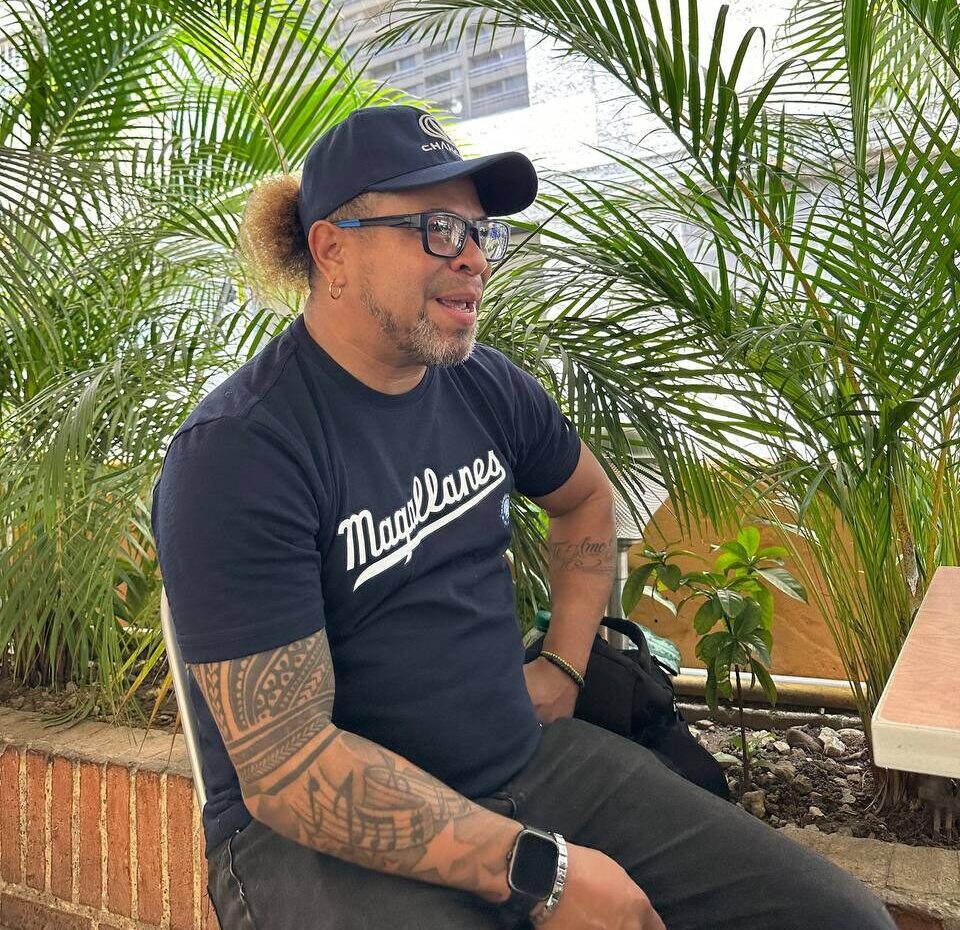
Meyby Ugueto-Ponce. (Venezuelanalysis)

Meyby Ugueto-Ponce is an Afro-Venezuelan activist, dancer, and researcher. She holds a Ph.D. in Anthropology and currently works at the Venezuelan Institute for Scientific Research (IVIC). In this interview, she addresses some of the main themes of her research, including structural racism in Venezuelan society, restorative justice, and the impact of the Bolivarian Revolution.

Many Venezuelans deny that there is systemic racism by reducing it to isolated incidents. How would you explain the ways in which racism operates in everyday life? What is the difference between everyday micro-racism and structural racism?

To address this topic in depth, we must examine the historical and political project that underpins it. The dominant, mainstream narrative on racism in Venezuela denies its existence. It claims that the colonial contradictions between “races”, which provided the cultural and historical foundation for who we are today, were overcome following the nineteenth-century independence struggle.

In our collective imagination, there is often this entrenched idea that the biological and cultural mixing that occurred among “Indigenous peoples,” “Africans,” and “Spaniards” during the colonial period generated a kind of “harmony” that erased the violence and the racial and economic hierarchies characteristic of more than 300 years of slavery and a caste-based society.

Another idea prevalent in Venezuela is that, having achieved the long-cherished republican dream and with Bolívar decreeing “equality among men,” it was believed that deepening this mixing would guarantee the harmony the future republic needed, giving rise to a “new man” superior to the three component parts.

The white political, intellectual, and economic elite has insisted that the fact that we established ourselves as a republic made us equal as citizens, without questioning that this same elite perpetuated social and economic hierarchies based on criteria of race, gender, and caste.

Furthermore, we Venezuelans have many times been told that we should thank the Europeans who arrived in the early decades of the twentieth century for the country’s modernization, following the selective immigration policies such as the “February Program” of 1928. These policies were grounded in scientific positivism, which ascribed the essence of civilization, progress, and culture to the “white race.”

Faced with this “truth effect” constructed over centuries, what is the logical next step that can guarantee citizenship, inclusion, and acceptance of the population? Logically, it is to mix culturally and biologically in order to become part of the nation and a modern citizen.

And if the “seed” of citizenship lay with the “white race,” as claimed by Venezuelan intellectual Arturo Uslar Pietri, then what was the implied direction of that mixing? One that privileges whiteness, of course. That is, a veiled logic toward “whitening,” which simultaneously implies a rejection of African and Indigenous identities.

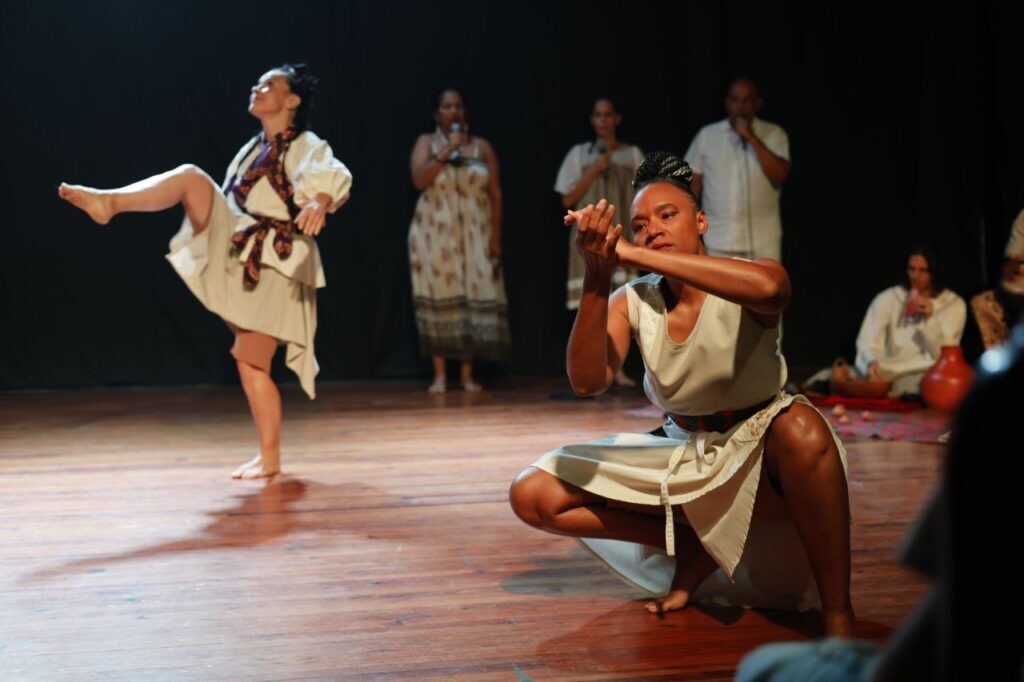
Ugueto-Ponce created and directed the Memorias Danzadas [Danced Memories] project.

How did this construct evolve over the rest of the 20th century?

This dissociative narrative gained strength throughout most of the twentieth century, marked by an intense marginalization and denial of Indigenous and African identities, and at the same time a veiled glorification of whiteness. Just imagine: we were building the country, internalizing the values of European and later Anglo-Saxon whiteness in a disguised way, while silencing the other two components, which were understood as synonymous with backwardness.

Every institution, every administrative procedure, every university curriculum, every cultural policy, every public policy, every beauty standard, every food habit, every religious sentiment, every idea about care, about health, and so on, had to be modernized. In other words, it had to be “whitened” at the expense of the diverse and unique aspects inherited from the misnamed “primitive” African and Indigenous traditions.

Systemic racism was thus gradually established; it seeped into the collective imagination, into people’s emotions, and into the everyday and institutional relationships of Venezuelans. This results in racism flowing in a “naturalized” way through the veins of the country’s entities, coagulating in administrative procedures, in state bureaucracy, in the creation of belief practices, in the ways the deceased are laid to rest, in the conceptions of sport and beauty, in what is considered art, in what is deemed worthy of ridicule, and so on.

Racism is systemic because it circulates through the arteries of the state. And mestizaje is the mechanism created to “harmoniously” instill whiteness into society, not just in Venezuela but throughout the entire Latin American region.

What a contradiction, isn’t it? The psychological effects of this are very powerful, given that it involves a dissociation and denial of both the individual and society. That is why, when a person of African descent, for example, for whatever reason or due to culinary tradition, decides to bring their lunch to the office or school, and that lunch consists of foods typical of their region of origin, prepared using local methods rather than processed products, an uncomfortable situation can arise, one that may go unnoticed as micro-racism.

Something as simple as lunch can be questioned or made to seem exotic by others through the most common mechanism: the joke, which is considered harmless. The person in question may feel out of place, uncomfortable. They may wonder if no one else eats that way, if their way of eating is weird. Possible consequence: they stop bringing their lunch and instead go to fast-food chains or restaurants, or eat alone.

This is the mechanism of “whitening” at work. Although it may not appear to be violence, we are dealing with a form of micro-racism. It is a way of denying practices, aesthetics, care, and local knowledge surrounding food and, at the same time, with an unconscious encouragement to conform to behaviors and practices considered more modern.

This affects positive self-perception, leads to the devaluation of family wisdom, and causes local food practices to be forgotten. In other words, it fosters endoracism, the erosion of small-scale local economies based on Afro-family logic, and, at the same time, the strengthening of the logic of the globalized food system. It is deeply racist.

How can we present these issues to new generations?

It’s not easy, but the only way to teach it is to put it into practice in the situations that arise, since each one is different and unique; or to think about it structurally within the classroom, together with teachers, specialists, students, decision-makers, mothers, and others.

For example, when I worked with preschool and elementary school children through dance, I focused on conveying the importance of the country’s cultural diversity. I created a workbook featuring various traditional dances to help them learn the alphabet and understand the cultural practices associated with each of these forms of movement.

I also implemented an exercise in which participants must match magazine clippings featuring images of people with different skin tones, hair textures, eye colors, professions, and clothing with other magazine clippings depicting various objects, elements, and themes such as money, pots, airplanes, cars, landscapes, professions, tools, technologies, and so on.

The task is to associate the people with these objects. The goal is to uncover the associations participants make and the reasons behind them. I believe this brings to light the mental constructs surrounding gender, race, and class that lift the veil of racial mixing and make structural racism visible along with its everyday micro-racist manifestations.

The activist explained how independence did not solve racism in Venezuela overnight. (Archive)

“Restorative justice” has become an important element in the discourse and thinking of Afro-descendant peoples. Can you explain this concept?

To answer this question, the first thing we must consider is the meaning of “to restore.” Restoring, or repairing, is synonymous with fixing, amending, remedying harm, correcting an error, and making amends to the offended party. There are at least three premises from this definition:

  1. There is another person or entity who has caused harm, an injustice, or an offense to someone;
  2. In the face of harm, there are laws that classify it as a crime and determine who committed it; and
  3. The word “restore” is a verb that calls for actions that address the aggrieved party’s condition. In other words, those who cause harm commit an offense or crime that requires compensatory actions to improve the affected person’s circumstances.

In 2001, at the World Conference Against Racism held in Durban, South Africa, slavery and the transatlantic slave trade were declared crimes against humanity.

Furthermore, very recently, in March 2026, the UN General Assembly adopted a historic resolution, proposed by Ghana and earlier by the African Union, declaring that the transatlantic slave trade and the enslavement of Africans have been the most serious crime against humanity in history.

Faced with this historical truth, what must be done? We are talking about at least four centuries of a system and a logic of inhuman exploitation; about the systemic nature of the devaluation of individuals who were considered inferior, lacking in intellect, spirituality, and existence, and treated as property.

The normalization of these practices following the invention of “race” served to establish a hierarchy across all levels of society, leaving structural consequences for future generations in the form of accumulated dispossession and inequality.

Knowing this, what is the most urgent form of reparations demanded by the Afro-descendant people? I would say that we should overhaul the entire system, precisely because of what we discussed earlier regarding systemic racism. Racism is a global order of economic and subjective power.

However, we can make a list. After all, we have to start somewhere. First, of the 54 countries that abstained from voting this past March 2026 at the UN, the Western bloc and the countries directly involved in enslavement and the transatlantic slave trade (the United Kingdom, Spain, Portugal, France, the Netherlands, etc.) must issue a public apology, as Pope Leo XIV recently did on May 24, for the leading role the Catholic Church played in the crimes of colonization, the slave trade, and slavery.

Furthermore, these countries must develop joint policies and plans for material and symbolic reparations among nations, aimed at ending the perpetuation of the inequality that was institutionalized during 400 years of slavery and modernized over the following 200 years.

And in the case of Venezuela, what form would this restorative justice take?

In particular, Venezuela has a restorative agenda developed by social movements, intellectuals, institutions, Afro-Venezuelan communities, individuals, and others. It highlights several aspects, such as:

  1. Territory;
  2. Afro-Venezuelan epistemology, thought, and spirituality;
  3. The deracialization of the justice system; and
  4. Recognition as citizens in all dimensions, from legal rights, through culture, to public safety.

As an Afro-Venezuelan movement, we have highlighted two specific projects. One that directly addresses territorial reparations: the return of land to the people of Turiamo, Aragua State, who were displaced in 1957. On the other hand, a demand for reparations regarding symbolic memory linked to the right to justice and the recognition of Afro-Venezuelan thought and culture: clarifying the circumstances surrounding the death of the Madera Experimental Folkloric Group in 1980.

By all this, I mean that reparations must be understood as multidimensional and multilateral, involving specific actions by nation-states and concrete policies tailored to each territory, aimed at moral and economic compensation. This includes formal recognition of the affected individuals, as well as territorial, cultural, and political restitution, and the removal of economic and legal barriers that prevent the active participation of the Afro-descendant population.

At the same time, this must include a review of technologies that can improve education, health, security, and justice, while recognizing Afro-diasporic knowledge in the wake of the deliberate actions of the powers that perpetrated crimes against humanity.

For its part, Venezuela supports a reparations plan introduced by CARICOM (Caribbean Community) in 2014. At the same time, it is pursuing lines of research that, using specific and local data, can showcase the affected areas and the extent of the impact.

Recently, the Ministry of Science and Technology has funded research so that the Afro-Venezuelan people themselves can lead the process, which demonstrates greater awareness in understanding Afro-Venezuelan identity and the social debt owed to them, ensuring they are treated as citizens with full rights. Much remains to be done. An immediate step would be the inclusion of Afro-Venezuelans in the Constitution of the Bolivarian Republic of Venezuela.

Afro-Venezuelan communities have preserved gastronomical traditions. (Miranda governorship)

Building on the example you mentioned earlier, and since it is a topic of your research, let us talk about “food racism.” How can we understand traditional Afro-Venezuelan cuisine as a space of memory, resistance, and justice?

I think the food sector is one of the least recognized as a site of racist attack because folkloric tradition is conflated with recognition, reparations, and redistribution. Examples include the label “traditional food” or the exoticization of cacao by luxury markets. Public validation does not eliminate racism. Rather, it can help conceal it. My goal is to show how the food system reproduces racism as a mechanism for accumulating privilege and dispossession.

I acknowledge the Afro-Venezuelan intellectual contribution to dishes such as Caracas-style asado negro, the versatility with which Afro-Venezuelan women use coconut, the Holy Week rice dish, and the complex concept of sazón [seasoning]. All of that exists, but it is not my focus as a researcher: I want to concentrate on how the historical structure of the food system, both globally and in Venezuela, is underpinned by hierarchies of race, class, and gender established since European colonization. This leads to the erasure, devaluation, and “whitening” not only of people but also of food-related knowledge and practices.

Monocultures such as sugarcane, cacao, and coffee consolidated the colonial order. White landowners and merchants exercised power over bodies, knowledge, and labor. The plantation economy extracted raw materials and subordinated people and spices to the European markets, shaping how food is produced, consumed, and valued, including health and food aesthetics. Despite this, Indigenous, Afro-descendant, and mestizo communities preserved agricultural techniques and knowledge, such as the conuco, and plant-based health practices, knowledge on which the elites depended even though they did not recognize it. Cacao is a symbolic case in point: it has organized material and symbolic inequality since the eighteenth century.

In this context of structural racism and inequality, what was the impact of the Bolivarian Revolution?

After the formal end of slavery and the wars of independence, the model did not change: capitalism maintained racial hierarchies in order to perpetuate itself. In the twentieth century, “modernization” and colonization policies favored white agricultural settlements, deepening inequality. The oil boom urbanized the economy and rebuilt it around rent, leading to massive food imports and stigmatizing of Afro-Venezuelan and Indigenous dietary practices as “backward,” thereby standardizing class-based consumption patterns.

The agrarian reform of the 1960s was limited. The crises of the late twentieth century and neoliberal measures widened inequality and led to uprisings such as the Caracazo [1989], demonstrating that modernization did not resolve the racial-class hierarchy.

The Bolivarian Revolution sought to reverse this model. Examples of such initiatives included the Seed Law, the Land Law, rural programs, and land titling for Afro-Venezuelan communities, all aimed at valuing ancestral knowledge and promoting food sovereignty. However, sanctions, corruption, and the logic of large-scale capitalism constrained these policies. The creation of the CLAP [subsidized food distribution program] in 2016 to alleviate shortages fostered imports with no nutritional controls, and the pandemic worsened access to food, hitting the working class, which is predominantly Afro, Indigenous, and mestizo, the hardest.

In the face of the crisis, families developed subsistence strategies: cutting back on meals, substituting staples with less nutritious options, resuming bartering and solidarity-based exchanges, buying directly from producers, and reviving ancestral recipes with high nutritional value. That is why I maintain that recognizing racism as a foundation of the food system explains current inequality and offers guidance on how to build food sovereignty. The ancestral knowledge of Indigenous peoples and Afro-Venezuelan communities embodies memory and resistance: these are practices of food, health, and territory that connect people to the land and pave the way toward food justice.
Source link

The Life Cycle Festivities in Venezuela (II): a Conversation with Rolando Canónico

A second delivery on the Cruz de Mayo and San Juan festivities. (Venezuelanalysis)

San Juan arrives at the Cruz de Mayo Wake

For this second installment of our work on Venezuela’s life cycle festivities (click here for part I), we present an in-depth conversation with the renowned Venezuelan musician, cultural practitioner, and percussionist Rolando Canónico. Together, we reflect on the immense responsibility of preserving Venezuelan traditions, specifically during festivals such as Cruz de Mayo and San Juan. From his dual role as a professional musician and cultural worker, Canónico addresses the tension between the commodification of music or competitive virtuosity and absolute respect for ancestral rhythmic and melodic patterns, defending the playing of the drum as an act of genuine devotion rather than a spectacle. He further delves into the powerful spiritual and syncretic connection he experiences when “dialoguing” with the instrument, underscoring his firm commitment to protecting and passing on this invaluable family and cultural heritage to new generations in Caracas.

A percussionist, drummer, and cultural creator, Canónico has participated in Fundación Bigott and renowned musical groups such as Caracas Sincrónica and Francisco Pacheco y su Pueblo. His trajectory is intertwined with a more discrete, yet vital, task: safeguarding Venezuelan musical memory. What began as a conversation between friends turned into a deep discussion about ethics, spirituality, and the responsibility of honoring the legacy of our ancestors in the twenty-first century.

Family and heritage: the weaving of a music lineage

To understand Rolando Canónico, one must look back at his ancestry. “My paternal grandparents passed away many years ago: Luisa Amelia Aponte de Canónico and Benito Canónico,” he recounts. Benito Canónico was the author of “El Totumo de Guarenas,” an important folk music composition. A musical heritage that flows through Rolando’s veins. However, as we delve into his role as a “host” of these festivities, Rolando turned his gaze toward his maternal lineage –to the women who, through the energy of daily life, kept the flame of devotion alive.

His story takes us to the Afinque Marín in the densely populated Afro-Venezuelan community of San Agustín, Caracas, where his maternal great-grandmother became a cultural bridge. “When that wave of people from Barlovento arrived –that migration boom from Barlovento to Caracas –she had the opportunity to be there when all these cultural expressions arrived,” he explained. It was there that, without any artistic pretensions, driven solely by faith, his great-grandmother began to adorn the Cruz de Mayo.

This responsibility passed to his grandmother, Rosa Emilia Pérez Sanz. “She embraced it as such,” Rolando told us, describing a pedagogical-community learning process where knowledge wasn’t taught in classrooms, but rather through observation and habits shared with neighbors. Music, for its part, was naturally incorporated through his mother, the founder of local band Los Tucusitos, blending Christmas carols with the fervor of the Cruz de Mayo vigil. For Rolando, that early exposure to music, combined with the discipline of his musical training, allowed him to turn a family passion into a profession.

A double celebration: a rite of transition and coming together

The celebration that Rolando Canónico holds at his home in La Pastora is not a one-off event, but rather part of a 43-year tradition that has been formally recognized by the Culture Ministry’s Institute of Cultural Heritage for the past 15 years. Every last Saturday in May, the house becomes the setting for a symbolic transition: the farewell to May, dedicated to Cruz de Mayo (May Cross), and welcoming June, the month of San Juan.

The logistical effort is monumental. “It’s not just a matter of sitting there, shouting some stuff, and that’s it,” Rolando emphasized. The process begins days in advance, with the presentation of newborn children and spiritual cleansings. Rather than merely attending as spectators, the community becomes an active participant: “People already know when it is; they don’t even ask anymore –they just show up with a small bouquet of flowers, a candle, fruit, or even a kilo of vegetables for the soup.”

The masterfully designed altar serves both festivities. “We make one, but it also serves as decoration for both,” explained Rolando, describing a symbolic overlap where the Cross is moved aside to make way for San Juan. This is the moment when devotion becomes tangible.

One of the most tense and beautiful moments of the night is the ritual procession. When San Juan arrives, the Cross, guarded by its devotees, seems to resist the change. “That encounter there, that clash, there comes a moment when San Juan announces that he’s going to come out, and the Cross doesn’t want him to,” Rolando tells us with the intensity of someone who has deeply witnessed that “struggle.”

To manage this tension, Rolando delegates to a decimista [poet], who acts as a mediator. He not only sings but also has the authority to say “He said it right!” at the precise moment when the euphoria outside the house reaches its climax. It’s a necessary exercise in control: “I have to do it this way because otherwise the whole thing turns into a conflict.” As the sirens* and golpes de tambor** intertwine, the cross at the altar gives way to the triumphal entry of San Juan, closing one portal to open another.

Rolando Canónico narrates the intensity of this coming together:

That encounter there, that clash, there comes a moment when San Juan announces that he’s coming out, and the Cross doesn’t want him to. So the devotees of the Cross hold their ground. It’s something beautiful, truly beautiful. Right there in that moment, with San Juan already coming down the stairs and the fulía [traditional rhythm] playing at the altar, the devotees form a circle so the fulía doesn’t stop. In the end it’s not a struggle but a meeting. The meeting where San Juan rises as he descends the stairs, already looking toward the Cross, and he’s trying to leave the house to welcome those who are coming. It’s as if he’s saying, “I’m letting you know that I’m on my way here.”

Regarding the energy that is unleashed when the festival reaches its peak with the arrival of the San Juan statues, Canónico adds: “That’s the moment when the altar of the Cross begins to be dismantled, when all the crosses are removed to make way for San Juan.” “That clash there between the Cross and San Juan gives you a powerful feeling,” he continued. “And when the three San Juan statues meet in front of the house, I can’t even describe it…”

Responsibility toward our ancestors and their legacy

If there is something Rolando Canónico is known for, it is his intransigence toward shoddy work. In a world where the commodification of traditional music threatens to sever it from its roots, he stands as a bulwark.

“In my house, I don’t accept things done poorly.” For him, the drum is not an instrument for competition or for displaying empty virtuosity. “I’m not putting on a show. I’m fulfilling a family promise,” he emphatically clarifies. His authority within the festival doesn’t stem from arrogance, but from a deep understanding of and respect for the musical codes, styles, discipline, and rigor that his teachers instilled in him.

This rigor extends to his training of new generations. Rolando is fully aware of his role as a guide and seeks to prepare his nephew and other young people so that the tradition is not diluted by stage “improvisations.” It is a pedagogy by example: he inaugurates each drum, ensuring that the rhythmic foundation is consistent with what has been passed down for centuries.

Finally, the conversation heads into more intimate territory: the relationship between the musician-artist and the divine. When asked if he experiences an altered state of consciousness while playing, Rolando responds with overwhelming sincerity. “I am a devotee of San Juan the Baptist; I am a santero… my spirituality is deeply connected to the drum.”

For Canónico, there is no separation between the musician who reads the score and the practitioner who offers his prayer through the drum’s vibrations. “That’s the best spiritual cleansing there can be here –playing the drum the right way,” he affirms. “I say ‘the right way’ because with the drum, you have to communicate with it.”

This dialogue, this meeting between the sacred and the profane, is what makes the festival in La Pastora, in Rolando’s own words, a “formidable experience.” By the end of our interview, it’s clear that his work is not merely a tribute to the past, but a strategy for cultural re-existence. As our interviewee aptly summarized at the end of our meeting, the true responsibility of a cultural artist is to ensure that, when San Juan arrives at his doorstep, the drum sounds exactly as it should: with the truth of the ancestors and the strength of a future that, thanks to people like him, is guaranteed a place in Venezuela’s collective memory.

Notes

*Sirenas are a cappella songs with an octosyllabic quatrain meter used to express devotion to both the Cross and San Juan.

**Golpes de tambor refers to multiple rhythms where drums, usually in sets of three, are the main protagonists. From a melody standpoint, singers take turns between solos and choruses.

See below for more details on the festivities and the surrounding music.

Fabiola José is a Venezuelan singer. She has performed in countries across South America, Africa, Europe, and Asia. Her singles and albums are available on all digital platforms. She hosted and produced “Cantante y Sonante” for Radio Nacional de Venezuela. In 2018–2019, she created a series of videos for social media, published on her YouTube channel #HechoEnCasa. She holds a bachelor’s degree in Music from IUDEM, Caracas (2005); specialized under Maestro Tom Krause in Spain (2007); and an M.A. in Arts and Cultures of the South from UNEARTE, Venezuela (2020).

Fidel Barbarito is a Venezuelan musician and researcher, with a bachelor’s and master’s degrees in music and history, respectively. He teaches in the undergraduate and graduate programs at the National Experimental University of the Arts (UNEARTE). Together with Fabiola José, he promotes several musical projects aimed at disseminating traditional folk repertoires, integrating them with contemporary compositions inspired by these sounds. Joropo llanero. Parranda de reexistencia is one of his published essays.

The views expressed in this article are the authors’ own and do not necessarily reflect those of the Venezuelanalysis editorial staff.

Rolando Canónico. (Photo by Simón Barbarito)

Source link

The Life Cycle Festivities in Venezuela (I)

Venezuelan communities have wrested several festivities away from the Church. (Venezuelanalysis)

Black amber, all painted, white foam…
The rain sings, summer is over.
White foam… May flower.

“Flor de Mayo”, Otilio Galíndez

The Chakana path,
It is up and down, inside and out…

Water is synonymous with life, and rain is perhaps the metaphor through which Mother Earth conveys the importance of preserving, nurturing, and multiplying life on this planet. For the peoples of the South, May is a turning point. It brings the rainfall, and thus abundance is renewed. The wet season begins in these torrid regions of exuberant contrasts and excessive beauty. Everything sprouts, blooms, and matures.

In May, the night sky in the South allows us to behold the zenith of a constellation that holds immense value in the ancestral worldview of our peoples: the Southern Cross. This fixed constellation consists of Alpha Crucis, Gamma Crucis, Beta Crucis, Delta Crucis, and a fifth star, Epsilon Crucis, which, although not part of the main points, serves to distinguish it from the “False Cross.” 

Our Andean ancestry, which exerts a deep influence on all the Indigenous peoples of Abya Yala, identifies this constellation by the name Chakana, which can be translated as a ladder or bridge between the earthly and spiritual worlds. It means complementarity, harmony, and purpose, as well as a path for returning to the core. The Chakana is the organizational center of the Andean world and its entire sphere of influence, which is why it is the focus of numerous and diverse rituals, ceremonies, offerings, and festivals throughout these territories. 

From the moment of their arrival, the Spanish conquistadors were struck by the symbolic power, veneration, and cultural identity of the peoples of Abya Yala with the Chakana. This is why they suppressed all traditional knowledge and ritual symbols, imposing their Eurocentric worldview in the clearest demonstration of colonial epistemicide. Temples, codices, and sages were demolished, burned, tortured, and martyred in the name of Christianity, which came to replace the Southern Cross, a symbol of knowledge and life, with the Catholic Cross, as a condensed symbol of pain, domination, sacrifice, death, and the promise of resurrection.

In Venezuela, a series of daytime and nighttime ritual activities persist, drawing young people and adults alike, in cities and rural areas alike. Afro-Venezuelan peoples especially cherish these traditions. The celebrations of the Cruz de Mayo, San Isidro, San Pascual Bailón, Corpus Christi, San Antonio, San Juan, and San Pedro, among others, escape the Catholic liturgical calendar that continues to try to assimilate them. They are celebrations framed within those exuberant contrasts of excessive beauty that cause everything to sprout, bloom, and mature. These are the days in which the Venezuelan people celebrate the cycle of life and for which they have created music, dances, drinks, foods, costumes, and poetry that have transcended both the Catholic Church and its Inquisition as well as civil and military power, in a testament to the most committed re-existence.

Lighting the altar candles

Wakes (“velorios”) are community gatherings organized to honor the deceased, a saint, the Virgin Mary, the Baby Jesus, or the Cross. These gatherings are held to fulfill a vow or out of devotion, and they feature prayers, drinks, food, poetry, singing, and dancing.

The velorio is a popular tradition that goes beyond the institutional framework of the Catholic Church. In fact, as early as the Synodal Constitutions of the Bishopric of Venezuela and Santiago de León de Caracas of 1687, published by Bishop Diego de Baños y Sotomayor, these activities, which “attract large crowds” and in which “many indecencies and offenses against God are committed,” were prohibited under penalty of “Major Excommunication.” Certainly, the Church seized on these practices of profane worship of the madero (the wood) to imbue them with Christian meaning.

At the center of the velorio dedicated to the Cruz de Mayo (“May Cross”) stands an altar with a main cross and two smaller ones. These are crosses without the image of Christ, “dressed” with cloth, paper, and multicolored flowers. The altar and its surroundings are also decorated in harmony with the crosses, and the offerings of candles, fruits, food, and drinks are arranged in such a way as to celebrate the abundance of a countryside that turns green again at this time of year.

The church’s calendar states that May 3 marks the celebration of “The Finding of the Cross.” Therefore, on the night of May 2, vigils begin in all the eastern states, as well as in Guárico, Lara, Cojedes, Aragua, Yaracuy, Carabobo, Barinas, Apure, Portuguesa, Miranda, Falcón, and in the city of Caracas. People give thanks for health and the fertility of the land. In the central coastal region, where Afro-Venezuelan communities are present, sirenas and fulías are sung. In the llanos, three-voice tonos are performed. In the east, the rhythms include galerones, malagueñas, fulías, jotas, and punto y llanto. The decimistas (poets) make offerings in a circular formation and vie for the spotlight as the musicians and singers perform.

Cantos a la Cruz de Mayo | Live session | Venezuela Un Solo Pueblo

Dancing up and down in a cross 

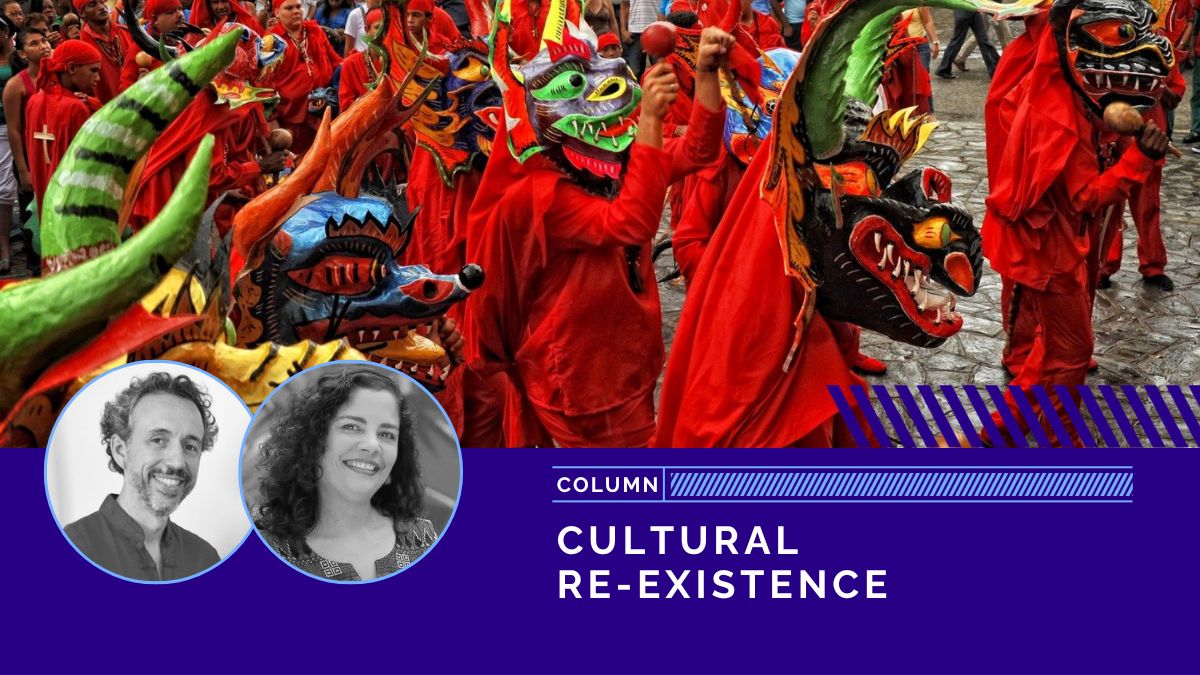
The Dancing Devils of Corpus Christi dance by forming a cross on the ground, to which they add new crosses with every turn, spiral, backward step, and leap. Each movement has a specific meaning and timing because the goal is to maintain order between the upper and lower realms, between complementary forces that must harmonize. Or, put more simply, to ensure that good prevails over evil.

The Incarnation of Christ in the Eucharist is a movable feast that occurs nine Thursdays after Holy Thursday. There are references to its celebration dating back to the third century in the Roman Empire. In 1350, it began to be celebrated in Barcelona with processions that reenacted the Devil’s defeat by the power of the Cross. In Venezuela –specifically in Ocumare de La Costa –there is evidence of Dancing Devils dating back to 1621, and although masked devils were present in many places, this practice survived only in the central region as a magical-religious ritual in the states of Aragua, Carabobo, Cojedes, Guárico, Miranda, and La Guaira.

The people, embodying the Devil, do not view the Evil One as a figure but as a concept. He is simply a force opposed to God. A revelrous, playful, and imperfect being. However, the promesero, dressed in colorful pants and a shirt, wearing masks of different sizes, shapes, and shades, which bear no resemblance to the European portrayal of the devil, protects himself with prayers, scapulars, bells, whips, and crosses that he carries as part of his attire. But his greatest protection is the insistent sign of the Cross he traces with the movements of his foot and the hand holding a maraca.

The cuatro or the caja (snare drum) are the instruments that accompany this celebration, depending on the community. Only in the town of Chuao are both used, though at different times. There is no singing, and the rhythms are performed with different beats that vary in intensity and speed. There are eleven Afro-Venezuelan lay brotherhoods or cofradías recognized as Intangible Cultural Heritage of Humanity by UNESCO, and each has a distinct musical identity linked to its spiritual environment.

Diablos danzantes de Corpus Christi

Beating the drums

Pipas, quitiplás, culos ‘e puya, minas, curbatas, cumacos, and maracas are the essential instruments with which the Venezuelan people celebrate the arrival of San Juan (John the Baptist), the most popular Catholic festival in seventeenth-century Spain that was brought over to preserve the identity of the conquistadors while simultaneously subjugating the Indigenous peoples and later the kidnapped and enslaved African peoples. Coinciding with the second cocoa harvest in these territories, the birth of John the Baptist, exactly six months after Jesus, became the figure of greatest devotion on the major slave-owning plantations along our country’s northern coast. 

San Juan is regarded by the people as a saint who charges for his miracles. He’s drinker of aguardiente, a dancer, and a reveler, which is why there is both a popular celebration and an institutional, Catholic one. It must be remembered that Black people were barred from entering the church until well into the nineteenth century. Today, depending on the town and the priest, drums may or may not be allowed inside the church. In any case, the popular celebration of San Juan involves dancing, singing, drumming, drinks, and food –all meant to reclaim a freedom that was historically limited to an extreme. For this reason, it was a celebration that was persecuted and punished with excommunication during the colonial period, as we saw in the above mentioned Synodal Constitutions.

The San Juan festival cycle begins on June 1 with the “Repique de San Juan.” Families, communities, and various organizations meet in advance to plan and assign responsibilities. It is a colorful celebration reflected in the participants’ attire, flags, and scarves. Women’s participation is essential, particularly in the singing that takes place during the sirenas, the sangueo, and the golpes. These songs accompany the individual dancing of those carrying the flags and the saint in the sangueo, which is part of a group dance, but also the dancing of individual couples and, to a lesser extent, of linked couples.

The songs to San Juan are, above all, responsorial, alternating between soloist and choir, often improvised. Each drum has its own “tonada” or way of singing it, and in each locality, even if the same drum is used, the way of playing it and the style of singing this or that beat may vary. They follow the African tradition of three-drum ensembles –interdependent and complementary –where polyrhythm is enhanced by the timbral qualities of each drum, with the lowest-pitched one taking the “lead,” providing the beats and embellishments. “The Saint is in the drum,” it is said, affirming the enduring relevance of the worldview of the Indigenous peoples of West Africa.

Fiestas en Honor a San Juan Bautista, Choroni Venezuela

¡Arriba negro!

With this call, a singer signals to his partner that it is their turn to sing, because in the bella, the galerón, and the seis figureao, consecutive duets of singers in two different voices (a third apart) take turns. Meanwhile, in the yiyivamos, the juruminga, the perrendenga, and the poco a poco, one singer improvises verses and a chorus responds. The so-called Sones de Negros are made up of seven songs. However, it all begins with La Salve, a solemn song in which permission and a blessing are sought from the saint to begin the dance; once this is finished, the battle ensues, sung in two-part harmony and “danced” by two men with traditional stick-fighting. 

The dance in the bella and galerón consists of male-female couples who participate one after another in a free-form manner. The seis figureao features a choreographed dance by three couples performing intricate, intertwined movements and turns. In the yiyivamos, juruminga, perrendenga, and poco a poco, independent couples dance, executing figures and movements as directed by the singer. San Antonio presides over an altar beautifully adorned with flowers, fruits, candles, clubs, crosses, bread, and other foods. Musicians and singers stand facing the altar, and each time the dancers enter the circle, they bow to the saint as a sign of respect and gratitude.

The Baile de Negros or Sones de Negros may have originated in the vicinity of El Tocuyo, in the fertile valley irrigated by the Tocuyo river, where the sugarcane-producing slave plantations were located. Its characteristic sound comes from an ensemble of stringed instruments related to the Baroque and Renaissance guitar, known as the cinco, medio cinco, requinto, and cuatro. The master or most experienced player plays the cinco. The timbral variety of the instruments and the ornamentation of the requinto give this instrumental ensemble an unmistakable texture. 

In front of the saint stands the Tamunango or Tambor de Negro, a fundamental instrument constructed from a long, hollowed-out log, sized so that one musician can sit on it and play with their hands on its single head, while another strikes the wooden body with the drumsticks. The rest of the musicians are arranged around this instrument. A double-headed drum, a tambourine, and maracas complete this celebration, which is most popular in the states of Lara, Falcón, Yaracuy, and Portuguesa. Throughout June, with a focus on the 13th, these communities organize this traditional dance in homes, squares, streets, and fields -a celebration that cannot end without a sancocho (wood fire, community-prepared stew)  soup) and a glass of cocuy de penca (agave-derived drink).

Siete Sones – Sones de Negros (Tamunangue)

Stomp on the boss!

The San Pedro festival is perhaps one of the most complex. Certainly, it is part of the cycle of life celebrations, featuring music, dance, food, and drink specially prepared as an offering to the saint. But as a kind of narrative that highlights Peter’s benevolence, there is the story of the enslaved María Ignacia, who, desperate over her daughter Rosa Ignacia’s illness, offered the deity an annual celebration. Once the miracle was fulfilled, María Ignacia danced until the last day of her life, and on her deathbed asked her husband to keep the promise. That is why a man in drag, carrying a rag doll in his arms, reenacts today the promise that María Ignacia’s husband made to his wife.

The cuatro and maracas are the accompanying instruments, and there may be many of them providing harmonic and rhythmic support to a soloist, which are answered by a chorus from the audience. The latter either joins in or simply watches this parranda as it winds its way through the streets of Guatire and Guarenas (outskirts of Caracas), starting from the church and making strategic stops at the homes of the revelers, the headquarters of the cofradías, and other points of interest.

Although there is no dramatized performance, during the procession there are characters in costume with carefully assigned roles, performing specific actions to convey the story of the miracle that was granted.

It is a distinctly joyful celebration. In the lyrics, music, and dance, there is a feeling of gratitude for favors received. This festive nature does not mean a loss of conscience. The Parranda de San Pedro carries a very powerful symbolic weight that recalls the use of irony and theatrics as a tool of clandestine insurgency, allowing people to denounce oppression and express their own identity as human dignity. When they sing: “With the cotiza [sandal], stomp the earth / turn it to dust without mercy…” and suddenly switch earth (“terrón”) for “boss” (“patrón”), it becomes perfectly clear what they are talking about.

La parranda de San Pedro de Guarenas y Guatire

The candles remain lit in the collective memory altar and the music continues to sound. After following the path of the Southern Cross and the beats of existence, the Chakana route has another stop. In the upcoming delivery of this column, we will go deep into the heart of these festivities in their wonderful displays of cyclicity, complementarity, and interconnectedness.

Fabiola José is a Venezuelan singer. She has performed in countries across South America, Africa, Europe, and Asia. Her singles and albums are available on all digital platforms. She hosted and produced “Cantante y Sonante” for Radio Nacional de Venezuela. In 2018–2019, she created a series of videos for social media, published on her YouTube channel #HechoEnCasa. She holds a bachelor’s degree in Music from IUDEM, Caracas (2005); specialized under Maestro Tom Krause in Spain (2007); and an M.A. in Arts and Cultures of the South from UNEARTE, Venezuela (2020).

Fidel Barbarito is a Venezuelan musician and researcher, with a bachelor’s and master’s degrees in music and history, respectively. He teaches in the undergraduate and graduate programs at the National Experimental University of the Arts (UNEARTE). Together with Fabiola José, he promotes several musical projects aimed at disseminating traditional folk repertoires, integrating them with contemporary compositions inspired by these sounds. Joropo llanero. Parranda de reexistencia is one of his published essays.

The views expressed in this article are the authors’ own and do not necessarily reflect those of the Venezuelanalysis editorial staff.

Source link

Racism in Venezuela? A Question No One Wants to Answer

The Day of Venezuelan Afro-Descendance celebrates José Leonardo Chirino’s uprising against the Spanish crown in 1795. (Venezuelanalysis)

“In my humble opinion, you have never known how to make coffee or Negroes. The former you leave too light, the latter too black.”

– Venezuelan poet and politician Andrés Eloy Blanco to US visitors, 1944

Contemporary racist attitudes in Venezuela have deep roots in the colonial period (sixteenth to nineteenth centuries). After independence, Venezuela constructed a national narrative that claimed to have overcome racism through miscegenation. We were (are) a “café con leche” (coffee with milk) nation, a blend in which racial differences had dissolved. But this supposed harmony concealed a persistent idea: whiteness remained the ideal, while African and Indigenous identities were seen as something to be diluted and gradually eliminated. 

This whitening process was not only biological, but also cultural and political. Paradoxically, racism in Venezuela became invisible to those who practiced it and even to those who suffered from it, masked under the pretext that “here we are all mestizos.” However, we have seen that when political conflicts intensify, the mask of mestizaje falls away and colonial prejudices resurface. 

The origin of an ideology

Although the validity of the term “race” has been questioned – on the grounds that we all belong to the human race and differ only in phenotypic traits – according to Venezuelan historian Luis Felipe Pellicer, “…if racism exists, race exists,” but only as an ideological construct of domination, and by no means as a scientific truth.

Racism emerged in Venezuela as a result of an exploitative and extractive economy that created a need for enslaved labor. Initially, this labor force consisted of Indigenous people and was later supplemented by individuals brought from the Atlantic coast of Africa. Countries such as present-day Ghana, Togo, Benin, Angola, and the Republic of the Congo were particularly affected. 

Now, the issue of slavery in Africa has deeper roots that warrant a more comprehensive examination, but in the Americas this system underwent a transformation, and what began as an economic activity ultimately established ideas that created negative associations around those subjected to slavery, thereby inventing the political and social category of “blackness.” By merging the condition of slavery with skin pigmentation into a single concept, the colonial mindset ended up stigmatizing every cultural and vital expression of these groups, considering them inferior, ugly, and despicable.

One of the characteristics of enslavement in the Americas was dehumanization and its racial justification. That is to say, here the idea of enslavement due to war or debt repayment was abandoned. The automatic association was: you are a slave because you are a Black African, and vice versa. This phenomenon created the idea that all Africans and their descendants were predestined for servitude and forced labor. 

The racist backlash

The recent incident in Madrid that saw supporters of far-right leader María Corina Machado shout slogans against Venezuelan Acting President Delcy Rodríguez reflects a deep social divide. Sectors of the opposition who identify – whether phenotypically or aspirationally – with a Eurocentric worldview and the ideal of “whiteness” believe that the exercise of power by groups they associate with or perceive as people of African descent constitutes a historical affront. For decades before the Bolivarian Revolution, epithets like “monkey,” “mulatto,” “zambo,” “bembón,” and “bad hair,” among others, paraded across TV screens and in the national press with complete normality and often disguised as jokes – another mechanism for propagating Venezuelan racism. Following his government’s post-2001 radicalization of revolutionary reforms, Hugo Chávez was himself notoriously called a “monkey” and prominently caricatured as such by Venezuela’s right-wing opposition.

It is no surprise, then, that the presence of figures such as Venezuela’s current acting president transcends the issue of political ideology to constitute a rupture in “quality,” a term used in eighteenth-century Venezuela. “What is quality or race?” asks Pellicer. “It is an idea of inferiority regarding a human group that is transmitted, corporeally, through sexual reproduction.” It is an affront, then, to the natural order of things, to the pyramid of colonial society that placed peninsular Spaniards at the apex and people of African descent at the base. 

With the chant “Fuera la mona” (“Out with the monkey”), the Venezuelan far-right hurled an insult that reveals their undemocratic nature. But more importantly, these insults are not even linked to any incompetence in governance, but rather to what these groups perceive as “racial incompetence.” It is the expression of a wounded “whiteness” that uses racism as a defense mechanism against what they see as a displacement of their traditional privileges. It is, in essence, an attempt to restore a colonial order. 

Racism is a power structure. “Colonial thought,” Pellicer observes, “invents the other, whether Indigenous, mestizo, mulatto, or Black, as well as the white self … thereby establishing the ideology of race as the primary marker of inequality, beginning with the invasion of the Americas.” The struggle for honor in the colony was a struggle for differentiation and political recognition. Today, the “animalization” of non-white political leaders is the continuation of that colonial war, which is why the Madrid slur is not a simple rudeness; it is an act of historical violence. It is the voice of the eighteenth century trying to silence the twenty-first. And at this point, one must ask: what is admirable about the idea that, based on skin color, some are more or less fit to govern a country? 

The slave owner/racist does not see a person; he sees a tool, a piece of property, and for this to happen, the mind must adopt a psychopathic and callous mindset. The racist needs to strip the oppressed of their status as subjects in order to invoke a visceral fear of otherness that, if acknowledged, threatens their illusion of superiority. Choosing to be part of this ideological operation of domination today should be a source of shame, for it is the most glaring expression of a violence that heralds the end of humanity.

From Cortés to Díaz Ayuso

This exclusionary mindset is part of a transatlantic trend toward neocolonial revival that seeks to re-legitimize old hierarchies. A telling example is Spanish right-wing politician Isabel Díaz Ayuso’s recent visit to Mexico, where her proposal to celebrate the figure of Hernán Cortés serves as an ideological parallel to the “Fuera la mona” chants heard in Madrid. By attempting to portray the invasion and genocide in the Americas as a “civilizing” feat, Ayuso revives the logic of the “society of qualities”: a structure where moral and political superiority is an exclusive Hispanic and white inheritance, while Indigenous and Afro-descendant peoples are reduced to a state of barbarism remediable only through paternalistic tutelage.

This narrative is not merely a historical debate, but a contemporary validation of the racial hierarchy and justification for overthrowing processes of popular sovereignty in Latin America. Ayuso’s discourse seeks to reaffirm a “Hispanic identity” that views ethnic otherness as a threat to the values of Western civilization. In this sense, what happened in Madrid is a clear symptom of the reactionary neo-fascist wave sweeping large parts of the Global North and South.

Racist remarks

The trauma of Venezuela’s War of Independence (1810–1830) and the Federal War (1859–1863) created the need to invent a narrative in which Venezuelan society was free of conflicts and differences, and thus the persistence of racial and social tensions has been glossed over. However, it resurfaces in comments such as: “Fuera la mona”; “We need to improve the race”; “Black but refined”; “Money whitens.” 

In 1948, conservative writer Arturo Uslar Pietri responded to Rómulo Gallegos’s presidential campaign by stating: “Anyone who speaks of blacks or whites, anyone who invokes racial hatred or privileges, denies the essence of Venezuela. In Venezuela, in political and social matters, there are neither whites nor blacks, neither mestizos nor Indigenous people. There are only Venezuelans .” This argument was almost exactly the same as that put forward by María Corina Machado when asked about the event at La Puerta del Sol, stating that it had occurred because of the fissures of hatred that Chavismo introduced into its discourse over 27 years in power. 

The end of denial

As part of the commemoration of the Day of Venezuelan Afro-Descendance, established under the Hugo Chávez government in 2005 to be celebrated every May 10 [on the anniversary of the 1795 slave uprising led by José Leonardo Chirino], it is both pertinent and necessary to reflect on and understand that racism in Venezuela is a long-standing phenomenon that surfaces with particular virulence during times of political crisis. The historical association between power and whiteness, inherited from the colonial era and reinforced by twentieth-century positivist thought, remains alive in the minds of sections of society that refuse to accept the nation’s diversity, including among working-class communities through what is known as endoracism. 

Understanding the origin of this phenomenon is the first step toward dismantling it. We must move from the false harmony of “café con leche” to true decolonial justice, where a person’s “quality” is not dictated by their “whiteness.” The Madrid incident reminds us that the battle for Venezuela’s mental independence far from over.

Rosanna Álvarez holds an MSc in History of Republican Venezuela from the Central University of Venezuela (UCV). She is a researcher at the Centro de Estudios Simón Bolívar and Fundación Hugo Chávez, as well as a writer at the Libertador 8 Estrellas magazine. She is the author of Venezuela vista e imaginada. Un recorrido visual por nuestra historia and host of the Bolívar Nuestro show on Radio del Sur.

The views expressed in this article are the author’s own and do not necessarily reflect those of the Venezuelanalysis editorial staff.

Source link

Racism in Venezuela? A Question No One Wants to Answer

The Day of Venezuelan Afro-Descendance celebrates José Leonardo Chirino’s uprising against the Spanish crown in 1795. (Venezuelanalysis)

“In my humble opinion, you have never known how to make coffee or Negroes. The former you leave too light, the latter too black.”

– Venezuelan poet and politician Andrés Eloy Blanco to US visitors, 1944

Contemporary racist attitudes in Venezuela have deep roots in the colonial period (sixteenth to nineteenth centuries). After independence, Venezuela constructed a national narrative that claimed to have overcome racism through miscegenation. We were (are) a “café con leche” (coffee with milk) nation, a blend in which racial differences had dissolved. But this supposed harmony concealed a persistent idea: whiteness remained the ideal, while African and Indigenous identities were seen as something to be diluted and gradually eliminated. 

This whitening process was not only biological, but also cultural and political. Paradoxically, racism in Venezuela became invisible to those who practiced it and even to those who suffered from it, masked under the pretext that “here we are all mestizos.” However, we have seen that when political conflicts intensify, the mask of mestizaje falls away and colonial prejudices resurface. 

The origin of an ideology

Although the validity of the term “race” has been questioned – on the grounds that we all belong to the human race and differ only in phenotypic traits – according to Venezuelan historian Luis Felipe Pellicer, “…if racism exists, race exists,” but only as an ideological construct of domination, and by no means as a scientific truth.

Racism emerged in Venezuela as a result of an exploitative and extractive economy that created a need for enslaved labor. Initially, this labor force consisted of Indigenous people and was later supplemented by individuals brought from the Atlantic coast of Africa. Countries such as present-day Ghana, Togo, Benin, Angola, and the Republic of the Congo were particularly affected. 

Now, the issue of slavery in Africa has deeper roots that warrant a more comprehensive examination, but in the Americas this system underwent a transformation, and what began as an economic activity ultimately established ideas that created negative associations around those subjected to slavery, thereby inventing the political and social category of “blackness.” By merging the condition of slavery with skin pigmentation into a single concept, the colonial mindset ended up stigmatizing every cultural and vital expression of these groups, considering them inferior, ugly, and despicable.

One of the characteristics of enslavement in the Americas was dehumanization and its racial justification. That is to say, here the idea of enslavement due to war or debt repayment was abandoned. The automatic association was: you are a slave because you are a Black African, and vice versa. This phenomenon created the idea that all Africans and their descendants were predestined for servitude and forced labor. 

The racist backlash

The recent incident in Madrid that saw supporters of far-right leader María Corina Machado shout slogans against Venezuelan Acting President Delcy Rodríguez reflects a deep social divide. Sectors of the opposition who identify – whether phenotypically or aspirationally – with a Eurocentric worldview and the ideal of “whiteness” believe that the exercise of power by groups they associate with or perceive as people of African descent constitutes a historical affront. For decades before the Bolivarian Revolution, epithets like “monkey,” “mulatto,” “zambo,” “bembón,” and “bad hair,” among others, paraded across TV screens and in the national press with complete normality and often disguised as jokes – another mechanism for propagating Venezuelan racism. Following his government’s post-2001 radicalization of revolutionary reforms, Hugo Chávez was himself notoriously called a “monkey” and prominently caricatured as such by Venezuela’s right-wing opposition.

It is no surprise, then, that the presence of figures such as Venezuela’s current acting president transcends the issue of political ideology to constitute a rupture in “quality,” a term used in eighteenth-century Venezuela. “What is quality or race?” asks Pellicer. “It is an idea of inferiority regarding a human group that is transmitted, corporeally, through sexual reproduction.” It is an affront, then, to the natural order of things, to the pyramid of colonial society that placed peninsular Spaniards at the apex and people of African descent at the base. 

With the chant “Fuera la mona” (“Out with the monkey”), the Venezuelan far-right hurled an insult that reveals their undemocratic nature. But more importantly, these insults are not even linked to any incompetence in governance, but rather to what these groups perceive as “racial incompetence.” It is the expression of a wounded “whiteness” that uses racism as a defense mechanism against what they see as a displacement of their traditional privileges. It is, in essence, an attempt to restore a colonial order. 

Racism is a power structure. “Colonial thought,” Pellicer observes, “invents the other, whether Indigenous, mestizo, mulatto, or Black, as well as the white self … thereby establishing the ideology of race as the primary marker of inequality, beginning with the invasion of the Americas.” The struggle for honor in the colony was a struggle for differentiation and political recognition. Today, the “animalization” of non-white political leaders is the continuation of that colonial war, which is why the Madrid slur is not a simple rudeness; it is an act of historical violence. It is the voice of the eighteenth century trying to silence the twenty-first. And at this point, one must ask: what is admirable about the idea that, based on skin color, some are more or less fit to govern a country? 

The slave owner/racist does not see a person; he sees a tool, a piece of property, and for this to happen, the mind must adopt a psychopathic and callous mindset. The racist needs to strip the oppressed of their status as subjects in order to invoke a visceral fear of otherness that, if acknowledged, threatens their illusion of superiority. Choosing to be part of this ideological operation of domination today should be a source of shame, for it is the most glaring expression of a violence that heralds the end of humanity.

From Cortés to Díaz Ayuso

This exclusionary mindset is part of a transatlantic trend toward neocolonial revival that seeks to re-legitimize old hierarchies. A telling example is Spanish right-wing politician Isabel Díaz Ayuso’s recent visit to Mexico, where her proposal to celebrate the figure of Hernán Cortés serves as an ideological parallel to the “Fuera la mona” chants heard in Madrid. By attempting to portray the invasion and genocide in the Americas as a “civilizing” feat, Ayuso revives the logic of the “society of qualities”: a structure where moral and political superiority is an exclusive Hispanic and white inheritance, while Indigenous and Afro-descendant peoples are reduced to a state of barbarism remediable only through paternalistic tutelage.

This narrative is not merely a historical debate, but a contemporary validation of the racial hierarchy and justification for overthrowing processes of popular sovereignty in Latin America. Ayuso’s discourse seeks to reaffirm a “Hispanic identity” that views ethnic otherness as a threat to the values of Western civilization. In this sense, what happened in Madrid is a clear symptom of the reactionary neo-fascist wave sweeping large parts of the Global North and South.

Racist remarks

The trauma of Venezuela’s War of Independence (1810–1830) and the Federal War (1859–1863) created the need to invent a narrative in which Venezuelan society was free of conflicts and differences, and thus the persistence of racial and social tensions has been glossed over. However, it resurfaces in comments such as: “Fuera la mona”; “We need to improve the race”; “Black but refined”; “Money whitens.” 

In 1948, conservative writer Arturo Uslar Pietri responded to Rómulo Gallegos’s presidential campaign by stating: “Anyone who speaks of blacks or whites, anyone who invokes racial hatred or privileges, denies the essence of Venezuela. In Venezuela, in political and social matters, there are neither whites nor blacks, neither mestizos nor Indigenous people. There are only Venezuelans .” This argument was almost exactly the same as that put forward by María Corina Machado when asked about the event at La Puerta del Sol, stating that it had occurred because of the fissures of hatred that Chavismo introduced into its discourse over 27 years in power. 

The end of denial

As part of the commemoration of the Day of Venezuelan Afro-Descendance, established under the Hugo Chávez government in 2005 to be celebrated every May 10 [on the anniversary of the 1795 slave uprising led by José Leonardo Chirino], it is both pertinent and necessary to reflect on and understand that racism in Venezuela is a long-standing phenomenon that surfaces with particular virulence during times of political crisis. The historical association between power and whiteness, inherited from the colonial era and reinforced by twentieth-century positivist thought, remains alive in the minds of sections of society that refuse to accept the nation’s diversity, including among working-class communities through what is known as endoracism. 

Understanding the origin of this phenomenon is the first step toward dismantling it. We must move from the false harmony of “café con leche” to true decolonial justice, where a person’s “quality” is not dictated by their “whiteness.” The Madrid incident reminds us that the battle for Venezuela’s mental independence far from over.

Rosanna Álvarez holds an MSc in History of Republican Venezuela from the Central University of Venezuela (UCV). She is a researcher at the Centro de Estudios Simón Bolívar and Fundación Hugo Chávez, as well as a writer at the Libertador 8 Estrellas magazine. She is the author of Venezuela vista e imaginada. Un recorrido visual por nuestra historia and host of the Bolívar Nuestro show on Radio del Sur.

The views expressed in this article are the author’s own and do not necessarily reflect those of the Venezuelanalysis editorial staff.

Source link