Protesters in about 20 cities, including Berlin, Hamburg and Munich, demand the banning of the Alternative for Germany.
Published On 12 Sep 202612 Sep 2026
Tens of thousands of people took to the streets across Germany to protest against the Alternative for Germany (AfD) after the far-right party won a state election by a landslide.
About 150,000 demonstrators turned out in roughly 20 cities on Saturday, including Berlin, Hamburg and Munich, in rallies organised by Pruef, a campaign group pushing for a ban on the AfD.
Recommended Stories
list of 3 itemsend of list
Protesters carried signs reading “Ban the AfD now” and “Democracy needs no alternatives.”
“A broad cross-section of civil society is taking to the streets to prevent the enemies of the constitution … from gaining government power,” said Christoph Bautz, head of Campact, another campaign group involved in the protests, which put turnouts at about 25,000 in Hamburg and 12,000 in Munich.
According to police, several thousand more joined separate demonstrations in Berlin.
The AfD held its own counter-rally in the German capital, attended by Kristin Brinker, the party’s lead candidate for Berlin’s upcoming regional election.
The protests follow a stunning result for the AfD in Saxony-Anhalt, a state in eastern Germany, where the party took nearly 44 percent of the vote on September 6 — far ahead of the roughly 17 percent won by Chancellor Friedrich Merz’s Christian Democratic Union (CDU), which has long dominated German politics.
The AfD, known for its anti-immigration stance and friendly posture towards Russia, fell just short of an outright majority and is now in talks with other parties to try to form a government, which would make it the first far-right party to lead a German state since the Nazi era ended in 1945.
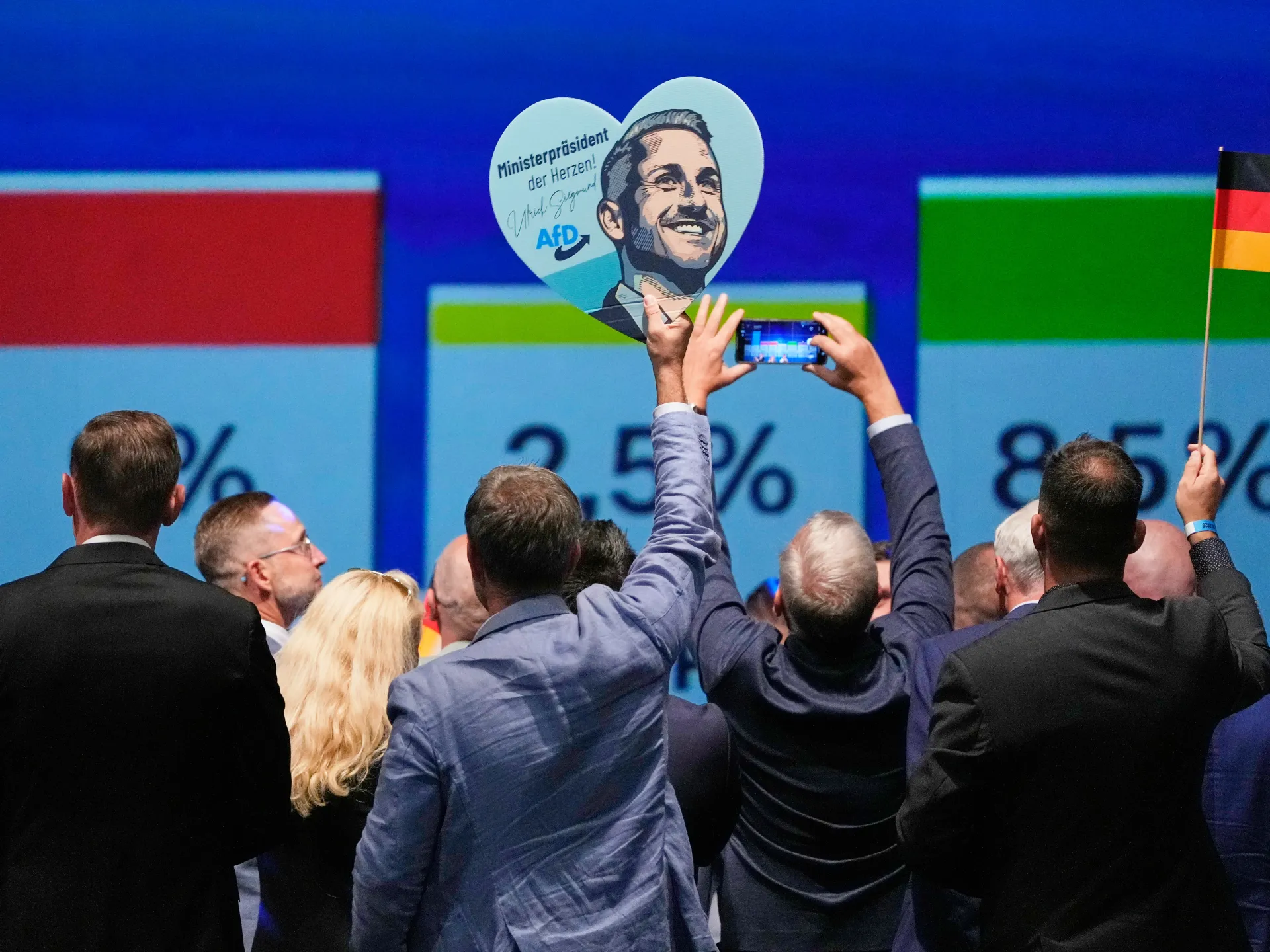
AfD state leader Ulrich Siegmund called the result historic, telling supporters: “The people have made it absolutely clear that they finally want political change and, above all, they have shown that they want it with us.” He has since signalled openness to working with other parties, after previously saying he wanted to govern alone.
The AfD’s growing strength has deeply unsettled many Germans, given the country’s history and its commitment to never repeating it.
The party is projected to win 39 of 83 seats in the state parliament, three short of a majority. It now needs a coalition partner, though all mainstream parties have so far refused to govern with the AfD under a longstanding policy known as the “firewall.” The far-right party has never joined a governing coalition anywhere in Germany, at either state or national level.
The unease has fuelled growing calls to ban the AfD altogether, though that would be legally difficult in Germany, and Chancellor Merz has been reluctant to pursue it.
For the first time since World War II, a far-right party is within reach of power at state level in Germany, after coming first in Saxony-Anhalt on Sunday.
The Alternative for Germany (AfD) won 44 percent of the vote, stopping short of an overall majority but making clear its wide political significance.
Recommended Stories
list of 3 itemsend of list
On election night, AfD’s leader in the state called on other political groups to cooperate. “As a democrat, I will reach out to all those who wish to work with us to bring about a fundamental political turnaround,” Ulrich Siegmund said.
Yet, forming a government will prove difficult. The AfD has been classified as “far-right extremist” by the domestic intelligence agency and other political groups remain wary of striking an alliance.
The AfD has dismissed accusations of extremism and mainstream parties have been unable to halt its surge in the polls over recent months. Latest polling indicates the party, which stands for strong restrictions on immigration, restoring ties with Russia, cutting support to Ukraine and quitting the euro, is Germany’s most popular at national level.
The Saxony-Anhalt election could be a harbinger of a historic return of the far-right in the 2029 national election, when forecasts say the AfD stands a realistic chance of finishing first.
What happened in Saxony-Anhalt?
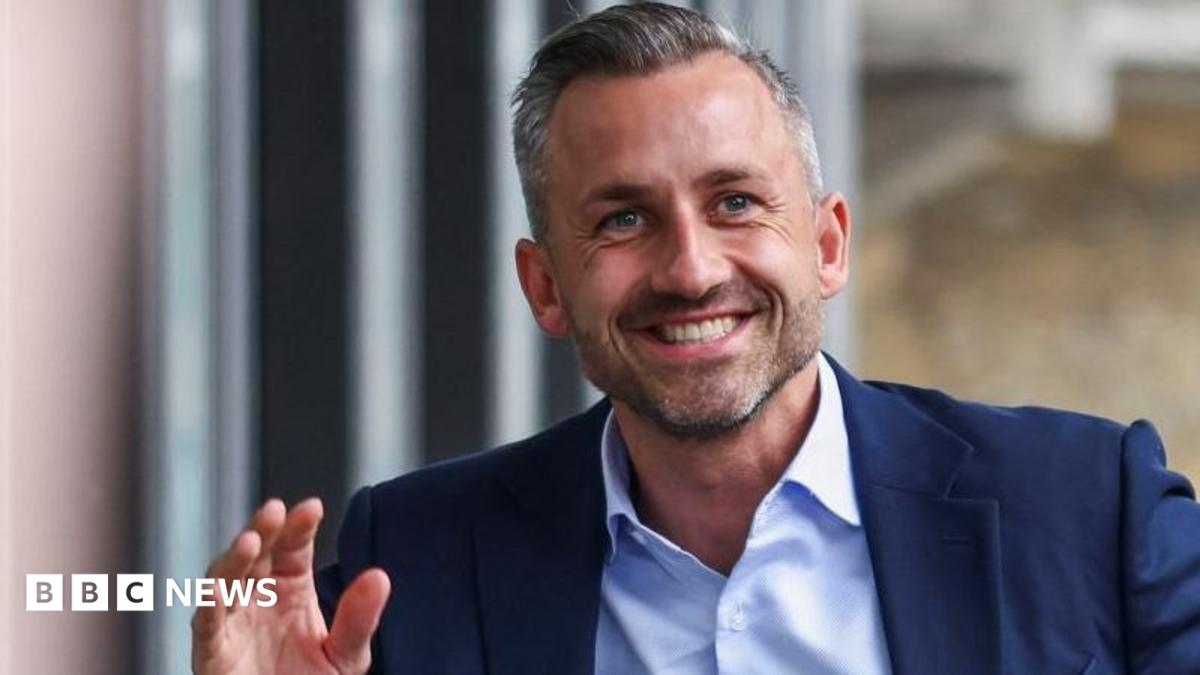
Siegmund, the charismatic 35-year-old who attracted thousands to his campaign rallies, said AfD “made history”.
“The people have made it absolutely clear that they finally want political change and, above all, they have shown that they want it with us,” he told supporters.
The AfD achieved its best-ever election result in Saxony-Anhalt with 44 percent of the vote, leaving all other parties far behind. The incumbent centre-right Christian Democrats (CDU), led by Chancellor Friedrich Merz, scored less than half of that share with 17 percent.
The AfD is projected to gain 39 of the 83 seats in the state parliament in Magdeburg, leaving it three short of the 42 needed for an absolute majority.
That means the party must find allies, but all other mainstream parties refuse to work with the far-right, a strategy of non-cooperation known as the “firewall”. The AfD has so far never participated in a governing coalition in Germany’s 16 states nor in its federal government.
While he now appears willing to strike deals with other parties to come to power, previously Siegmund signalled unwillingness to find middle ground with other political groups. Leading up to the vote, he stated that he was only interested in governing alone to bring about fundamental political change in Germany.
How did AfD fare in recent elections?
The election takes the AfD one step closer to advancing its agenda, while also reflecting the growing unpopularity of Germany’s ruling coalition.
In Saxony-Anhalt, the party more than doubled its vote share — from 21 percent in the last election. By contrast, the CDU’s vote halved from 37 percent to 17 percent, its worst result ever in the east-central German state.
Federal elections last year similarly resulted in a landmark performance by the AfD, which emerged as the largest opposition faction in the Bundestag, the German federal parliament in Berlin. The party came second with 21 percent of the vote, securing its highest-ever showing.
In state elections in Baden-Wurttemberg and Rhineland-Palatinate earlier this year too, the AfD more than doubled its seats — though it still finished third. In 2024, the AfD emerged victorious in the Thuringia state election and second in the Brandenburg state election — both were firsts for the party.
The AfD’s electoral gains in Saxony-Anhalt mirror growing dissatisfaction among voters — especially in the former East Germany — about the stagnant economy, high unemployment and domestic security, which the party largely pins on immigration.
What challenges lie ahead for AfD?
Since its formation in 2013, the AfD has been embroiled in various scandals and has faced major controversies, including alleged foreign espionage links, secret deportation plans and internal nepotism.
The party went from a fringe Eurosceptic group to the country’s most powerful opposition force in little more than a decade, becoming too extreme even for the European Parliament’s far-right Identity & Democracy group. It kicked the party out in May 2024 after lead AfD candidate Maximilian Krah stated that not everyone in the SS – Adolf Hitler’s infamous Nazi paramilitary organisation – was a criminal.
Krah has also been under investigation by German prosecutors for alleged illegal payments, bribery and money laundering linked to China and Russia. The German parliament last year decided to lift the far-right legislator’s immunity to help investigators.
AfD politicians have also come under fire for employing family members, including in Saxony-Anhalt, where several parliamentarians are reported to have employed relatives.
Bundestag President, Julia Klockner, banned seven AfD employees from entering the German parliament over security concerns, after they failed internal background reliability checks due to their ties to right-wing extremist networks and past criminal convictions.
Senior AfD figures also faced a backlash for attending a secretive meeting to discuss mass deportation plans for people with a migration background.
What are the AfD’s prospects for the national election in 2029?
Pollsters are unanimous in forecasting the AfD as the largest party in Germany in the next national election in 2029, with around 28 percent of the vote.
That would mark a major transformation in the German political landscape from 2025, when the CDU and its ally the Christian Social Union together won 28.5 percent of the vote.
Yet even that outcome would not necessarily give AfD the ability to govern. If other parties maintain a “firewall” policy, that could prevent the far-right party from forming a coalition government.
Still, the Saxony-Anhalt election has been received by some politicians as a call for change. “Politics begins with considering reality,” Cem Ozdemir, head of government in the southwestern state of Baden-Wurttemberg and a member of the Green Party, wrote on X.
“That means the AfD is the election winner in Saxony-Anhalt. And that must mean for all democratic forces that nothing can remain as it is, and we must fundamentally reconsider our politics and our political style.”
The far-right Alternative for Germany (AfD) is “very, very close” to taking power, its deputy parliamentary leader has told the BBC, after a historic victory in elections for the eastern state of Saxony-Anhalt.
Sunday’s preliminary results show it fell three seats short of an outright majority, with 43.8% of the vote. It is now seeking support from other parties or individuals in order to govern.
While most German political parties refuse to work with the AfD, Beatrix von Storch called for its opponents to enter talks and said: “You cannot say I do not accept the vote of the people”.
Germany’s Chancellor Friedrich Merz said he was “deeply shocked” by the result, describing it as “seismic… not just in the country but also in my own political party and I take that very seriously”.
His party, the conservative CDU, saw its share of the vote almost halved to 17.2% in the state’s preliminary results.
Merz said it was not possible to return to “business as usual”, adding that the country needed “profound reforms” and the CDU needed to “reach people at an emotional level.
“This election result is a seismic result not just in the country but also in my own political party and I take that very seriously,” he said.
No far-right party has controlled a German state since World War Two, and governing at state level would mean powers over policing and local education.
Von Storch said the state’s results “were on the table and now democrats have to talk to [one] another. This is what democracy demands”.
She added that if parties refused to work with the AfD, “then we might end up in severe chaos and maybe we have a new election”.
Her comments were echoed by AfD’s leader in Saxony-Anhalt, Ulrich Siegmund, who told a news conference on Monday that the party had won a “clear mandate to govern”.
The state’s defeated premier, the CDU’s Sven Schulze, also said the mandate to govern Saxony-Anhalt “now lies with the AfD”.
Saxony-Anhalt has a small population of 2.1 million and the AfD in the state is assessed by domestic intelligence as “right-wing extremist”, a classification rejected by Siegmund, 35.
The party’s plans for Saxony-Anhalt, which include segregating child refugees into special classes and setting up a task-force to help detain and deport migrants who no longer have the right to be in the state, are highly controversial within Germany.
Siegmund said discussions with other parties were initiated on Sunday night and could potentially take days or weeks to conclude.
“We reach out to everybody first, we will have consultations and then we’ll see whether [there are] individual parliamentary groups or MPs who would be willing to help us,” he added.
The AfD is currently heading for 39 seats in the 83-seat state parliament instead of the 42 needed for an outright majority, although the result has not yet been finalised.
Von Storch told the BBC the AfD was talking to individuals within the CDU group – the largest party in both the state’s outgoing coalition and Germany’s government – because they were “very, very unhappy with their own party”.
BERLIN — Leaders of an extremist, far-right party in Germany have quietly borrowed pages from President Trump’s playbook to cast doubt on the integrity of absentee voting — alleging without evidence that residents of nursing homes have had their ballots manipulated and calling for an end to postal voting.
The attack on mail ballots comes as Germany approaches a potentially historic state election that could shatter one of the taboos of its postwar political order by opening the door to a far-right government.
Politicians across the ideological spectrum, mindful that polls show Trump to be widely unpopular, don’t invoke his name.
But the specter of the American president nevertheless hangs over the election that could have reverberations across Europe if the Alternative for Germany, or AfD, party — tacitly echoing Trump’s attacks on migrants, the media and the integrity of elections — pulls off an unprecedented political shock in postwar Germany.
In a country where the guilt of its Nazi past is never far from the surface, the AfD has unapologetically campaigned against what it portrays as the shackles of Germany’s history and won over many new supporters, in part by adopting Trump’s hard-line stance on migrants and his drumbeat of attacks on mainstream news outlets.
Trumpism and the MAGA movement have undoubtedly been an inspiration and model for many European radical right parties
— Lars Rensmann, political scientist
The AfD leader, Tino Chrupalla, surprised Germans recently with warnings of voter fraud in the Sunday election in Saxony-Anhalt state, telling a national television audience that some senior citizens in nursing homes had had their absentee ballots cast and signed for them without their knowledge.
This week, in neighboring Mecklenburg-Vorpommern state, the AfD candidate for governor, Leif-Erik Holm, declared, “Postal voting is more vulnerable to potential attempts of manipulation.”
Election officials and organizations representing nursing home caregivers have rejected the allegations and say there is no evidence of voter fraud.
The AfD, considered one of the most extreme far-right parties in Europe, has surged so far ahead in opinion polls that it could emerge as the dominant political force in Saxony-Anhalt and potentially lead a German state government for the first time, either with an absolute majority or with a junior coalition partner.
Trump has spent years attacking mail-in voting as vulnerable to fraud, despite scant evidence of widespread abuse. Trump himself has voted by mail in recent elections. His administration continues to fight court battles to limit voting by mail.
“Sowing distrust in political institutions is part of the strategy of right-wing populist parties,” said Marcel Lewandowsky, a political scientist at Martin Luther University in Halle, Germany.
“The ‘rigged election’ lie is a powerful narrative within the MAGA movement,” he added, “and serves as a crucial element that fosters a shared identity” with far-right parties in Europe. (Such messaging has also been employed by many rightist politicians in Latin America.)
An AfD victory in one of Germany’s 16 federal states would in one fell swoop obliterate a central tenet of the postwar order: that the far right must never return to power in the country responsible for the Holocaust and the devastation of Europe in World War II.
Many fear that taking power there could serve as a springboard for the ostracized party at the national level, where it is leading opinion polls with about 29% support, putting it far ahead of the other four parties with seats in the federal Parliament.
“Trumpism and the MAGA movement have undoubtedly been an inspiration and model for many European radical right parties,” said Lars Rensmann, a political scientist at the University of Passau who has studied the far right. “In many ways, Trump has been the successful model many European radical right parties try to follow while adopting it to European conditions.”
The AfD’s ascent has parallels across Europe, from Italian Prime Minister Giorgia Meloni and her Brothers of Italy party to Britain’s Nigel Farage, Geert Wilders in the Netherlands and Herbert Kickl in Austria. In France, the far-right Rassemblement National is looking to the 2027 presidential race with its candidate, Marine Le Pen, having perhaps her strongest chance yet of winning after reaching the runoff in 2017 and 2022.
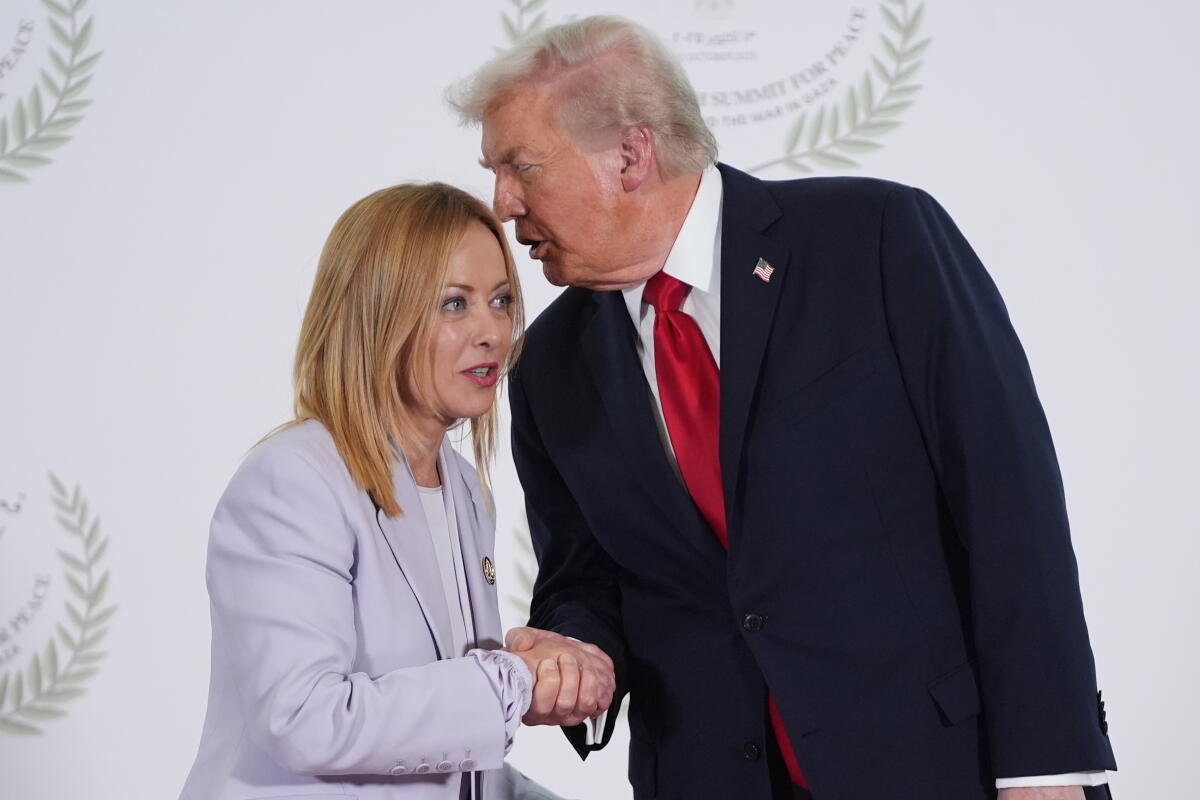
Meloni`s relationship with Trump has cooled during her nearly four years in power, due in part to the war in Iran, tariffs and security policies that have strained U.S. relations with Italy and all of Europe.
President Trump greets Italy’s Prime Minister Giorgia Meloni at a summit Egypt in 2025. Their once warm relationship has since cooled.
(Evan Vucci / Pool via Associated Press)
Yet there is no pan-European alliance of the far right, in part because these parties champion their own national interests.
“Some components of Trumpism can be shared and exported, such as hostility towards migration and ‘wokeism,’ but it is very clear that national interests that the far-right champion cannot be defended the same way as the American national interests,” said Giovanni Orsina, head of the political science department at LUISS University in Rome.
“If you put your nation first and do so aggressively, you have diverging national interests and so it’s not possible to have an international network of nationalists,” Orsina added.
But many far-right leaders are united in one sense. They admire not just Trump’s tactics, but the “boldness of his transgressions, dismantling liberal and civil norms by repeating things that were once deemed unacceptable for someone seeking public office,” said Rensmann.
“Trump is unpopular in Germany, even across the political right,” Lewandowsky said. “It would be risky for the AfD to embrace him openly, especially because he failed to keep his promise not to start any further wars and large segments of the public feel threatened by the United States under Trump.”
The AfD was created in 2013 as a small anti-euro party before morphing into an anti-migrant force that tapped into voter frustration over immigration and the strains many Germans perceive on housing, jobs and public services.
Despite being ostracized by mainstream parties and kept out of coalition cooperation, it has survived and thrived as a disruptive force.
In the last decade Germany has sheltered millions of refugees, mainly from Syria and other troubled countries in the Middle East. It provides housing, medical care and generous financial support to refugees that AfD politicians say serve as a magnet. Trump once accused former German Chancellor Angela Merkel of “ruining” her country by allowing in so many refugees.
“I think this could be a watershed moment for Europe,” Orsina said of the upcoming election.
An election poster touts the far-right Alternative for Germany party, AfD, right, in Berlin in 2025. It reads “Now AfD.”
(Michael Sohn / Associated Press)
He said the election in 2022 of Meloni and her Brothers of Italy party, which traces its origins to Italy’s postwar neo-fascist movement, sparked fears across Europe that, in hindsight, may have been exaggerated. But Germany is a different story when it comes to the far right.
“Some said she is a neo-fascist and a danger to democracy, but most people in Italy didn’t believe that,” he said. “Italy isn’t a better democracy after four years of Meloni but it isn’t any worse either. But Germany isn’t Italy. And Germany’s relationship with its past is a lot different.”
David Bebnowski, an author who has written books on far-right populism and who is a history instructor at the Free University in Berlin, said there is another important connection among far-right voters across Europe that the AfD is tapping into — a yearning for change in countries where establishment parties have struggled to respond to voter frustration.
Trump’s success as a force for disruption, he said, has provided a powerful example.
“You can’t really trace a grand MAGA strategy adopted by the far right, but you can see that they are, in part, very much in line with the ‘spirit of Trumpism,’” Bebnowski said. “What aligns them is a sense of disruption and optimism that they will be able to change the way politics are done in a way the other parties can’t.”