Trump administration considering trading Yosemite land to private developer
The Trump administration is considering trading a parcel of Yosemite National Park to a private commercial developer, according to administration officials, members of Congress and documents reviewed by The Times.
The proposed deal would allow the developer to build a road connecting adjacent property it already owns in the Stanislaus National Forest to a service road within Yosemite, providing any future development on that property with unique access to the famed public wilderness, documents show.
According to a Friday report by the news outlet NOTUS, Trump administration officials have been quietly pressuring the National Park Service to approve the deal for the land despite such pressure being highly unusual and previous proposals for the land being repeatedly denied under the Bush and Obama administrations and in court.
The Department of the Interior, which includes the National Park Service, acknowledged in a statement to The Times on Friday that a land deal is under consideration, but denied any inappropriate influence from the White House.
It said negotiations for the land will comply with all federal rules for federal lands, and that “no final decisions have been made.”
An attorney for the private developer said the deal has nothing to do with politics and is in fact an “environmentally friendly” solution, in that it would dramatically cut down on the amount of driving the future upscale development’s residents would have to do to access the park.

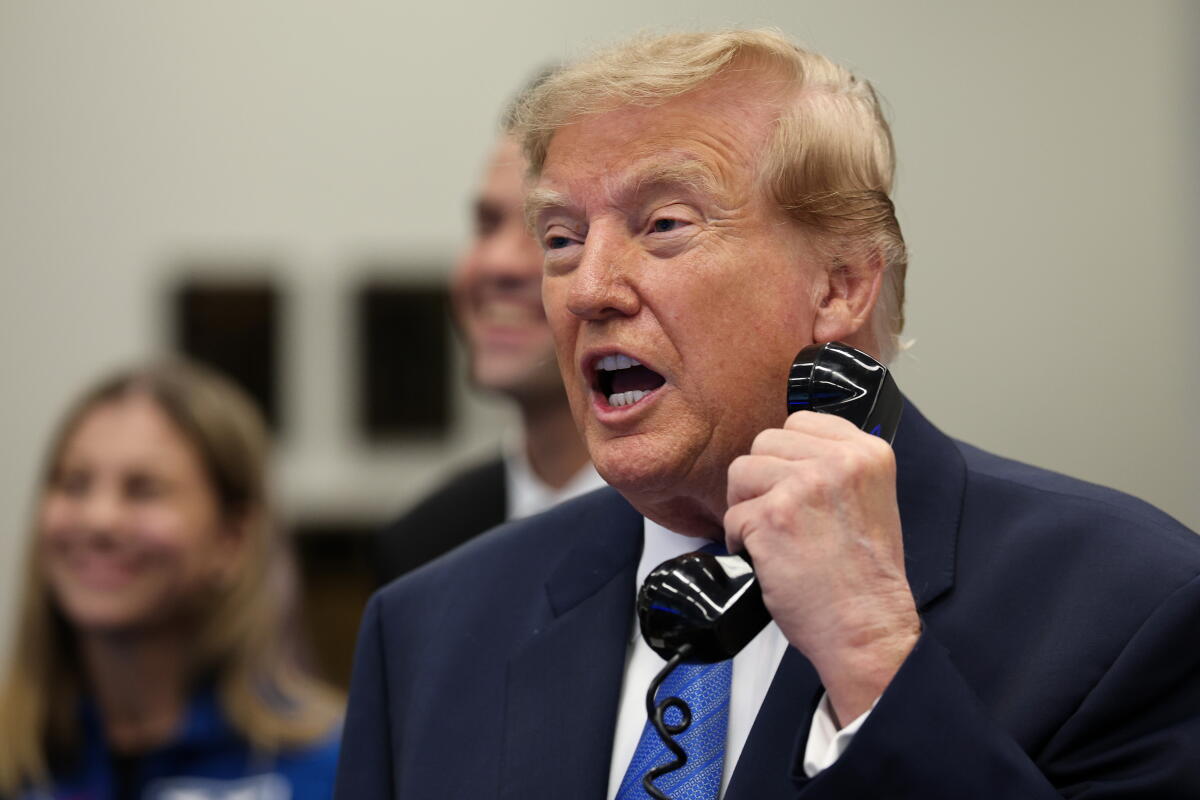
President Trump speaks to astronauts aboard the International Space Station as he visits NASA’s Mission Control Center on Aug. in Houston, Texas.
(Win McNamee / Getty Images)
Congressional Democrats — including Sens. Alex Padilla and Adam Schiff of California — are trying to block the deal, after being informed of it earlier this year by the Land and Water Conservation Fund. The fund was created by Congress in 1964 to safeguard natural areas and public lands, and often works to acquire lands to add to national parks.
A fact sheet on the project reviewed by The Times identified the parcel by a former name, the “Hazel Green Ranch,” and said the landowner is seeking to acquire an “interest” in land within the park in order to build a new road connecting “a planned commercial development” to Big Oak Flat Road, an existing federally owned road that “provides access to the park and is a major route to Yosemite Valley.”
The fact sheet said the National Park Service does not have the authority to grant that interest, but has been working with the landowner to facilitate an “exchange” of the land for some other, unidentified parcel of land that is beneficial to the U.S., as allowed under law for federal land swaps.
The project has been identified to lawmakers, without explanation, as a “priority.” Both Padilla and Schiff have objected to it, and Padilla’s office said it is working with Senate Appropriations Committee staff to block the deal.
“The Land and Water Conservation Fund exists to acquire land and interests in land in order to safeguard natural areas, water resources, and cultural heritage — and to provide recreation opportunities for all Americans,” Padilla said in a statement to The Times. “Projects should be chosen on merit, not on an applicant’s connections to high-ranking Trump administration officials.”
Schiff, in his own statement, said Yosemite is “one of California’s natural wonders, and must be protected from further development.”
He said the Trump administration “appears hellbent on moving forward in the face of opposition from the public, Congress and the courts,” and that “the only thing the administration cares about is whether there is money involved.”
The company behind the private development is Nevada-based real estate developer and investment firm Kingsbarn Realty Capital. According to Federal Election Commission records, Kingsbarn CEO Jeff Pori is a donor to Trump, the Republican National Committee and other Republican groups.
Lanny Davis, a former special counsel to President Clinton, represents Kingsbarn, and said the notion the project is moving forward due to Trump administration pressure and Pori’s political contributions despite being environmentally detrimental is false.
He said Kingsbarn wants to build “upscale, single-family houses” on its property, but hasn’t so far because residents would have to drive 28 miles using current roads to reach the park.
To cut that distance down and make the development more feasible, it asked the National Park Service to purchase an 11-mile strip of land within Yosemite to build a shorter, more direct access road, Davis said.
The Park Service responded by saying the company could not purchase park land directly, but could purchase other nearby land of equal or greater value, and then swap it for the park land, Davis said.
It is now working with the Interior Department to identify such land, and is “very close” to doing so, Davis said — calling it a “pro environmental solution” that follows federal law and has “nothing to do” with Pori’s politics.
The White House referred questions about the proposed deal to the Interior Department.
In its statement to The Times, the Interior Department said the NOTUS story “relies on anonymous allegations to manufacture a political narrative that simply is not true. There has been no political pressure to reach a predetermined outcome, and claims suggesting the Department is secretly working to hand over National Park Service land to a private developer are false.”
If a proposal does advance, the statement said, the department will follow established procedures with “transparency and public involvement consistent with federal law. Anonymous speculation does not change those facts.”
The department did not respond to a request for more details as to the proposal.
The land in question represents a tiny portion of the sprawling Yosemite National Park, which is nearly 750,000 acres in total — or roughly the size of Rhode Island. Still, slicing off any piece of the California wilderness — considered a crown jewel in the national park system — runs counter to promises from Trump and Interior Secretary Doug Burgum.
“My Administration is committed to protecting every acre of our lands and preserving the cleanest air and water in the world,” Trump said in a presidential message on Monday.
Ceding federal lands is also anathema to land preservation groups, which expressed dismay at the idea that any piece of Yosemite might be lost, no matter how small.
Aaron Weiss, executive director of the Center for Western Priorities, said that the NOTUS reporting was “consistent” with what his organization has been hearing “for several months” — and would be inconsistent with public desires for national park lands.
“The American people have consistently said that our public lands, especially our national parks, are not for sale,” he said. “If Secretary Burgum spent more time listening to Americans instead of indulging President Trump’s whims on the National Mall, he’d understand what a terrible idea this is.”
Jayson O’Neill, a spokesman for the group Save Our Parks, said the proposed deal as described by NOTUS represented the latest attempt by the Trump administration and Burgum to gut the Park Service and “then quietly cede treasured park land to private developers, thinking nobody’s watching.”
“National parks belong to the American people, not monied developers who are part of Trump’s donor class,” O’Neill said.
Mark Rose, senior Sierra Nevada program manager for the National Parks Conservation Assn., slammed the proposed land swap as a “secretive, backroom deal” and “an attack on the American people that own this national park.”
He said Yosemite is already facing overcrowding due to “run-away lodging” development outside its borders and the Trump administration’s decision to do away with the park’s reservation system, and a new development would “exacerbate the chaos.”
“The National Park Service needs to get back to prioritizing conservation, not helping bulldoze land, cut down towering trees and construct a luxury development that will harm Yosemite’s wildlife and increase wildfire risks,” Rose said.