Adam Smith

Lawmakers grill Pete Hegseth over Iran war in defense budget hearing

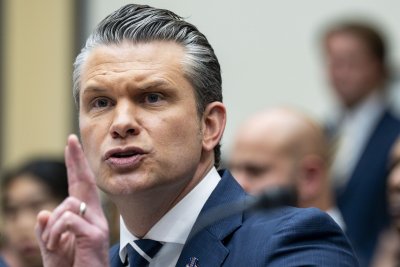
WASHINGTON, Apri; 29 (UPI) — Secretary of Defense Pete Hegseth alternated between championing a proposed massive increase to defense spending and fielding attacks from Democratic lawmakers during testimony on Capitol Hill Wednesday.

It marked the secretary’s first appearance before lawmakers since the start of a war that has roiled the global economy and decimated Iran’s military.

Hegseth appeared before the House Armed Services Committee alongside Gen. Dan Caine, chairman of the Joint Chiefs of Staff, and the Pentagon’s comptroller, Jules Hurst III. They entered the hearing room past protesters’ chants of “arrest Hegseth” and yells of “war criminal.” The secretary appeared unfazed.

“We’re rebuilding a military that the American people can be proud of — one that instills nothing less than unrelenting fear in our adversaries.” Hegseth said in his opening statement.

Hegseth’s testimony was intended to serve as a defense of the White House’s petition to Congress for $1.5 trillion in defense spending for 2027, a 44%t increase from the 2026 budget.

It’s an increase that, by itself, would be more than the total defense spending of any other nation, according to recently released figures. The spending level exceeds that spent on the Reagan-era military buildup and would be only overshadowed by levels seen during World War II.

The spending boom would come at the cost of domestic programs and at a time when federal tax revenue is set to take a $4.5 trillion hit over the next 10 years, mostly from tax cuts codified in last year’s One Big Beautiful Bill Act, according to the Bipartisan Policy Center, a Washington-based think tank.

But rather than question Hegseth on the specifics of the budget proposal, many Democratic members grilled him about the war in Iran, recent firings of senior leaders in the Pentagon and lethal strikes against alleged drug traffickers in the Pacific and Caribbean oceans.

In one heated exchange, Rep. John Garamendi, D-Calif., delivered a sharp critique of the war in Iran when questioning the defense secretary, calling it a “blunder” in which the United States had expended much to gain little.

Garamendi said it would take years for the U.S. and global economies to recover. The war has hiked average unleaded gas prices in the country to more than $4.20 a gallon and inflation to its highest level in nearly two years.

“Secretary Hegseth, you have been lying to the American public about this war from Day 1,” Garamendi said. “The strategy has been an astounding example of incompetence.”

Hegseth counterattacked. With his voice raised, he accused the congressman of “handing propaganda to our enemies.”

“I hope you appreciate how reckless it is,” Hegseth said of Garamendi’s description of the two-month-long war as a quagmire. “Shame on you.”

Hurst, the comptroller, told lawmakers the Iran war has cost the Pentagon $25 billion. Committee ranking member Rep. Adam Smith, D-Wash., responded that was the first time he had been given a cost figure, despite repeated inquiries to the department.

In March, the Pentagon reportedly petitioned Congress for an additional $200 billion to replace stocks from the war and prepare for future operations, should they be ordered. When asked about it at the time, Hegseth indicated the report’s veracity.

“That number could move, obviously,” Hegseth said then. “It takes money to kill bad guys.”

Hegseth’s central defense of the war during the hearing was arguing that it served to prevent Iran from obtaining a nuclear weapon. Republican members echoed his contention.

Iran maintains uranium supplies that could eventually be used to build a nuclear weapon if it were to be further enriched. But since the U.S. bombed Iran’s nuclear facilities in June, Iran has made “no efforts since then to try to rebuild their enrichment capability,” Tulsi Gabbard, the director of national intelligence, said in a written statement to Congress in March.

“What is it worth to ensure Iran never gets a nuclear weapon?” Hegseth asked rhetorically in Wednesday’s hearing.

A defense budget unprecedented in modern times

The Pentagon’s budget request is composed of $1.1 trillion in base discretionary funding and an additional $350 billion in mandatory spending.

The mandatory funds, which are earmarked mostly for munitions and the expansion of the defense industry, would go through the budget reconciliation process and therefore would be shielded from a potential Democratic filibuster in the Senate.

The expansion of America’s defense industrial base — the network of private manufacturers that supply the Pentagon — is a central facet of the proposed budget.

“President Trump inherited a defense industrial base that had been hollowed out by years of ‘America Last’ policies,” Hegseth said. “Under the leadership of President Trump, our builder-in-chief, we are reversing this systemic decay and putting our defense industrial base on a war-time footing.”

Another of the administration’s top defense funding priorities, as reflected in the budget document, is the procurement of munitions.

“Critical munitions are vital to the administration’s priorities to defend the homeland and deter potential aggression after years of neglect by the previous administration,” the White House wrote in a recent budget justification. Limited munitions stockpiles and the United States’ inability to quickly produce them have long troubled U.S. war planners.

While the Trump administration has pushed to expand munitions stockpiles, it has also expended massive amounts of scarce ordnance in the Middle East in recent months.

An April analysis by the Center for Strategic and International Studies estimated that the U.S. military has expended more than 850 Tomahawk cruise missiles in the Iran war from an estimated prewar inventory of 3,100.

Key U.S. capabilities like the Patriot and THAAD air defense systems have also seen stockpiles dwindle by about half since the start of the war, according to the report.

“We’re fighting wars”

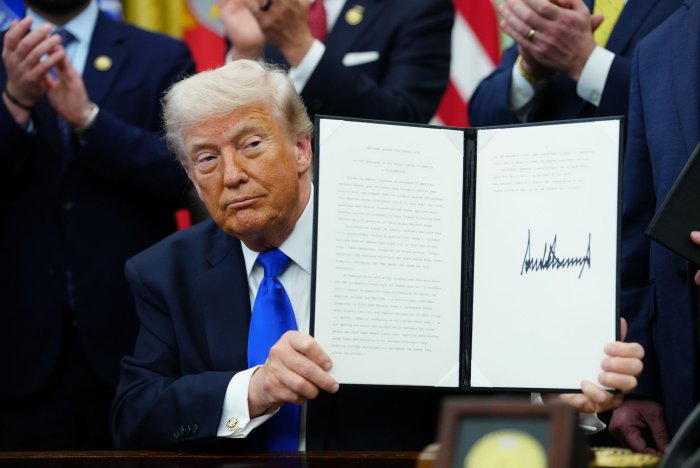
The administration’s request for the massive infusion of cash comes as Trump has said that federal spending on healthcare and social programs should take a back seat to “military protection.”

In its proposed budget, the White House moved to cut non-defense discretionary spending by 10%. The spending category comprises public health, scientific research and scores of other domestic programs, but excludes mandatory programs like Medicare and Medicaid.

In a speech at a private Easter luncheon, Trump said spending on childcare, Medicare and Medicaid should be left to the states, while the federal government should be focused solely on national defense.

“We’re fighting wars,” Trump said.

The sentiment runs contrary to Trump’s long-held foundational critique of his predecessors — that money spent on foreign wars from Iraq, to Afghanistan, to Ukraine, should have been used to benefit Americans at home.

Source link