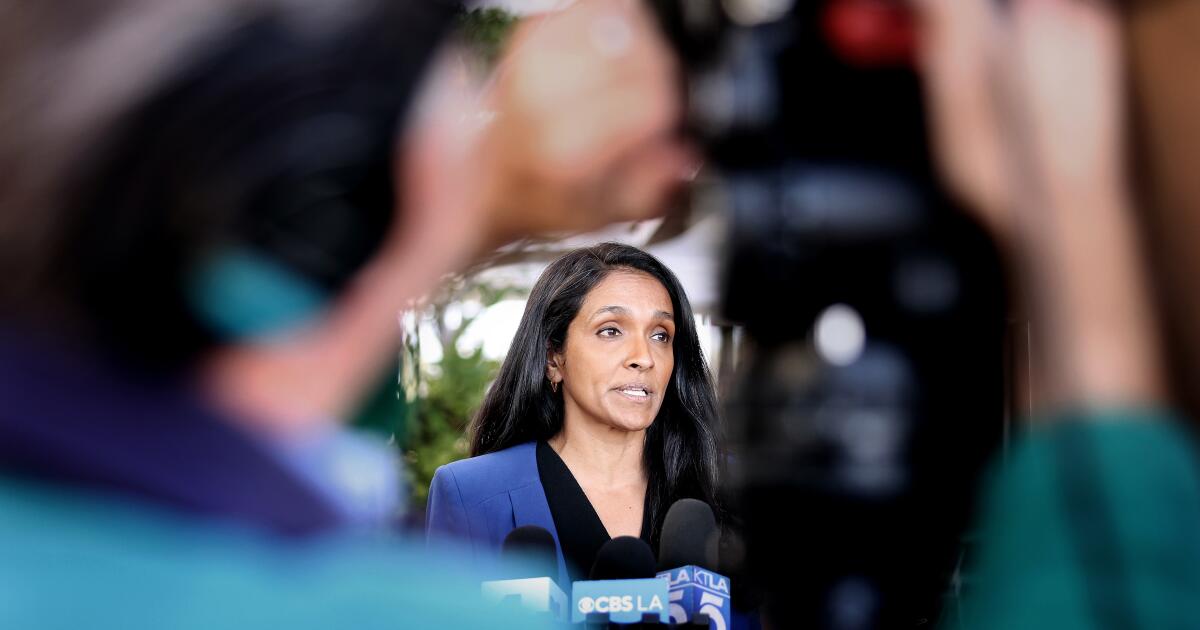
Nithya Raman stunned the L.A. political world in 2020. Now, she wants to do it again
Nithya Raman began her political career by defeating a well-funded incumbent with deep ties to the Democratic Party establishment.
Raman, an urban planner who was running to shake up the status quo, became the first person to oust a sitting councilmember in 17 years, stunning the Los Angeles political establishment with her defeat of David Ryu in 2020.
Now, with her surprise, last-minute entry into the mayor’s race, the 44-year-old Silver Lake resident is hoping to defeat another incumbent, Karen Bass, by expanding on the formula that led to her first upset victory.
“I was an outsider when I first ran, and I think I’ll be an outsider in this race,” Raman said after filing her candidate paperwork on Feb. 7, hours before the deadline.
But after six years at City Hall, Raman is no longer an outsider. She has her own record, which is in many ways intertwined with the mayor’s, particularly on homelessness, an issue the onetime allies have worked closely together to remedy.
As a City Council member, Raman, whose previous campaigns were backed by Democratic Socialists of America Los Angeles, has sometimes walked a political tightrope, exasperating her progressive base on issues like policing. Last week, she said that the LAPD must not shrink further — a substantial evolution from her “defund the police” declaration during her first run for council.
She has also frustrated some on the left by calling for changes to the city’s “mansion tax,” which she backed in 2022 but which she now says is getting in the way of much-needed development.
Raman shook up a mayoral race that was devoid of high-powered challengers after former L.A. schools Supt. Austin Beutner dropped out and L.A. County Supervisor Lindsey Horvath and billionaire developer Rick Caruso decided not to run.
“Nithya has shown that she can get votes. She’s going to be competitive,” said Bill Carrick, a longtime Democratic political consultant who worked on campaigns for former Mayors Eric Garcetti, James Hahn and Richard Riordan.
But her late entry will make it more difficult to get endorsements and raise money. With three months before ballots are mailed for the June 2 primary, she will have to work at double speed to build a campaign infrastructure and tap into bases that have helped her win before, from Hollywood supporters to DSA members and pro-housing advocates from the YIMBY — Yes in My Backyard — movement.
She has already missed DSA’s endorsement season. And last week, nine of her 14 City Council colleagues reiterated their endorsements of Bass, including another progressive council member, Hugo Soto-Martínez, who said he was “caught off-guard” by Raman’s “last-minute maneuver.”
Raman, who had also endorsed Bass, will have to combat hard feelings among some L.A. politicos who feel that her entry into the race is a betrayal of a mayor who helped her win reelection in 2024.
Raman has said that her decision to run was driven in part by her frustration with city leaders’ inability to get the basics right, such as fixing streetlights and paving streets.
Since launching her campaign, Raman has also joined a chorus of Angelenos criticizing Bass’ handling of the catastrophic Palisades fire, saying the city must be better prepared for major emergencies.
As the dust settles on her unexpected candidacy, political observers are assessing Raman’s prospects — both her strengths and the obstacles that stand between her and the mayor’s office.
Bass campaign spokesperson Douglas Herman declined to comment. A Raman campaign spokesperson, Jeff Millman, also declined to comment.
Ryu, who lost to Raman in 2020, said Bass should be “nervous” about her newest opponent.
To win, Ryu said, Raman must tap into the strengths that helped propel her to victory in the past, including her prowess with social media.
“She couldn’t speak in front of crowds at the beginning. She was super nervous,” Ryu said. “But oh my God, her social media team, the production value of her videos. It’s a science.”
Raman’s 2020 campaign will be hard to replicate. That year, the council race focused not just on local policy but also on national issues such as #MeToo and the police murder of George Floyd, Ryu said. Big-name politicians weighed in, with Vermont Sen. Bernie Sanders endorsing Raman and former Secretary of State Hillary Clinton endorsing Ryu.
The most important difference, Ryu said, is that Raman can no longer plausibly position herself as an outsider.
“Now there’s a record. It’s easy when you’re the activist fighting the system. But when you’re in there, you realize it’s a zero-sum game,” he said. “Do you want to trim trees and fix potholes or build housing? Sometimes that is the brutal reality.”
In the coming months, Raman will have to reach beyond her district, which stretches from Silver Lake to Reseda, introducing herself and her record to voters across the city. She began a media blitz in her first week as a candidate, doing interviews with NBC4, KNX News and The Times.
Her main goal should be to make it to the November runoff, said Mike Trujillo, a Democratic political consultant.
If no candidate among the roughly 40 running for mayor wins more than 50% of the vote in the June 2 primary, the top two finishers will move to the runoff.
A runoff would allow Raman a fresh start, with each candidate starting a new round of fundraising and pitching themselves to voters in a one-on-one contest.
“If it’s Nithya and Mayor Bass, they would both start at zero,” Trujillo said. “For a challenger, that is a godsend.”
That leaves political watchers doing the math of how the mayor and the councilmember could get to the runoff, and which candidates might block their way.
After Bass and Raman, the three biggest figures in the race are Spencer Pratt, Rae Huang and Adam Miller.
Pratt is a registered Republican whose house burned down in the Palisades fire. He has been sharply critical of the mayor’s handling of the fire and has gained traction with national Republicans, including allies of President Trump.
Of the more than 2 million registered voters in the city of Los Angeles, just under 15% were Republicans as of December 2025.
Mike Murphy, a Republican political consultant, thinks Pratt could get 19% to 21% of the vote, with a ceiling in the mid to high 20s.
“Not liking Karen does not make you a Republican,” Murphy said.
On the other side of the spectrum, community organizer Rae Huang has been running an unabashedly leftist campaign, calling for free buses and the abolition of Immigration and Customs Enforcement. Huang has not been endorsed by DSA’s Los Angeles chapter, but she is a member of the organization.
In 2022, leftist Gina Viola won nearly 7% of the vote in the primary.
Trujillo, the Democratic consultant, said the other wild card is Adam Miller, the tech entrepreneur who has waded into the fight against homelessness. Miller could spend a significant amount of his own fortune in the race — as Caruso did against Bass in 2022.
If Pratt and Huang combine to take 25% and Miller can take somewhere in the 20% range, then Raman and Bass would have to worry about not making the runoff.
“Suddenly, you have a three-way jump ball,” Trujillo said.
Despite having more name recognition than some of her opponents, Raman will need to raise significant funds in a short time.
“My hope is that money will flow,” said Dave Rand, a land use attorney active on housing issues who supports Raman.
Rand said that developers and people in the YIMBY movement will support Raman, who has been a strong advocate for building more housing in Los Angeles.
Mott Smith, a developer and Raman supporter, said he believes fellow developers who know Raman will “gladly” contribute to her campaign.
Smith said he is concerned about Angelenos associating Raman with DSA, which could turn off more moderate voters.
“She will win if Los Angeles gets to know the pragmatic, solutions-oriented Nithya, as opposed to the cartoon image that one paints when they hear she is the latest of the DSA candidates to run for office here,” he said.