Records detail ICE medical claims before payment system collapsed
WASHINGTON — The Department of Homeland Security’s system for paying for detainee medical care has collapsed, records show, leaving a backlog of unpaid claims likely costing millions of dollars.
With a new payment system still not in place, advocates for immigrant detainees fear some are going without necessary treatment as medical providers near a year without compensation.
Newly released federal records reveal what that treatment could be for, detailing more than 233,000 claims for off-site medical and dental care between January and early October of 2025. The claims, for which Homeland Security spent $96 million, show detainees were treated for a wide variety of conditions, including strokes, pregnancy, suicide attempts and frostbite.
For years, Homeland Security relied on a unit of the Department of Veterans Affairs, its financial services center, to process reimbursement claims for detainee medical care. But since that arrangement abruptly ended Oct. 3, the company hired to create a new payment processing system has yet to start reimbursing the medical clinics, dental practices and pharmacies that treat detained patients.
The documents were released by the VA to the nonprofit watchdog group American Oversight through the Freedom of Information Act and shared exclusively with The Times. They paint the clearest picture yet of the off-site medical care received by immigrants in the custody of the federal government before the payment system fractured.
The old system used by Homeland Security was scrapped after critics questioned why the VA was processing paperwork for a different federal department.
During the Biden administration, Republicans claimed that the contract between Homeland Security and the VA took resources from veterans to facilitate healthcare for immigrants and introduced a bill to stop it.
Last year, with President Trump back in office, the VA wrote Immigration and Customs Enforcement on Aug. 19 to say that it would stop processing detainee medical claims by Feb. 28, 2026.
“This termination is necessary to reallocate resources to support mission-facing programs,” the letter states.
On Sept. 30, the right-wing Center to Advance Security in America filed a lawsuit against the VA seeking answers to a year-old request for records related to the alleged diversion of resources. The VA didn’t respond to requests for comment. But then-VA press secretary Pete Kasperowicz told the Daily Signal that the department had, under President Biden, focused on unnecessary activities such as processing healthcare claims for immigrants.
“Under President Trump, the department has abandoned these radical liberal priorities and rededicated itself to providing the best possible care and benefits to the Veterans, families, caregivers and survivors we serve,” he said.
Three days after the lawsuit was filed, the VA stopped processing Homeland Security claims. Later that month, ICE awarded multimillion dollar no-bid contracts to two companies tasked with taking over claims processing: Acentra Health for healthcare services and Ardent Group for pharmacy services.

Federal law requires Homeland Security to provide medical care to the people in its custody. Those held by Customs and Border Protection near the border, or by ICE in the country’s interior, are civilly detained for the purpose of removal proceedings. ICE is holding more than 65,000 detainees as the agency touts record-high arrests this summer.
ICE and Customs and Border Protection rely on about 3,000 community-based providers and local hospitals, which submit about 300,000 claims annually for detainee care, according to ICE.
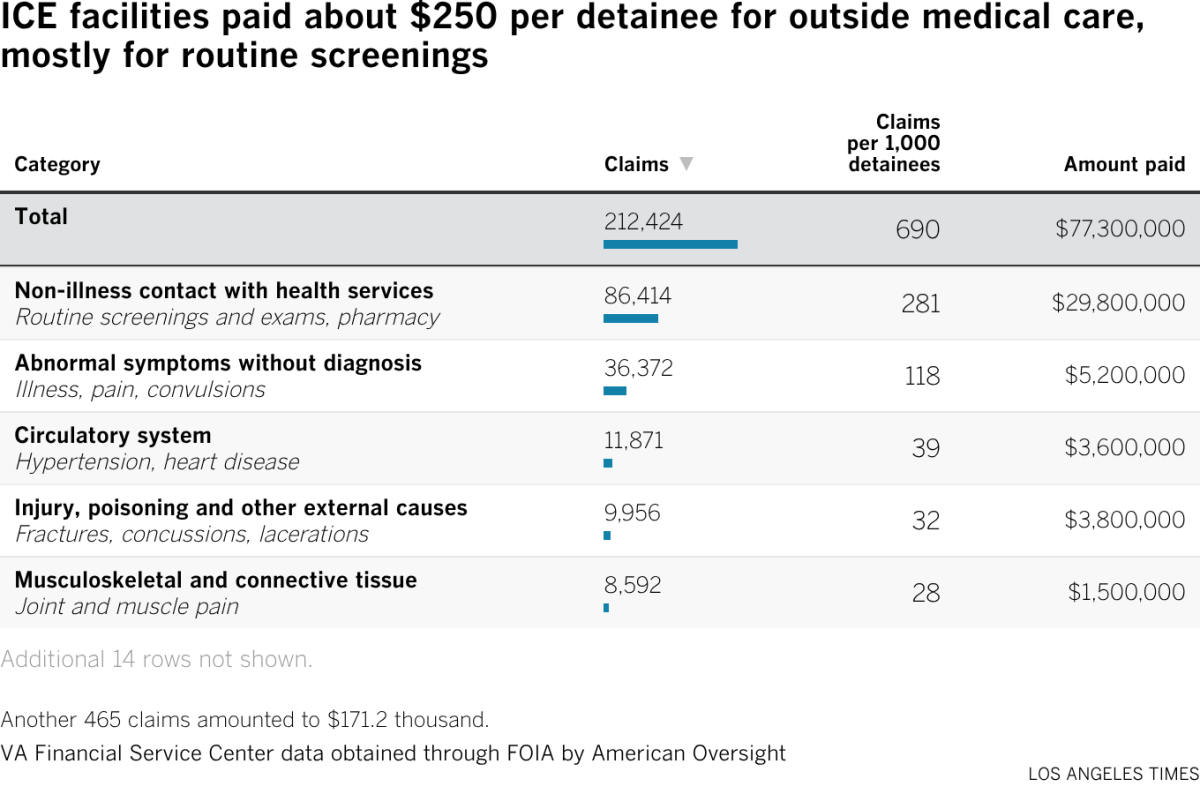
The claims outlined in the VA documents show ICE paid $77.3 million, 80% of the total, and CBP paid $19 million. Together, the agencies paid on average about $260 for off-site care per detainee from January to October 2025, a Times analysis found. By comparison, federal prisons in fiscal year 2025 spent about $2,700 per inmate on external medical care.
For ICE, medical conditions that had the highest number of claims included screenings for tuberculosis and other diseases and treatment for hypertension, chest pain and type 2 diabetes. Some of the highest-paid amounts related to treatment of psychosis, schizophrenia and sepsis.
More than a third of the claims for CBP — and more than half of the total paid amount — went to a category of claims called “injury, poisoning and certain consequences of external causes.” That includes traumatic injuries such as fractures, concussions and hemorrhages.

Among other notable claims are 2,267 for pregnancy, birth and maternal care, 1,793 for seizures and 419 for suicide or self-harm. The most expensive claim was $292,199 for treatment of leukemia.
Homeland Security did not return requests for comment but frequently says it provides comprehensive medical, dental and mental health care, which officials tout as the best healthcare many detainees ever received.
Dr. Amy Zeidan, an emergency medicine doctor and associate professor at Emory University who studies immigrant detainee health outcomes, said the VA data show detained immigrants require significant medical care. She said some of those entering detention facilities likely have chronic conditions and don’t get proper care, while others likely develop serious conditions while detained.
“There is a high burden of disease in detention facilities that we have always suspected but really had no evidence to support,” she said. “It’s not like these are people getting routine visits for mildly high blood pressure — these are people who require hospitalizations.”
“If claims are no longer being paid, this is a big problem because outside care is certainly needed,” she added.

The decision to end the processing agreement with the VA “created an emergency,” according to ICE officials. That phrase appears in a contracting document for Acentra Health that was first reported on by independent journalists through the newsletter Popular Information.
Several vendors expressed interest in the job, but ICE said a formal competition would take months and the lack of a way to process claims could delay necessary medical care, such as dialysis, prenatal care and chemotherapy.
ICE needed to come up with a new way to process medical claims “instantly” in order to “prevent any further medical complications or loss of life,” the contracting document states. “Off-site providers who are not paid timely may not accept new patients or continue to provide vital care and services.”
The ICE officials wrote that Acentra Health provides the same claims processing system used by the VA and would be able to restore claims processing services quickly.
Claims processing was slated to resume April 30, but providers still haven’t been paid.
The ICE Health Service Corps website says providers should “hold all claim submissions while we work to bring the new system online.”
Lindsey Rodarmer, public relations manager for Acentra Health, said the company’s role under its contract is solely to build out the claims processing system — not to start processing claims.
“The timeline for the completion of this project depends on factors beyond any single party, including two government shutdowns, funding lapses, and the timing of federal authorizations, all of which have impacted the project schedule,” Rodarmer said.
According to a federal contracting website, Acentra has been paid $44.6 million of its $67.5-million contract, which Rodarmer said was extended until Sept. 24. Ardent Group has been paid $26.7 million of its $42.6-million contract, which is slated to end Oct. 24.
In June, Homeland Security posted a request for information to identify other potential vendors. The agency wants companies to answer 29 questions. The first asks for a “realistic timeline” on when the processing of claims can begin.
Rodarmer said Acentra responded to the request for information and, if chosen, would begin paying out claims under the system it built.
Last month, Reps. Mark Takano (D-Riverside) and Delia Ramirez (D-Ill.) wrote to the leaders of the VA and Homeland Security seeking answers about when Acentra will begin processing reimbursements, whether any claims have been paid since Oct. 3, and how many detainees have had health complications or died because they were unable to access off-site healthcare. The lawmakers said the agencies haven’t responded.
In an interview, Ramirez said she believes the lack of payment for medical claims is directly tied to an increase in detainee deaths. At least 23 people have died in immigration custody this year. Last year the agency reported 33 in-custody deaths.
She said that without answers to the questions she raised with Takano, there’s no way to know what Homeland Security has been billing for and how much care has been put on hold.
“In our current system, if no one is paying for services, no one gets healthcare,” Ramirez said. “Since DHS and VA stopped processing medical claims nine months ago, it is clear that our neighbors are being deprived of necessary medical care in violation of the law.”
Meanwhile, detained immigrants and their supporters have raised increasing alarms over medical care provided by ICE.
ICE said Edwin Jovanny Lopez Cornejo, 41, of El Salvador suffered a medical emergency on Saturday and was pronounced dead after being taken to a New Jersey hospital.
The agency said Lopez Cornejo had received proper medical care and was seen by medical professionals. His mother, however, told a local immigrant rights group that she believed he hadn’t received his medication for diabetes, high blood pressure and seizures.
In California, a court-appointed medical monitor issued a report last month finding that the state’s largest immigrant detention center repeatedly has delayed assessments, treatment and administration of medication for detainees. The center’s operator told The Times it was reviewing the report and that nothing matters more than the health, safety and well-being of people under its care.
At the California City Detention Facility, one man waited months for a surgery he never received. The 34-year-old man asked to be identified by his initials, A.S., over concerns about his immigration case.
A.S. said he tripped and broke an ankle while detained in late February. He was transported to a local hospital and placed in a cast.
Medical records show A.S. didn’t see a specialist until April 10, when it was determined he needed surgery. At an appointment June 1, A.S. said a doctor told him he had missed a scheduled operation, which medical records appear to confirm.
He said the doctor told him too much time had passed and the surgery no longer was possible because of risk of complications. The doctor ordered physical therapy, A.S. said, but medical records show he didn’t receive any.
A.S. was released from the detention center last month still limping and in pain. Unable to find work or pay to see a doctor, he has resorted to recycling cans and bottles to support himself.
“They knew about my situation — there were requests asking to be seen, there were complaints I had filed, so it’s not like they didn’t know,” A.S. said. “Instead, it’s as if they didn’t want to give me the medical attention.”