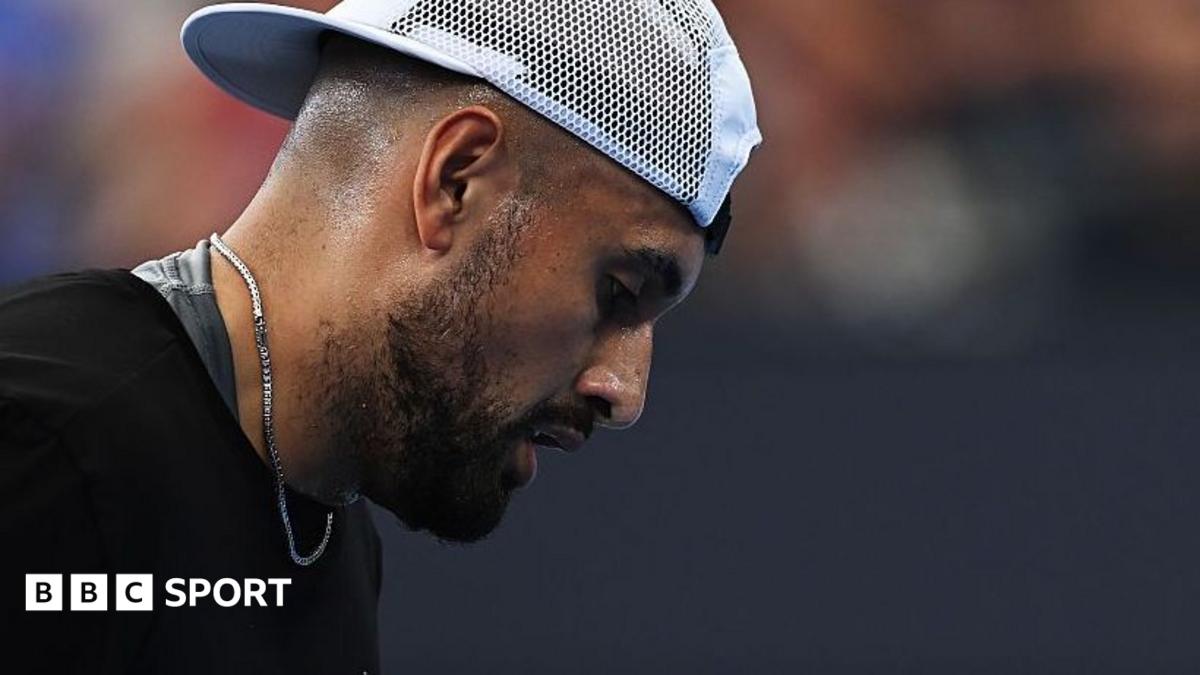
Nick Kyrgios cleared to return to tennis after accepting one-month ban for positive cocaine test
Nick Kyrgios is eligible to return to tennis after accepting a one-month ban for testing positive for cocaine.
The Australian, 31, was provisionally suspended on 4 August after a sample he submitted during the Mallorca Open in June was found to contain benzoylecgonine, a metabolite of cocaine.
Kyrgios told investigators from the International Tennis Integrity Agency (ITIA) that he used cocaine at a nightclub in Magaluf in the early hours of 20 June.
He played his first-round match at the Mallorca tournament two days later, losing in straight sets to compatriot Adam Walton.
The ITIA accepted he used cocaine outside of competition after consulting with an an independent expert.
Kyrgios could have faced a maximum three-month ban but it has been reduced to one month after he entered a treatment programme.
His one-month ban ended on Thursday, 3 September.
Kyrgios, who has fallen to 918 in the world rankings, will also lose his prize money of 6,570 euros (£5,650).
When the positive test was announced, Kyrgios said he would step away from social media and public life for the next 28 days to “focus on getting myself right”.
The former world number 13 has played just four singles matches this season, having struggled with knee and wrist injuries in recent years.
He last played in the men’s doubles at Wimbledon, where he and partner Alexander Bublik lost in the first round.
After his initial suspension was announced, Kyrgios said the past few years of injuries had taken “a huge toll on me, both mentally and physically”.
“My body hasn’t been able to do what my mind expects it to do,” he wrote in a lengthy statement on Instagram.
“Coming to terms with being near the end of my career has been harder than I ever imagined.
“None of that excuses what I did.”
Cocaine is classified as a stimulant and substance of abuse on the World Anti-Doping Agency’s prohibited list.
Kyrgios has long been a controversial figure in tennis.
His behaviour on court has been widely criticised and he has been given numerous large fines for smashing racquets, making audible obscenities and arguing with the umpire.
In 2023, he admitted assaulting an ex-girlfriend two years earlier. He avoided a criminal conviction.
He was criticised further for making a series of comments which have been considered misogynistic.
In 2024 he shared a post from controversial influencer Andrew Tate. He later said he had gone “to all lengths” to distance himself from the self-proclaimed misogynist.
Kyrgios was also critical of the handling of two high-profile anti-doping cases involving top players Jannik Sinner and Iga Swiatek, calling them “disgusting” for tennis.
Kyrgios has won seven ATP Tour singles titles and reached the Wimbledon final in 2022, losing in four sets to Novak Djokovic.
He and compatriot Thanasi Kokkinakis won the Australian Open men’s doubles title together in 2022.
Kyrgios has also spoken about his struggles with mental health, saying he “genuinely contemplated” suicide and spent time in a psychiatric hospital in London after losing at Wimbledon in 2019.