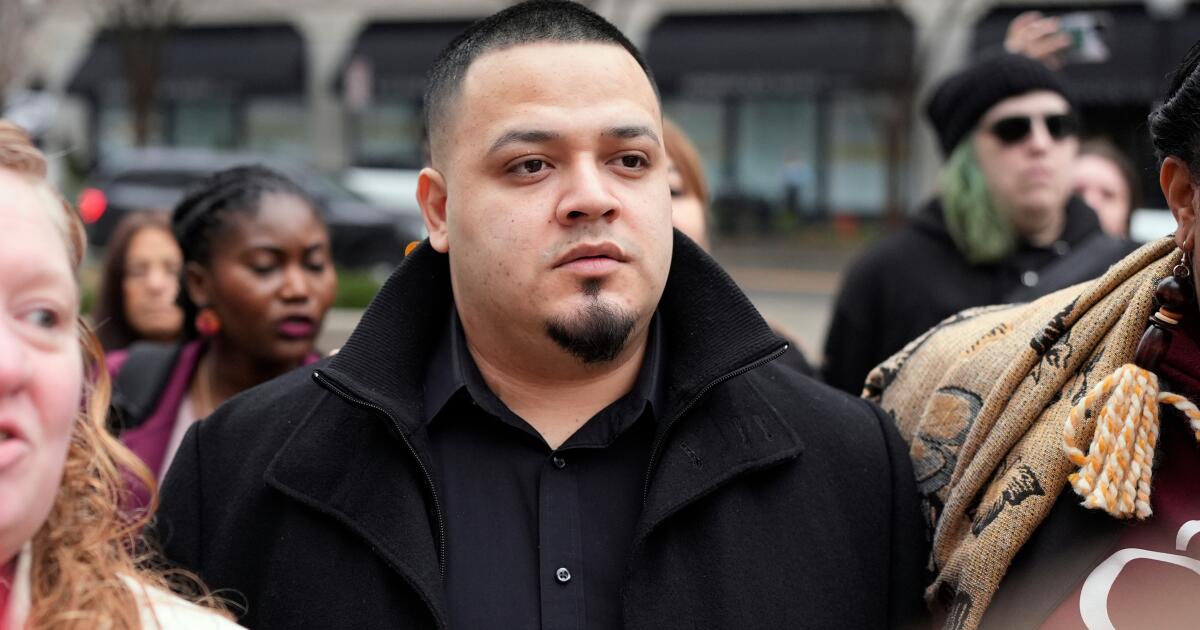
Justice Department pushes to revive criminal case against Kilmar Abrego Garcia
NASHVILLE — The Justice Department is pushing to revive criminal charges against Kilmar Abrego Garcia, telling a federal appeals court late Monday that a judge erred in his scathing ruling that called the case against the man mistakenly deported to an El Salvador prison an “abuse of prosecuting power.”
The government is appealing the May ruling by U.S. District Judge Waverly Crenshaw that threw out charges of human smuggling against the Salvadoran national. The ruling amounted to an extraordinary rebuke of a Justice Department that under President Trump has repeatedly been accused of targeting defendants for political purposes.
Crenshaw found that Abrego Garcia would never have faced criminal charges had he not successfully sued the government over his 2025 deportation. The ruling was an embarrassment for the Trump administration, which only brought him back after securing a criminal indictment against him.
Crenshaw stopped short of finding the government acted with “actual vindictiveness,” a rarely-met standard that usually requires evidence such as a prosecutor admitting that charges were filed in retaliation against someone. But the judge did find there was enough evidence of “presumptive vindictiveness.”
That included the timing of the indictment. Homeland Security had been aware of the 2022 traffic stop in Tennessee that was the basis for the human smuggling charges for more than two years before Abrego Garcia was deported. The agency only reopened the case and began investigating in earnest after Abrego Garcia was ordered returned to the U.S.
Crenshaw also found that statements by U.S. Atty. Gen. Todd Blanche, who was a deputy at the time, suggested the Justice Department was targeting Abrego Garcia because he won his wrongful-deportation case.
In a brief filed Monday night with the 6th U.S. Circuit Court of Appeals, federal prosecutors argued that Crenshaw got it wrong. Blanche’s statements, they argue, demonstrated a legitimate motive for prosecuting him. His rationale reflected a “normal assessment of the societal interest in punishment,” not an “improper penalty,” they said. The statements “explained that the government was seeking to protect the public and confirm its prior assertions about Abrego’s criminal activity,” the brief states.
But even if Blanche’s statements reflected an animus against Abrego Garcia, they are irrelevant because the person who actually brought the charges was then-Acting U.S. Atty. for the Middle District of Tennessee Rob McGuire, the brief states — rehashing an argument thoroughly rejected by Crenshaw that McGuire’s motives were the only motives that mattered in the case.
Crenshaw’s ruling noted the sustained oversight of the case by top Justice Department officials, including regular communications between McGuire and Associate Deputy Atty. Gen. Aakash Singh, in finding that the criminal case was thoroughly tainted. Crenshaw also noted that prosecutors never called as a witness the investigator who actually reopened the case, to explain why.
Abrego Garcia, 31, is a Salvadoran citizen with an American wife and child who has lived in Maryland for years, although he immigrated to the U.S. illegally as a teenager. A 2019 order by an immigration judge prohibited his deportation to El Salvador, finding he had a “well founded fear” of a gang that had targeted his family there. The judge allowed him to live and work in the U.S. under Immigration and Customs Enforcement supervision, but he was not given residency status.
Blocked from re-deporting Abrego Garcia to El Salvador, the Trump administration has vowed to deport him to a third county, threatening to send him to Uganda, Eswatini, Ghana and, most recently, Liberia. Abrego Garcia has said he would agree to be deported to Costa Rica, which has said it will accept him, but the government has so far declined to send him there.
He is fighting deportation to Liberia in a separate federal court case in Maryland.
Loller writes for the Associated Press.
